Paper II — Q7
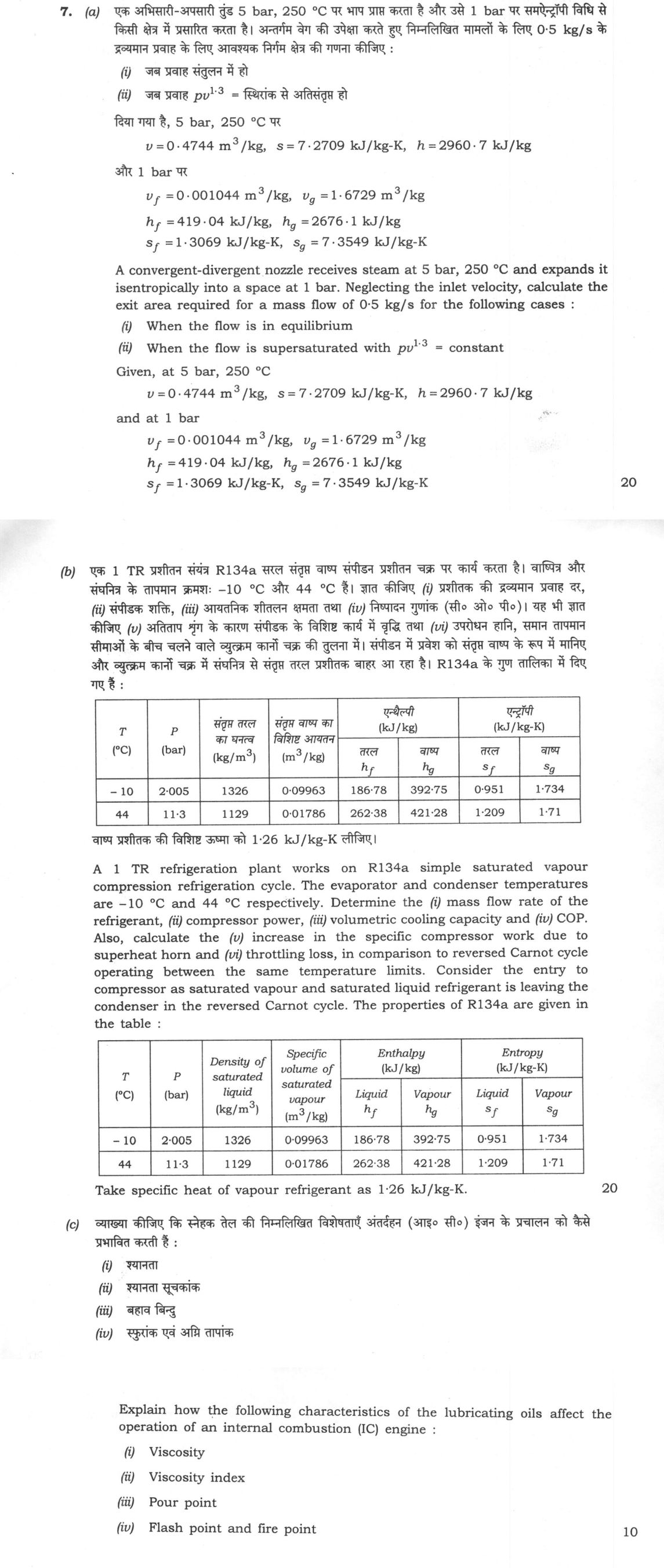
(a) A convergent-divergent nozzle receives steam at 5 bar, 250 °C and expands it isentropically into a space at 1 bar. Neglecting…
A convergent-divergent nozzle receives steam at 5 bar, 250 °C and expands it isentropically into a space at 1 bar. Neglecting the inlet velocity, calculate the exit area required for a mass flow of 0·5 kg/s for the following cases:
When the flow is in equilibrium
When the flow is supersaturated with pv^1.3 = constant
Given, at 5 bar, 250 °C
v = 0·4744 m³/kg, s = 7·2709 kJ/kg-K, h = 2960·7 kJ/kg
and at 1 bar
v_f = 0·001044 m³/kg, v_g = 1·6729 m³/kg
h_f = 419·04 kJ/kg, h_g = 2676·1 kJ/kg
s_f = 1·3069 kJ/kg-K, s_g = 7·3549 kJ/kg-K
A 1 TR refrigeration plant works on R134a simple saturated vapour compression refrigeration cycle. The evaporator and condenser temperatures are –10 °C and 44 °C respectively. Determine the (i) mass flow rate of the refrigerant, (ii) compressor power, (iii) volumetric cooling capacity and (iv) COP. Also, calculate the (v) increase in the specific compressor work due to superheat horn and (vi) throttling loss, in comparison to reversed Carnot cycle operating between the same temperature limits. Consider the entry to compressor as saturated vapour and saturated liquid refrigerant is leaving the condenser in the reversed Carnot cycle. The properties of R134a are given in the table:
Take specific heat of vapour refrigerant as 1·26 kJ/kg-K.
Explain how the following characteristics of the lubricating oils affect the operation of an internal combustion (IC) engine:
Viscosity
Viscosity index
Pour point
Flash point and fire point
हिंदी में प्रश्न पढ़ें
एक अभिसारी-अपसारी नोजल 5 bar, 250 °C पर भाप प्राप्त करता है और उसे 1 bar पर समएन्ट्रॉपी विधि से किसी क्षेत्र में प्रसारित करता है। अंतरिम वेग की उपेक्षा करते हुए निम्नलिखित मामलों के लिए 0·5 kg/s के द्रव्यमान प्रवाह के लिए आवश्यक निर्गम क्षेत्र की गणना कीजिए :
जब प्रवाह संतुलन में हो
जब प्रवाह pv^1.3 = स्थिरांक से अतिसंतृप्त हो
दिया गया है, 5 bar, 250 °C पर
v = 0·4744 m³/kg, s = 7·2709 kJ/kg-K, h = 2960·7 kJ/kg
और 1 bar पर
v_f = 0·001044 m³/kg, v_g = 1·6729 m³/kg
h_f = 419·04 kJ/kg, h_g = 2676·1 kJ/kg
s_f = 1·3069 kJ/kg-K, s_g = 7·3549 kJ/kg-K
एक 1 TR प्रशीतन संयंत्र R134a सरल संतृप्त वाष्प संपीडन प्रशीतन चक्र पर कार्य करता है। वाष्पीकरण और संघनन के तापमान क्रमशः: –10 °C और 44 °C हैं। ज्ञात कीजिए (i) प्रशीतक की द्रव्यमान प्रवाह दर, (ii) संपीडक शक्ति, (iii) आयतनिक शीतलन क्षमता तथा (iv) निष्पादन गुणांक (सी.ओ. पी.)। यह भी ज्ञात कीजिए (v) अतिताप श्रंग के कारण संपीडक के विशिष्ट कार्य में वृद्धि तथा (vi) उपरोधन हानि, समान तापमान सीमाओं के बीच चलने वाले व्युत्क्रम कार्नो चक्र की तुलना में। संपीडन में प्रवेश को संतृप्त वाष्प के रूप में मानिए और व्युत्क्रम कार्नो चक्र में संघनित्र से संतृप्त तरल प्रशीतक बाहर आ रहा है। R134a के गुण तालिका में दिए गए हैं :
व्याख्या कीजिए कि स्नेहक तेल की निम्नलिखित विशेषताएँ अंतर्दहन (आई. सी.) इंजन के प्रचालन को कैसे प्रभावित करती हैं :
श्यानता
श्यानता सूचकांक
बहाव बिंदु
स्फुरक एवं अग्नि तापांक
The figure this question refers to, in words
The question paper is a scan and the diagram did not survive as text. This is the figure as read from the original page — every component, value and label — so the question can be worked from the text below.
(b) Table of properties for R134a:
Columns: T (°C), P (bar), Density of saturated liquid (kg/m³), Specific volume of saturated vapour (m³/kg), Enthalpy (kJ/kg) [sub-columns: Liquid hf, Vapour hg], Entropy (kJ/kg-K) [sub-columns: Liquid sf, Vapour sg]
Row 1: -10, 2.005, 1326, 0.09963, 186.78, 392.75, 0.951, 1.734 Row 2: 44, 11.3, 1129, 0.01786, 262.38, 421.28, 1.209, 1.71
PSYCHROMETRIC CHART. Barometric Pressure: 1.01325 bar (Sea Level). The chart is a grid with the following axes and lines: 1. Bottom Horizontal Axis: Moisture Content (kg/kg DRY AIR), scale from 0.000 to 0.035. 2. Top Horizontal Axis: Specific Enthalpy at Saturation (kJ/kg AIR), scale from 0 to 145. 3. Left Vertical Axis: Dry Bulb Temperature (°C), scale from -10 to 55. 4. Right Vertical Axis: Specific Volume (m³/kg Dry Air), scale from 0.75 to 0.95. 5. Diagonal Lines: Wet Bulb or Saturation Temperature (°C), scale from -5 to 40. 6. Curved Lines: Relative Humidity (%), marked at 10%, 20%, 30%, 40%, 50%, 60%, 70%, 80%, 90%. 7. Other Lines: Enthalpy Deviation lines (e.g., -0.1, -0.2, -0.4, -0.6, -0.8, -1.0, -1.2) and Sensible Heat Factor lines at the bottom.
What "Calculate" is asking you to do
Apply the standard formula or schedule to data the question has already supplied — a table of readings, cost records, a balance sheet — and produce the number. The method is rarely in doubt; the marks sit in the named intermediate quantities, each of which has to appear as a labelled line.
Structure that answers it
Data as given → formula or standard treatment, named → substitution → each intermediate, labelled → result with units
Where marks are lost
Omitting an intermediate the marking scheme pays for separately, or rounding at an intermediate line so the final figure drifts. In commerce and accountancy, any figure in a statement that no numbered working note supports is treated as unearned.
How this answer will be evaluated
Approach
(a(i)) calculate: given > formula > substitution > result with units > interpretation | (a(ii)) calculate: given > formula > substitution > result with units > interpretation | (b) calculate: given > formula > substitution > result with units > interpretation | (c) explain: definition/context > points in order > small example > short close Full marks: Rigorous application of thermodynamic laws with clear distinction between equilibrium and metastable states; precise use of property tables.
Key points expected
- Determine dryness fraction x at 1 bar using s1 = s2
- Calculate specific volume v2 from x, vf, and vg
- Apply energy equation to find exit velocity C2
- Compute area A = m_dot * v2 / C2
- Calculate v2 using p1v1^1.3 = p2v2^1.3
- Determine h2 using isentropic enthalpy (s2 = s1)
- Calculate velocity C2 from enthalpy drop (h1 - h2)
- Calculate mass flow rate from 1 TR cooling load
Evaluation rubric
Each sub-part is marked on its own, against the marks and word limit printed on the paper.
- (a(i)) Exit area for isentropic equilibrium flow of steam.
calculate— given → formula → substitution → result with units → interpretation
Must cover
- Determine dryness fraction x at 1 bar using s1 = s2
- Calculate specific volume v2 from x, vf, and vg
- Apply energy equation to find exit velocity C2
- Compute area A = m_dot * v2 / C2
Loses marks
- Using h2 = h1 instead of s2 = s1
- Ignoring the dryness fraction in volume calculation
Earns more
- Explicitly state assumption of negligible inlet velocity
- Show unit conversion for velocity (J to m^2/s^2)
Extra mark
- T-s diagram showing the isentropic expansion path
- (a(ii)) Exit area for supersaturated flow with pv^1.3 = constant.
calculate— given → formula → substitution → result with units → interpretation
Must cover
- Calculate v2 using p1v1^1.3 = p2v2^1.3
- Determine h2 using isentropic enthalpy (s2 = s1)
- Calculate velocity C2 from enthalpy drop (h1 - h2)
- Compute area A = m_dot * v2 / C2
Loses marks
- Using equilibrium v2 from part (i) for this calculation
- Using pv^gamma = constant instead of pv^1.3
Earns more
- Explicitly distinguishing between v2 (metastable) and h2 (equilibrium)
Extra mark
- Comparison of area with part (i) result
- (b) Refrigeration cycle performance parameters and Carnot comparison.
calculate— given → formula → substitution → result with units → interpretation
Must cover
- Calculate mass flow rate from 1 TR cooling load
- Determine compressor power using isentropic work
- Calculate COP and volumetric cooling capacity
- Compute Carnot COP and specific work for comparison
Loses marks
- Using wrong enthalpy values from the table
- Confusing refrigeration effect with compressor work
Earns more
- Correctly identifying state points on the T-s diagram
- Explicit calculation of superheat and throttling losses
Extra mark
- Labelled T-s diagram of the refrigeration cycle
- (c) Effect of lubricating oil characteristics on IC engine operation.
explain— definition/context → points in order → small example → short close
Must cover
- Explain effect of viscosity on film strength and friction
- Explain viscosity index regarding temperature stability
- Explain pour point regarding cold starting capability
- Explain flash/fire point regarding safety and thermal limits
Loses marks
- Defining terms without explaining the effect on operation
- Confusing flash point with fire point
Earns more
- Linking viscosity to oil consumption and wear
- Mentioning specific engine components (piston, bearings)
Extra mark
- Reference to specific oil grades (e.g., SAE 10W-40)
Model answer coming soon
Every evaluation on this site is marked against a verified model answer. This question's answer is still being written; evaluation opens the moment it lands.
More from Mechanical Engineering 2023 Paper II
- Q4 (a) Considering an ideal, isentropic gas flow through a nozzle, show that choking will oc…
- Q5 (a) Show in the form of a table, how the increase in the following variables affects (inc…
- Q6 (a) The power output of a six-cylinder, four-stroke CI engine is absorbed by a hydraulic…
- Q7 (a) A convergent-divergent nozzle receives steam at 5 bar, 250 °C and expands it isentrop…
- Q8 (a) An SI engine working on the Otto cycle has cylinder bore of 210 mm and stroke length…