Paper II — Q8
(a) An SI engine working on the Otto cycle has cylinder bore of 210 mm and stroke length of 240 mm. The clearance volume is 1550…
An SI engine working on the Otto cycle has cylinder bore of 210 mm and stroke length of 240 mm. The clearance volume is 1550 cc. The pressure and temperature at the beginning of compression are 1 bar and 17 °C respectively. The maximum pressure of the cycle is 50 bar. Determine the pressure and temperature at the salient points in the cycle, the air-standard efficiency, the work done and the mean effective pressure. Show the cycle on P-v and T-s diagrams. Evaluate the fuel consumption in kg/kWh, if the calorific value of the fuel is 40 MJ/kg.
Take Cp and Cv of air as 1·005 kJ/kg-K and 0·718 kJ/kg-K respectively.
Air flowing at the rate of 100 m³/min at 40 °C DBT and 50% RH is mixed with another stream of air flowing at the rate of 20 m³/min at 26 °C DBT and 50% RH. The mixture flows over a cooling coil whose ADP temperature is 10 °C and bypass factor is 0·2. Find the DBT and RH of air leaving the coil. If this air is supplied to an air-conditioned room, where DBT of 26 °C and RH of 50% are maintained, then calculate the (i) room sensible heat factor and (ii) coil cooling capacity in tons of refrigeration.
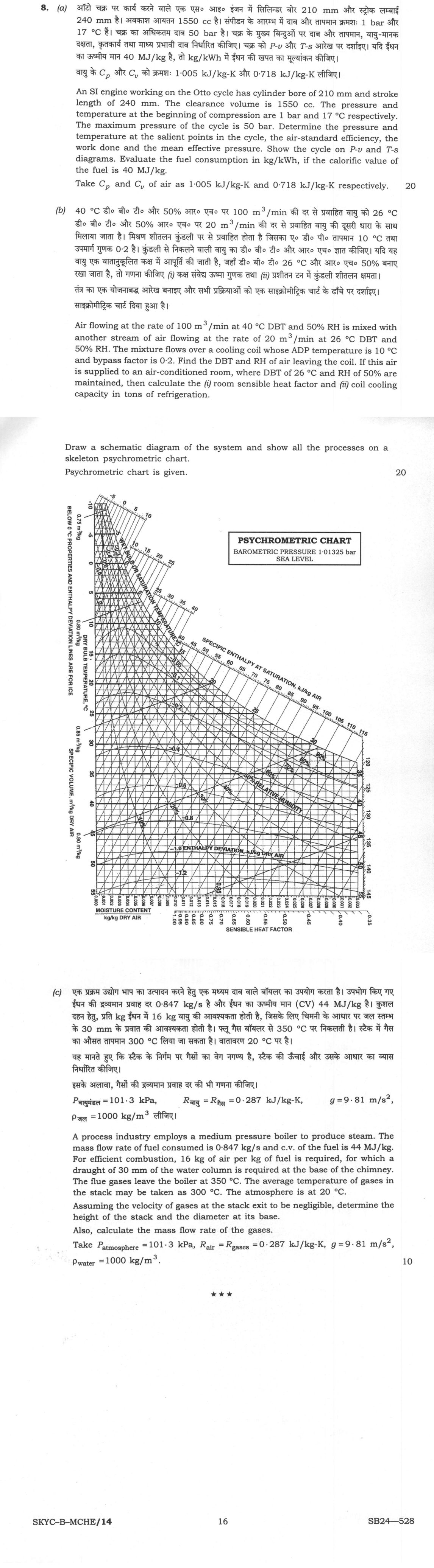
Draw a schematic diagram of the system and show all the processes on a skeleton psychrometric chart.
Psychrometric chart is given.
A process industry employs a medium pressure boiler to produce steam. The mass flow rate of fuel consumed is 0·847 kg/s and c.v. of the fuel is 44 MJ/kg. For efficient combustion, 16 kg of air per kg of fuel is required, for which a draught of 30 mm of the water column is required at the base of the chimney. The flue gases leave the boiler at 350 °C. The average temperature of gases in the stack may be taken as 300 °C. The atmosphere is at 20 °C.
Assuming the velocity of gases at the stack exit to be negligible, determine the height of the stack and the diameter at its base.
Also, calculate the mass flow rate of the gases.
Take Patmosphere = 101·3 kPa, Rair = Rgases = 0·287 kJ/kg-K, g = 9·81 m/s²,
ρwater = 1000 kg/m³.
हिंदी में प्रश्न पढ़ें
ओटो चक्र पर कार्य करने वाले एक स्पार्क इग्निशन इंजन में सिलिंडर बोर 210 mm और स्ट्रोक लंबाई 240 mm है। अवकाश आयतन 1550 cc है। संपीडन के आरंभ में दाब और तापमान क्रमशः 1 bar और 17 °C है। चक्र का अधिकतम दाब 50 bar है। चक्र के मुख्य बिंदुओं पर दाब और तापमान, वायु-मानक दक्षता, कृतकार्य तथा माध्य प्रभावी दाब निर्धारित कीजिए। चक्र को P-v और T-s आरेख पर दर्शाइए। यदि ईंधन का उष्मीय मान 40 MJ/kg है, तो kg/kWh में ईंधन की खपत का मूल्यांकन कीजिए।
वायु के Cp और Cv को क्रमशः 1·005 kJ/kg-K और 0·718 kJ/kg-K लीजिए।
40 °C डी० बी० टी० और 50% आर० एच० पर 100 m³/min की दर से प्रवाहित वायु को 26 °C डी० बी० टी० और 50% आर० एच० पर 20 m³/min की दर से प्रवाहित वायु की दूसरी धारा के साथ मिलाया जाता है। मिश्रण शीतलन कुंडली पर से प्रवाहित होता है जिसका ए० डी० पी० तापमान 10 °C तथा उपमार्ग गुणक 0·2 है। कुंडली से निकलने वाली वायु का डी० बी० टी० और आर० एच० ज्ञात कीजिए। यदि यह वायु एक वातानुकूलित कक्ष में आपूर्ति की जाती है, जहाँ डी० बी० टी० 26 °C और आर० एच० 50% बनाए रखा जाता है, तो गणना कीजिए (i) कक्ष संवेदी उष्मा गुणक तथा (ii) प्रशीतन टन में कुंडली शीतलन क्षमता।
तंत्र का एक योजनाबद्ध आरेख बनाइए और सभी प्रक्रियाओं को एक साइक्रोमीट्रिक चार्ट के ढाँचे पर दर्शाइए।
साइक्रोमीट्रिक चार्ट दिया हुआ है।
एक प्रक्रम उद्योग भाप का उत्पादन करने हेतु एक मध्यम दाब वाले बॉयलर का उपयोग करता है। उपभोग किए गए ईंधन की द्रव्यमान प्रवाह दर 0·847 kg/s है और ईंधन का उष्मीय मान (CV) 44 MJ/kg है। कुशल दहन हेतु, प्रति kg ईंधन में 16 kg वायु की आवश्यकता होती है, जिसके लिए चिमनी के आधार पर जल स्तंभ के 30 mm के प्रवात की आवश्यकता होती है। फ्लू गैस बॉयलर से 350 °C पर निकलती है। स्टैक में गैस का औसत तापमान 300 °C लिया जा सकता है। वातावरण 20 °C पर है।
यह मानते हुए कि स्टैक के निर्गम पर गैसों का वेग नगण्य है, स्टैक की ऊँचाई और उसके आधार का व्यास निर्धारित कीजिए।
इसके अलावा, गैसों की द्रव्यमान प्रवाह दर की भी गणना कीजिए।
Pवायुमंडल = 101·3 kPa, Rवायु = Rगैस = 0·287 kJ/kg-K, g = 9·81 m/s²,
ρजल = 1000 kg/m³ लीजिए।
The figure this question refers to, in words
The question paper is a scan and the diagram did not survive as text. This is the figure as read from the original page — every component, value and label — so the question can be worked from the text below.
(b) A psychrometric chart with the title 'PSYCHROMETRIC CHART' and subtitle 'BAROMETRIC PRESSURE 1.01325 bar SEA LEVEL'. The chart is a grid with multiple axes. The bottom horizontal axis is 'MOISTURE CONTENT kg/kg DRY AIR' ranging from 0.000 to 0.035. The right vertical axis is 'DRY BULB TEMPERATURE, °C' ranging from -10 to 55. The top diagonal axis is 'SPECIFIC ENTHALPY AT SATURATION, kJ/kg AIR' ranging from 0 to 145. The left vertical axis is 'SPECIFIC VOLUME, m³/kg DRY AIR' with values 0.75, 0.80, 0.85, 0.90 m³/kg. The bottom right axis is 'SENSIBLE HEAT FACTOR' ranging from 0.00 to 1.00. The chart contains curved lines for 'WET BULB OR SATURATION TEMPERATURE, °C' ranging from -5 to 40, and curved lines for 'RELATIVE HUMIDITY' ranging from 10% to 90%. There are also diagonal lines for 'ENTHALPY DEVIATION, kJ/kg DRY AIR' with values -0.1, -0.2, -0.4, -0.6, -0.8, -1.0, -1.2.
What "Calculate" is asking you to do
Apply the standard formula or schedule to data the question has already supplied — a table of readings, cost records, a balance sheet — and produce the number. The method is rarely in doubt; the marks sit in the named intermediate quantities, each of which has to appear as a labelled line.
Structure that answers it
Data as given → formula or standard treatment, named → substitution → each intermediate, labelled → result with units
Where marks are lost
Omitting an intermediate the marking scheme pays for separately, or rounding at an intermediate line so the final figure drifts. In commerce and accountancy, any figure in a statement that no numbered working note supports is treated as unearned.
How this answer will be evaluated
Approach
(a) calculate: given > formula > substitution > result with units > interpretation | (b) calculate: given > formula > substitution > result with units > interpretation | (c) calculate: given > formula > substitution > result with units > interpretation Full marks: All parts fully solved with correct equations, units, and diagrams; clear interpretation of results.
Key points expected
- Calculate compression ratio from bore, stroke, and clearance volume
- Determine pressure and temperature at all salient points (1, 2, 3, 4)
- Calculate air-standard efficiency and mean effective pressure (MEP)
- Evaluate fuel consumption in kg/kWh using given calorific value
- Calculate DBT and RH of air leaving the cooling coil
- Determine room sensible heat factor (SHF)
- Calculate coil cooling capacity in tons of refrigeration
- Show all processes on a psychrometric chart
Evaluation rubric
Each sub-part is marked on its own, against the marks and word limit printed on the paper.
- (a) Determine cycle parameters, efficiency, work, MEP, and fuel consumption for an SI engine on the Otto cycle. 20 marks
calculate— given → formula → substitution → result with units → interpretation
Must cover
- Calculate compression ratio from bore, stroke, and clearance volume
- Determine pressure and temperature at all salient points (1, 2, 3, 4)
- Calculate air-standard efficiency and mean effective pressure (MEP)
- Evaluate fuel consumption in kg/kWh using given calorific value
Loses marks
- Plugging numbers without stating governing equations
- Unmarked or missing states on cycle diagrams
- Omitting unit conversions or dimensional checks
Earns more
- Draws labelled P-v and T-s diagrams of the Otto cycle
- States assumptions (adiabatic processes, constant specific heats)
- Shows dimensional consistency in unit conversions
- Interprets efficiency result physically
Extra mark
- Provides a clear, labelled cycle diagram with all states marked
- Explicitly states governing equations before substitution
- (b) Determine air properties after mixing and cooling, room SHF, and coil cooling capacity. 20 marks
calculate— given → formula → substitution → result with units → interpretation
Must cover
- Calculate DBT and RH of air leaving the cooling coil
- Determine room sensible heat factor (SHF)
- Calculate coil cooling capacity in tons of refrigeration
- Show all processes on a psychrometric chart
Loses marks
- Incorrect use of psychrometric chart for state determination
- Missing or unlabelled processes on the chart
- Omitting the schematic diagram of the system
Earns more
- Draws a schematic diagram of the air-conditioning system
- Uses psychrometric chart correctly for state determination
- States assumptions (steady state, no heat loss)
- Shows clear process paths on the chart
Extra mark
- Provides a detailed schematic with all components labelled
- Explicitly states bypass factor calculation method
- (c) Determine stack height, base diameter, and mass flow rate of gases for a boiler system. 10 marks
calculate— given → formula → substitution → result with units → interpretation
Must cover
- Calculate mass flow rate of flue gases
- Determine height of the stack using draught equation
- Calculate diameter at the base of the stack
- Use given values for atmospheric pressure, gas constant, and gravity
Loses marks
- Incorrect application of draught equation
- Omitting mass flow rate calculation
- Using wrong units or constants in calculations
Earns more
- States assumptions (negligible exit velocity, ideal gas behavior)
- Shows dimensional consistency in calculations
- Interprets results in context of boiler operation
- Uses correct draught equation for natural ventilation
Extra mark
- Provides a simple diagram of the boiler and stack system
- Explicitly states the draught equation used
Model answer coming soon
Every evaluation on this site is marked against a verified model answer. This question's answer is still being written; evaluation opens the moment it lands.
More from Mechanical Engineering 2023 Paper II
- Q5 (a) Show in the form of a table, how the increase in the following variables affects (inc…
- Q6 (a) The power output of a six-cylinder, four-stroke CI engine is absorbed by a hydraulic…
- Q7 (a) A convergent-divergent nozzle receives steam at 5 bar, 250 °C and expands it isentrop…
- Q8 (a) An SI engine working on the Otto cycle has cylinder bore of 210 mm and stroke length…