Paper II — Q5
(a) Show in the form of a table, how the increase in the following variables affects (increase or decrease) the ignition delay…
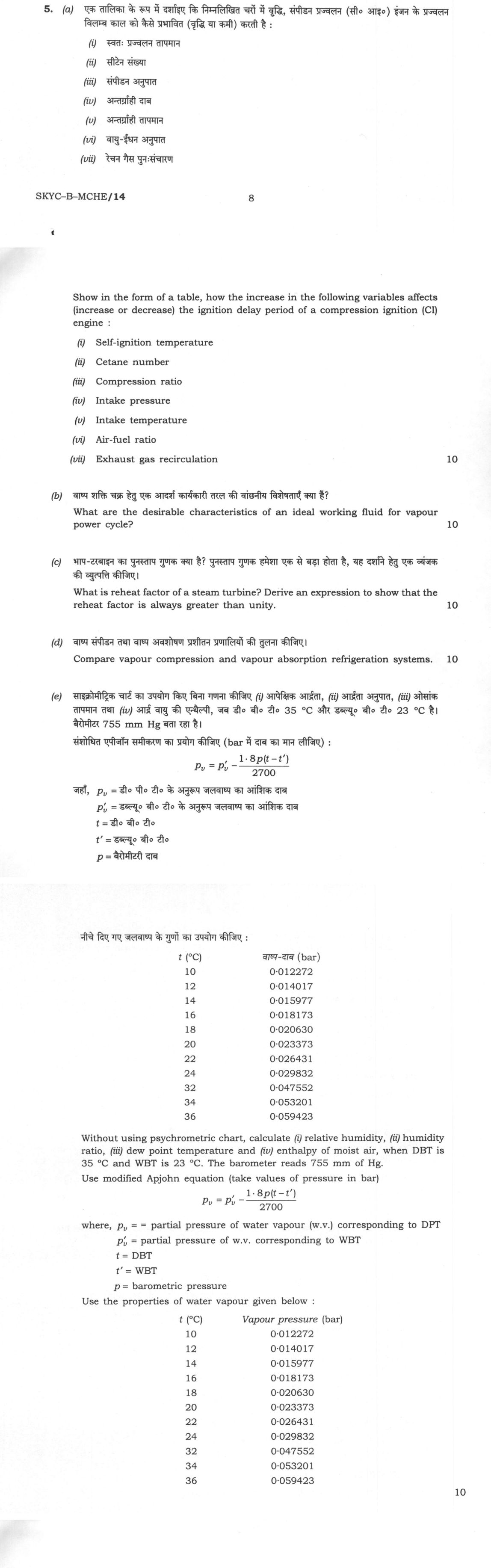
Show in the form of a table, how the increase in the following variables affects (increase or decrease) the ignition delay period of a compression ignition (CI) engine: (i) Self-ignition temperature, (ii) Cetane number, (iii) Compression ratio, (iv) Intake pressure, (v) Intake temperature, (vi) Air-fuel ratio, (vii) Exhaust gas recirculation. 10 marks
What are the desirable characteristics of an ideal working fluid for vapour power cycle? 10 marks
What is reheat factor of a steam turbine? Derive an expression to show that the reheat factor is always greater than unity. 10 marks
Compare vapour compression and vapour absorption refrigeration systems. 10 marks
Without using psychrometric chart, calculate (i) relative humidity, (ii) humidity ratio, (iii) dew point temperature and (iv) enthalpy of moist air, when DBT is 35 °C and WBT is 23 °C. The barometer reads 755 mm of Hg. Use modified Apjohn equation (take values of pressure in bar): p_v = p'_v - (1.8p(t-t'))/2700 where, p_v = partial pressure of water vapour (w.v.) corresponding to DPT, p'_v = partial pressure of w.v. corresponding to WBT, t = DBT, t' = WBT, p = barometric pressure. Use the properties of water vapour given below: t (°C) | Vapour pressure (bar) ---|--- 10 | 0·012272, 12 | 0·014017, 14 | 0·015977, 16 | 0·018173, 18 | 0·020630, 20 | 0·023373, 22 | 0·026431, 24 | 0·029832, 32 | 0·047552, 34 | 0·053201, 36 | 0·059423. 10 marks
हिंदी में प्रश्न पढ़ें
एक तालिका के रूप में दर्शाइए कि निम्नलिखित चरों में वृद्धि, संपीडन प्रज्वलन (सी. ओ.) इंजन के प्रज्वलन विलम्ब काल को कैसे प्रभावित (वृद्धि या कमी) करती है: (i) स्वतः प्रज्वलन तापमान, (ii) सीटेन संख्या, (iii) संपीडन अनुपात, (iv) अंतर्ग्राही दाब, (v) अंतर्ग्राही तापमान, (vi) वायु-ईंधन अनुपात, (vii) रेचन गैस पुनःसंचारण। (10 अंक)
वाष्प शक्ति चक्र हेतु एक आदर्श कार्यकारी तरल की वांछनीय विशेषताएं क्या हैं? (10 अंक)
भाप-टरबाइन का पुनःस्थाप गुणक क्या है? पुनःस्थाप गुणक हमेशा एक से बड़ा होता है, यह दर्शाने हेतु एक व्यंजक की व्युत्पत्ति कीजिए। (10 अंक)
वाष्प संपीडन तथा वाष्प अवशोषण प्रशीतन प्रणालियों की तुलना कीजिए। (10 अंक)
साइक्रोमीट्रिक चार्ट का उपयोग किए बिना गणना कीजिए (i) आपेक्षिक आर्द्रता, (ii) आर्द्रता अनुपात, (iii) ओसांक तापमान तथा (iv) आर्द्र वायु की एन्थैल्पी, जब डी० बी० टी० 35 °C और डब्ल्यू० बी० टी० 23 °C है। बैरोमीटर 755 mm Hg बता रहा है। संशोधित एपीजॉन समीकरण का प्रयोग कीजिए (bar में दाब का मान लीजिए): p_v = p'_v - (1.8p(t-t'))/2700 जहाँ, p_v = डी० पी० टी० के अनुरूप जलवाष्प का आंशिक दाब, p'_v = डब्ल्यू० बी० टी० के अनुरूप जलवाष्प का आंशिक दाब, t = डी० बी० टी०, t' = डब्ल्यू० बी० टी०, p = बैरोमीटरी दाब। निचे दिए गए जलवाष्प के गुणों का उपयोग कीजिए: t (°C) | वाष्प-दाब (bar) ---|--- 10 | 0·012272, 12 | 0·014017, 14 | 0·015977, 16 | 0·018173, 18 | 0·020630, 20 | 0·023373, 22 | 0·026431, 24 | 0·029832, 32 | 0·047552, 34 | 0·053201, 36 | 0·059423। (10 अंक)
The figure this question refers to, in words
The question paper is a scan and the diagram did not survive as text. This is the figure as read from the original page — every component, value and label — so the question can be worked from the text below.
(e) Table of water vapour properties: t (°C) Vapour pressure (bar) 10 0.012272 12 0.014017 14 0.015977 16 0.018173 18 0.020630 20 0.023373 22 0.026431 24 0.029832 32 0.047552 34 0.053201 36 0.059423
Model answer
Written by UPSC Answer Check against this question's marking rubric, to the expected length. UPSC does not publish answers for Mains — this is one way to score well, not an official key.
(a) The effect of an increase in each variable on the ignition delay period of a CI engine, assuming all other parameters remain constant, is:
- (i) Self-ignition temperature increases → ignition delay increases.
- (ii) Cetane number increases → ignition delay decreases.
- (iii) Compression ratio increases → ignition delay decreases.
- (iv) Intake pressure increases → ignition delay decreases.
- (v) Intake temperature increases → ignition delay decreases.
- (vi) Air-fuel ratio increases, i.e. mixture becomes leaner → ignition delay increases.
- (vii) Exhaust gas recirculation increases → ignition delay increases.
(b) The desirable characteristics of an ideal working fluid for a vapour power cycle are:
- It should have a high latent heat of vaporisation, so that a large amount of energy can be transported per unit mass.
- It should have a high critical temperature so that a high boiler temperature can be used without going supercritical.
- Its critical pressure should be moderate, and its saturation pressure at the boiler temperature should not be excessively high.
- Its saturation pressure at the condenser temperature should not be too low, otherwise deep vacuum is required and air leakage becomes serious.
- It should have a high vapour density and low specific volume, so that turbine, piping and heat-exchanger sizes are small.
- It should have a low liquid specific volume, so that pump work is small.
- It should have a low liquid specific heat, so that less heat is required to raise the liquid to the boiling temperature.
- It should have high thermal conductivity, high heat-transfer coefficient and low viscosity.
- It should be chemically stable over the entire cycle temperature range.
- It should be non-corrosive, non-toxic, non-flammable and safe to handle.
- Its expansion in the turbine should remain dry or only slightly wet, to avoid blade erosion.
- It should be cheap, readily available and environmentally benign.
(c) The reheat factor of a steam turbine is defined as the ratio of the sum of the isentropic heat drops of all individual stages to the overall isentropic heat drop between the initial pressure and the final pressure. Thus, if H₁, H₂, ..., Hₙ are the stage isentropic drops and H is the overall isentropic drop, then
R.F. = (H₁ + H₂ + ... + Hₙ)/H.
Consider an infinitesimal expansion through pressure difference dp. For an isentropic process, T ds = dh − v dp = 0, so dh = v dp. Since pressure decreases, dp is negative, and the isentropic enthalpy drop is dH = −v dp.
Let p₁ be the initial pressure and p₂ the final pressure, with p₁ > p₂. Let s₀ be the initial entropy. The overall isentropic drop is H = ∫_p₁^p₂ −v(p, s₀) dp = ∫_p₂^p₁ v(p, s₀) dp.
In an actual multistage turbine, friction and other irreversibilities increase the entropy. Therefore, at any pressure p, the actual entropy s(p) is greater than s₀. The sum of the stage isentropic drops is ΣHᵢ = ∫_p₁^p₂ −v(p, s(p)) dp = ∫_p₂^p₁ v(p, s(p)) dp.
For steam, at constant pressure, specific volume increases with entropy: (∂v/∂s)_p > 0. This is true in the wet region, where higher entropy means higher dryness fraction, and in the superheated region, where higher entropy means higher temperature. Hence v(p, s(p)) > v(p, s₀). Therefore, the integrand in ΣHᵢ is greater than that in H. It follows that H₁ + H₂ + ... + Hₙ > H. Hence R.F. = (ΣHᵢ)/H > 1.
Thus the reheat factor is always greater than unity. Typical values lie between about 1.02 and 1.06.
(d) Comparison of vapour compression refrigeration (VCR) and vapour absorption refrigeration (VAR) systems:
- Energy input: VCR is driven mainly by mechanical work supplied to the compressor. VAR is driven mainly by thermal energy supplied to the generator, with a small amount of pump work.
- Pressure rise: In VCR, pressure is raised by the compressor. In VAR, pressure is raised by the combined absorber-generator-pump arrangement, often called a thermal compressor.
- Refrigerant: VCR uses a single pure refrigerant. VAR uses a binary mixture of refrigerant and absorbent, such as NH₃-H₂O or LiBr-H₂O.
- Main components: VCR has compressor, condenser, expansion valve and evaporator. VAR has generator, absorber, pump, rectifier, condenser, expansion valve and evaporator.
- COP: For VCR, COP = Q_evaporator/W_compressor. For VAR, COP = Q_evaporator/(Q_generator + W_pump). VCR generally has a much higher COP.
- Moving parts: VCR has many moving parts because of the compressor, so it is noisier and has more vibration. VAR has very few moving parts, so it is quieter and smoother.
- Maintenance: VCR requires more maintenance because of the compressor. VAR requires less maintenance.
- Size and capacity: VCR is compact and economical for small and medium capacities. VAR is bulky, but becomes economical for large capacities where waste heat, solar heat or cheap heat is available.
- Temperature range: VCR can achieve very low temperatures. LiBr-H₂O VAR is limited to temperatures above 0 °C, while NH₃-H₂O VAR can reach lower temperatures but ammonia is toxic.
- Applications: VCR is used in domestic refrigerators, air conditioners, automobiles and cold storage. VAR is used in industrial refrigeration, large air-conditioning plants, waste-heat recovery and solar cooling.
- Initial and running cost: VCR usually has lower initial cost for small units. VAR may have higher initial cost, but running cost can be low if waste heat is available.
- Environmental aspect: VCR may use synthetic refrigerants with global warming or ozone-depletion potential. VAR using water-LiBr is environmentally benign, while NH₃ is toxic but environmentally friendly.
(e) Given: DBT t = 35 °C, WBT t′ = 23 °C, barometer p = 755 mm Hg. Convert pressure to bar: p = (755/760) × 1.01325 = 1.00658 bar.
For WBT 23 °C, interpolate between 22 °C and 24 °C: p′_v = 0.026431 + (23 − 22)/(24 − 22) × (0.029832 − 0.026431) = 0.026431 + 0.5 × 0.003401 = 0.0281315 bar.
Using the modified Apjohn equation, p_v = p′_v − (1.8 p(t − t′))/2700 = 0.0281315 − (1.8 × 1.00658 × 12)/2700 = 0.0281315 − 0.0080527 = 0.0200788 bar.
(e)(i) Relative humidity At DBT 35 °C, interpolate between 34 °C and 36 °C: p_sat,35 = (0.053201 + 0.059423)/2 = 0.056312 bar.
Relative humidity φ = p_v/p_sat,35 = 0.0200788/0.056312 = 0.3566. Therefore, φ = 35.66 %.
(e)(ii) Humidity ratio ω = 0.622 × p_v/(p − p_v) = 0.622 × 0.0200788/(1.00658 − 0.0200788) = 0.622 × 0.0200788/0.9865012 = 0.01266 kg water vapour/kg dry air. Therefore, ω = 0.01266 kg/kg dry air = 12.66 g/kg dry air.
(e)(iii) Dew point temperature The dew point is the saturation temperature corresponding to p_v = 0.0200788 bar. From the table, this lies between 16 °C and 18 °C.
At 16 °C, p = 0.018173 bar. At 18 °C, p = 0.020630 bar.
Interpolation: t_dp = 16 + [(0.0200788 − 0.018173)/(0.020630 − 0.018173)] × (18 − 16) = 16 + [0.0019058/0.002457] × 2 = 16 + 1.5514 = 17.55 °C. Therefore, Dew point temperature = 17.55 °C.
(e)(iv) Enthalpy of moist air Using h = 1.005 t + ω(2501 + 1.86 t) kJ/kg dry air, h = 1.005 × 35 + 0.01266 × (2501 + 1.86 × 35) = 35.175 + 0.01266 × (2501 + 65.1) = 35.175 + 0.01266 × 2566.1 = 35.175 + 32.486 = 67.66 kJ/kg dry air. Therefore, Enthalpy of moist air = 67.66 kJ/kg dry air.
What "Calculate" is asking you to do
Apply the standard formula or schedule to data the question has already supplied — a table of readings, cost records, a balance sheet — and produce the number. The method is rarely in doubt; the marks sit in the named intermediate quantities, each of which has to appear as a labelled line.
Structure that answers it
Data as given → formula or standard treatment, named → substitution → each intermediate, labelled → result with units
Where marks are lost
Omitting an intermediate the marking scheme pays for separately, or rounding at an intermediate line so the final figure drifts. In commerce and accountancy, any figure in a statement that no numbered working note supports is treated as unearned.
How this answer will be evaluated
Approach
(a) derive: given > assumptions > stepwise derivation > result > check | (b) write short notes: define > 3-4 key features > one example > one-line significance | (c) derive: given > assumptions > stepwise derivation > result > check | (d) compare: paired headings or table > key differences > significance > conclusion | (e) calculate: given > formula > substitution > result with units > interpretation Full marks: All parts answered with correct method, clear derivations, and accurate calculations.
Key points expected
- Table format with variable and effect columns
- Correct effect for all 7 variables
- Identify variables as increasing or decreasing delay
- High critical temperature
- Low freezing point
- High latent heat of vaporization
- Chemical stability and safety
- Definition: Ratio of actual work to isentropic work
Evaluation rubric
Each sub-part is marked on its own, against the marks and word limit printed on the paper.
- (a) Table showing effect of 7 variables on CI engine ignition delay. 10 marks
derive— given → assumptions → stepwise derivation → result → check
Must cover
- Table format with variable and effect columns
- Correct effect for all 7 variables
- Identify variables as increasing or decreasing delay
Loses marks
- Listing variables without tabular format
- Incorrect effect for key variables like cetane number
Earns more
- Brief physical reasoning for each effect
- Mention of auto-ignition mechanism
Extra mark
- Reference to specific fuel properties
- (b) List of desirable characteristics for ideal vapour power cycle fluid. 10 marks
write short notes— define → 3-4 key features → one example → one-line significance
Must cover
- High critical temperature
- Low freezing point
- High latent heat of vaporization
- Chemical stability and safety
Loses marks
- Listing properties of ideal gas instead of working fluid
- Vague statements without specific thermodynamic properties
Earns more
- Mention of low specific volume of vapour
- Non-corrosive nature
Extra mark
- Example of a real fluid (e.g., water)
- (c) Definition of reheat factor and derivation showing it is > 1. 10 marks
derive— given → assumptions → stepwise derivation → result → check
Must cover
- Definition: Ratio of actual work to isentropic work
- Use of T-s diagram for derivation
- Show that actual enthalpy drop > isentropic drop
- Final inequality RF > 1
Loses marks
- Stating RF > 1 without derivation
- Confusing reheat factor with isentropic efficiency
Earns more
- Explanation of why actual path deviates from isentropic
- Clear labelling of states on T-s diagram
Extra mark
- Mention of typical RF values for steam turbines
- (d) Comparison of vapour compression and vapour absorption refrigeration. 10 marks
compare— paired headings or table → key differences → significance → conclusion
Must cover
- Comparison of power source (mechanical vs thermal)
- Comparison of components (compressor vs generator/absorber)
- Comparison of efficiency/COP
- Comparison of applications
Loses marks
- Describing one system without comparing to the other
- Confusing absorption with adsorption
Earns more
- Mention of noise levels
- Mention of environmental impact
Extra mark
- Schematic diagrams of both cycles
- (e) Calculate RH, humidity ratio, DPT, and enthalpy using Apjohn equation. 10 marks
calculate— given → formula → substitution → result with units → interpretation
Must cover
- Correct application of modified Apjohn equation
- Calculation of partial pressure of water vapour
- Calculation of all 4 requested parameters
- Use of provided steam table data
Loses marks
- Using psychrometric chart instead of calculation
- Arithmetic errors in Apjohn equation
Earns more
- Step-by-step substitution in equations
- Correct units for all final answers
Extra mark
- Verification of results using psychrometric chart
Practice this exact question
Write your answer and it is marked point by point against the model answer above — what you covered, what you missed, what you got wrong.
Evaluate my answer →More from Mechanical Engineering 2023 Paper II
- Q2 (a) A 15 m high cylinder with a cross-sectional area of 0.6 m² contains 3 m³ of liquid wa…
- Q3 (a) Heat is generated in a stainless steel plate (thermal conductivity = 22 W/m-K) of thi…
- Q4 (a) Considering an ideal, isentropic gas flow through a nozzle, show that choking will oc…
- Q5 (a) Show in the form of a table, how the increase in the following variables affects (inc…
- Q6 (a) The power output of a six-cylinder, four-stroke CI engine is absorbed by a hydraulic…
- Q7 (a) A convergent-divergent nozzle receives steam at 5 bar, 250 °C and expands it isentrop…
- Q8 (a) An SI engine working on the Otto cycle has cylinder bore of 210 mm and stroke length…