Paper II — Q2
(a) A 15 m high cylinder with a cross-sectional area of 0.6 m² contains 3 m³ of liquid water at 25 °C on the top of a thin…
A 15 m high cylinder with a cross-sectional area of 0.6 m² contains 3 m³ of liquid water at 25 °C on the top of a thin insulated piston of mass 20 kg. Below the piston, argon gas is at 15 °C with a volume of 3 m³, as shown in the figure. Heat is supplied to argon such that the piston rises and pushes the water out over the top edge. Find the (i) work done (kJ) to remove the whole water from the top of the piston and (ii) heat transferred (kJ) to argon during the process. (iii) Plot the process on P-v diagram for argon. Assume atmospheric pressure (P₀) as 101 kPa, Cᵥ and R for argon as 0·312 kJ/kg-K and 0·2081 kJ/kg-K respectively. The specific volume of water at 25 °C is 0·001003 m³/kg. Neglect piston thickness. 20 marks
Air at 100 kPa and 290 K enters a gas turbine cycle with two stages of compression and two stages of expansion. This system uses ideal regenerator, reheater and intercooler. The pressure ratio across each stage is 4. 300 kJ/kg of heat is added in combustion chamber and reheater each. The regenerator increases the air temperature by 20 °C. Draw T-s plot and determine the (i) total heat rejected (kJ/kg), (ii) net work output (kJ/kg) and (iii) thermal efficiency of the system. Assume isentropic operation for all compressors and turbines. Take Cₚ of air = 1·005 kJ/kg-K and γ = 1·4. 20 marks
A convergent-divergent nozzle has a throat area of 250 mm² and an exit area of 500 mm². Air enters the nozzle with a stagnation temperature of 350 K and stagnation pressure of 1 MPa. Determine the maximum flow rate of air through the nozzle and the static pressure, static temperature, Mach number and velocity at the exit from the nozzle. Given γ = 1·4, R = 0·287 kJ/kg-K. Use Gas Table to solve the problem. 10 marks
हिंदी में प्रश्न पढ़ें
0.6 m² के अनुप्रस्थ-काट क्षेत्रफल वाले एक 15 m ऊँचे सिलिंडर में 20 kg द्रव्यमान के पतले उष्मारोधित पिस्टन के शीर्ष पर 25 °C पर 3 m³ तरल पानी निहित है। पिस्टन के नीचे, 15 °C पर 3 m³ आयतन के साथ आर्गन गैस है, जैसा कि चित्र में दर्शाया गया है। आर्गन को उष्मा की आपूर्ति इस प्रकार की जाती है कि पिस्टन ऊपर उठता है और पानी को ऊपरी किनारे से बाहर धकेलता है। ज्ञात कीजिए (i) पिस्टन के ऊपर से पूरा पानी निकालने के लिए किया गया कार्य (kJ) और (ii) प्रक्रम के दौरान आर्गन को उष्मा अंतरण (kJ). (iii) आर्गन के लिए प्रक्रम का P-v आरेख खींचिए। वायुमंडलीय दाब (P₀) को 101 kPa, आर्गन के लिए Cᵥ और R क्रमशः: 0.312 kJ/kg-K और 0.2081 kJ/kg-K मान लीजिए। 25 °C पर पानी का विशिष्ट आयतन 0.001003 m³/kg है। पिस्टन की मोटाई की उपेक्षा कीजिए। (20 अंक)
100 kPa और 290 K पर वायु संपीडन के दो चरणों और प्रसरण के दो चरणों के साथ एक गैस टरबाइन चक्र में प्रवेश करती है। यह निकाय आदर्श पुन्योजक, पुनस्तापक तथा अंतराशीतक का उपयोग करता है। प्रत्येक चरण में दाब अनुपात 4 है। दहन कक्ष और पुनस्तापक प्रत्येक में 300 kJ/kg ऊष्मा डाली जाती है। पुन्योजक वायु का तापमान 20 °C से बढ़ा देता है। T-s आरेख खींचिए और ज्ञात कीजिए (i) कुल परित्यक्त ऊष्मा (kJ/kg), (ii) शुद्ध उत्पादित कार्य (kJ/kg) तथा (iii) निकाय की तापीय दक्षता। सभी संपीडकों और टरबाइनों के लिए समएंट्रॉपी प्रचालन मान लीजिए। वायु के लिए Cₚ = 1·005 kJ/kg-K तथा γ = 1·4 लीजिए। (20 अंक)
एक अभिसारी-अपसारी टुंड का कंठ क्षेत्र 250 mm² तथा निकास क्षेत्र 500 mm² है। वायु 350 K के स्थिर तापमान तथा 1 MPa के स्थिर दाब के साथ टुंड में प्रवेश करती है। टुंड के माध्यम से वायु की अधिकतम प्रवाह दर तथा स्थैतिक दाब, स्थैतिक तापमान, मैक संख्या और वेग, टुंड के निकास पर, ज्ञात कीजिए। γ = 1·4, R = 0·287 kJ/kg-K दिया गया है। प्रश्न के हल हेतु गैस तालिका का उपयोग कीजिए। (10 अंक)
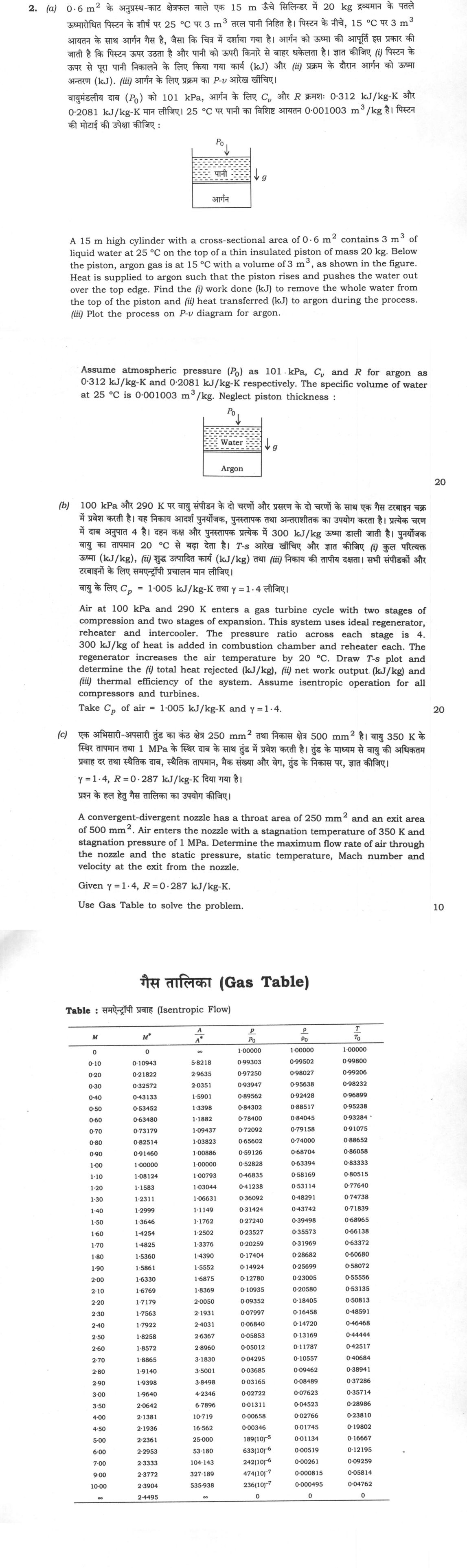
The figure this question refers to, in words
The question paper is a scan and the diagram did not survive as text. This is the figure as read from the original page — every component, value and label — so the question can be worked from the text below.
(a) A vertical cross-section of a cylindrical container. Inside, a horizontal piston separates the volume into two sections. The top section contains a fluid labeled 'Water'. The bottom section contains a gas labeled 'Argon'. An arrow labeled 'P0' points vertically downward onto the top surface of the water. An arrow labeled 'g' points vertically downward from the right side of the piston, indicating gravity.
What "Solve" is asking you to do
Choose the method, then carry it through to a final answer. Identifying what kind of problem this is and why that method applies is the first thing marked; a correct figure arrived at invisibly earns almost nothing.
Structure that answers it
Given data and what is required → method chosen, with the reason it applies → set-up (equation, circuit, free body, trial balance) → working, step by step → answer with units and any condition of validity
Where marks are lost
Doing the middle steps mentally and writing only the result. In mathematics papers, a further loss comes from giving a decimal where the exact value in surds or fractions was wanted, or from skipping the justification a part explicitly asks for.
How this answer will be evaluated
Approach
(a) calculate: given > formula > substitution > result with units > interpretation | (b) calculate: given > formula > substitution > result with units > interpretation | (c) calculate: given > formula > substitution > result with units > interpretation Full marks: Complete solution with all required calculations, proper diagrams, and clear physical interpretation of results
Key points expected
- Calculate mass of argon and water from given volumes and properties
- Determine initial and final pressures of argon using force balance
- Calculate work done by argon using P-V relationship
- Apply first law of thermodynamics to find heat transfer
- Draw T-s diagram showing all states and processes
- Calculate temperatures at each compressor and turbine stage
- Determine heat added in combustion chamber and reheater
- Calculate net work output and thermal efficiency
Evaluation rubric
Each sub-part is marked on its own, against the marks and word limit printed on the paper.
- (a) Determine work done, heat transfer, and plot P-v diagram for the argon-water system. 20 marks
calculate— given → formula → substitution → result with units → interpretation
Must cover
- Calculate mass of argon and water from given volumes and properties
- Determine initial and final pressures of argon using force balance
- Calculate work done by argon using P-V relationship
- Apply first law of thermodynamics to find heat transfer
Loses marks
- Omits atmospheric pressure in pressure calculations
- Confuses work done by gas with work done on water
- Fails to account for piston mass in force balance
Earns more
- Correctly identifies constant pressure process for argon
- Accurately calculates piston displacement and volume change
- Properly accounts for atmospheric pressure in force balance
- Clear P-v diagram with labeled states and process path
Extra mark
- Includes free body diagram of piston showing all forces
- Verifies energy balance with explicit numerical check
- (b) Analyze two-stage gas turbine cycle with regeneration, reheat, and intercooling to find heat rejection, net work, and efficiency. 20 marks
calculate— given → formula → substitution → result with units → interpretation
Must cover
- Draw T-s diagram showing all states and processes
- Calculate temperatures at each compressor and turbine stage
- Determine heat added in combustion chamber and reheater
- Calculate net work output and thermal efficiency
Loses marks
- Ignores intercooling effect on compression work
- Incorrect application of regenerator temperature rise
- Fails to account for reheat in turbine work calculation
Earns more
- Correctly applies isentropic relations for compression and expansion
- Accurately accounts for regenerator effectiveness
- Properly handles intercooling between compression stages
- Clear labeling of all states on T-s diagram
Extra mark
- Includes pressure-temperature relationship verification
- Provides detailed state property table
- (c) Determine maximum flow rate and exit conditions for air in a convergent-divergent nozzle using gas tables. 10 marks
calculate— given → formula → substitution → result with units → interpretation
Must cover
- Calculate throat conditions using isentropic flow relations
- Determine exit Mach number from area ratio
- Find static pressure and temperature at exit
- Calculate mass flow rate and exit velocity
Loses marks
- Incorrect area ratio calculation for exit Mach number
- Fails to account for stagnation conditions properly
- Misapplication of isentropic relations for property determination
Earns more
- Correct use of isentropic flow tables for property determination
- Accurate calculation of area-Mach number relationship
- Proper application of continuity equation for mass flow
- Clear identification of choked flow condition at throat
Extra mark
- Includes verification of flow regime (subsonic/supersonic)
- Provides complete state property table for all sections
Model answer coming soon
Every evaluation on this site is marked against a verified model answer. This question's answer is still being written; evaluation opens the moment it lands.
More from Mechanical Engineering 2023 Paper II
- Q1 (a) A 50 kg block of iron at 500 K is placed into open atmosphere which is at a temperatu…
- Q2 (a) A 15 m high cylinder with a cross-sectional area of 0.6 m² contains 3 m³ of liquid wa…
- Q3 (a) Heat is generated in a stainless steel plate (thermal conductivity = 22 W/m-K) of thi…
- Q4 (a) Considering an ideal, isentropic gas flow through a nozzle, show that choking will oc…
- Q5 (a) Show in the form of a table, how the increase in the following variables affects (inc…