Paper II — Q1
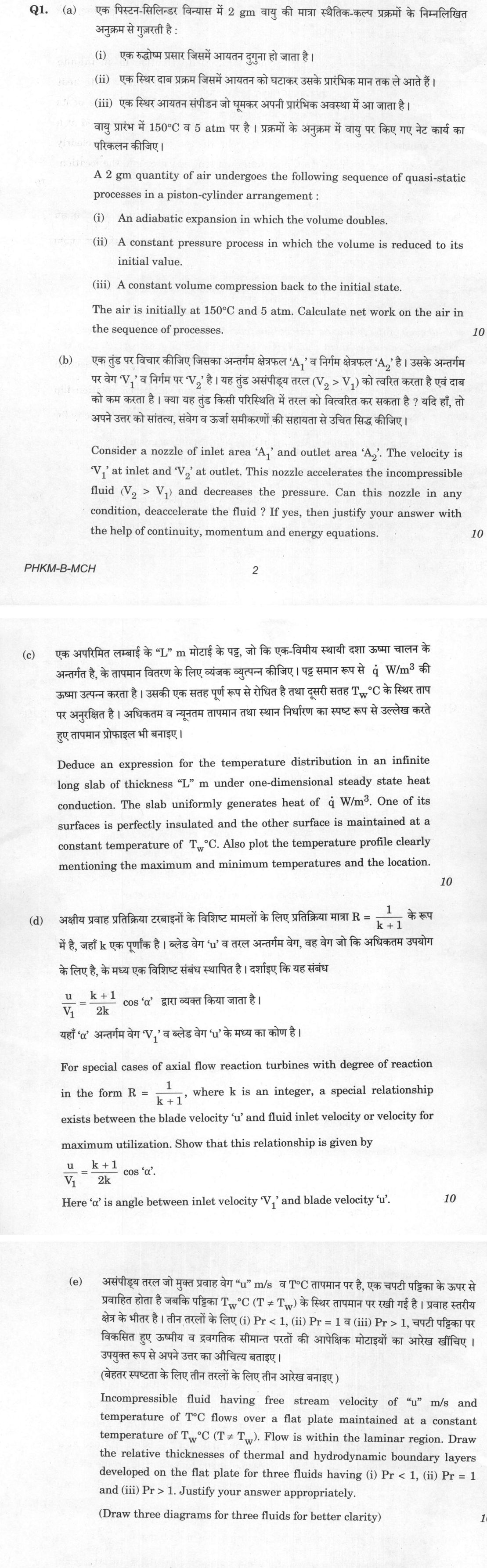
(a) A 2 gm quantity of air undergoes the following sequence of quasi-static processes in a piston-cylinder arrangement: (i) An…
A 2 gm quantity of air undergoes the following sequence of quasi-static processes in a piston-cylinder arrangement: An adiabatic expansion in which the volume doubles.
A constant pressure process in which the volume is reduced to its initial value.
A constant volume compression back to the initial state. The air is initially at 150°C and 5 atm. Calculate net work on the air in the sequence of processes. 10 marks
Consider a nozzle of inlet area 'A₁' and outlet area 'A₂'. The velocity is 'V₁' at inlet and 'V₂' at outlet. This nozzle accelerates the incompressible fluid (V₂ > V₁) and decreases the pressure. Can this nozzle in any condition, deaccelerate the fluid? If yes, then justify your answer with the help of continuity, momentum and energy equations. 10 marks
Deduce an expression for the temperature distribution in an infinite long slab of thickness "L" m under one-dimensional steady state heat conduction. The slab uniformly generates heat of q̇ W/m³. One of its surfaces is perfectly insulated and the other surface is maintained at a constant temperature of Tw °C. Also plot the temperature profile clearly mentioning the maximum and minimum temperatures and the location. 10 marks
For special cases of axial flow reaction turbines with degree of reaction in the form R = 1/(k+1), where k is an integer, a special relationship exists between the blade velocity 'u' and fluid inlet velocity or velocity for maximum utilization. Show that this relationship is given by u/V₁ = (k+1)/(2k) cos 'α'. Here 'α' is angle between inlet velocity 'V₁' and blade velocity 'u'. 10 marks
Incompressible fluid having free stream velocity of "u" m/s and temperature of T°C flows over a flat plate maintained at a constant temperature of T_w °C (T ≠ T_w). Flow is within the laminar region. Draw the relative thicknesses of thermal and hydrodynamic boundary layers developed on the flat plate for three fluids having (i) Pr < 1, (ii) Pr = 1 and (iii) Pr > 1. Justify your answer appropriately. (Draw three diagrams for three fluids for better clarity) 10 marks
हिंदी में प्रश्न पढ़ें
एक पिस्टन-सिलिंडर विन्यास में 2 gm वायु की मात्रा स्थैतिक-कल्प प्रक्रमों के निम्नलिखित अनुक्रम से गुजरती है: एक रूद्धोष्म प्रसार जिसमें आयतन दुगुना हो जाता है।
एक स्थिर दाब प्रक्रम जिसमें आयतन को घटाकर उसके प्रारंभिक मान तक ले आते हैं।
एक स्थिर आयतन संपीडन जो घूमकर अपनी प्रारंभिक अवस्था में आ जाता है। वायु प्रारंभ में 150°C व 5 atm पर है। प्रक्रमों के अनुक्रम में वायु पर किए गए नेट कार्य का परिकलन कीजिए। 10 marks
एक तुंड पर विचार कीजिए जिसका अंतर्गम क्षेत्रफल 'A₁' व निर्गम क्षेत्रफल 'A₂' है। उसके अंतर्गम पर वेग 'V₁' व निर्गम पर 'V₂' है। यह तुंड असंपीड्य तरल (V₂ > V₁) को त्वरित करता है एवं दाब को कम करता है। क्या यह तुंड किसी परिस्थिति में तरल को विवरित कर सकता है? यदि हाँ, तो अपने उत्तर को सांतत्य, संवेग व ऊर्जा समीकरणों की सहायता से उचित सिद्ध कीजिए। 10 marks
एक अपरिमित लम्बाई के "L" m मोटाई के पड़, जो कि एक-विमीय स्थायी दशा ऊष्मा चालन के अन्तर्गत है, के तापमान वितरण के लिए व्यंजक व्युत्पन्न कीजिए। पड़ समान रूप से q̇ W/m³ की ऊष्मा उत्पन्न करता है। उसकी एक सतह पूर्ण रूप से रोधित है तथा दूसरी सतह Tw °C के स्थिर ताप पर अनुरक्षित है। अधिकतम व न्यूनतम तापमान तथा स्थान निर्धारण का स्पष्ट रूप से उल्लेख करते हुए तापमान प्रोफाइल भी बनाइए। 10 marks
अक्षीय प्रवाह प्रतिक्रिया टरबाइनों के विशिष्ट मामलों के लिए प्रतिक्रिया मात्रा R = 1/(k+1) के रूप में है, जहाँ k एक पूर्णांक है। ब्लेड वेग 'u' व तरल अन्तर्गाम वेग, वह वेग जो कि अधिकतम उपयोग के लिए है, के मध्य एक विशिष्ट संबंध स्थापित है। दर्शाइए कि यह संबंध u/V₁ = (k+1)/(2k) cos 'α' द्वारा व्यक्त किया जाता है। यहाँ 'α' अन्तर्गाम वेग V₁ व ब्लेड वेग 'u' के मध्य का कोण है। 10 marks
असंपीड़ीय तरल जो मुक्त प्रवाह वेग "u" m/s व T°C तापमान पर है, एक चपटी पट्टिका के ऊपर से प्रवाहित होता है जबकि पट्टिका T_w °C (T ≠ T_w) के स्थिर तापमान पर रखी गई है। प्रवाह स्तरीय क्षेत्र के भीतर है। तीन तरलों के लिए (i) Pr < 1, (ii) Pr = 1 व (iii) Pr > 1, चपटी पट्टिका पर विकसित हुए ऊष्मीय व द्रवगतिक सीमान्त परतों की अपेक्षिक मोटाइयों का आरेख खींचिए। उपयुक्त रूप से अपने उत्तर का औचित्य बताइए। (बेहतर स्पष्टता के लिए तीन तरलों के लिए तीन आरेख बनाइए।) 10 marks
Model answer
Written by UPSC Answer Check against this question's marking rubric, to the expected length. UPSC does not publish answers for Mains — this is one way to score well, not an official key.
(a) Take air as an ideal gas with γ = 1.4 and R = 287 J/kg K. m = 2 g = 0.002 kg, T₁ = 150°C = 423.15 K, P₁ = 5 atm.
State 1: P₁, V₁, T₁. Process 1–2: reversible adiabatic expansion, V₂ = 2V₁. For an adiabatic process, TV^(γ−1) = constant and PV^γ = constant. T₂ = T₁(V₁/V₂)^(γ−1) = T₁/2^(γ−1) P₂ = P₁(V₁/V₂)^γ = P₁/2^γ.
Work done by air in 1–2: W₁₂ = (P₁V₁ − P₂V₂)/(γ−1) = mR(T₁ − T₂)/(γ−1). P₁V₁ = mRT₁ = 0.002 × 287 × 423.15 = 242.888 J.
2^(γ−1) = 2^0.4 = 1.31951, so T₂ = 423.15/1.31951 = 320.69 K. W₁₂ = 0.002 × 287 × (423.15 − 320.69)/(0.4) = 147.02 J.
Process 2–3: constant pressure, volume reduced to initial value V₃ = V₁, so P₃ = P₂. W₂₃ = P₂(V₃ − V₂) = P₂(V₁ − 2V₁) = −P₂V₁ = −P₁V₁/2^γ. 2^1.4 = 2.63902, so W₂₃ = −242.888/2.63902 = −92.04 J.
Process 3–1: constant volume, so W₃₁ = 0.
Net work by air: W_net,by = W₁₂ + W₂₃ + W₃₁ = 147.02 − 92.04 = 54.98 J ≈ 55.0 J. Net work on air = −55.0 J. Thus 55.0 J is delivered by the air to the piston.
(b) Let the flow be steady, one-dimensional, incompressible, adiabatic, with no shaft work. Continuity: A₁V₁ = A₂V₂ = Q. If V₂ > V₁, then A₂ < A₁: the passage is convergent in the forward direction.
Energy equation (Bernoulli): P₁/ρ + V₁²/2 = P₂/ρ + V₂²/2. If V₂ > V₁, then P₂ < P₁: pressure decreases. This is the stated accelerating nozzle.
Can it decelerate? Yes, if the same duct is operated in the reverse direction. Then the fluid enters at the original outlet (area A₂) and leaves at the original inlet (area A₁). The effective inlet area is A₂ and outlet area is A₁, with A₁ > A₂. Continuity gives V_out/V_in = A_in/A_out = A₂/A₁ < 1, so V_out < V_in. Thus the fluid decelerates and the duct acts as a diffuser.
Energy equation then gives P_out − P_in = ρ(V_in² − V_out²)/2 > 0, so pressure rises downstream.
Momentum equation for the control volume: P₁A₁ − P₂A₂ + F_wall = ρQ(V₂ − V₁). When V₂ < V₁, the right side is negative. A divergent wall geometry and the downstream pressure rise provide the wall force required to satisfy momentum.
In differential form, Euler’s equation is ρV dV/dx = −dP/dx. Continuity gives dV/V = −dA/A, hence dV/dx = −(V/A)dA/dx. Therefore, dA/dx > 0 gives dV/dx < 0 and dP/dx > 0, i.e. deceleration in a divergent passage. So the nozzle cannot decelerate the fluid in the stated forward direction, but it can do so when reversed and used as a diffuser with A_out > A_in.
(c) Let x be measured from the insulated surface, so x = 0 is insulated and x = L is maintained at Tw. For one-dimensional steady conduction with uniform heat generation q̇:
d²T/dx² + q̇/k = 0.
Integrate once: dT/dx = −q̇x/k + C₁. At x = 0, the surface is perfectly insulated, so dT/dx = 0. Hence C₁ = 0.
Integrate again: T = −q̇x²/(2k) + C₂. At x = L, T = Tw: Tw = −q̇L²/(2k) + C₂ C₂ = Tw + q̇L²/(2k).
Thus T(x) = Tw + q̇/(2k)(L² − x²).
Maximum temperature occurs at the insulated surface x = 0: T_max = Tw + q̇L²/(2k). Minimum temperature occurs at the cooled surface x = L: T_min = Tw.
Profile:
T(x) ^ | T_max ● at x = 0 | ⋯ | ⋯ | ● Tw at x = L +-------------------------> x 0 L
The curve is parabolic and concave downward.
(d) For an axial flow reaction turbine with constant axial velocity and no losses, let station 1 be rotor inlet and station 2 rotor outlet. Blade speed is u. The inlet absolute velocity V₁ makes angle α with u, so its whirl component is Vw₁ = V₁ cos α. Let Vw₂ be the whirl component at outlet.
Work per unit mass: w = u(Vw₁ − Vw₂).
For constant axial velocity, the degree of reaction is R = 1 − (Vw₁ + Vw₂)/(2u).
Given R = 1/(k+1): 1/(k+1) = 1 − (Vw₁ + Vw₂)/(2u) => Vw₁ + Vw₂ = 2u k/(k+1) => Vw₂ = 2u k/(k+1) − Vw₁.
Then w = u[Vw₁ − (2u k/(k+1) − Vw₁)] = 2u Vw₁ − 2u² k/(k+1).
For maximum utilization, maximise w with respect to u for fixed V₁, α and R: dw/du = 2Vw₁ − 4u k/(k+1) = 0 => u = Vw₁ (k+1)/(2k).
Since Vw₁ = V₁ cos α, u/V₁ = (k+1)/(2k) cos α. At this condition Vw₂ = 0, i.e. the exit absolute velocity is axial.
(e) For laminar flow over a flat plate, the Prandtl number is Pr = ν/α, where ν is momentum diffusivity and α is thermal diffusivity. For laminar forced convection, δ_t/δ_h ≈ Pr^(−1/3), where δ_t is the thermal boundary-layer thickness and δ_h is the hydrodynamic boundary-layer thickness.
- If Pr < 1, then α > ν: heat diffuses faster than momentum, so δ_t > δ_h.
- If Pr = 1, then α = ν, so δ_t = δ_h.
- If Pr > 1, then ν > α: momentum diffuses faster than heat, so δ_t < δ_h.
(e)(i) Pr < 1 u, T∞ → → → → δ_t (thermal) ⋯⋯⋯ δ_h (hydrodynamic) ⋯⋯ plate ________________________________
(e)(ii) Pr = 1 u, T∞ → → → → δ_t = δ_h ⋯⋯⋯ plate ________________________________
(e)(iii) Pr > 1 u, T∞ → → → → δ_h (hydrodynamic) ⋯⋯⋯ δ_t (thermal) ⋯ plate ________________________________
The wall temperature Tw only determines the direction of heat flow; it does not change the relative thicknesses, which are controlled by Pr.
What "Solve" is asking you to do
Choose the method, then carry it through to a final answer. Identifying what kind of problem this is and why that method applies is the first thing marked; a correct figure arrived at invisibly earns almost nothing.
Structure that answers it
Given data and what is required → method chosen, with the reason it applies → set-up (equation, circuit, free body, trial balance) → working, step by step → answer with units and any condition of validity
Where marks are lost
Doing the middle steps mentally and writing only the result. In mathematics papers, a further loss comes from giving a decimal where the exact value in surds or fractions was wanted, or from skipping the justification a part explicitly asks for.
How this answer will be evaluated
Approach
Framework: Mechanical Engineering Paper 2. (a) calculate: given > formula > substitution > result with units > interpretation | (b) justify: claim > 3-4 reasons > evidence > conclusion | (c) derive: given > assumptions > stepwise derivation > result > check | (d) derive: given > assumptions > stepwise derivation > result > check | (e) describe: define > structure or process in order > labelled diagram > significance Full marks: All parts show complete method with labelled diagrams, stated assumptions, and correct final results.
Key points expected
- State initial conditions (150°C, 5 atm, 2g)
- Apply adiabatic relation for process (i)
- Calculate work for constant pressure process (ii)
- Sum works to find net work on air
- Apply continuity equation for incompressible flow
- Apply momentum equation (Bernoulli/Euler)
- Relate area change to velocity change
- Justify deacceleration with pressure increase
Evaluation rubric
Each sub-part is marked on its own, against the marks and word limit printed on the paper.
- (a) Net work on air for the 3-process cycle. 10 marks
calculate— given → formula → substitution → result with units → interpretation
Must cover
- State initial conditions (150°C, 5 atm, 2g)
- Apply adiabatic relation for process (i)
- Calculate work for constant pressure process (ii)
- Sum works to find net work on air
Loses marks
- Plugging numbers without governing equations
- Unmarked states on cycle diagram
Earns more
- Draws labelled p-V or T-s diagram
- States assumptions (ideal gas, k=1.4)
Extra mark
- Checks dimensional consistency of work terms
- (b) Conditions for nozzle deacceleration of incompressible fluid. 10 marks
justify— claim → 3-4 reasons → evidence → conclusion
Must cover
- Apply continuity equation for incompressible flow
- Apply momentum equation (Bernoulli/Euler)
- Relate area change to velocity change
- Justify deacceleration with pressure increase
Loses marks
- Confusing nozzle with diffuser geometry
- Ignoring incompressible constraint
Earns more
- Draws schematic of diffuser/nozzle
- States assumptions (steady, incompressible)
Extra mark
- Mentions energy equation explicitly
- (c) Temperature distribution in slab with heat generation. 10 marks
derive— given → assumptions → stepwise derivation → result → check
Must cover
- Write 1D steady state heat equation with q̇
- Apply boundary conditions (insulated, Tw)
- Integrate to find T(x) expression
- Plot profile with max/min locations
Loses marks
- Missing boundary conditions in derivation
- Unlabelled temperature profile plot
Earns more
- States assumptions (uniform k, 1D flow)
- Labels maximum and minimum temperatures
Extra mark
- Checks dimensional consistency of T(x)
- (d) Relationship u/V₁ = (k+1)/(2k) cos α for R=1/(k+1). 10 marks
derive— given → assumptions → stepwise derivation → result → check
Must cover
- Define degree of reaction R for axial turbine
- Express work done in terms of u, V₁, α
- Substitute R = 1/(k+1) into work equation
- Derive u/V₁ = (k+1)/(2k) cos α
Loses marks
- Skipping intermediate algebraic steps
- Unmarked velocity triangle
Earns more
- Draws velocity triangle for axial turbine
- States assumptions (axial flow, steady)
Extra mark
- Interprets physical meaning of k
- (e) Relative thicknesses of thermal and hydrodynamic boundary layers. 10 marks
describe— define → structure or process in order → labelled diagram → significance
Must cover
- Define Prandtl number Pr
- Draw diagram for Pr < 1 (δt > δ)
- Draw diagram for Pr = 1 (δt = δ)
- Draw diagram for Pr > 1 (δt < δ)
Loses marks
- Missing any of the three diagrams
- Unlabelled boundary layer thicknesses
Earns more
- Labels δ and δt on each diagram
- Justifies with physical reasoning
Extra mark
- Mentions typical fluids for each Pr case
Practice this exact question
Write your answer and it is marked point by point against the model answer above — what you covered, what you missed, what you got wrong.
Evaluate my answer →More from Mechanical Engineering 2024 Paper II
- Q1 (a) A 2 gm quantity of air undergoes the following sequence of quasi-static processes in…
- Q2 (a) Air flows through a 5 cm diameter pipe. Measurements indicate that at the inlet to th…
- Q3 (a) A shell and tube heat exchanger used in a thermal power plant is designed to condense…
- Q4 (a) A convergent-divergent nozzle is designed to expand air from a chamber in which the p…