Paper II — Q4
(a) A convergent-divergent nozzle is designed to expand air from a chamber in which the pressure is 800 kPa and temperature is…
A convergent-divergent nozzle is designed to expand air from a chamber in which the pressure is 800 kPa and temperature is 40°C to give Mach 2·5. The throat area of the nozzle is 0·0025 m². Find the following:
The flow rate through the nozzle under design conditions.
The exit area of the nozzle.
The design back-pressure and the temperature of the air leaving the nozzle with this back-pressure.
The lowest back-pressure for which there is only subsonic flow in the nozzle.
The back-pressure at which there is a normal shock wave on the exit plane of the nozzle.
The back-pressure below which there are no shock waves in the nozzle.
The back-pressure over which there are oblique shock waves in the exhaust from the nozzle.
The back-pressure over which there are expansion waves in the exhaust from the nozzle.
Use Isentropic and Shock tables attached at the end.
20 marks
A stainless steel plate of 1 m length, 1 m width and 10 mm thickness is kept horizontal. The thermal conductivity of the plate is 10 W/mK. Bottom surface of the plate is exposed to hot gases at 700°C with heat transfer coefficient at the bottom surface of 50 W/m²K. Top surface of the plate is cooled by air at 69°C and flowing parallel to the top surface. Any part of the plate should not exceed a maximum permissible temperature of 400°C to avoid failure. Find the minimum permissible velocity of the air required to ensure the plate does not get over-heated beyond the permissible limit. Neglect the heat loss from the side surfaces of the plate and assume one-dimensional heat transfer. Use the following correlation to solve the problem:
Nū_L = Pr⁰.333 [ 0.037 Re_L⁰.8 - 871 ]
Take the appropriate properties of the air from the table attached at the end.
20 marks
A vertical flat plate is maintained at a temperature of "T_w °C" and exposed to a stagnant atmospheric air "Tₐ °C". If T_w < Tₐ, show the shape of thermal and velocity boundary layers developed on the surface of the plate. Also show the variation "hₓ" along the vertical surface of the plate. Assume the flow is within the laminar region and consider only free convection.
5 marks
A fluid flows through a tube exposed to constant heat flux condition. The flow is in the turbulent flow regime for which the Dittus-Boelter correlation is applicable for determining the Nu number as given below:
Nu_d = (0·023) Re⁰.8 Pr⁰.4
In order to reduce the surface temperature of the tube, it is suggested to double the velocity of the flow. Find the percentage increase in the heat transfer coefficient due to increased velocity.
5 marks
हिंदी में प्रश्न पढ़ें
एक अभिसारी-अपसारी तुंड का डिजाइन एक चैम्बर में, जहाँ दाब 800 kPa व तापमान 40°C है, वायु के प्रसार के लिए किया गया है जिससे कि 2·5 मैक दिया जा सके। तुंड का कंठ क्षेत्रफल 0·0025 m² है। निम्नलिखित को ज्ञात कीजिए:
डिजाइन शर्तों के अंतर्गत तुंड द्वारा प्रवाह दर।
तुंड का निर्गम क्षेत्रफल।
डिजाइन पश्च-दाब तथा इस पश्च-दाब पर तुंड द्वारा निर्गमित वायु का तापमान।
सबसे कम पश्च-दाब जिसके लिए तुंड में केवल अवध्वनिक प्रवाह रहे।
पश्च-दाब जिस पर सामान्य प्रघात तरंग तुंड के निर्गम तल पर हो।
पश्च-दाब जिसके नीचे तुंड में प्रघात तरंगें ना हों।
पश्च-दाब जिसके ऊपर तिरछी प्रघात तरंगें तुंड के निर्गम पर हों।
पश्च-दाब जिसके ऊपर प्रसार तरंगें तुंड के निर्गम पर हों।
समपेंट्रॉपी (आइसेंट्रॉपिक) व प्रघात सारणियों का प्रयोग कीजिए जो अंत में संलग्न हैं।
(20 अंक)
एक जंगरोधी इस्पात पट्टिका जिसकी लम्बाई 1 m, चौड़ाई 1 m और मोटाई 10 mm है, क्षैतिज स्थिति में रखी है। पट्टिका की ऊष्मीय चालकता 10 W/mK है। पट्टिका की नीचे की सतह गर्म गैसों में 700°C पर खुली है जबकि निचली सतह का ऊष्मा अंतरण गुणांक 50 W/m²K है। 69°C पर पट्टिका की ऊपरी सतह को वायु द्वारा ठंडा किया जाता है जो कि ऊपरी सतह के समानांतर बह रही है। विफलता रोकने के लिए पट्टिका के किसी भाग का अधिकतम अनुमेय तापमान 400°C से अधिक नहीं होना चाहिए। पट्टिका अनुमेय सीमा से अधिक गर्म न हो यह सुनिश्चित करने के लिए आवश्यक वायु का न्यूनतम अनुमेय वेग ज्ञात कीजिए। पट्टिका के किनारे की सतहों से होने वाली ऊष्मा हानि को नगण्य मानिए तथा एक-विमीय ऊष्मा अंतरण मानिए। प्रश्न को हल करने के लिए निम्नलिखित सहसंबंध का प्रयोग कीजिए:
Nū_L = Pr⁰.333 [ 0.037 Re_L⁰.8 - 871 ]
अंत में संलग्न सारणी से वायु के उपयुक्त गुणों का चयन कीजिए।
(20 अंक)
एक उद्वाधर चपटी पट्टिका को "T_w °C" तापमान पर अनुरक्षित रखा गया है तथा "Tₐ °C" निष्पंदित वातावरणीय वायु में अनावृत किया गया है। यदि T_w < Tₐ है, तो ऊष्मीय एवं वेग सीमांत परतें, जो पट्टिका की सतह पर विकसित हुई हैं, उनका आकार दर्शाइए। साथ ही परिवर्तन "hₓ" को पट्टिका की उद्वाधर सतह की दिशा में भी दर्शाइए। प्रवाह को स्तरीय क्षेत्र में मानिए तथा केवल मुक्त संवहन पर विचार कीजिए।
(5 अंक)
एक तरल एक नलिका में बह रहा है जो कि स्थिर ऊष्मा फ्लक्स अवस्था में अनावृत है। प्रवाह विश्षुब्ध प्रवाह क्षेत्र में है जिसमें डिट्स-बोएल्टर (Dittus-Boelter) सहसंबंध का प्रयोग, नीचे दर्शाए अनुसार Nu संख्या ज्ञात करने के लिए किया जाता है:
Nu_d = (0·023) Re⁰.8 Pr⁰.4
नलिका का सतह तापमान घटाने के लिए, यह सलाह दी जाती है कि प्रवाह का वेग दुगुना कीजिए। बढ़े हुए वेग के कारण ऊष्मा अंतरण गुणांक में प्रतिशत बढ़ोतरी को ज्ञात कीजिए।
(5 अंक)
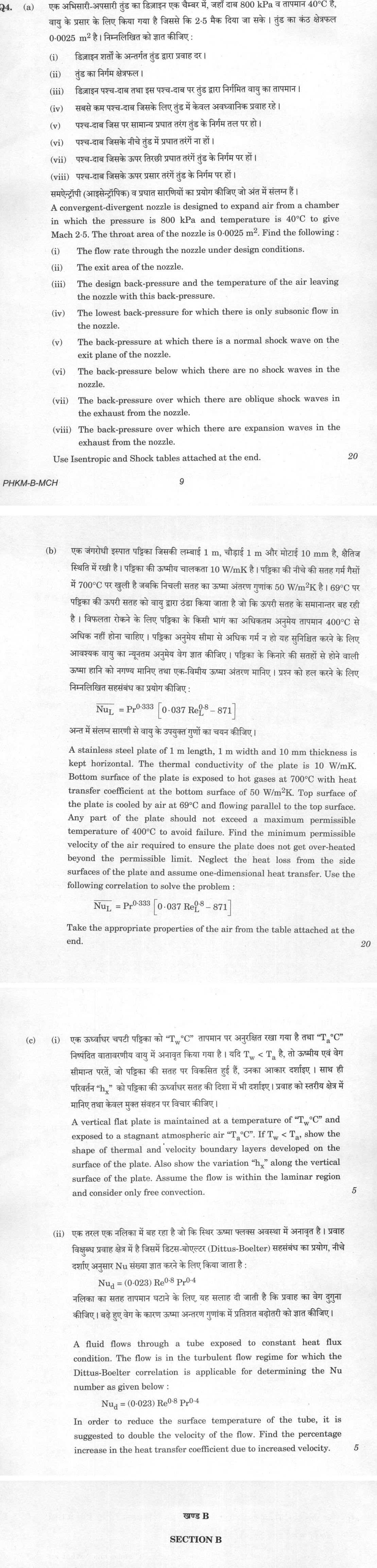
The figure this question refers to, in words
The question paper is a scan and the diagram did not survive as text. This is the figure as read from the original page — every component, value and label — so the question can be worked from the text below.
(a) Table: Saturated R-134a (Continued). Columns: Temp. (°C), Press. (kPa), Enthalpy kJ/kg (Sat. Liquid hf, Evap. hfg, Sat. Vapor hg), Entropy kJ/k-K (Sat. Liquid sf, Evap. sfg, Sat. Vapor sg). Rows: -70, 8.3, 119.47, 235.15, 354.62, 0.6645, 1.1575, 1.8220; -65, 11.7, 123.18, 234.55, 357.73, 0.6825, 1.1268, 1.8094; -60, 16.3, 127.53, 233.33, 360.86, 0.7031, 1.0947, 1.7978; -55, 22.2, 132.37, 231.63, 364.00, 0.7256, 1.0618, 1.7874; -50, 29.9, 137.62, 229.54, 367.16, 0.7493, 1.0286, 1.7780; -45, 39.6, 143.18, 227.14, 370.32, 0.7740, 0.9956, 1.7695; -40, 51.8, 148.98, 224.50, 373.48, 0.7991, 0.9629, 1.7620; -35, 66.8, 154.98, 221.67, 376.64, 0.8245, 0.9308, 1.7553; -30, 85.1, 161.12, 218.68, 379.80, 0.8499, 0.8994, 1.7493; -26.3, 101.3, 165.80, 216.36, 382.16, 0.8690, 0.8763, 1.7453; -25, 107.2, 167.38, 215.57, 382.95, 0.8754, 0.8687, 1.7441; -20, 133.7, 173.74, 212.34, 386.08, 0.9007, 0.8388, 1.7395; -15, 165.0, 180.19, 209.00, 389.20, 0.9258, 0.8096, 1.7354; -10, 201.7, 186.72, 205.56, 392.28, 0.9507, 0.7812, 1.7319; -5, 244.5, 193.32, 202.02, 395.34, 0.9755, 0.7534, 1.7288; 0, 294.0, 200.00, 198.36, 398.36, 1.0000, 0.7262, 1.7262; 5, 350.9, 206.75, 194.57, 401.32, 1.0243, 0.6995, 1.7239; 10, 415.8, 213.58, 190.65, 404.23, 1.0485, 0.6733, 1.7218; 15, 489.5, 220.49, 186.58, 407.07, 1.0725, 0.6475, 1.7200; 20, 572.8, 227.49, 182.35, 409.84, 1.0963, 0.6220, 1.7183; 25, 666.3, 234.59, 177.92, 412.51, 1.1201, 0.5967, 1.7168; 30, 771.0, 241.79, 173.29, 415.08, 1.1437, 0.5716, 1.7153; 35, 887.6, 249.10, 168.42, 417.52, 1.1673, 0.5465, 1.7139; 40, 1017.0, 256.54, 163.28, 419.82, 1.1909, 0.5214, 1.7123; 45, 1160.2, 264.11, 157.85, 421.96, 1.2145, 0.4962, 1.7106; 50, 1318.1, 271.83, 152.08, 423.91, 1.2381, 0.4706, 1.7088; 55, 1491.6, 279.72, 145.93, 425.65, 1.2619, 0.4447, 1.7066; 60, 1681.8, 287.79, 139.33, 427.13, 1.2857, 0.4182, 1.7040; 65, 1889.9, 296.00, 132.21, 428.30, 1.3099, 0.3910, 1.7008; 70, 2117.0, 304.64, 124.47, 429.11, 1.3343, 0.3627, 1.6970; 75, 2364.4, 313.51, 115.94, 429.45, 1.3592, 0.3330, 1.6923; 80, 2633.6, 322.79, 106.40, 429.19, 1.3849, 0.3013, 1.6862; 85, 2926.2, 332.65, 95.45, 428.10, 1.4117, 0.2665, 1.6782; 90, 3244.5, 343.38, 82.31, 425.70, 1.4404, 0.2267, 1.6671; 95, 3591.5, 355.83, 64.98, 420.81, 1.4733, 0.1765, 1.6498; 100, 3973.2, 374.74, 32.47, 407.21, 1.5228, 0.0870, 1.6098; 101.2, 4064.0, 390.98, 0, 390.98, 1.5658, 0, 1.5658.
(b) Table: Properties of air at atmospheric pressure. Note: The values of mu, k, cp, and Pr are not strongly pressure-dependent and may be used over a fairly wide range of pressures. Columns: T (K), rho (kg/m^3), cp (kJ/kg . degC), mu x 10^5 (kg/m . s), nu x 10^6 (m^2/s), k (W/m . degC), alpha x 10^4 (m^2/s), Pr. Rows: 100, 3.6010, 1.0266, 0.6924, 1.923, 0.009246, 0.02501, 0.770; 150, 2.3675, 1.0099, 1.0283, 4.343, 0.013735, 0.05745, 0.753; 200, 1.7684, 1.0061, 1.3289, 7.490, 0.01809, 0.10165, 0.739; 250, 1.4128, 1.0053, 1.5990, 11.31, 0.02227, 0.15675, 0.722; 300, 1.1774, 1.0057, 1.8462, 15.69, 0.02624, 0.22160, 0.708; 350, 0.9980, 1.0090, 2.075, 20.76, 0.03003, 0.2983, 0.697; 400, 0.8826, 1.0140, 2.286, 25.90, 0.03365, 0.3760, 0.689; 450, 0.7833, 1.0207, 2.484, 31.71, 0.03707, 0.4222, 0.683; 500, 0.7048, 1.0295, 2.671, 37.90, 0.04038, 0.5564, 0.680; 550, 0.6423, 1.0392, 2.848, 44.34, 0.04360, 0.6532, 0.680; 600, 0.5879, 1.0551, 3.018, 51.34, 0.04659, 0.7512, 0.680; 650, 0.5430, 1.0635, 3.177, 58.51, 0.04953, 0.8578, 0.682; 700, 0.5030, 1.0752, 3.332, 66.25, 0.05230, 0.9672, 0.684; 750, 0.4709, 1.0856, 3.481, 73.91, 0.05509, 1.0774, 0.686; 800, 0.4405, 1.0978, 3.625, 82.29, 0.05779, 1.1951, 0.689; 850, 0.4149, 1.1095, 3.765, 90.75, 0.06028, 1.3097, 0.692; 900, 0.3925, 1.1212, 3.899, 99.3, 0.06279, 1.4271, 0.696; 950, 0.3716, 1.1321, 4.023, 108.2, 0.06525, 1.5510, 0.699; 1000, 0.3524, 1.1417, 4.152, 117.8, 0.06752, 1.6779, 0.702; 1100, 0.3204, 1.160, 4.44, 138.6, 0.0732, 1.969, 0.704; 1200, 0.2947, 1.179, 4.69, 159.1, 0.0782, 2.251, 0.707; 1300, 0.2707, 1.197, 4.93, 182.1, 0.0837, 2.583, 0.705; 1400, 0.2515, 1.214, 5.17, 205.5, 0.0891, 2.920, 0.705; 1500, 0.2355, 1.230, 5.40, 229.1, 0.0946, 3.262, 0.705; 1600, 0.2211, 1.248, 5.63, 254.5, 0.100, 3.609, 0.705; 1700, 0.2082, 1.267, 5.85, 280.5, 0.105, 3.977, 0.705; 1800, 0.1970, 1.287, 6.07, 308.1, 0.111, 4.379, 0.704; 1900, 0.1858, 1.309, 6.29, 338.5, 0.117, 4.811, 0.704; 2000, 0.1762, 1.338, 6.50, 369.0, 0.124, 5.260, 0.702; 2100, 0.1682, 1.372, 6.72, 399.6, 0.131, 5.715, 0.700; 2200, 0.1602, 1.419, 6.93, 432.6, 0.139, 6.120, 0.707; 2300, 0.1538, 1.482, 7.14, 464.0, 0.149, 6.540, 0.710; 2400, 0.1458, 1.574, 7.35, 504.0, 0.161, 7.020, 0.718; 2500, 0.1394, 1.688, 7.57, 543.5, 0.175, 7.441, 0.730
Model answer
Written by UPSC Answer Check against this question's marking rubric, to the expected length. UPSC does not publish answers for Mains — this is one way to score well, not an official key.
(a) Take air as an ideal gas, γ=1.4, R=287 J/kgK. Stagnation state: T₀=313.15 K, P₀=800 kPa, throat area A*=0.0025 m². Pressures are absolute; the flow is isentropic until a shock appears. The design flow is choked because Me=2.5>1.
- (i) Choked-throat mass-flow theorem: m = A*P₀/√T₀ × √(γ/R) × 1.2⁻³. For γ=1.4, 1.2⁻³=0.578704. √313.15=17.70 and √(1.4/287)=0.06984. m = 0.0025×800000/17.70 × 0.06984 × 0.578704 = 4.57 kg/s.
- (ii) Isentropic area–Mach relation: A/A* = (1/M)[(2/(γ+1))(1+(γ-1)M²/2)]³. At Me=2.5, 1+0.2×6.25=2.25 and (5/6)×2.25=1.875. Ae/A* = (1/2.5)×1.875³ = 675/256 = 2.6367. Ae = 2.6367×0.0025 = 0.00659 m².
- (iii) Isentropic pressure and temperature relations: Pe/P₀ = [1+0.2Me²]⁻³·⁵ = 2.25⁻³·⁵ = 128/2187 = 0.058528. The design back-pressure is the static exit pressure, so pb = Pe = 800×0.058528 = 46.82 kPa. Te/T₀ = 1/2.25 = 4/9, so Te = 313.15×4/9 = 139.18 K = -134.0 °C.
- (iv) The lowest pb for subsonic-only flow is the limiting case with the throat just sonic and the exit subsonic. Interpolating the subsonic branch for A/A*=2.6367 gives Me≈0.23 and Pe/P₀≈0.964. Hence pb≈800×0.964 = 771 kPa. Below this, the diverging section becomes supersonic and shocks or exhaust waves appear.
- (v) Normal shock on the exit plane: M₁=2.5 and P₁=46.82 kPa. Normal-shock pressure ratio: P₂/P₁ = 1 + [2γ/(γ+1)](M₁²-1) = 1 + (7/6)×5.25 = 7.125. Since the shock is on the exit plane, pb=P₂=7.125×46.82 = 333.6 kPa.
- (vi) No shock wave is inside the nozzle when pb is below the exit-plane normal-shock value: pb < 333.6 kPa. At 333.6 kPa the shock is on the plane; below it the interior is shock-free, although exhaust waves may exist.
- (vii) Oblique shock waves in the exhaust occur when the jet is over-expanded, i.e. pb is above the design value but below the exit normal-shock value: 46.82 kPa < pb < 333.6 kPa.
- (viii) Expansion waves in the exhaust occur when the jet is under-expanded: pb < 46.82 kPa.
(b)
- Steady one-dimensional heat balance: q'' = hb(Tg-Tsb) = (kp/Lp)(Tsb-Tst) = ht(Tst-Ta). Side losses are neglected, so the same q'' passes through the plate. The maximum plate temperature is at the bottom surface, so set Tsb=400 °C for the minimum-velocity limit.
- q'' = 50×(700-400) = 15000 W/m². Plate temperature drop ΔTp = q''Lp/kp = 15000×0.010/10 = 15 K, so Tst=385 °C.
- Required top-surface coefficient: ht = q''/(Tst-Ta) = 15000/(385-69) = 47.47 W/m²K.
- Film temperature Tf=(385+69)/2=227 °C≈500 K. Air properties at 500 K: k=0.04038 W/mK, ν=37.90×10⁻⁶ m²/s, Pr=0.680.
- Average Nusselt number: Nū_L = htL/k = 47.47×1/0.04038 = 1175.5, with L=1 m.
- Given correlation: Nū_L = Pr⁰·³³³[0.037Re_L⁰·⁸ - 871]. Pr⁰·³³³=0.680⁰·³³³=0.8794. Thus 0.037Re_L⁰·⁸ - 871 = 1175.5/0.8794 = 1336.8, so Re_L⁰·⁸ = (1336.8+871)/0.037 = 5.967×10⁴.
- Re_L = (5.967×10⁴)¹·²⁵ = 9.33×10⁵. Since Re_L > 5×10⁵, the turbulent flat-plate correlation is applicable.
- Minimum velocity: V = Re_Lν/L = 9.33×10⁵×37.90×10⁻⁶/1 = 35.3 m/s.
(c)
- (i) For T_w<Tₐ, air next to the plate is cooled, becomes denser, and flows downward. Measure x downward from the top edge. The velocity boundary layer starts at the top edge, grows with x, has u=0 at the wall and in the stagnant free stream, and a maximum inside the layer. The thermal boundary layer also starts at the top edge and grows downward; for air Pr≈0.7<1, δt>δ. A sketch would show both layers widening downward and hₓ starting high at the top and decreasing smoothly. The local coefficient is largest at the top edge because the boundary layers are thinnest there. In laminar free convection, hₓ∝x⁻⁰·²⁵.
- (ii) Dittus-Boelter: Nu_d = 0.023Re⁰·⁸Pr⁰·⁴. With the same fluid, tube diameter and Pr, h∝Nu∝Re⁰·⁸∝V⁰·⁸. Doubling velocity gives h₂/h₁=2⁰·⁸=1.741. Percentage increase = (1.741-1)×100 = 74.1%.
What "Solve" is asking you to do
Choose the method, then carry it through to a final answer. Identifying what kind of problem this is and why that method applies is the first thing marked; a correct figure arrived at invisibly earns almost nothing.
Structure that answers it
Given data and what is required → method chosen, with the reason it applies → set-up (equation, circuit, free body, trial balance) → working, step by step → answer with units and any condition of validity
Where marks are lost
Doing the middle steps mentally and writing only the result. In mathematics papers, a further loss comes from giving a decimal where the exact value in surds or fractions was wanted, or from skipping the justification a part explicitly asks for.
How this answer will be evaluated
Approach
(a) calculate: given > formula > substitution > result with units > interpretation | (b) calculate: given > formula > substitution > result with units > interpretation | (c(i)) describe: define > structure or process in order > labelled diagram > significance | (c(ii)) calculate: given > formula > substitution > result with units > interpretation Full marks: Complete working with all sub-parts, correct application of correlations, proper units, and physical interpretation of results.
Key points expected
- State stagnation conditions and throat area
- Apply isentropic relations for M=2.5
- Calculate mass flow rate at throat
- Determine exit area and design back-pressure
- Perform heat balance at 400°C limit
- Calculate required convective heat transfer coefficient
- Determine Nusselt number from correlation
- Solve for air velocity using Re and Pr
Evaluation rubric
Each sub-part is marked on its own, against the marks and word limit printed on the paper.
- (a) Determine flow rate, areas, and back-pressures for a C-D nozzle at Mach 2.5. 20 marks
calculate— given → formula → substitution → result with units → interpretation
Must cover
- State stagnation conditions and throat area
- Apply isentropic relations for M=2.5
- Calculate mass flow rate at throat
- Determine exit area and design back-pressure
Loses marks
- Using static pressure instead of stagnation for flow rate
- Ignoring area ratio for exit area calculation
- Confusing back-pressure with stagnation pressure
Earns more
- Calculate lowest subsonic back-pressure
- Determine back-pressure for normal shock at exit
- Identify pressure for oblique shocks/expansion waves
- Use isentropic and shock tables correctly
Extra mark
- Sketch nozzle with shock/expansion wave locations
- Provide T-s diagram of the expansion process
- (b) Find minimum air velocity to keep plate below 400°C using given correlation. 20 marks
calculate— given → formula → substitution → result with units → interpretation
Must cover
- Perform heat balance at 400°C limit
- Calculate required convective heat transfer coefficient
- Determine Nusselt number from correlation
- Solve for air velocity using Re and Pr
Loses marks
- Using wrong temperature for air properties
- Ignoring plate thermal resistance in heat balance
- Incorrect application of Nusselt number correlation
Earns more
- Select appropriate air properties at film temperature
- Show step-by-step substitution in correlation
- Verify Reynolds number range for correlation
- Check dimensional consistency of units
Extra mark
- Calculate actual plate temperature profile
- Discuss effect of velocity on heat transfer
- (c(i)) Show boundary layer shapes and h_x variation for cold vertical plate. 5 marks
describe— define → structure or process in order → labelled diagram → significance
Must cover
- Draw velocity and thermal boundary layers
- Show h_x variation along plate height
- Indicate flow direction for T_w < T_a
- Label laminar region clearly
Loses marks
- Drawing boundary layers for wrong temperature case
- Omitting h_x variation curve
- Not indicating flow direction
Earns more
- Show boundary layer thickness variation
- Indicate temperature gradient direction
- Mark leading edge effects
- Show flow separation if applicable
Extra mark
- Provide mathematical expression for h_x
- Compare with hot plate case
- (c(ii)) Find percentage increase in heat transfer coefficient when velocity doubles. 5 marks
calculate— given → formula → substitution → result with units → interpretation
Must cover
- Use Dittus-Boelter correlation Nu = 0.023 Re^0.8 Pr^0.4
- Show Re is proportional to velocity
- Calculate ratio of Nu for 2V vs V
- Convert Nu ratio to percentage increase
Loses marks
- Using wrong exponent for Re in correlation
- Forgetting that h is proportional to Nu
- Incorrect percentage calculation
Earns more
- Show step-by-step algebraic manipulation
- State assumption of constant Pr
- Verify turbulent flow condition
- Provide final percentage with proper rounding
Extra mark
- Discuss practical implications of increased velocity
- Mention pressure drop considerations
Practice this exact question
Write your answer and it is marked point by point against the model answer above — what you covered, what you missed, what you got wrong.
Evaluate my answer →More from Mechanical Engineering 2024 Paper II
- Q1 (a) A 2 gm quantity of air undergoes the following sequence of quasi-static processes in…
- Q2 (a) Air flows through a 5 cm diameter pipe. Measurements indicate that at the inlet to th…
- Q3 (a) A shell and tube heat exchanger used in a thermal power plant is designed to condense…
- Q4 (a) A convergent-divergent nozzle is designed to expand air from a chamber in which the p…
- Q5 (a) Explain the functions of three types of superheaters used in power boilers. Sketch th…
- Q6 (a) A four-cylinder gasoline engine has a bore of 75 mm and a stroke length of 100 mm. It…
- Q7 (a) In a cooling tower used in a thermal power plant, 26,000 kg/s of air enters at DBT =…