Paper II — Q2
(a) Air flows through a 5 cm diameter pipe. Measurements indicate that at the inlet to the pipe the velocity is 70 m/s, the…
Air flows through a 5 cm diameter pipe. Measurements indicate that at the inlet to the pipe the velocity is 70 m/s, the temperature is 80°C and the pressure 1 MPa. Find the temperature, the pressure, and the Mach Number at the exit of the pipe if the pipe is 25 m long. Assume that the flow is adiabatic and the mean friction factor is 0.005. Use Fanno table attached. 20 marks
Saturated liquid refrigerant at – 7°C flows through a horizontal copper (k = 330 W/mK) tube of inside diameter 25 mm, thickness 2·5 mm and length 10 m. The tube is exposed to surrounding air at 20°C. Find the exit dryness fraction of the refrigerant from the tube if the flow rate is 0·0012 kg/s and latent heat of evaporation is 400 kJ/kg. Take the property values of air at 280 K as given below: ρ = 1·271 kg/m³, k = 0·0246 W/mK, γ = 1·4 × 10⁻⁵ m²/s, Pr = 0·717. For natural convection from a horizontal tube, the following correlation be used: Nūf = (0·48)[Gr . Pr]⁰·²⁵. Neglect the temperature difference between the copper tube and the refrigerant. Also neglect the thermal resistance of copper tube. 20 marks
Explain the procedure to arrive at Stefan-Boltzmann law from the Planck's law. Also find the total emissive power of a black sphere of 5 cm diameter maintained at 500 K. Take σ = 5·67 × 10⁻⁸ W/m²K⁴. 5 marks
Explain the procedure of arriving at Wien's displacement law from Planck's law. Also find the temperature of the sun if the wavelength at which maximum monochromatic emissive power is received is 0·55 μm. Take Wien's constant = 2·9 mm K. 5 marks
हिंदी में प्रश्न पढ़ें
वायु 5 cm व्यास के पाइप से बह रही है। मापन बताते हैं कि पाइप के अन्तर्गम पर वेग 70 m/s, तापमान 80°C व दाब 1 MPa है। यदि पाइप 25 m लम्बी है, तो पाइप के निर्गम पर तापमान, दाब एवं मैक संख्या ज्ञात कीजिए। मान लीजिए कि प्रवाह रूद्धोष्म है तथा माध्य घर्षण गुणांक 0·005 है। संलग्न फैनो (Fanno) तालिका का प्रयोग कीजिए। 20 marks
एक क्षैतिज ताँबे (k = 330 W/mK) की नलिका, जिसका आन्तरिक व्यास 25 mm, मोटाई 2·5 mm व लम्बाई 10 m है, के द्वारा एक संतृप्त द्रव प्रशीतक – 7°C पर प्रवाहित होता है। नलिका 20°C पर परिवेश वायु से अनावृत है। यदि प्रवाह दर 0·0012 kg/s व वाष्पन की गुप्त ऊष्मा 400 kJ/kg है, तो नलिका से निर्गम पर प्रशीतक का शुष्कतांश ज्ञात कीजिए। 280 K पर वायु के गुणों के मान, निम्नवत हैं: ρ = 1·271 kg/m³, k = 0·0246 W/mK, γ = 1·4 × 10⁻⁵ m²/s, Pr = 0·717. एक क्षैतिज नलिका से प्राकृतिक संवहन के लिए निम्नलिखित सहसंबंध का प्रयोग कीजिए: Nūf = (0·48)[Gr . Pr]⁰·²⁵. ताँबे की नलिका व प्रशीतक के मध्य ताप-अन्तर नगण्य मानिए। ताँबे की नलिका का ऊष्मीय प्रतिरोध भी नगण्य मानिए। 20 marks
प्लांक के नियम से स्टेफान-बोल्ट्ज़मान नियम पर पहुँचने की विधि समझाइए। एक काले गोले की कुल उत्सर्जक शक्ति भी ज्ञात कीजिए जिसका व्यास 5 cm एवं जिसको 500 K पर अनुरक्षित किया गया है। σ = 5·67 × 10⁻⁸ W/m²K⁴ लीजिए। 5 marks
प्लांक के नियम से वीन के विस्थापन नियम तक पहुँचने की विधि समझाइए। यदि वह तरंगदैर्ध्य जिस पर अधिकतम एकवर्णी उत्सर्जक शक्ति पाई जाती है, 0·55 μm हो, तो सूर्य के तापमान को भी ज्ञात कीजिए। वीन स्थिरांक = 2·9 mm K लीजिए। 5 marks
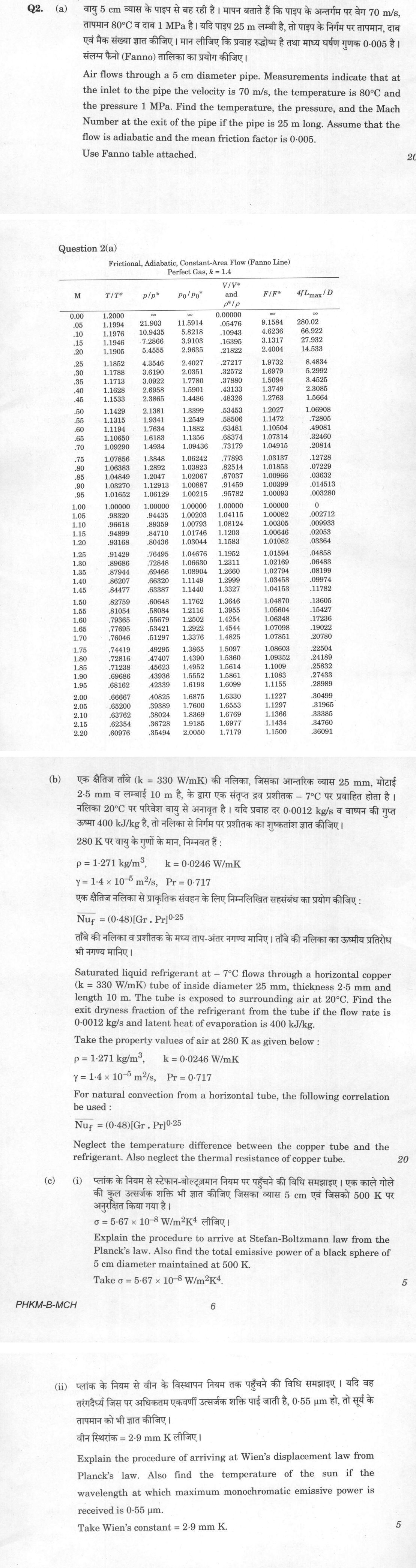
The figure this question refers to, in words
The question paper is a scan and the diagram did not survive as text. This is the figure as read from the original page — every component, value and label — so the question can be worked from the text below.
(a) Table titled 'Frictional, Adiabatic, Constant-Area Flow (Fanno Line)', 'Perfect Gas, k = 1.4'. Columns: M, T/T*, p/p*, p_0/p_0*, V/V* and rho*/rho, F/F*, 4fL_max/D 0.00, 1.2000, infinity, infinity, 0.00000, infinity, infinity .05, 1.1994, 21.903, 11.5914, .05476, 9.1584, 280.02 .10, 1.1976, 10.9435, 5.8218, .10943, 4.6236, 66.922 .15, 1.1946, 7.2866, 3.9103, .16395, 3.1317, 27.932 .20, 1.1905, 5.4555, 2.9635, .21822, 2.4004, 14.533 .25, 1.1852, 4.3546, 2.4027, .27217, 1.9732, 8.4834 .30, 1.1788, 3.6190, 2.0351, .32572, 1.6979, 5.2992 .35, 1.1713, 3.0922, 1.7780, .37880, 1.5094, 3.4525 .40, 1.1628, 2.6958, 1.5901, .43133, 1.3749, 2.3085 .45, 1.1533, 2.3865, 1.4486, .48326, 1.2763, 1.5664 .50, 1.1429, 2.1381, 1.3399, .53453, 1.2027, 1.06908 .55, 1.1315, 1.9341, 1.2549, .58506, 1.1472, .72805 .60, 1.1194, 1.7634, 1.1882, .63481, 1.10504, .49081 .65, 1.10650, 1.6183, 1.1356, .68374, 1.07314, .32460 .70, 1.09290, 1.4934, 1.09436, .73179, 1.04915, .20814 .75, 1.07856, 1.3848, 1.06242, .77893, 1.03137, .12728 .80, 1.06383, 1.2892, 1.03823, .82514, 1.01853, .07229 .85, 1.04849, 1.2047, 1.02067, .87037, 1.00966, .03632 .90, 1.03270, 1.12913, 1.00887, .91459, 1.00399, .014513 .95, 1.01652, 1.06129, 1.00215, .95782, 1.00093, .003280 1.00, 1.00000, 1.00000, 1.00000, 1.00000, 1.00000, 0 1.05, .98320, .94435, 1.00203, 1.04115, 1.00082, .002712 1.10, .96618, .89359, 1.00793, 1.08124, 1.00305, .009933 1.15, .94899, .84710, 1.01746, 1.1203, 1.00646, .02053 1.20, .93168, .80436, 1.03044, 1.1583, 1.01082, .03364 1.25, .91429, .76495, 1.04676, 1.1952, 1.01594, .04858 1.30, .89686, .72848, 1.06630, 1.2311, 1.02169, .06483 1.35, .87944, .69466, 1.08904, 1.2660, 1.02794, .08199 1.40, .86207, .66320, 1.1149, 1.2999, 1.03458, .09974 1.45, .84477, .63387, 1.1440, 1.3327, 1.04153, .11782 1.50, .82759, .60648, 1.1762, 1.3646, 1.04870, .13605 1.55, .81054, .58084, 1.2116, 1.3955, 1.05604, .15427 1.60, .79365, .55679, 1.2502, 1.4254, 1.06348, .17236 1.65, .77695, .53421, 1.2922, 1.4544, 1.07098, .19022 1.70, .76046, .51297, 1.3376, 1.4825, 1.07851, .20780 1.75, .74419, .49295, 1.3865, 1.5097, 1.08603, .22504 1.80, .72816, .47407, 1.4390, 1.5360, 1.09352, .24189 1.85, .71238, .45623, 1.4952, 1.5614, 1.1009, .25832 1.90, .69686, .43936, 1.5552, 1.5861, 1.1083, .27433 1.95, .68162, .42339, 1.6193, 1.6099, 1.1155, .28989 2.00, .66667, .40825, 1.6875, 1.6330, 1.1227, .30499 2.05, .65200, .39389, 1.7600, 1.6553, 1.1297, .31965 2.10, .63762, .38024, 1.8369, 1.6769, 1.1366, .33385 2.15, .62354, .36728, 1.9185, 1.6977, 1.1434, .34760 2.20, .60976, .35494, 2.0050, 1.7179, 1.1500, .36091
Model answer
Written by UPSC Answer Check against this question's marking rubric, to the expected length. UPSC does not publish answers for Mains — this is one way to score well, not an official key.
(a) Take R = 287 J/kg K and γ = 1.4 for air. T₁ = 80 + 273.15 = 353.15 K. a₁ = √(γRT₁) = √(1.4 × 287 × 353.15) = 376.69 m/s. M₁ = V₁/a₁ = 70/376.69 = 0.18583.
Using the attached Fanno table, interpolate between M = 0.15 and M = 0.20. At M = 0.15: 4fL*/D = 27.932, T/T* = 1.1946, p/p* = 7.2866. At M = 0.20: 4fL*/D = 14.533, T/T* = 1.1905, p/p* = 5.4555. Fraction f₁ = (0.18583 − 0.15)/(0.20 − 0.15) = 0.7166. 4fL₁*/D = 27.932 + 0.7166(14.533 − 27.932) = 18.331. T₁/T* = 1.1946 + 0.7166(1.1905 − 1.1946) = 1.19166. p₁/p* = 7.2866 + 0.7166(5.4555 − 7.2866) = 5.9743.
Actual friction length parameter: 4fL/D = 4 × 0.005 × 25/0.05 = 10.000. Therefore 4fL₂*/D = 18.331 − 10.000 = 8.331.
Interpolate M₂ between M = 0.25 and M = 0.30. At M = 0.25: 4fL*/D = 8.4834, T/T* = 1.1852, p/p* = 4.3546. At M = 0.30: 4fL*/D = 5.2992, T/T* = 1.1788, p/p* = 3.6190. f₂ = (8.4834 − 8.331)/(8.4834 − 5.2992) = 0.04786. M₂ = 0.25 + 0.04786 × 0.05 = 0.2524. T₂/T* = 1.1852 + 0.04786(1.1788 − 1.1852) = 1.18489. p₂/p* = 4.3546 + 0.04786(3.6190 − 4.3546) = 4.3194.
Thus, T₂ = 353.15 × (1.18489/1.19166) = 351.14 K = 77.99°C. P₂ = 1.000 × (4.3194/5.9743) = 0.7230 MPa.
Final: M₂ ≈ 0.252, T₂ ≈ 351.1 K = 78.0°C, P₂ ≈ 0.723 MPa.
(b) Outer diameter: D₀ = 25 + 2 × 2.5 = 30 mm = 0.03 m. Film temperature ≈ (20 − 7)/2 + 273 = 279.65 K ≈ 280 K. β = 1/Tf = 1/279.65 = 3.575 × 10⁻³ K⁻¹. ΔT = 20 − (−7) = 27 K. ν = 1.4 × 10⁻⁵ m²/s, Pr = 0.717.
Grashof number: Gr = gβΔT D₀³/ν² = 9.81 × 3.575 × 10⁻³ × 27 × (0.03)³/(1.4 × 10⁻⁵)² = 1.305 × 10⁵.
Gr·Pr = 1.305 × 10⁵ × 0.717 = 9.36 × 10⁴.
Using Nūf = 0.48(Gr·Pr)⁰·²⁵: Nūf = 0.48 × (9.36 × 10⁴)⁰·²⁵ = 8.39.
h = Nūf k/D₀ = 8.39 × 0.0246/0.03 = 6.88 W/m²K.
Outer area: A₀ = πD₀L = π × 0.03 × 10 = 0.9425 m².
Heat absorbed: Q = hA₀ΔT = 6.88 × 0.9425 × 27 = 175.1 W.
If x is exit dryness fraction, Q = ṁ x hfg. x = Q/(ṁhfg) = 175.1/(0.0012 × 400000) = 0.365.
Final: exit dryness fraction x ≈ 0.365. Since x < 1, evaporation is incomplete.
(c)(i) Planck’s spectral emissive power is E_bλ = 2πhc²/[λ⁵(exp(hc/λkT) − 1)].
Total emissive power is E_b = ∫₀^∞ E_bλ dλ. Put x = hc/(λkT). Then the integral reduces to E_b = (2πk⁴T⁴/h³c²) ∫₀^∞ x³/(eˣ − 1) dx. The standard integral ∫₀^∞ x³/(eˣ − 1) dx = π⁴/15. Thus, E_b = (2π⁵k⁴/15h³c²)T⁴ = σT⁴. This is the Stefan-Boltzmann law.
At T = 500 K: E_b = σT⁴ = 5.67 × 10⁻⁸ × 500⁴ = 3543.75 W/m².
For a sphere of diameter 0.05 m: A = πD² = π(0.05)² = 0.007854 m². Total emitted power = E_bA = 3543.75 × 0.007854 = 27.83 W.
Final: emissive flux = 3.54375 kW/m²; total emission from the sphere = 27.83 W.
(c)(ii) From Planck’s law, E_bλ = C₁/[λ⁵(exp(C₂/λT) − 1)]. Put x = C₂/(λT). Differentiating E_bλ with respect to λ and setting dE_bλ/dλ = 0 gives x eˣ = 5(eˣ − 1), equivalently x = 5(1 − e⁻ˣ). The non-zero root is x = 4.965. Therefore, λmaxT = C₂/x = hc/(kx) ≈ 2.9 × 10⁻³ m K = 2.9 mm K. This is Wien’s displacement law.
For λmax = 0.55 μm = 5.5 × 10⁻⁷ m: T = b/λmax = (2.9 × 10⁻³)/(0.55 × 10⁻⁶) = 5273 K.
Final: temperature of the sun ≈ 5.27 × 10³ K.
What "Solve" is asking you to do
Choose the method, then carry it through to a final answer. Identifying what kind of problem this is and why that method applies is the first thing marked; a correct figure arrived at invisibly earns almost nothing.
Structure that answers it
Given data and what is required → method chosen, with the reason it applies → set-up (equation, circuit, free body, trial balance) → working, step by step → answer with units and any condition of validity
Where marks are lost
Doing the middle steps mentally and writing only the result. In mathematics papers, a further loss comes from giving a decimal where the exact value in surds or fractions was wanted, or from skipping the justification a part explicitly asks for.
How this answer will be evaluated
Approach
(a) calculate: given > formula > substitution > result with units > interpretation | (b) calculate: given > formula > substitution > result with units > interpretation | (c(i)) explain: definition/context > points in order > small example > short close | (c(ii)) explain: definition/context > points in order > small example > short close Full marks: Rigorous application of Fanno flow and heat transfer principles with clear derivations and correct calculations.
Key points expected
- Calculate inlet Mach number using speed of sound
- Compute dimensionless pipe length parameter 4fL/D
- Use Fanno table to find exit Mach number
- Calculate exit temperature and pressure from ratios
- Calculate heat transfer rate using natural convection correlation
- Determine mass of refrigerant evaporated
- Calculate exit dryness fraction from mass balance
- Integrate Planck's spectral distribution over all wavelengths
Evaluation rubric
Each sub-part is marked on its own, against the marks and word limit printed on the paper.
- (a) Determine exit temperature, pressure, and Mach number for adiabatic flow in a constant-area pipe. 20 marks
calculate— given → formula → substitution → result with units → interpretation
Must cover
- Calculate inlet Mach number using speed of sound
- Compute dimensionless pipe length parameter 4fL/D
- Use Fanno table to find exit Mach number
- Calculate exit temperature and pressure from ratios
Loses marks
- Using isentropic relations instead of Fanno flow
- Ignoring the friction factor in length calculation
Earns more
- Explicitly state adiabatic and constant area assumptions
- Show unit conversions for temperature and pressure
Extra mark
- Sketch of pipe flow with inlet and exit states marked
- (b) Determine the exit dryness fraction of the refrigerant evaporating in a horizontal tube. 20 marks
calculate— given → formula → substitution → result with units → interpretation
Must cover
- Calculate heat transfer rate using natural convection correlation
- Determine mass of refrigerant evaporated
- Calculate exit dryness fraction from mass balance
Loses marks
- Using forced convection correlations
- Ignoring the latent heat of evaporation
Earns more
- Correct calculation of Grashof number
- Explicit statement of neglecting tube resistance
Extra mark
- Schematic of tube with heat flow direction indicated
- (c(i)) Explain the derivation of Stefan-Boltzmann law from Planck's law and calculate total emissive power. 5 marks
explain— definition/context → points in order → small example → short close
Must cover
- Integrate Planck's spectral distribution over all wavelengths
- Show the resulting T^4 dependence
- Calculate total emissive power for the given sphere
Loses marks
- Stating the law without showing the integration step
- Incorrect calculation of the sphere's surface area
Earns more
- Mentioning the integration limits (0 to infinity)
- Correct use of the Stefan-Boltzmann constant
Extra mark
- Graphical representation of spectral distribution
- (c(ii)) Explain the derivation of Wien's displacement law from Planck's law and find the sun's temperature. 5 marks
explain— definition/context → points in order → small example → short close
Must cover
- Differentiate Planck's law with respect to wavelength
- Set the derivative to zero to find peak wavelength
- Calculate the sun's temperature using Wien's constant
Loses marks
- Confusing Wien's displacement law with Stefan-Boltzmann law
- Incorrect application of the given Wien's constant
Earns more
- Showing the transcendental equation for the peak
- Correct unit conversion for wavelength
Extra mark
- Mentioning the numerical value of the constant
Practice this exact question
Write your answer and it is marked point by point against the model answer above — what you covered, what you missed, what you got wrong.
Evaluate my answer →More from Mechanical Engineering 2024 Paper II
- Q1 (a) A 2 gm quantity of air undergoes the following sequence of quasi-static processes in…
- Q2 (a) Air flows through a 5 cm diameter pipe. Measurements indicate that at the inlet to th…
- Q3 (a) A shell and tube heat exchanger used in a thermal power plant is designed to condense…
- Q4 (a) A convergent-divergent nozzle is designed to expand air from a chamber in which the p…
- Q5 (a) Explain the functions of three types of superheaters used in power boilers. Sketch th…