Paper II — Q3
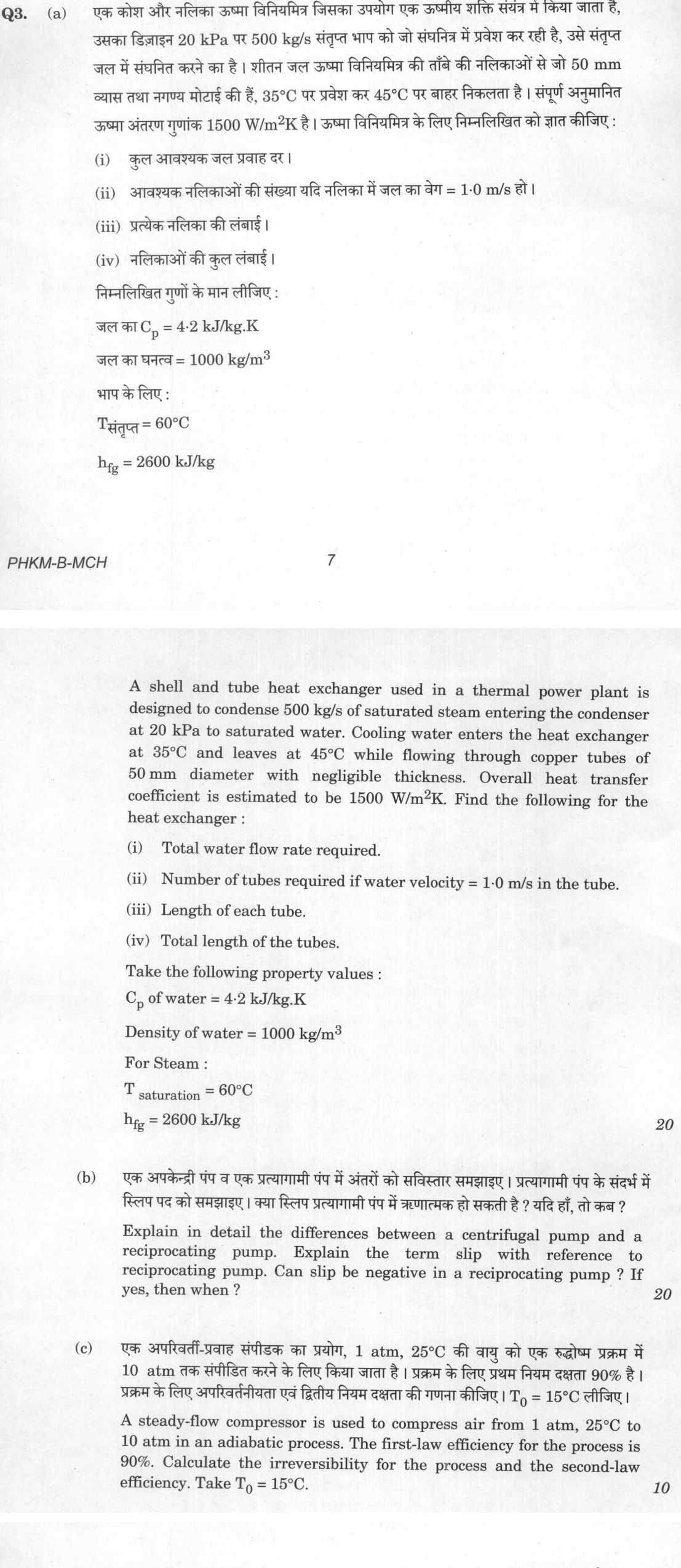
(a) A shell and tube heat exchanger used in a thermal power plant is designed to condense 500 kg/s of saturated steam entering…
A shell and tube heat exchanger used in a thermal power plant is designed to condense 500 kg/s of saturated steam entering the condenser at 20 kPa to saturated water. Cooling water enters the heat exchanger at 35°C and leaves at 45°C while flowing through copper tubes of 50 mm diameter with negligible thickness. Overall heat transfer coefficient is estimated to be 1500 W/m²K. Find the following for the heat exchanger:
Total water flow rate required.
Number of tubes required if water velocity = 1·0 m/s in the tube.
Length of each tube.
Total length of the tubes.
Take the following property values: Cₚ of water = 4·2 kJ/kg.K Density of water = 1000 kg/m³
For Steam: T saturation = 60°C h_fg = 2600 kJ/kg
20 marks
Explain in detail the differences between a centrifugal pump and a reciprocating pump. Explain the term slip with reference to reciprocating pump. Can slip be negative in a reciprocating pump? If yes, then when?
20 marks
A steady-flow compressor is used to compress air from 1 atm, 25°C to 10 atm in an adiabatic process. The first-law efficiency for the process is 90%. Calculate the irreversibility for the process and the second-law efficiency. Take T₀ = 15°C.
10 marks
हिंदी में प्रश्न पढ़ें
एक कोश और नलिका उष्मा विनियामित्र जिसका उपयोग एक ऊष्मीय शक्ति संयंत्र में किया जाता है, उसका डिज़ाइन 20 kPa पर 500 kg/s संतृप्त भाप को जो संयंत्र में प्रवेश कर रही है, उसे संतृप्त जल में संघनित करने का है। शीतल जल उष्मा विनियामित्र की ताँबे की नलिकाओं से जो 50 mm व्यास तथा नगन्य मोटाई की है, 35°C पर प्रवेश कर 45°C पर बाहर निकलता है। संपूर्ण अनुमानित उष्मा अंतरण गुणांक 1500 W/m²K है। उष्मा विनियामित्र के लिए निम्नलिखित को ज्ञात कीजिए:
कुल आवश्यक जल प्रवाह दर।
आवश्यक नलिकाओं की संख्या यदि नलिका में जल का वेग = 1·0 m/s हो।
प्रत्येक नलिका की लंबाई।
नलिकाओं की कुल लंबाई।
निम्नलिखित गुणों के मान लीजिए: जल का Cₚ = 4·2 kJ/kg.K जल का घनत्व = 1000 kg/m³
भाप के लिए: Tसंतृप्त = 60°C h_fg = 2600 kJ/kg
(20 अंक)
एक अपकेन्द्री पंप व एक प्रत्यागामी पंप में अंतरों को सविस्तार समझाइए। प्रत्यागामी पंप के संदर्भ में स्लिप पद को समझाइए। क्या स्लिप प्रत्यागामी पंप में ऋणात्मक हो सकती है? यदि हाँ, तो कब?
(20 अंक)
एक अपरिवर्ती-प्रवाह संपीडक का प्रयोग, 1 atm, 25°C की वायु को एक रुद्धोष्म प्रक्रम में 10 atm तक संपीडित करने के लिए किया जाता है। प्रक्रम के लिए प्रथम नियम दक्षता 90% है। प्रक्रम के लिए अपरिवर्तनीयता एवं द्वितीय नियम दक्षता की गणना कीजिए। T₀ = 15°C लीजिए।
(10 अंक)
Model answer
Written by UPSC Answer Check against this question's marking rubric, to the expected length. UPSC does not publish answers for Mains — this is one way to score well, not an official key.
(a) Heat rejected by condensing steam: Q = m_s h_fg = 500 kg/s × 2600 kJ/kg = 1.3×10⁶ kJ/s = 1.3×10⁹ W.
(i) For cooling water, Q = m_w Cₚ ΔT_w. ΔT_w = 45°C − 35°C = 10 K. m_w = Q/(Cₚ ΔT_w) = 1.3×10⁹/(4200 × 10) = 30,952.38 kg/s. Volume flow rate = m_w/ρ = 30,952.38/1000 = 30.952 m³/s. Final: m_w ≈ 3.095×10⁴ kg/s (30.952 m³/s).
(ii) Tube cross-sectional area: A₁ = πD²/4 = π(0.05 m)²/4 = π/1600 = 1.9635×10⁻³ m². N = Volume flow rate/(A₁ × velocity) = 30.952/(1.9635×10⁻³ × 1.0) = 15,763.9. Use whole tubes, so Final: N = 15,764 tubes.
(iii) For a condenser, steam temperature is constant at 60°C. ΔT₁ = 60 − 35 = 25 K, ΔT₂ = 60 − 45 = 15 K. LMTD = (ΔT₁ − ΔT₂)/ln(ΔT₁/ΔT₂) = 10/ln(25/15) = 10/ln(5/3) = 19.576 K. Heat-transfer area: A = Q/(U × LMTD) = 1.3×10⁹/(1500 × 19.576) = 44,271.55 m². Area per tube = πD L. L = A/(NπD) = 44,271.55/(15,764 × π × 0.05) = 17.879 m. Final: length of each tube ≈ 17.88 m.
(iv) Total tube length = N L = 15,764 × 17.879 = 281,841 m. Alternatively, total length = A/(πD) = 44,271.55/(π × 0.05) = 281,841 m. Final: total tube length ≈ 2.818×10⁵ m.
(b) A centrifugal pump is a rotodynamic pump. It uses centrifugal force produced by a rotating impeller to lift and move liquid. Its flow is continuous and steady, and it has no suction or delivery valves. It is suitable for large discharges at low to medium heads. Its discharge falls as head increases and can be regulated by throttling the delivery valve. It normally requires priming, runs at high speed, is compact, and has low maintenance. It is not suitable for very viscous liquids.
A reciprocating pump is a positive-displacement pump. It uses a piston or plunger moving to and fro inside a cylinder. Liquid is admitted through a suction valve and forced out through a delivery valve. Its flow is pulsating, so an air vessel is often used to make delivery smoother. It is suitable for low to medium discharges at very high heads. Its discharge is almost independent of head, except for slip. It is self-priming in many designs, runs at low speed, is bulky, has more wearing parts and valves, and needs higher maintenance. It can handle viscous liquids and must be started with the delivery valve open. Flow is regulated by speed or bypass, not by throttling.
Slip in a reciprocating pump: Theoretical discharge for single acting pump is Q_th = A L N/60, where A is piston area, L stroke, N rpm. Actual discharge Q_act is less than Q_th due to leakage past piston and valves, air ingress, valve lag, incomplete filling, and compressibility. Slip = Q_th − Q_act. Percentage slip = [(Q_th − Q_act)/Q_th] × 100. Normally slip is positive because Q_act < Q_th.
Yes, slip can be negative. It occurs when Q_act > Q_th. This can happen when the suction pipe is long and the pump runs at high speed. The inertia of water in the long suction pipe keeps the suction valve open even after the suction stroke ends, so extra water enters during the beginning of the delivery stroke and is discharged. Thus actual discharge becomes greater than theoretical swept-volume discharge, giving negative slip.
(c) For air, take γ = 1.4, Cₚ = 1.005 kJ/kg·K, R = 0.287 kJ/kg·K. T₁ = 25 + 273.15 = 298.15 K, T₀ = 15 + 273.15 = 288.15 K.
Isentropic compression: T₂ₛ = T₁(P₂/P₁)^((γ−1)/γ) = 298.15(10)^(0.4/1.4) = 298.15(10)^(2/7) = 575.64 K.
First-law efficiency: η_I = (T₂ₛ − T₁)/(T₂ − T₁) = 0.90. T₂ = T₁ + (T₂ₛ − T₁)/0.90 = 298.15 + (575.64 − 298.15)/0.90 = 606.47 K.
Actual work per kg: w = Cₚ(T₂ − T₁) = 1.005(606.47 − 298.15) = 309.86 kJ/kg.
For adiabatic steady flow, entropy generation per kg: s_gen = s₂ − s₁ = Cₚ ln(T₂/T₁) − R ln(P₂/P₁) = 1.005 ln(606.47/298.15) − 0.287 ln 10 = 1.005(0.71006) − 0.66084 = 0.05277 kJ/kg·K.
Irreversibility per kg: i = T₀ s_gen = 288.15 × 0.05277 = 15.20 kJ/kg.
Second-law efficiency: η_II = (w − i)/w = (309.86 − 15.20)/309.86 = 0.9509 = 95.1%.
Final: irreversibility = 15.20 kJ/kg; second-law efficiency = 95.1%.
What "Solve" is asking you to do
Choose the method, then carry it through to a final answer. Identifying what kind of problem this is and why that method applies is the first thing marked; a correct figure arrived at invisibly earns almost nothing.
Structure that answers it
Given data and what is required → method chosen, with the reason it applies → set-up (equation, circuit, free body, trial balance) → working, step by step → answer with units and any condition of validity
Where marks are lost
Doing the middle steps mentally and writing only the result. In mathematics papers, a further loss comes from giving a decimal where the exact value in surds or fractions was wanted, or from skipping the justification a part explicitly asks for.
How this answer will be evaluated
Approach
Framework: ME Paper 2: Given > Assumptions > Governing Equation > Solve. (a) calculate: given > formula > substitution > result with units > interpretation | (b) explain: definition/context > points in order > small example > short close | (c) calculate: given > formula > substitution > result with units > interpretation Full marks: Rigorous application of LMTD and entropy balance with clear assumptions.
Key points expected
- Energy balance: m_steam*h_fg = m_water*Cp*ΔT
- Continuity equation for tube count: m_dot = N*A*v*ρ
- Heat transfer rate: Q = U*A_total*ΔT_lm
- LMTD calculation for condensing steam
- Comparison of centrifugal vs reciprocating (head/flow/efficiency)
- Definition of slip: (Theoretical - Actual) / Theoretical
- Explanation of negative slip (actual > theoretical)
- Conditions for negative slip (high speed/leakage)
Evaluation rubric
Each sub-part is marked on its own, against the marks and word limit printed on the paper.
- (a) Determine water flow rate, tube count, and length for the condenser. 20 marks
calculate— given → formula → substitution → result with units → interpretation
Must cover
- Energy balance: m_steam*h_fg = m_water*Cp*ΔT
- Continuity equation for tube count: m_dot = N*A*v*ρ
- Heat transfer rate: Q = U*A_total*ΔT_lm
- LMTD calculation for condensing steam
Loses marks
- Using arithmetic mean temp instead of LMTD
- Missing units in intermediate steps
Earns more
- Correct LMTD value (approx 20.5 K)
- Consistent units (kW vs W)
- Schematic of shell-and-tube flow
Extra mark
- Explicit statement of assumptions (negligible KE/PE)
- (b) Compare pump types and define slip with negative slip conditions. 20 marks
explain— definition/context → points in order → small example → short close
Must cover
- Comparison of centrifugal vs reciprocating (head/flow/efficiency)
- Definition of slip: (Theoretical - Actual) / Theoretical
- Explanation of negative slip (actual > theoretical)
- Conditions for negative slip (high speed/leakage)
Loses marks
- Confusing slip with volumetric efficiency
- Failing to explain the 'when' for negative slip
Earns more
- Mention of self-priming capability
- Reference to indicator diagrams
- Distinction between positive and negative slip
Extra mark
- Sketch of pump characteristics (H-Q curve)
- (c) Compute irreversibility and second-law efficiency for the compressor. 10 marks
calculate— given → formula → substitution → result with units → interpretation
Must cover
- Isentropic work calculation (W_s)
- Actual work from efficiency (W_a = W_s / η)
- Irreversibility: I = T0*S_gen
- Second-law efficiency: η_II = W_s / W_a
Loses marks
- Using Celsius for T0 in entropy terms
- Confusing first-law and second-law efficiency
Earns more
- Correct entropy generation calculation
- Use of absolute temperature (Kelvin) for T0
Extra mark
- T-s diagram showing the process path
Practice this exact question
Write your answer and it is marked point by point against the model answer above — what you covered, what you missed, what you got wrong.
Evaluate my answer →More from Mechanical Engineering 2024 Paper II
- Q1 (a) A 2 gm quantity of air undergoes the following sequence of quasi-static processes in…
- Q2 (a) Air flows through a 5 cm diameter pipe. Measurements indicate that at the inlet to th…
- Q3 (a) A shell and tube heat exchanger used in a thermal power plant is designed to condense…
- Q4 (a) A convergent-divergent nozzle is designed to expand air from a chamber in which the p…
- Q5 (a) Explain the functions of three types of superheaters used in power boilers. Sketch th…
- Q6 (a) A four-cylinder gasoline engine has a bore of 75 mm and a stroke length of 100 mm. It…