Paper II — Q6
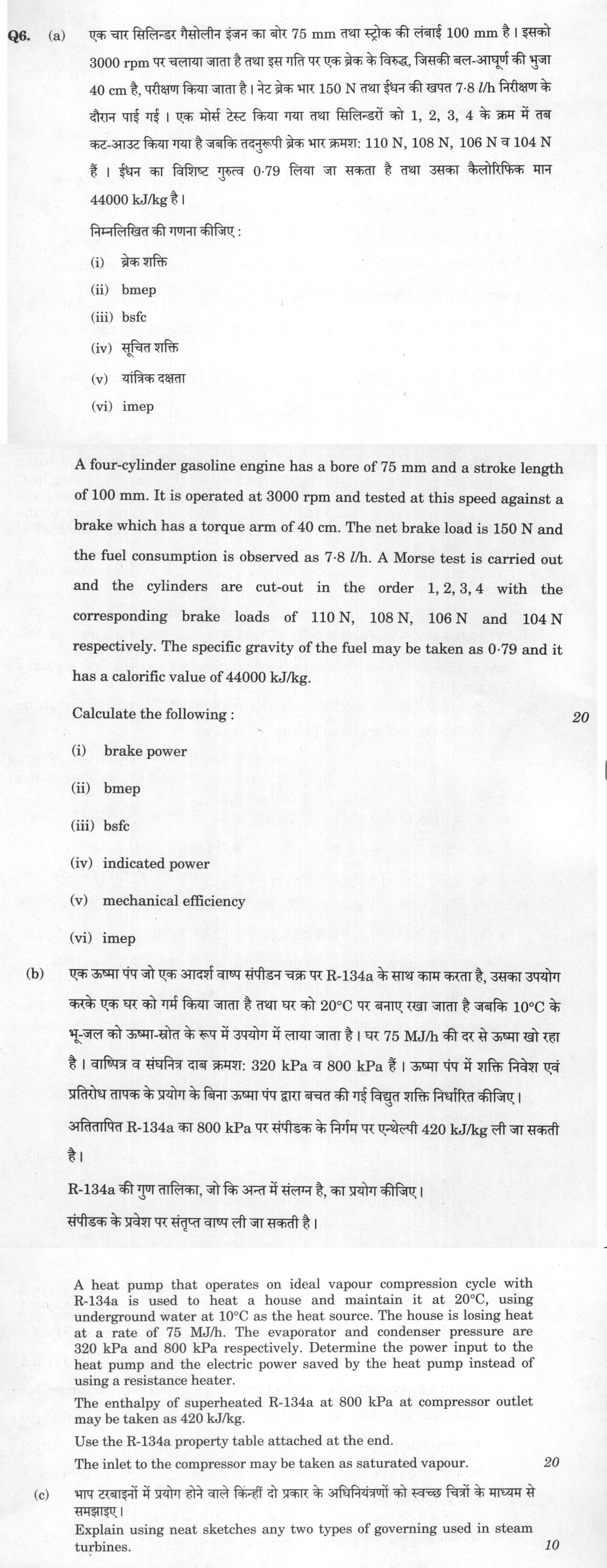
(a) A four-cylinder gasoline engine has a bore of 75 mm and a stroke length of 100 mm. It is operated at 3000 rpm and tested at…
A four-cylinder gasoline engine has a bore of 75 mm and a stroke length of 100 mm. It is operated at 3000 rpm and tested at this speed against a brake which has a torque arm of 40 cm. The net brake load is 150 N and the fuel consumption is observed as 7·8 l/h. A Morse test is carried out and the cylinders are cut-out in the order 1, 2, 3, 4 with the corresponding brake loads of 110 N, 108 N, 106 N and 104 N respectively. The specific gravity of the fuel may be taken as 0·79 and it has a calorific value of 44000 kJ/kg. Calculate the following: (i) brake power (ii) bmep (iii) bsfc (iv) indicated power (v) mechanical efficiency (vi) imep
A heat pump that operates on ideal vapour compression cycle with R-134a is used to heat a house and maintain it at 20°C, using underground water at 10°C as the heat source. The house is losing heat at a rate of 75 MJ/h. The evaporator and condenser pressure are 320 kPa and 800 kPa respectively. Determine the power input to the heat pump and the electric power saved by the heat pump instead of using a resistance heater. The enthalpy of superheated R-134a at 800 kPa at compressor outlet may be taken as 420 kJ/kg. Use the R-134a property table attached at the end. The inlet to the compressor may be taken as saturated vapour. 20 marks
Explain using neat sketches any two types of governing used in steam turbines. 10 marks
हिंदी में प्रश्न पढ़ें
एक चार सिलिंडर गैसोलीन इंजन का बोर 75 mm तथा स्ट्रोक की लंबाई 100 mm है। इसको 3000 rpm पर चलाया जाता है तथा इस गति पर एक ब्रेक के विरुद्ध, जिसकी बल-आघूर्ण की भुजा 40 cm है, परीक्षण किया जाता है। नेट ब्रेक भार 150 N तथा ईंधन की खपत 7·8 l/h निरीक्षण के दौरान पाई गई। एक मोर्स टेस्ट किया गया तथा सिलिंडरों को 1, 2, 3, 4 के क्रम में तब कट-आउट किया गया है जबकि तदनुकूली ब्रेक भार क्रमशः: 110 N, 108 N, 106 N व 104 N है। ईंधन का विशिष्ट गुरुत्व 0·79 लिया जा सकता है तथा उसका कैलोरिफिक मान 44000 kJ/kg है। निम्नलिखित की गणना कीजिए: (i) ब्रेक शक्ति (ii) bmep (iii) bsfc (iv) सूचित शक्ति (v) यांत्रिक दक्षता (vi) imep
एक उष्मा पंप जो एक आदर्श वाष्प संपीडन चक्र पर R-134a के साथ काम करता है, उसका उपयोग करके एक घर को गर्म किया जाता है तथा घर को 20°C पर बनाए रखा जाता है जबकि 10°C के भू-जल को उष्मा-स्रोत के रूप में उपयोग में लाया जाता है। घर 75 MJ/h की दर से उष्मा खो रहा है। वाष्पित्र व संघनित्र दाब क्रमशः: 320 kPa व 800 kPa हैं। उष्मा पंप में शक्ति निवेश एवं प्रतिरोध तापक के प्रयोग के बिना उष्मा पंप द्वारा बचत की गई विद्युत शक्ति निर्धारित कीजिए। अतिरिक्त R-134a का 800 kPa पर संपीडक के निर्गम पर एन्थैल्पी 420 kJ/kg ली जा सकती है। R-134a की गुण तालिका, जो कि अंत में संलग्न है, का प्रयोग कीजिए। संपीडक के प्रवेश पर संतृप्त वाष्प ली जा सकती है। 20 अंक
भाप तरबाइनों में प्रयोग होने वाले किन्हीं दो प्रकार के अधिनियंत्रणों को स्वच्छ चित्रों के माध्यम से समझाइए। 10 अंक
The figure this question refers to, in words
The question paper is a scan and the diagram did not survive as text. This is the figure as read from the original page — every component, value and label — so the question can be worked from the text below.
(b) Table: Steam Tables (Temperature) (Continued) - Saturated Water. Columns: Temp. (°C), Press. (kPa), Sat. Liquid hf (kJ/kg), Evap. hfg (kJ/kg), Sat. Vapor hg (kJ/kg), Sat. Liquid sf (kJ/kg-K), Evap. sfg (kJ/kg-K), Sat. Vapor sg (kJ/kg-K). Rows: 0.01, 0.6113, 0.00, 2501.35, 2501.35, 0, 9.1562, 9.1562; 5, 0.8721, 20.98, 2489.57, 2510.54, 0.0761, 8.9496, 9.0257; 10, 1.2276, 41.99, 2477.75, 2519.74, 0.1510, 8.7498, 8.9007; 15, 1.705, 62.98, 2465.93, 2528.91, 0.2245, 8.5569, 8.7813; 20, 2.339, 83.94, 2454.12, 2538.06, 0.2966, 8.3706, 8.6671; 25, 3.169, 104.87, 2442.30, 2547.17, 0.3673, 8.1905, 8.5579; 30, 4.246, 125.77, 2430.48, 2556.25, 0.4369, 8.0164, 8.4533; 35, 5.628, 146.66, 2418.62, 2565.28, 0.5052, 7.8478, 8.3530; 40, 7.384, 167.54, 2406.72, 2574.26, 0.5724, 7.6845, 8.2569; 45, 9.593, 188.42, 2394.77, 2583.19, 0.6386, 7.5261, 8.1647; 50, 12.350, 209.31, 2382.75, 2592.06, 0.7037, 7.3725, 8.0762; 55, 15.758, 230.20, 2370.66, 2600.86, 0.7679, 7.2234, 7.9912; 60, 19.941, 251.11, 2358.48, 2609.59, 0.8311, 7.0784, 7.9095; 65, 25.03, 272.03, 2346.21, 2618.24, 0.8934, 6.9375, 7.8309; 70, 31.19, 292.96, 2333.85, 2626.80, 0.9548, 6.8004, 7.7552; 75, 38.58, 313.91, 2321.37, 2635.28, 1.0154, 6.6670, 7.6824; 80, 47.39, 334.88, 2308.77, 2643.66, 1.0752, 6.5369, 7.6121; 85, 57.83, 355.88, 2296.05, 2651.93, 1.1342, 6.4102, 7.5444; 90, 70.14, 376.90, 2283.19, 2660.09, 1.1924, 6.2866, 7.4790; 95, 84.55, 397.94, 2270.19, 2668.13, 1.2500, 6.1659, 7.4158; 100, 101.3, 419.02, 2257.03, 2676.05, 1.3068, 6.0480, 7.3548; 105, 120.8, 440.13, 2243.70, 2683.83, 1.3629, 5.9328, 7.2958; 110, 143.3, 461.27, 2230.20, 2691.47, 1.4184, 5.8202, 7.2386; 115, 169.1, 482.46, 2216.50, 2698.96, 1.4733, 5.7100, 7.1832; 120, 198.5, 503.69, 2202.61, 2706.30, 1.5275, 5.6020, 7.1295; 125, 232.1, 524.96, 2188.50, 2713.46, 1.5812, 5.4962, 7.0774; 130, 270.1, 546.29, 2174.16, 2720.46, 1.6343, 5.3925, 7.0269; 135, 313.0, 567.67, 2159.59, 2727.26, 1.6869, 5.2907, 6.9777; 140, 361.3, 589.11, 2144.75, 2733.87, 1.7390, 5.1908, 6.9298; 145, 415.4, 610.61, 2129.65, 2740.26, 1.7906, 5.0926, 6.8832; 150, 475.9, 632.18, 2114.26, 2746.44, 1.8417, 4.9960, 6.8378; 155, 543.1, 653.82, 2098.56, 2752.39, 1.8924, 4.9010, 6.7934; 160, 617.8, 675.53, 2082.55, 2758.09, 1.9426, 4.8075, 6.7501; 165, 700.5, 697.32, 2066.20, 2763.53, 1.9924, 4.7153, 6.7078; 170, 791.7, 719.20, 2049.50, 2768.70, 2.0418, 4.6244, 6.6663; 175, 892.0, 741.16, 2032.42, 2773.58, 2.0909, 4.5347, 6.6256; 180, 1002.2, 763.21, 2014.96, 2778.16, 2.1395, 4.4461, 6.5857; 185, 1122.7, 785.36, 1997.07, 2782.43, 2.1878, 4.3586, 6.5464; 190, 1254.4, 807.61, 1978.76, 2786.37, 2.2358, 4.2720, 6.5078
Model answer
Written by UPSC Answer Check against this question's marking rubric, to the expected length. UPSC does not publish answers for Mains — this is one way to score well, not an official key.
(a) The engine is treated as a four-stroke spark-ignition engine; the four-stroke cycle relation is used for mean effective pressures. Given D=75 mm=0.075 m, L=100 mm=0.100 m, n=4, N=3000 rpm, brake arm R=40 cm=0.40 m, and net brake load W=150 N. The net brake load is already corrected for tare, so it gives the net torque. The brake arm is the perpendicular distance from the shaft axis to the line of action of the net load. The brake torque is T=WR=150 N×0.40 m=60 N m. The angular speed is ω=2πN/60=2π×3000/60=100π rad/s. (i) Brake power By the rotational power theorem, BP=Tω. Hence BP=60 N m×100π rad/s=6000π W. In kilowatts, BP=6000π/1000=6π kW=18.85 kW. The result is exact while π is retained. BP=6000π W=18.85 kW.
(ii) bmep Mean effective pressure is the constant pressure that would produce the same work per cycle as the actual pressure-volume work. Swept volume of one cylinder is Vs=πD²L/4=π×(0.075 m)²×0.100 m/4=0.000441786 m³. Total swept volume is Vd=nVs=4×0.000441786 m³=0.001767146 m³=0.0005625π m³. The total displacement is also πD²L because the four cylinders cancel the factor 4. For a four-stroke engine, power strokes occur at N/120 per second; the factor 120 comes from 60 s/min divided by 2 revolutions per cycle. Hence BP=bmep×Vd×N/120. Therefore bmep=120BP/(VdN)=120×6000π W/(0.0005625π m³×3000)=426666.7 Pa. The pressure is a mean pressure difference, not an absolute gas pressure. bmep=1280/3 kPa=426.7 kPa=4.27 bar.
(iii) bsfc Brake specific fuel consumption is fuel mass flow divided by brake power. The unit kg/kWh is mass of fuel per unit brake energy output. Specific gravity 0.79 is relative to water, taken as 1000 kg/m³, so fuel density ρf=0.79×1000 kg/m³=790 kg/m³. Volume flow is 7.8 l/h=7.8×10⁻³ m³/h. Mass flow mf=7.8×10⁻³ m³/h×790 kg/m³=6.162 kg/h. Since BP=6π kW, bsfc=mf/BP=6.162/(6π)=1027/(1000π)=0.3269 kg/kWh. The calorific value 44000 kJ/kg is not needed for the requested quantities; it would be used for indicated thermal efficiency. bsfc=1027/(1000π) kg/kWh=0.327 kg/kWh.
(iv) Indicated power Morse test theorem: at the same speed and with friction unchanged, the fall in brake power when one cylinder is cut out equals the indicated power of that cylinder. Morse test assumes that cutting out one cylinder does not materially change the friction of the remaining engine. Since speed and brake arm are unchanged, brake power is proportional to brake load. Power per newton of brake load is 2πNR/60=2π×3000×0.40/60=40π W/N. The equivalent load losses are 40, 42, 44 and 46 N. Thus IP1=(150−110)×40π=1600π W, IP2=(150−108)×40π=1680π W, IP3=(150−106)×40π=1760π W, IP4=(150−104)×40π=1840π W. Total IP=1600π+1680π+1760π+1840π=6880π W=21.61 kW. The corresponding friction power is IP−BP=880π W=2.76 kW, but it is not separately asked. IP=6880π W=21.61 kW.
(v) Mechanical efficiency Mechanical efficiency is brake power divided by indicated power. ηm=BP/IP=6000π/6880π=6000/6880=75/86=0.87209. This value is below 100%, as required for a real engine. ηm=75/86=87.2%.
(vi) imep Indicated mean effective pressure is defined in the same way as bmep, but using indicated power. Hence IP=imep×Vd×N/120, so imep=120IP/(VdN)=120×6880π W/(0.0005625π m³×3000)=489244.4 Pa. The ratio imep/bmep equals IP/BP, giving the same check: 426.667×6880/6000=489.244 kPa. The imep is larger than bmep because it includes the work lost in friction. imep=22016/45 kPa=489.2 kPa=4.89 bar.
[(b)] The figure printed on the original question paper for this part could not be recovered from the scan, so this part is not answered here.
(c) A steam turbine governor compares actual speed with desired speed and changes steam admission to hold speed nearly constant. The governor must be self-acting: a speed increase closes steam admission, and a speed decrease opens it. Two common types are:
- Throttle governing: In the sketch, draw a horizontal turbine casing. At the left, show a steam pipe from the stop valve to a throttle valve, then to a nozzle block. The nozzle block contains all nozzles of the first stage and feeds the rotor; show the following stages to the right. Label the throttle valve, nozzle block, rotor, and governor link. Connect the turbine shaft to a flyball or hydraulic governor by a spindle, and draw a link from the governor to the throttle valve stem. The throttle valve is usually a butterfly or globe valve in the steam line. When load falls, speed rises, and the governor moves the throttle valve partly closed. The pressure and density of steam in the nozzle block fall, so the mass flow through the unchanged nozzle area falls and power is reduced. When load rises, the valve opens. All nozzles remain open; regulation is by inlet pressure. Because the nozzle pressure falls, the nozzle exit velocity may fall slightly; the method is simple but less efficient at part load. It is used in impulse turbines, especially small or single-stage machines.
- Nozzle governing: In the sketch, draw the first-stage nozzle block divided into several nozzle groups, for example four groups, each with its own nozzle valve on top. Label each nozzle group and its valve. Draw the turbine shaft connected to a governor, and draw separate governor links to each nozzle valve. At full load all nozzle groups are open. When load falls, the governor closes one or more groups in a predetermined sequence, reducing the effective nozzle area while the pressure in the open groups remains nearly constant. The closed groups are isolated by the nozzle valves, so the open groups operate at nearly full boiler pressure. When load rises, groups are opened in reverse sequence. This method avoids a large throttling pressure drop and gives better part-load efficiency because the pressure drop across the open nozzles remains large. It is used in reaction turbines and in large impulse turbines where nozzle groups can be controlled.
What "Calculate" is asking you to do
Apply the standard formula or schedule to data the question has already supplied — a table of readings, cost records, a balance sheet — and produce the number. The method is rarely in doubt; the marks sit in the named intermediate quantities, each of which has to appear as a labelled line.
Structure that answers it
Data as given → formula or standard treatment, named → substitution → each intermediate, labelled → result with units
Where marks are lost
Omitting an intermediate the marking scheme pays for separately, or rounding at an intermediate line so the final figure drifts. In commerce and accountancy, any figure in a statement that no numbered working note supports is treated as unearned.
How this answer will be evaluated
Approach
Framework: Mechanical Engineering, Paper 2. (a) calculate: given > formula > substitution > result with units > interpretation | (b) calculate: given > formula > substitution > result with units > interpretation | (c) explain: definition/context > points in order > small example > short close Full marks: All calculations correct with clear steps; diagrams labelled; sketches neat and accurate.
Key points expected
- Calculate Brake Power using torque and speed
- Determine Indicated Power via Morse test summation
- Compute bsfc using fuel consumption and BP
- Calculate bmep and imep using swept volume
- Identify state properties from R-134a tables
- Calculate mass flow rate from heat load
- Compute compressor work input (power)
- Calculate power saved vs resistance heater
Evaluation rubric
Each sub-part is marked on its own, against the marks and word limit printed on the paper.
- (a) Compute engine performance parameters (BP, bmep, bsfc, IP, mech eff, imep) from test data. 20 marks
calculate— given → formula → substitution → result with units → interpretation
Must cover
- Calculate Brake Power using torque and speed
- Determine Indicated Power via Morse test summation
- Compute bsfc using fuel consumption and BP
- Calculate bmep and imep using swept volume
Loses marks
- Omitting the Morse test summation for IP
- Incorrect unit conversion for fuel consumption
- Missing units on final answers
Earns more
- Correct unit conversions (mm to m, l/h to kg/s)
- Explicit calculation of mechanical efficiency
- Consistent use of 4-stroke cycle factor (N/2)
Extra mark
- Tabulated summary of all six results
- (b) Determine heat pump power input and electric power saved using R-134a cycle. 20 marks
calculate— given → formula → substitution → result with units → interpretation
Must cover
- Identify state properties from R-134a tables
- Calculate mass flow rate from heat load
- Compute compressor work input (power)
- Calculate power saved vs resistance heater
Loses marks
- Using wrong state points from property tables
- Confusing heat rejected with heat absorbed
- Failing to convert MJ/h to kW
Earns more
- Labelled T-s or p-h diagram of the cycle
- Explicit statement of COP (Coefficient of Performance)
- Correct identification of saturated vapor at compressor inlet
Extra mark
- Comparison of COP with Carnot COP
- (c) Explain two types of governing used in steam turbines with sketches. 10 marks
explain— definition/context → points in order → small example → short close
Must cover
- Identify two distinct governing types (e.g., throttle, nozzle)
- Provide neat sketches for each type
- Describe the operating principle of each
- Explain how speed is controlled in each
Loses marks
- Missing or unlabelled sketches
- Confusing governing with condenser control
- Vague description without specific mechanism
Earns more
- Comparison of efficiency between the two types
- Mention of specific applications (e.g., small vs large turbines)
Extra mark
- Sketch of the governor mechanism itself
Practice this exact question
Write your answer and it is marked point by point against the model answer above — what you covered, what you missed, what you got wrong.
Evaluate my answer →More from Mechanical Engineering 2024 Paper II
- Q3 (a) A shell and tube heat exchanger used in a thermal power plant is designed to condense…
- Q4 (a) A convergent-divergent nozzle is designed to expand air from a chamber in which the p…
- Q5 (a) Explain the functions of three types of superheaters used in power boilers. Sketch th…
- Q6 (a) A four-cylinder gasoline engine has a bore of 75 mm and a stroke length of 100 mm. It…
- Q7 (a) In a cooling tower used in a thermal power plant, 26,000 kg/s of air enters at DBT =…
- Q8 (a) A cogenerating steam power plant operates with a boiler output of 25 kg/s steam at 7…