Paper II — Q5
(a) Explain the functions of three types of superheaters used in power boilers. Sketch the heat addition process in them on a T-s…
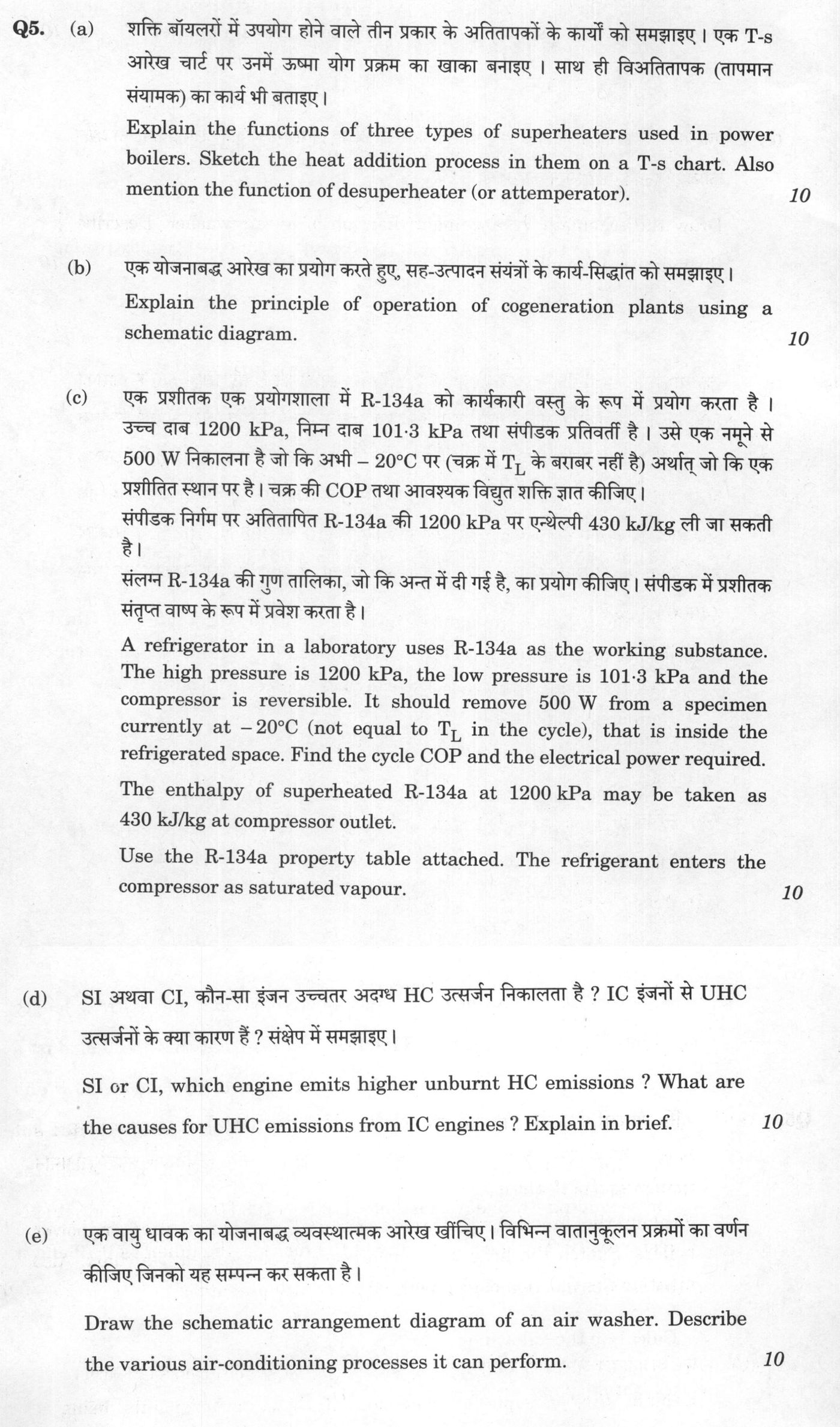
Explain the functions of three types of superheaters used in power boilers. Sketch the heat addition process in them on a T-s chart. Also mention the function of desuperheater (or attemperator). 10 marks
Explain the principle of operation of cogeneration plants using a schematic diagram. 10 marks
A refrigerator in a laboratory uses R-134a as the working substance. The high pressure is 1200 kPa, the low pressure is 101·3 kPa and the compressor is reversible. It should remove 500 W from a specimen currently at – 20°C (not equal to T_L in the cycle), that is inside the refrigerated space. Find the cycle COP and the electrical power required. The enthalpy of superheated R-134a at 1200 kPa may be taken as 430 kJ/kg at compressor outlet. Use the R-134a property table attached. The refrigerant enters the compressor as saturated vapour. 10 marks
SI or CI, which engine emits higher unburnt HC emissions? What are the causes for UHC emissions from IC engines? Explain in brief. 10 marks
Draw the schematic arrangement diagram of an air washer. Describe the various air-conditioning processes it can perform. 10 marks
हिंदी में प्रश्न पढ़ें
शक्ति बॉयलरों में उपयोग होने वाले तीन प्रकार के अतितापकों के कार्यों को समझाइए। एक T-s आरेख चार्ट पर उनमें ऊष्मा योग प्रक्रम का खाका बनाइए। साथ ही विअतितापक (तापमान संयामक) का कार्य भी बताइए। 10 अंक
एक योजनाबद्ध आरेख का प्रयोग करते हुए, सह-उत्पादन संयंत्रों के कार्य-सिद्धांत को समझाइए। 10 अंक
एक प्रशीतक एक प्रयोगशाला में R-134a को कार्यकारी वस्तु के रूप में प्रयोग करता है। उच्च दाब 1200 kPa, निम्न दाब 101·3 kPa तथा संपीडक प्रतिवर्ती है। उसे एक नमूने से 500 W निकालना है जो कि अभी – 20°C पर (चक्र में T_L के बराबर नहीं है) अर्थात् जो कि एक प्रशीतित स्थान पर है। चक्र की COP तथा आवश्यक विद्युत शक्ति ज्ञात कीजिए। संपीडक निर्गम पर अतितापित R-134a की 1200 kPa पर एन्थैल्पी 430 kJ/kg ली जा सकती है। संलग्न R-134a की गुण तालिका, जो कि अंत में दी गई है, का प्रयोग कीजिए। संपीडक में प्रशीतक संतृप्त वाष्प के रूप में प्रवेश करता है। 10 अंक
SI अथवा CI, कौन-सा इंजन उच्चतर अदग्ध HC उत्सर्जन निकालता है? IC इंजनों से UHC उत्सर्जनों के क्या कारण हैं? संक्षेप में समझाइए। 10 अंक
एक वायु धावक का योजनाबद्ध व्यवस्थात्मक आरेख खींचिए। विभिन्न वातानुकूलन प्रक्रमों का वर्णन कीजिए जिनको यह सम्पन्न कर सकता है। 10 अंक
The figure this question refers to, in words
The question paper is a scan and the diagram did not survive as text. This is the figure as read from the original page — every component, value and label — so the question can be worked from the text below.
(c) Table: Saturated R-134a (Continued)
Columns: Temp. (°C), Press. (kPa), Enthalpy kJ/kg (Sat. Liquid hf, Evap. hfg, Sat. Vapor hg), Entropy kJ/k-K (Sat. Liquid sf, Evap. sfg, Sat. Vapor sg)
Rows: -70, 8.3, 119.47, 235.15, 354.62, 0.6645, 1.1575, 1.8220 -65, 11.7, 123.18, 234.55, 357.73, 0.6825, 1.1268, 1.8094 -60, 16.3, 127.53, 233.33, 360.86, 0.7031, 1.0947, 1.7978 -55, 22.2, 132.37, 231.63, 364.00, 0.7256, 1.0618, 1.7874 -50, 29.9, 137.62, 229.54, 367.16, 0.7493, 1.0286, 1.7780 -45, 39.6, 143.18, 227.14, 370.32, 0.7740, 0.9956, 1.7695 -40, 51.8, 148.98, 224.50, 373.48, 0.7991, 0.9629, 1.7620 -35, 66.8, 154.98, 221.67, 376.64, 0.8245, 0.9308, 1.7553 -30, 85.1, 161.12, 218.68, 379.80, 0.8499, 0.8994, 1.7493 -26.3, 101.3, 165.80, 216.36, 382.16, 0.8690, 0.8763, 1.7453 -25, 107.2, 167.38, 215.57, 382.95, 0.8754, 0.8687, 1.7441 -20, 133.7, 173.74, 212.34, 386.08, 0.9007, 0.8388, 1.7395 -15, 165.0, 180.19, 209.00, 389.20, 0.9258, 0.8096, 1.7354 -10, 201.7, 186.72, 205.56, 392.28, 0.9507, 0.7812, 1.7319 -5, 244.5, 193.32, 202.02, 395.34, 0.9755, 0.7534, 1.7288 0, 294.0, 200.00, 198.36, 398.36, 1.0000, 0.7262, 1.7262 5, 350.9, 206.75, 194.57, 401.32, 1.0243, 0.6995, 1.7239 10, 415.8, 213.58, 190.65, 404.23, 1.0485, 0.6733, 1.7218 15, 489.5, 220.49, 186.58, 407.07, 1.0725, 0.6475, 1.7200 20, 572.8, 227.49, 182.35, 409.84, 1.0963, 0.6220, 1.7183 25, 666.3, 234.59, 177.92, 412.51, 1.1201, 0.5967, 1.7168 30, 771.0, 241.79, 173.29, 415.08, 1.1437, 0.5716, 1.7153 35, 887.6, 249.10, 168.42, 417.52, 1.1673, 0.5465, 1.7139 40, 1017.0, 256.54, 163.28, 419.82, 1.1909, 0.5214, 1.7123 45, 1160.2, 264.11, 157.85, 421.96, 1.2145, 0.4962, 1.7106 50, 1318.1, 271.83, 152.08, 423.91, 1.2381, 0.4706, 1.7088 55, 1491.6, 279.72, 145.93, 425.65, 1.2619, 0.4447, 1.7066 60, 1681.8, 287.79, 139.33, 427.13, 1.2857, 0.4182, 1.7040 65, 1889.9, 296.00, 132.21, 428.30, 1.3099, 0.3910, 1.7008 70, 2117.0, 304.64, 124.47, 429.11, 1.3343, 0.3627, 1.6970 75, 2364.4, 313.51, 115.94, 429.45, 1.3592, 0.3330, 1.6923 80, 2633.6, 322.79, 106.40, 429.19, 1.3849, 0.3013, 1.6862 85, 2926.2, 332.65, 95.45, 428.10, 1.4117, 0.2665, 1.6782 90, 3244.5, 343.38, 82.31, 425.70, 1.4404, 0.2267, 1.6671 95, 3591.5, 355.83, 64.98, 420.81, 1.4733, 0.1765, 1.6498 100, 3973.2, 374.74, 32.47, 407.21, 1.5228, 0.0870, 1.6098 101.2, 4064.0, 390.98, 0, 390.98, 1.5658, 0, 1.5658
Model answer
Written by UPSC Answer Check against this question's marking rubric, to the expected length. UPSC does not publish answers for Mains — this is one way to score well, not an official key.
(a) Superheaters and desuperheater. In a power boiler the superheater raises saturated steam to a higher temperature at essentially constant pressure, increasing cycle efficiency, reducing moisture at turbine inlet and increasing the available enthalpy drop. A radiant superheater is mounted in the furnace or near the flame; it receives mainly radiant heat, gives high initial superheat and tends to give higher outlet temperature at low load, so it is often used for the first stage of superheating. A convective superheater is placed in the flue-gas pass; its heat transfer rises with gas velocity and load, so outlet temperature increases with load and it is useful for final superheat and load following. A combined radiant-convective superheater uses both heat-transfer modes to obtain a stable outlet temperature over the load range. On a T-s chart the boiler heat addition is drawn at constant pressure: saturated liquid to saturated vapour is the horizontal evaporation line; from the saturated-vapour point the radiant section is the first upward superheat branch, the convective section is the next branch at higher entropy, and the combined unit is a single continuous branch joining the two. A desuperheater sprays water or low-pressure steam into the superheated steam to reduce its temperature, protecting turbine blades, controlling turbine-inlet temperature and maintaining efficiency during load changes or startup.
(b) Cogeneration. Cogeneration, or combined heat and power, produces electricity and useful process heat simultaneously from one fuel input. The schematic is: boiler → high-pressure turbine → generator; a steam extraction line or back-pressure exhaust from the turbine is taken to a process heater or industrial load; the remaining steam may expand in a low-pressure stage to a condenser, and condensate is returned to the boiler. In extraction type, part of the steam is bled off at intermediate pressure; in back-pressure type, the turbine exhaust itself is used for process heat and no condenser is required. The high-grade heat is first converted into work in the turbine; the residual heat, which would otherwise be rejected to a condenser, is recovered at a lower temperature for heating, drying, absorption chilling or domestic use. This energy cascade raises overall plant efficiency, expressible as (W_e + Q_useful)/Q_fuel, because the same fuel energy serves both electrical and thermal demands, and it reduces fuel consumption and emissions compared with separate power and heat generation. In India such arrangements are common in industrial plants, bagasse-fired sugar-mill units and steam cogeneration where process steam is available.
(c) Refrigerator calculation. At 101.3 kPa the table gives T_L = -26.3°C, h1 = hg = 382.16 kJ/kg and s1 = 1.7453 kJ/kg-K. At 1200 kPa, interpolating between 45°C and 50°C gives T_H ≈ 46.3°C and hf ≈ 266.1 kJ/kg. The throttling valve is isenthalpic, so h4 = hf = 266.1 kJ/kg. The question supplies the reversible-compressor outlet enthalpy as h2 = 430 kJ/kg; this is just above the saturated-vapour enthalpy at 1200 kPa and represents the small superheat at the compressor exit. The refrigeration effect is q_L = h1 - h4 = 382.16 - 266.1 = 116.1 kJ/kg. The compressor work is w_c = h2 - h1 = 430 - 382.16 = 47.84 kJ/kg. Hence cycle COP = q_L/w_c = 116.1/47.84 ≈ 2.43. For a 500 W refrigeration load, electrical power = 500/2.43 ≈ 206 W. The corresponding refrigerant mass flow is 500/116100 ≈ 0.0043 kg/s. The specimen at -20°C is warmer than the evaporating refrigerant at -26.3°C, so heat transfer from specimen to evaporator is possible; the specimen temperature is not the cycle T_L and is not used in the COP. As a check, Carnot COP between 246.8 K and 319.4 K is about 3.4, so the calculated COP is physically consistent; it is below Carnot because the expansion valve is irreversible.
(d) UHC emissions. SI engines emit higher unburnt hydrocarbon emissions than CI engines. In SI engines the charge is premixed and combustion is initiated by a spark; local flame quenching near cylinder walls, in valve crevices and in the piston-ring crevice allows fresh mixture to escape oxidation. Cold start, misfire, fuel-rich pockets, poor atomization of liquid fuel and absorption of fuel in the oil film also leave HC. CI engines operate overall lean with high compression and diffusion combustion, so more fuel is burned; nevertheless HC is produced by fuel trapped in crevices, oil-film absorption, incomplete or over-mixing in the diffusion flame, and quenching near walls. Thus the dominant difference is that SI engines have larger quench and crevice losses relative to their premixed charge, while CI engines have lower UHC but not zero.
(e) Air washer. An air washer is a chamber in which air is brought into contact with sprayed water. A fan draws air through the chamber; nozzles atomize water from a recirculating sump; a pump returns water to the nozzles; eliminators remove entrained droplets; and a cooler or heater controls the spray-water temperature. On a psychrometric chart the possible processes are selected by the water temperature relative to the air dry-bulb and dew-point temperatures. If the water is below the dew point, the air is cooled and dehumidified, moving down and left, because moisture condenses and latent heat is removed. If the water is between the dry-bulb and dew-point temperatures, the air is cooled and humidified, moving left and upward, because evaporation cools the air while increasing moisture content. If the water is at the wet-bulb temperature, the washer operates by adiabatic saturation, with no net heat exchange with the surroundings and the air approaching the wet-bulb state. If the water is above the dry-bulb temperature, the air is heated and humidified, moving up and right, by sensible heat transfer and evaporation. Thus the air washer is a single heat-and-mass-transfer device whose conditioning process is selected by the spray-water temperature.
What "Explain" is asking you to do
Make the working of something clear — what sets it off, what follows from what, and what it produces. Explain is the Commission's mechanism word: it dominates the technical papers and the “explain why” stems, where the marks sit in the causal chain and not in the label.
Structure that answers it
State what it is → the initiating condition → the chain of cause, step by step → an instance where it plays out → what the chain produces
Where marks are lost
Describing what something looks like instead of why it works that way. Naming the stages without linking them reads as description too.
How this answer will be evaluated
Approach
(a) explain: definition/context > points in order > small example > short close | (b) explain: definition/context > points in order > small example > short close | (c) calculate: given > formula > substitution > result with units > interpretation | (d) explain: definition/context > points in order > small example > short close | (e) describe: define > structure or process in order > labelled diagram > significance Full marks: Complete diagrams, correct calculations with units, clear explanations of all processes
Key points expected
- Identify three superheater types (e.g., radiant, convection, reheat)
- Sketch heat addition process on T-s chart
- State function of desuperheater/attemperator
- Explain purpose of each superheater type
- Draw schematic diagram of cogeneration plant
- Explain simultaneous production of power and heat
- Identify key components (turbine, heat exchanger, boiler)
- Describe energy flow in the system
Evaluation rubric
Each sub-part is marked on its own, against the marks and word limit printed on the paper.
- (a) Functions of three superheater types, T-s sketch, and desuperheater function. 10 marks
explain— definition/context → points in order → small example → short close
Must cover
- Identify three superheater types (e.g., radiant, convection, reheat)
- Sketch heat addition process on T-s chart
- State function of desuperheater/attemperator
- Explain purpose of each superheater type
Loses marks
- Missing T-s chart sketch
- Confusing superheater with economizer or air preheater
Earns more
- Mention specific location in boiler (furnace vs convection pass)
- Note effect on steam quality/efficiency
Extra mark
- Mention specific temperature limits for superheated steam
- (b) Principle of cogeneration plants with a schematic diagram. 10 marks
explain— definition/context → points in order → small example → short close
Must cover
- Draw schematic diagram of cogeneration plant
- Explain simultaneous production of power and heat
- Identify key components (turbine, heat exchanger, boiler)
- Describe energy flow in the system
Loses marks
- Missing schematic diagram
- Confusing cogeneration with simple power plant
Earns more
- Mention back-pressure vs extraction turbine
- Note efficiency advantage over separate generation
Extra mark
- Mention specific applications (district heating, industrial)
- (c) Cycle COP and electrical power for R-134a refrigerator. 10 marks
calculate— given → formula → substitution → result with units → interpretation
Must cover
- Use R-134a property table for state properties
- Calculate COP using enthalpy values
- Determine electrical power required (500W cooling load)
- State assumptions (reversible compressor, saturated vapor inlet)
Loses marks
- Plugging numbers without governing equations
- Incorrect state identification on property table
Earns more
- Show step-by-step enthalpy calculations
- Verify units consistency (kJ/kg, kW)
Extra mark
- Mention actual vs ideal COP comparison
- (d) Which engine (SI/CI) emits higher UHC and causes of UHC emissions. 10 marks
explain— definition/context → points in order → small example → short close
Must cover
- Identify which engine type emits higher UHC
- List causes of unburnt HC emissions
- Explain mechanism of incomplete combustion
- Differentiate between SI and CI emission characteristics
Loses marks
- Confusing UHC with CO or NOx emissions
- No clear identification of which engine type
Earns more
- Mention quenching, film formation, crevice effects
- Note effect of air-fuel ratio on UHC
Extra mark
- Mention catalytic converter effectiveness for UHC
- (e) Schematic of air washer and its air-conditioning processes. 10 marks
describe— define → structure or process in order → labelled diagram → significance
Must cover
- Draw schematic arrangement of air washer
- Describe cooling process (below wet bulb)
- Describe humidification process
- Describe dehumidification process
Loses marks
- Missing schematic diagram
- Confusing air washer with simple humidifier
Earns more
- Mention water temperature control
- Note air-water contact mechanism
Extra mark
- Mention specific applications (industrial, commercial)
Practice this exact question
Write your answer and it is marked point by point against the model answer above — what you covered, what you missed, what you got wrong.
Evaluate my answer →More from Mechanical Engineering 2024 Paper II
- Q2 (a) Air flows through a 5 cm diameter pipe. Measurements indicate that at the inlet to th…
- Q3 (a) A shell and tube heat exchanger used in a thermal power plant is designed to condense…
- Q4 (a) A convergent-divergent nozzle is designed to expand air from a chamber in which the p…
- Q5 (a) Explain the functions of three types of superheaters used in power boilers. Sketch th…
- Q6 (a) A four-cylinder gasoline engine has a bore of 75 mm and a stroke length of 100 mm. It…
- Q7 (a) In a cooling tower used in a thermal power plant, 26,000 kg/s of air enters at DBT =…
- Q8 (a) A cogenerating steam power plant operates with a boiler output of 25 kg/s steam at 7…