Paper II — Q7
(a) In a cooling tower used in a thermal power plant, 26,000 kg/s of air enters at DBT = 20°C and relative humidity at 20%. It…
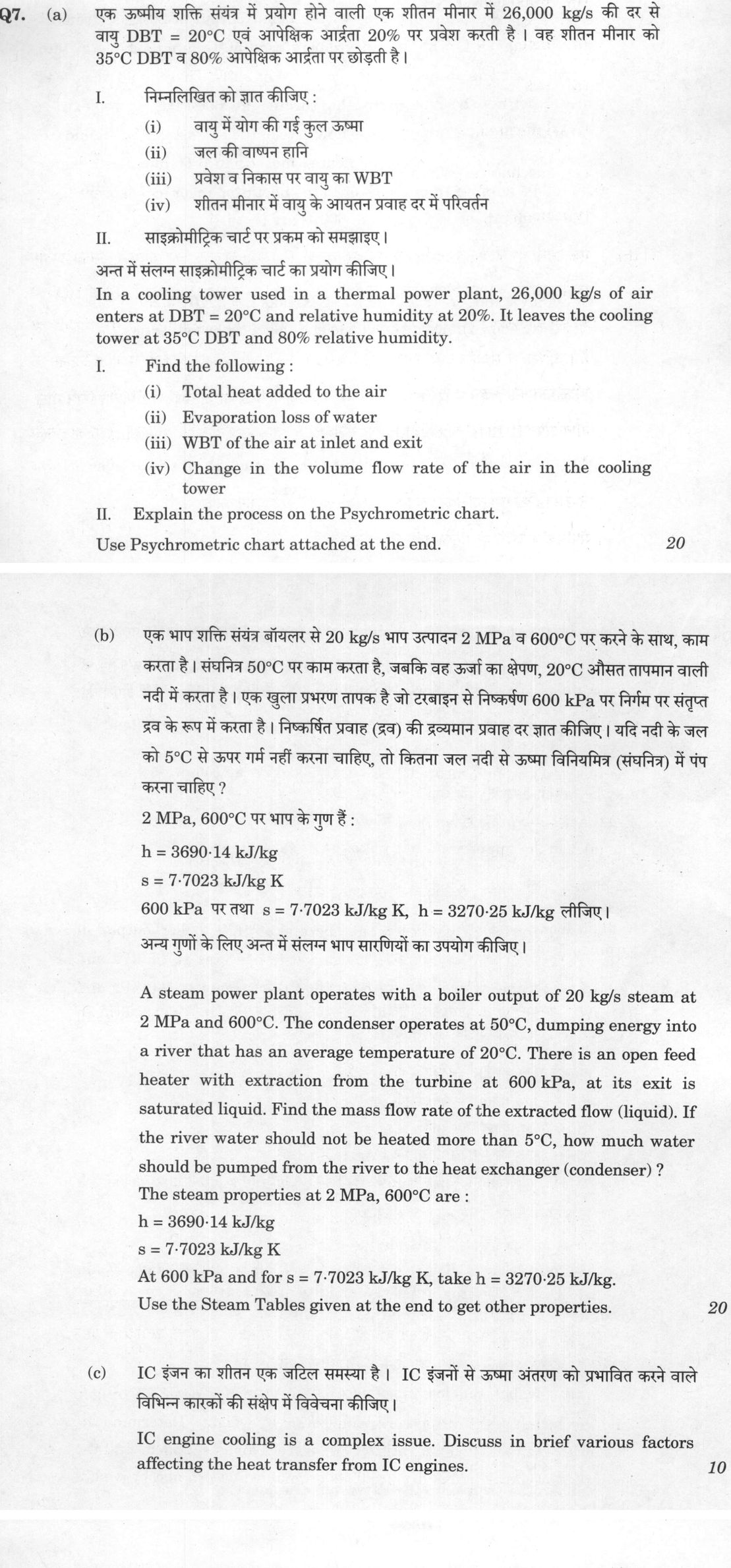
In a cooling tower used in a thermal power plant, 26,000 kg/s of air enters at DBT = 20°C and relative humidity at 20%. It leaves the cooling tower at 35°C DBT and 80% relative humidity.
I. Find the following : Total heat added to the air
Evaporation loss of water
WBT of the air at inlet and exit
Change in the volume flow rate of the air in the cooling tower
II. Explain the process on the Psychrometric chart.
Use Psychrometric chart attached at the end. 20 marks
A steam power plant operates with a boiler output of 20 kg/s steam at 2 MPa and 600°C. The condenser operates at 50°C, dumping energy into a river that has an average temperature of 20°C. There is an open feed heater with extraction from the turbine at 600 kPa, at its exit is saturated liquid. Find the mass flow rate of the extracted flow (liquid). If the river water should not be heated more than 5°C, how much water should be pumped from the river to the heat exchanger (condenser)?
The steam properties at 2 MPa, 600°C are : h = 3690·14 kJ/kg s = 7·7023 kJ/kg K
At 600 kPa and for s = 7·7023 kJ/kg K, take h = 3270·25 kJ/kg.
Use the Steam Tables given at the end to get other properties. 20 marks
IC engine cooling is a complex issue. Discuss in brief various factors affecting the heat transfer from IC engines. 10 marks
हिंदी में प्रश्न पढ़ें
एक ऊष्मीय शक्ति संयंत्र में प्रयोग होने वाली एक शीतन मीनार में 26,000 kg/s की दर से वायु DBT = 20°C एवं आपेक्षिक आर्द्रता 20% पर प्रवेश करती है। वह शीतन मीनार को 35°C DBT व 80% आपेक्षिक आर्द्रता पर छोड़ती है।
I. निम्नलिखित को ज्ञात कीजिए : वायु में योग की गई कुल ऊष्मा
जल की वाष्पन हानि
प्रवेश व निकास पर वायु का WBT
शीतन मीनार में वायु के आयतन प्रवाह दर में परिवर्तन
II. साइक्रोमीट्रिक चार्ट पर प्रक्रम को समझाइए।
अंत में संलग्न साइक्रोमीट्रिक चार्ट का प्रयोग कीजिए। (20 अंक)
एक भाप शक्ति संयंत्र बॉयलर से 20 kg/s भाप उत्पादन 2 MPa व 600°C पर करने के साथ, काम करता है। संघनित्र 50°C पर काम करता है, जबकि वह ऊर्जा का क्षेपण, 20°C औसत तापमान वाली नदी में करता है। एक खुला प्रभरण तापक है जो टरबाइन से निष्कर्षण 600 kPa पर निर्गम पर संतृप्त द्रव के रूप में करता है। निष्कर्षित प्रवाह (द्रव) की द्रव्यमान प्रवाह दर ज्ञात कीजिए। यदि नदी के जल को 5°C से ऊपर गर्म नहीं करना चाहिए, तो कितना जल नदी से उष्मा विनियमित्र (संघनित्र) में पंप करना चाहिए?
2 MPa, 600°C पर भाप के गुण हैं : h = 3690·14 kJ/kg s = 7·7023 kJ/kg K
600 kPa पर तथा s = 7·7023 kJ/kg K, h = 3270·25 kJ/kg लीजिए।
अन्य गुणों के लिए अंत में संलग्न भाप सारणियों का उपयोग कीजिए। (20 अंक)
IC इंजन का शीतन एक जटिल समस्या है। IC इंजनों से उष्मा अंतरण को प्रभावित करने वाले विभिन्न कारकों की संक्षेप में विवेचना कीजिए। (10 अंक)
The figure this question refers to, in words
The question paper is a scan and the diagram did not survive as text. This is the figure as read from the original page — every component, value and label — so the question can be worked from the text below.
(a) A standard Psychrometric Chart for Barometric Pressure 1.01325 bar (Sea Level). The chart includes:
- Vertical axis on the left: Dry Bulb Temperature (°C), ranging from -10 °C to 55 °C.
- Horizontal axis at the bottom: Moisture Content (kg/kg dry air), ranging from 0.000 to 0.033 kg/kg dry air.
- Saturation curve (upper left boundary): marked with Wet Bulb or Saturation Temperature (°C) from -10 °C to 45 °C, and an outer scale for Specific Enthalpy at Saturation (kJ/kg air) from 0 to 145 kJ/kg air.
- Relative Humidity curves: lines labeled from 10% to 90% RH.
- Specific Volume lines: steep sloping dashed/solid lines marked at 0.75, 0.80, 0.85, and 0.90 m^3/kg dry air.
- Wet bulb / Enthalpy lines sloping downwards to the right, along with Enthalpy Deviation lines (labeled -0.05, -0.1, -0.2, -0.4, -0.6, -0.8, -1.0, -1.2 kJ/kg dry air).
- A Sensible Heat Factor (SHF) scale at the bottom right ranging from 1.00 down to 0.35, with a note: 'Ref. Point for SHF is 25 °C, 50% RH'.
- Note at the top left: 'BELOW 0 °C PROPERTIES AND ENTHALPY DEVIATION LINES ARE FOR ICE'.
(b) Table titled 'Steam Tables (Pressure) - Saturated Water Pressure Entry': Columns: Press. (kPa) | Temp. (°C) | Specific Volume, m^3/kg: Sat. Liquid v_f | Evap. v_fg | Sat. Vapor v_g 0.6113 | 0.01 | 0.001000 | 206.131 | 206.132 1 | 6.98 | 0.001000 | 129.20702 | 129.20802 1.5 | 13.03 | 0.001001 | 87.97913 | 87.98013 2 | 17.50 | 0.001001 | 67.00285 | 67.00385 2.5 | 21.08 | 0.001002 | 54.25285 | 54.25385 3 | 24.08 | 0.001003 | 45.66402 | 45.66502 4 | 28.96 | 0.001004 | 34.79915 | 34.80015 5 | 32.88 | 0.001005 | 28.19150 | 28.19251 7.5 | 40.29 | 0.001008 | 19.23674 | 19.23775 10 | 45.81 | 0.001010 | 14.67254 | 14.67355 15 | 53.97 | 0.001014 | 10.02117 | 10.02218 20 | 60.06 | 0.001017 | 7.64835 | 7.64937 25 | 64.97 | 0.001020 | 6.20322 | 6.20424 30 | 69.10 | 0.001022 | 5.22816 | 5.22918 40 | 75.87 | 0.001026 | 3.99243 | 3.99345 50 | 81.33 | 0.001030 | 3.23931 | 3.24034 75 | 91.77 | 0.001037 | 2.21607 | 2.21711 100 | 99.62 | 0.001043 | 1.69296 | 1.69400 125 | 105.99 | 0.001048 | 1.37385 | 1.37490 150 | 111.37 | 0.001053 | 1.15828 | 1.15933 175 | 116.06 | 0.001057 | 1.00257 | 1.00363 200 | 120.23 | 0.001061 | 0.88467 | 0.88573 225 | 124.00 | 0.001064 | 0.79219 | 0.79325 250 | 127.43 | 0.001067 | 0.71765 | 0.71871 275 | 130.60 | 0.001070 | 0.65624 | 0.65731 300 | 133.55 | 0.001073 | 0.60475 | 0.60582 325 | 136.30 | 0.001076 | 0.56093 | 0.56201 350 | 138.88 | 0.001079 | 0.52317 | 0.52425 375 | 141.32 | 0.001081 | 0.49029 | 0.49137 400 | 143.63 | 0.001084 | 0.46138 | 0.46246 450 | 147.93 | 0.001088 | 0.41289 | 0.41398 500 | 151.86 | 0.001093 | 0.37380 | 0.37489 550 | 155.48 | 0.001097 | 0.34159 | 0.34268 600 | 158.85 | 0.001101 | 0.31457 | 0.31567 650 | 162.01 | 0.001104 | 0.29158 | 0.29268 700 | 164.97 | 0.001108 | 0.27176 | 0.27286 750 | 167.77 | 0.001111 | 0.25449 | 0.25560 800 | 170.43 | 0.001115 | 0.23931 | 0.24043
(b) Table: Steam Tables (Temperature) - Saturated water Columns: Temp. (°C) | Press. (kPa) | Specific Volume, m3/kg: Sat. Liquid vf | Evap. vfg | Sat. Vapor vg 0.01 | 0.6113 | 0.001000 | 206.131 | 206.132 5 | 0.8721 | 0.001000 | 147.117 | 147.118 10 | 1.2276 | 0.001000 | 106.376 | 106.377 15 | 1.705 | 0.001001 | 77.924 | 77.925 20 | 2.339 | 0.001002 | 57.7887 | 57.7897 25 | 3.169 | 0.001003 | 43.3583 | 43.3593 30 | 4.246 | 0.001004 | 32.8922 | 32.8932 35 | 5.628 | 0.001006 | 25.2148 | 25.2158 40 | 7.384 | 0.001008 | 19.5219 | 19.5229 45 | 9.593 | 0.001010 | 15.2571 | 15.2581 50 | 12.350 | 0.001012 | 12.0308 | 12.0318 55 | 15.758 | 0.001015 | 9.56734 | 9.56835 60 | 19.941 | 0.001017 | 7.66969 | 7.67071 65 | 25.03 | 0.001020 | 6.19554 | 6.19656 70 | 31.19 | 0.001023 | 5.04114 | 5.04217 75 | 38.58 | 0.001026 | 4.13021 | 4.13123 80 | 47.39 | 0.001029 | 3.40612 | 3.40715 85 | 57.83 | 0.001032 | 2.82654 | 2.82757 90 | 70.14 | 0.001036 | 2.35953 | 2.36056 95 | 84.55 | 0.001040 | 1.98082 | 1.98186 100 | 101.3 | 0.001044 | 1.67185 | 1.67290 105 | 120.8 | 0.001047 | 1.41831 | 1.41936 110 | 143.3 | 0.001052 | 1.20909 | 1.21014 115 | 169.1 | 0.001056 | 1.03552 | 1.03658 120 | 198.5 | 0.001060 | 0.89080 | 0.89186 125 | 232.1 | 0.001065 | 0.76953 | 0.77059 130 | 270.1 | 0.001070 | 0.66744 | 0.66850 135 | 313.0 | 0.001075 | 0.58110 | 0.58217 140 | 361.3 | 0.001080 | 0.50777 | 0.50885 145 | 415.4 | 0.001085 | 0.44524 | 0.44632 150 | 475.9 | 0.001090 | 0.39169 | 0.39278 155 | 543.1 | 0.001096 | 0.34566 | 0.34676 160 | 617.8 | 0.001102 | 0.30596 | 0.30706 165 | 700.5 | 0.001108 | 0.27158 | 0.27269 170 | 791.7 | 0.001114 | 0.24171 | 0.24283 175 | 892.0 | 0.001121 | 0.21568 | 0.21680 180 | 1002.2 | 0.001127 | 0.19292 | 0.19405 185 | 1122.7 | 0.001134 | 0.17295 | 0.17409 190 | 1254.4 | 0.001141 | 0.15539 | 0.15654
Model answer
Written by UPSC Answer Check against this question's marking rubric, to the expected length. UPSC does not publish answers for Mains — this is one way to score well, not an official key.
(a) I (i) Assume m_a = 26,000 kg/s dry air, P = 101.325 kPa. At inlet t1 = 20°C, φ1 = 20%: p_s1 = 2.339 kPa, so p_v1 = 0.20 × 2.339 = 0.4678 kPa. W1 = 0.622 p_v1/(P − p_v1) = 0.622 × 0.4678/(101.325 − 0.4678) = 0.002885 kg/kg dry air. At exit t2 = 35°C, φ2 = 80%: p_s2 = 5.628 kPa, p_v2 = 0.80 × 5.628 = 4.5024 kPa. W2 = 0.622 × 4.5024/(101.325 − 4.5024) = 0.028924 kg/kg dry air. h = 1.006t + W(2501 + 1.86t). h1 = 1.006×20 + 0.002885(2501 + 1.86×20) = 27.44 kJ/kg dry air. h2 = 1.006×35 + 0.028924(2501 + 1.86×35) = 109.43 kJ/kg dry air. Total heat added = m_a(h2 − h1) = 26,000(109.43 − 27.44) = 2.13×10^6 kW.
(a) I (ii) Evaporation loss = m_a(W2 − W1) = 26,000(0.028924 − 0.002885) = 677 kg/s.
(a) I (iii) Using the adiabatic-saturation equation W = [(2501 − 2.326t_wb)W_s(t_wb) − 1.006(t − t_wb)]/[2501 + 1.86t − 4.186t_wb], or reading the chart: inlet WBT ≈ 9.3°C; exit WBT ≈ 31.9°C.
(a) I (iv) Specific volume v = 0.287T/(P − p_v), T in K. v1 = 0.287×293.15/(101.325 − 0.4678) = 0.834 m^3/kg dry air. v2 = 0.287×308.15/(101.325 − 4.5024) = 0.913 m^3/kg dry air. Change = m_a(v2 − v1) = 26,000(0.913 − 0.834) = 2.06×10^3 m^3/s increase.
(a) II On the psychrometric chart, state 1 is at 20°C DBT and 20% RH; state 2 is at 35°C DBT and 80% RH. The process line slopes upward to the right: DBT, humidity ratio, enthalpy, wet-bulb temperature and specific volume all increase. Sensible heat transfer warms the air, while latent heat transfer from evaporation raises the moisture content. The line is not a constant wet-bulb line; it lies below the saturation curve. Heat added is the vertical enthalpy difference, and evaporation loss is the horizontal W difference.
(b) At 2 MPa, 600°C: h6 = 3690.14 kJ/kg, s6 = 7.7023 kJ/kg K. At 600 kPa extraction: h_ext = 3270.25 kJ/kg. From steam tables: at 50°C, h_f = 209.33 kJ/kg, h_fg = 2382.7 kJ/kg, s_f = 0.7038 kJ/kg K, s_fg = 7.3715 kJ/kg K, v_f = 0.001012 m^3/kg. At 600 kPa, h_f = 670.56 kJ/kg.
Turbine exhaust entropy s = s6. At 50°C, x = (7.7023 − 0.7038)/7.3715 = 0.9494. h_ex = 209.33 + 0.9494×2382.7 = 2471.5 kJ/kg.
Condensate pump to 600 kPa: w_p = v_f(600 − 12.35) = 0.001012×587.65 = 0.595 kJ/kg. h_cond,in = 209.33 + 0.595 = 209.93 kJ/kg.
Open feedwater heater energy balance: m_ext h_ext + (20 − m_ext)h_cond,in = 20h_f600. Thus m_ext = 20(670.56 − 209.93)/(3270.25 − 209.93) = 20×460.63/3060.32 = 3.01 kg/s.
Condenser duty: remaining flow = 20 − 3.01 = 16.99 kg/s. Q_cond = 16.99(2471.5 − 209.33) = 3.84×10^4 kW. River water: Q_cond = m_w c_p ΔT, c_p = 4.18 kJ/kg K, ΔT = 5°C. m_w = 38,400/(4.18×5) = 1.84×10^3 kg/s.
(c) Factors affecting heat transfer from IC engines include:
- Gas side: combustion temperature, flame speed, turbulence and swirl, air-fuel ratio, compression ratio, ignition timing, engine speed and load, residual gas fraction.
- Geometry and materials: surface-area-to-volume ratio, cylinder bore/stroke, head/piston/liner design, wall thickness, thermal conductivity, fins and coolant passages.
- Coolant side: coolant type (water, glycol, air), specific heat, thermal conductivity, viscosity, flow rate, pressure, coolant temperature, boiling, thermostat and radiator performance.
- Deposits and fouling: soot, oil films, scale and corrosion add thermal resistance.
- Lubrication and auxiliary: oil flow, piston cooling jets, oil cooler.
- Ambient and operation: air temperature, humidity, altitude, transient/steady operation, EGR and turbocharging. These factors control convective and radiative heat transfer to walls, conduction through metal, and convection to the coolant.
What "Solve" is asking you to do
Choose the method, then carry it through to a final answer. Identifying what kind of problem this is and why that method applies is the first thing marked; a correct figure arrived at invisibly earns almost nothing.
Structure that answers it
Given data and what is required → method chosen, with the reason it applies → set-up (equation, circuit, free body, trial balance) → working, step by step → answer with units and any condition of validity
Where marks are lost
Doing the middle steps mentally and writing only the result. In mathematics papers, a further loss comes from giving a decimal where the exact value in surds or fractions was wanted, or from skipping the justification a part explicitly asks for.
How this answer will be evaluated
Approach
(a) calculate: given > formula > substitution > result with units > interpretation | (b) calculate: given > formula > substitution > result with units > interpretation | (c) discuss: intro > 3-4 dimensions > example > balanced close Full marks: All parts fully answered with correct method, clear diagrams, and physical interpretation.
Key points expected
- State inlet/outlet properties from psychrometric chart
- Apply energy balance for total heat added
- Calculate evaporation loss via humidity ratio difference
- Identify WBT and volume flow rate change
- Use given steam properties at 2 MPa, 600°C
- Apply mass/energy balance for open feed heater
- Calculate extracted flow rate (liquid)
- Determine river water flow for 5°C rise
Evaluation rubric
Each sub-part is marked on its own, against the marks and word limit printed on the paper.
- (a) Determine heat, evaporation, WBT, and volume flow changes for the cooling tower. 20 marks
calculate— given → formula → substitution → result with units → interpretation
Must cover
- State inlet/outlet properties from psychrometric chart
- Apply energy balance for total heat added
- Calculate evaporation loss via humidity ratio difference
- Identify WBT and volume flow rate change
Loses marks
- Plugging numbers without governing equations
- Unmarked states on psychrometric chart
Earns more
- Correctly labelled psychrometric chart process
- Consistent units in all calculations
- Explicit statement of assumptions
Extra mark
- Schematic diagram of cooling tower
- (b) Find extracted flow rate and river water flow for the steam plant. 20 marks
calculate— given → formula → substitution → result with units → interpretation
Must cover
- Use given steam properties at 2 MPa, 600°C
- Apply mass/energy balance for open feed heater
- Calculate extracted flow rate (liquid)
- Determine river water flow for 5°C rise
Loses marks
- Ignoring given steam properties
- No mass/energy balance equations shown
Earns more
- Correct use of steam tables for other states
- Clear identification of all states
- Dimensional consistency in calculations
Extra mark
- T-s or p-V diagram of the cycle
- (c) Briefly discuss factors affecting heat transfer from IC engines. 10 marks
discuss— intro → 3-4 dimensions → example → balanced close
Must cover
- Identify 3-4 key factors affecting heat transfer
- Explain how each factor influences cooling
- Provide one example for a factor
- Conclude with balanced summary
Loses marks
- Vague or generic statements
- No examples provided
Earns more
- Mention of specific cooling mechanisms
- Link to engine performance
- Clear and concise explanation
Extra mark
- Reference to specific engine type
Practice this exact question
Write your answer and it is marked point by point against the model answer above — what you covered, what you missed, what you got wrong.
Evaluate my answer →More from Mechanical Engineering 2024 Paper II
- Q4 (a) A convergent-divergent nozzle is designed to expand air from a chamber in which the p…
- Q5 (a) Explain the functions of three types of superheaters used in power boilers. Sketch th…
- Q6 (a) A four-cylinder gasoline engine has a bore of 75 mm and a stroke length of 100 mm. It…
- Q7 (a) In a cooling tower used in a thermal power plant, 26,000 kg/s of air enters at DBT =…
- Q8 (a) A cogenerating steam power plant operates with a boiler output of 25 kg/s steam at 7…