Paper I — Q2
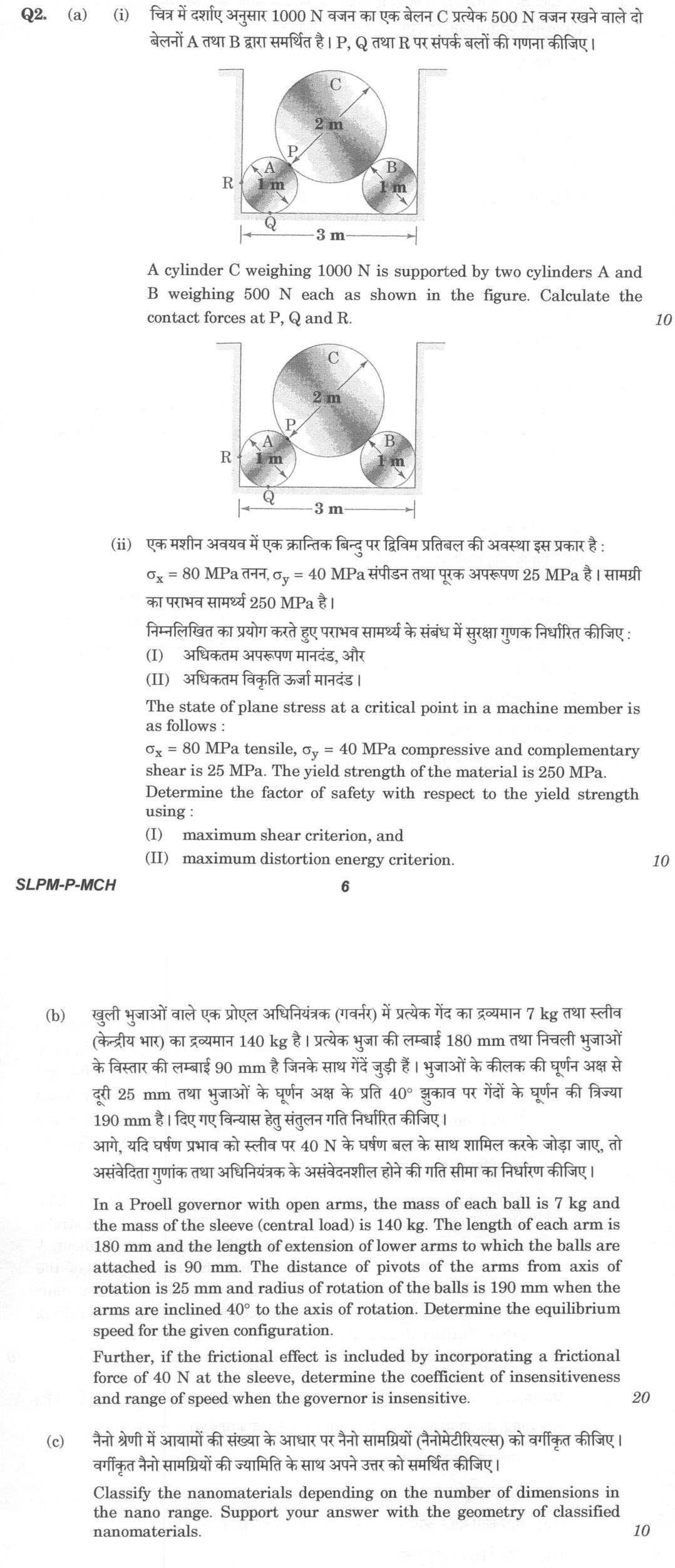
(a) (i) A cylinder C weighing 1000 N is supported by two cylinders A and B weighing 500 N each as shown in the figure. Calculate…
A cylinder C weighing 1000 N is supported by two cylinders A and B weighing 500 N each as shown in the figure. Calculate the contact forces at P, Q and R. 10 marks
The state of plane stress at a critical point in a machine member is as follows: σₓ = 80 MPa tensile, σᵧ = 40 MPa compressive and complementary shear is 25 MPa. The yield strength of the material is 250 MPa. Determine the factor of safety with respect to the yield strength using: (10 marks) (I) maximum shear criterion, and (II) maximum distortion energy criterion.
In a Proell governor with open arms, the mass of each ball is 7 kg and the mass of the sleeve (central load) is 140 kg. The length of each arm is 180 mm and the length of extension of lower arms to which the balls are attached is 90 mm. The distance of pivots of the arms from axis of rotation is 25 mm and radius of rotation of the balls is 190 mm when the arms are inclined 40° to the axis of rotation. Determine the equilibrium speed for the given configuration. 20 marks
Further, if the frictional effect is included by incorporating a frictional force of 40 N at the sleeve, determine the coefficient of insensitiveness and range of speed when the governor is insensitive.
Classify the nanomaterials depending on the number of dimensions in the nano range. Support your answer with the geometry of classified nanomaterials. 10 marks
हिंदी में प्रश्न पढ़ें
चित्र में दर्शाए अनुसार 1000 N वजन का एक बेलन C प्रत्येक 500 N वजन रखने वाले दो बेलनों A तथा B द्वारा समर्थित है। P, Q तथा R पर संपर्क बलों की गणना कीजिए। (10 अंक)
एक मशीन अवयव में एक क्रांतिक बिंदु पर द्विविम प्रतिबल की अवस्था इस प्रकार है: σₓ = 80 MPa तनन, σᵧ = 40 MPa संपीडन तथा पूरक अपरूपण 25 MPa है। सामग्री का प्रारंभ सामर्थ्य 250 MPa है। निम्नलिखित का प्रयोग करते हुए प्रारंभ सामर्थ्य के संबंध में सुरक्षा गुणक निर्धारित कीजिए: (10 अंक) (I) अधिकतम अपरूपण मानदंड, और (II) अधिकतम विकृति ऊर्जा मानदंड।
खुली भुजाओं वाले एक प्रोएल अधिनियंत्रक (गवर्नर) में प्रत्येक गेंद का द्रव्यमान 7 kg तथा स्लीव (केंद्रीय भार) का द्रव्यमान 140 kg है। प्रत्येक भुजा की लंबाई 180 mm तथा निचली भुजाओं के विस्तार की लंबाई 90 mm है जिनके साथ गेंदें जुड़ी हैं। भुजाओं के कीलक की घूर्णन अक्ष से दूरी 25 mm तथा भुजाओं के घूर्णन अक्ष के प्रति 40° झुकाव पर गेंदों के घूर्णन की त्रिज्या 190 mm है। दिए गए विन्यास हेतु संतुलन गति निर्धारित कीजिए। (20 अंक)
आगे, यदि घर्षण प्रभाव को स्लीव पर 40 N के घर्षण बल के साथ शामिल करके जोड़ा जाए, तो असंवेदिता गुणांक तथा अधिनियंत्रक के असंवेदनशील होने की गति सीमा का निर्धारण कीजिए।
नैनो श्रेणी में आयामों की संख्या के आधार पर नैनो सामग्रियों (नैनोमटीरियल्स) को वर्गीकृत कीजिए। वर्गीकृत नैनो सामग्रियों की ज्यामिति के साथ अपने उत्तर को समर्थित कीजिए। (10 अंक)
The figure this question refers to, in words
The question paper is a scan and the diagram did not survive as text. This is the figure as read from the original page — every component, value and label — so the question can be worked from the text below.
(a) A cross-sectional view of a container with vertical side walls and a horizontal floor. Inside, three circular cylinders are arranged. Cylinder C is the largest, positioned at the top center, resting on two smaller cylinders, A and B. Cylinder A is on the left, touching the left vertical wall and the floor. Cylinder B is on the right, touching the right vertical wall and the floor. Cylinder C touches Cylinder A at a point labeled P and touches Cylinder B at a point labeled R. The contact point between Cylinder A and the floor is labeled Q. The radius of Cylinder C is labeled '2 m'. The radius of Cylinder A is labeled '1 m'. The radius of Cylinder B is labeled '1 m'. A horizontal dimension line at the bottom indicates the distance between the vertical walls is '3 m'.
(b) A horizontal beam AB is simply supported at both ends. Support A is a roller support and support B is a pin support. The beam carries a uniformly distributed load of 750 N/m over its entire length. A rigid rod DEF is welded to the beam at point D. The rod extends vertically downwards from D to E, then horizontally to the left from E to F, and then vertically downwards from F. A concentrated load of 700 N acts vertically downwards at point F. The distance from A to C is 2.4 m, from C to D is 0.9 m, and from D to B is 1.5 m. The total length of the beam is 4.8 m. The flexural rigidity EI is given as 200 GPa * 20 x 10^6 mm^4.
What "Calculate" is asking you to do
Apply the standard formula or schedule to data the question has already supplied — a table of readings, cost records, a balance sheet — and produce the number. The method is rarely in doubt; the marks sit in the named intermediate quantities, each of which has to appear as a labelled line.
Structure that answers it
Data as given → formula or standard treatment, named → substitution → each intermediate, labelled → result with units
Where marks are lost
Omitting an intermediate the marking scheme pays for separately, or rounding at an intermediate line so the final figure drifts. In commerce and accountancy, any figure in a statement that no numbered working note supports is treated as unearned.
How this answer will be evaluated
Approach
(a(i)) calculate: given > formula > substitution > result with units > interpretation | (a(ii)) calculate: given > formula > substitution > result with units > interpretation | (b) calculate: given > formula > substitution > result with units > interpretation | (c) describe: define > structure or process in order > labelled diagram > significance Full marks: Complete working with all diagrams, correct formulas, and physical interpretation.
Key points expected
- Free body diagram of cylinder C
- Free body diagram of cylinder A
- Equilibrium equations (sum of forces)
- Final values for P, Q, R with units
- Principal stress calculation
- Tresca (max shear) criterion application
- Von Mises (distortion energy) criterion application
- Factor of safety values for both
Evaluation rubric
Each sub-part is marked on its own, against the marks and word limit printed on the paper.
- (a(i)) Determine contact forces at P, Q, and R for the cylinder system. 10 marks
calculate— given → formula → substitution → result with units → interpretation
Must cover
- Free body diagram of cylinder C
- Free body diagram of cylinder A
- Equilibrium equations (sum of forces)
- Final values for P, Q, R with units
Loses marks
- Missing free body diagrams
- No units on final answers
Earns more
- Correct geometric angle calculation
- Consistent sign convention
Extra mark
- Verification of total vertical force balance
- (a(ii)) Calculate factor of safety using maximum shear and distortion energy criteria. 10 marks
calculate— given → formula → substitution → result with units → interpretation
Must cover
- Principal stress calculation
- Tresca (max shear) criterion application
- Von Mises (distortion energy) criterion application
- Factor of safety values for both
Loses marks
- Incorrect principal stress formula
- Confusing yield strength with ultimate strength
Earns more
- Correct sign convention for compressive stress
- Clear substitution of values
Extra mark
- Comparison of the two safety factors
- (b) Determine equilibrium speed, coefficient of insensitiveness, and speed range. 20 marks
calculate— given → formula → substitution → result with units → interpretation
Must cover
- Proell governor geometry analysis
- Equilibrium speed calculation
- Friction effect on speed range
- Coefficient of insensitiveness formula and value
Loses marks
- Ignoring arm extension length
- Incorrect friction force direction
Earns more
- Labeled schematic of governor arms
- Step-by-step force balance
Extra mark
- Discussion of governor sensitivity
- (c) Classify nanomaterials by dimensionality with geometric examples. 10 marks
describe— define → structure or process in order → labelled diagram → significance
Must cover
- 0D, 1D, 2D, 3D classification
- Geometric description for each type
- Examples of each dimensionality
- Clear distinction between dimensions
Loses marks
- Missing one dimensionality category
- No geometric description
Earns more
- Simple diagrams of each type
- Mention of specific nanomaterials
Extra mark
- Application examples for each type
Model answer coming soon
Every evaluation on this site is marked against a verified model answer. This question's answer is still being written; evaluation opens the moment it lands.
More from Mechanical Engineering 2025 Paper I
- Q1 (a) A gripper is shown in the figure. A horizontal force F = 50 N is applied to the handl…
- Q2 (a) (i) A cylinder C weighing 1000 N is supported by two cylinders A and B weighing 500 N…
- Q3 (a) (i) The recoil mechanism of a gun consists of a critically damped spring-damper syste…
- Q4 (a) A car is moving in a straight line with a velocity of v = (0·6t² + 2t) m/s for a shor…
- Q5 (a) A low carbon steel stock of thickness 25 mm is to be rolled in two stages. In the fir…