Paper I — Q5
(a) A low carbon steel stock of thickness 25 mm is to be rolled in two stages. In the first stage, the reduction is to be from 25…
A low carbon steel stock of thickness 25 mm is to be rolled in two stages. In the first stage, the reduction is to be from 25 mm to 15 mm and in the second stage from 15 mm to 5 mm. Determine the minimum diameter of the rolls for the two stages if the maximum angle of bite is 35° for the first stage and 25° for the second stage. Also, calculate the required coefficient of friction in both the stages. 10 marks
In an arc welding process of steel with a potential of 15 volt, current of 150 Amp and travel speed is 5 mm/sec, the cross-sectional area of joint is observed as 15 mm². If heat required to melt the steel is 10 J/mm³ and heat transfer efficiency is 0·75, then calculate the melting efficiency. 10 marks
In an automobile manufacturing industry the demand for a specific part was 250 in April, 100 in May and 200 in June. The forecast for April was 150. Calculate the forecast for the month of July with a smoothing constant of 0·25 and using first order exponential smoothing. 10 marks
Five different products are manufactured in a mixed model production line. The time required for each task is given below:
Each product requires a set of tasks. Calculate the total number of work stations for this mixed-model assembly line, if the cycle time is 15 seconds. 10 marks
For the given dimensions of mated parts, determine the values of allowance, hole tolerance and shaft tolerance using the basic hole system.
Hole : 57·50 mm Shaft : 57·47 mm 57·52 mm 57·45 mm
10 marks
हिंदी में प्रश्न पढ़ें
25 mm मोटाई वाले निम्न कार्बन इस्पात स्कंध (स्टॉक) को दो चरणों में रोल किया जाना है | प्रथम चरण में संकुचन 25 mm से 15 mm तक तथा द्वितीय चरण में 15 mm से 5 mm तक होना है | यदि प्रथम चरण के लिए अधिकतम कटाव कोण 35° तथा द्वितीय चरण के लिए 25° है, तो दोनों चरणों के लिए बेलनों (रोल्स) के न्यूनतम व्यास को निर्धारित कीजिए | दोनों चरणों में आवश्यक घर्षण गुणांक की भी गणना कीजिए | 10
15 वोल्ट के विभव (पोटेंशियल) के साथ इस्पात के आर्क वेल्डिंग प्रक्रम में, 150 Amp की धारा (करंट) तथा 5 mm/sec की यात्रा गति के साथ जोड़ का अनुप्रस्थ-काट क्षेत्रफल 15 mm² देखा गया है | यदि इस्पात की गलन के लिए 10 J/mm³ ऊष्मा की आवश्यकता है तथा ऊष्मा स्थानांतरण दक्षता 0·75 है, तो गलन दक्षता (एफीसिएंसी) की गणना कीजिए | 10
एक ऑटोमोबाइल विनिर्माण उद्योग में एक विशिष्ट घटक की मांग अप्रैल में 250, मई में 100 और जून में 200 थी | अप्रैल के लिए पूर्वानुमान 150 था | जुलाई माह के लिए 0·25 मसृणकारी (स्मूथिंग) स्थिरांक तथा प्रथम क्रम के चरघातांकी मसृणीकरण का प्रयोग करते हुए पूर्वानुमान की गणना कीजिए | 10
एक मिश्रित मॉडल उत्पादन लाइन में पाँच अलग-अलग उत्पादों का निर्माण किया जाता है। प्रत्येक कार्य के लिए आवश्यक समय नीचे दिया गया है :
प्रत्येक उत्पाद के लिए कार्यों का एक सेट आवश्यक है। यदि चक्र समय 15 सेकंड है, तो इस मिश्रित-मॉडल समन्वयोजन लाइन (असेंबली लाइन) के लिए कार्य स्थलों की कुल संख्या की गणना कीजिए। 10
दिए गए मिलान वाले भागों की विमाओं के लिए, मूल (बेसिक) छिद्र प्रणाली का उपयोग करते हुए छूट (अलाउंस), छिद्र सहिष्णुता तथा शाफ्ट सहिष्णुता के मान निर्धारित कीजिए।
छिद्र : 57·50 mm शाफ्ट : 57·47 mm 57·52 mm 57·45 mm
10
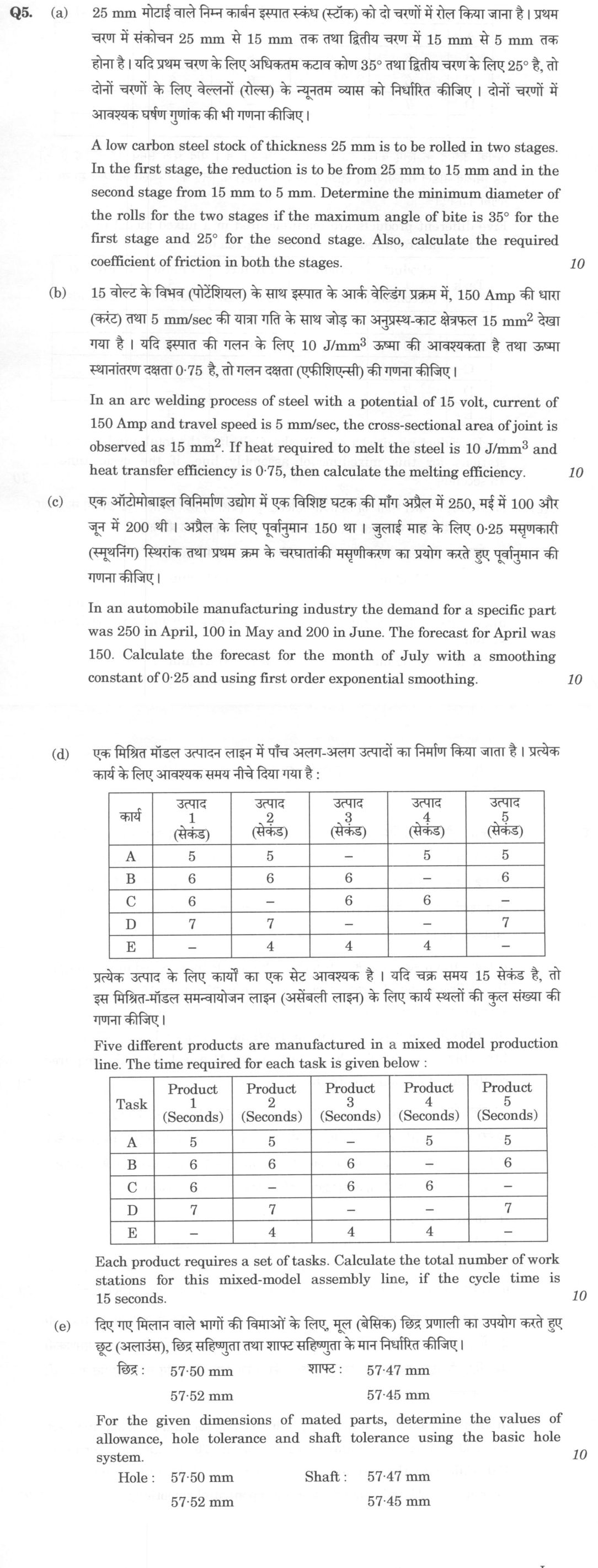
The figure this question refers to, in words
The question paper is a scan and the diagram did not survive as text. This is the figure as read from the original page — every component, value and label — so the question can be worked from the text below.
(d) Table with columns: Task, Product 1 (Seconds), Product 2 (Seconds), Product 3 (Seconds), Product 4 (Seconds), Product 5 (Seconds). Rows: A: 5, 5, -, 5, 5; B: 6, 6, 6, -, 6; C: 6, -, 6, 6, -; D: 7, 7, -, -, 7; E: -, 4, 4, 4, -.
Model answer
Written by UPSC Answer Check against this question's marking rubric, to the expected length. UPSC does not publish answers for Mains — this is one way to score well, not an official key.
(a) For flat rolling, use the bite geometry of a roll pair. Let h0 be the incoming thickness, hf the outgoing thickness, R the roll radius, and α the bite angle. The thickness reduction is Δh = h0 - hf. From the entry geometry, the vertical projection of the contact arc equals the reduction, so Δh = R - R cos α = R(1 - cos α). For a specified reduction, a smaller roll radius gives a larger bite angle; therefore the minimum roll radius occurs when α is the maximum permitted bite angle. The bite condition is that friction must be sufficient to draw the stock into the gap, μ ≥ tan α. At the limiting maximum bite angle, the minimum required coefficient of friction is μ = tan α. These relations assume flat rolls, negligible spread, and no slip at the exit.
- Stage 1: h0 = 25 mm, hf = 15 mm, so Δh1 = 10 mm. α1 = 35°. 1 - cos 35° = 0.180848. R1 = 10 mm / 0.180848 = 55.29 mm. D1 = 2R1 = 110.59 mm. μ1 = tan 35° = 0.700.
- Stage 2: h0 = 15 mm, hf = 5 mm, so Δh2 = 10 mm. α2 = 25°. 1 - cos 25° = 0.093692. R2 = 10 mm / 0.093692 = 106.73 mm. D2 = 2R2 = 213.46 mm. μ2 = tan 25° = 0.466.
The exact symbolic forms are D1 = 20/(1 - cos 35°) mm and D2 = 20/(1 - cos 25°) mm. The second stage needs a larger diameter because the same 10 mm reduction is imposed with a smaller bite angle. The numerical values are rounded to three decimal places for diameter and three significant figures for friction; the exact trigonometric expressions should be used if higher precision is required.
Final (a): minimum roll diameters are 110.59 mm and 213.46 mm; minimum coefficients of friction are 0.700 and 0.466.
(b) Use the welding heat balance and the standard efficiency definitions. The electrical power generated at the arc is P arc = V I. The heat transfer efficiency η transfer is the fraction of this arc heat that enters the workpiece, so P work = η transfer P arc. The volume of weld metal melted per second is the joint cross-sectional area multiplied by the travel speed, q v = A v. The heat required to melt that volume per second is P melt = h m q v, where h m is the heat required per unit volume. When heat transfer efficiency is given separately, melting efficiency is the fraction of the heat received by the workpiece that is actually used for melting: η melt = P melt / P work.
- P arc = 15 V × 150 A = 2250 W = 2250 J/s.
- P work = 0.75 × 2250 J/s = 1687.5 J/s.
- q v = 15 mm² × 5 mm/s = 75 mm³/s.
- P melt = 10 J/mm³ × 75 mm³/s = 750 J/s.
- η melt = 750 J/s / 1687.5 J/s = 0.4444 = 4/9.
The volt-ampere product is in watts because 1 V × 1 A = 1 W. The travel speed converts the linear welding rate into a volumetric rate: in one second the torch advances 5 mm, and the 15 mm² cross-section gives a 5 mm long weld segment of volume 75 mm³. The given heat required to melt is treated as the total heat needed to bring the joint metal to the molten state and maintain the observed weld volume; no separate latent heat or specific heat calculation is needed. As a check, the overall efficiency relative to the total arc heat is η transfer × η melt = 0.75 × 4/9 = 1/3 = 33.33 %. The melting efficiency asked for is the value relative to the heat received by the workpiece.
Final (b): melting efficiency is 44.44 %. This assumes the observed joint cross-section is fully melted and no further heat loss is deducted after the 0.75 transfer efficiency.
(c) Use first-order exponential smoothing. The recurrence is: forecast for the next month = α × actual demand of the current month + (1 - α) × forecast for the current month. Here α = 0.25, so the latest actual demand receives 25 % weight and the previous forecast receives 75 % weight. The forecast must be updated month by month because each new forecast uses the immediately preceding forecast. If the April forecast is F-Apr and the April actual is A-Apr, then the May forecast is α A-Apr + (1 - α) F-Apr; the same form is repeated with May and June data. No separate initialization is needed because the April forecast is already given. The result is not rounded in the recurrence; rounding only at the end avoids accumulating small errors.
Given forecast for April = 150 parts.
- Forecast for May: 0.25 × 250 + 0.75 × 150 = 62.5 + 112.5 = 175 parts.
- Forecast for June: 0.25 × 100 + 0.75 × 175 = 25 + 131.25 = 156.25 parts.
- Forecast for July: 0.25 × 200 + 0.75 × 156.25 = 50 + 117.1875 = 167.1875 parts.
The exact decimal is 167.1875 parts. In practical planning it may be rounded to 167.19 parts or 167.2 parts, depending on the required precision.
Final (c): forecast for July is 167.19 parts.
(d) Use mixed-model line balancing. The cycle time is C = 15 s. A dash in the table means that the task is not required for that product, so its time is taken as 0 s. With no precedence constraints specified, and with tasks treated as indivisible, tasks may be grouped into workstations provided that, for every product, the sum of the task times assigned to any one station is not greater than the cycle time. The required total number of stations is the smallest integer for which such a grouping is feasible.
First compute the total work content for each product:
- Product 1: 5 + 6 + 6 + 7 = 24 s.
- Product 2: 5 + 6 + 7 + 4 = 22 s.
- Product 3: 6 + 6 + 4 = 16 s.
- Product 4: 5 + 6 + 4 = 15 s.
- Product 5: 5 + 6 + 7 = 18 s.
A quick lower bound is N ≥ maximum of Wp/C, rounded up, where Wp is the total work content of product p. Here the largest ratio is 24/15 = 1.6, so the bound gives 2. This bound is necessary but not sufficient; an actual assignment must also be shown. Since Product 1 requires 24 s of work, which is greater than 15 s, one workstation cannot complete Product 1 within the cycle time. Hence at least two workstations are necessary.
Now test whether two workstations can be balanced. Assign:
- Station 1: tasks A and B.
- Station 2: tasks C, D and E.
Check the station load for each product:
- Product 1: Station 1 = 5 + 6 = 11 s; Station 2 = 6 + 7 + 0 = 13 s.
- Product 2: Station 1 = 5 + 6 = 11 s; Station 2 = 0 + 7 + 4 = 11 s.
- Product 3: Station 1 = 0 + 6 = 6 s; Station 2 = 6 + 0 + 4 = 10 s.
- Product 4: Station 1 = 5 + 0 = 5 s; Station 2 = 6 + 0 + 4 = 10 s.
- Product 5: Station 1 = 5 + 6 = 11 s; Station 2 = 0 + 7 + 0 = 7 s.
Every station load is less than or equal to 15 s. Therefore two stations are feasible. The assignment is not unique; any other grouping that keeps every product load at or below 15 s would also prove that two stations are sufficient. Because one station is impossible and two stations are feasible, the minimum feasible total number of workstations is two. If precedence constraints were imposed, the number could increase, but none are given in the question.
Final (d): total number of work stations is 2.
(e) Use the basic hole system. In this system, the basic size is taken as the lower limit of the hole, and the lower deviation of the hole is zero. Here the hole limits are 57.50 mm and 57.52 mm, so the basic size is 57.50 mm. The shaft limits are 57.45 mm and 57.47 mm. The hole tolerance is the difference between the upper and lower hole limits. The shaft tolerance is the difference between the upper and lower shaft limits. Because the smallest hole, 57.50 mm, is larger than the largest shaft, 57.47 mm, the fit is a clearance fit. The allowance for a clearance fit is the minimum clearance, i.e. the smallest hole size minus the largest shaft size.
The deviations from the basic size are: hole upper deviation +0.02 mm, hole lower deviation 0; shaft upper deviation -0.03 mm, shaft lower deviation -0.05 mm. These deviations confirm that the shaft is always smaller than the hole, so no interference is possible. The basic hole system is used here because the hole lower limit is the reference size; the shaft limits are then interpreted as negative deviations from that reference.
- Hole tolerance = 57.52 mm - 57.50 mm = 0.02 mm.
- Shaft tolerance = 57.47 mm - 57.45 mm = 0.02 mm.
- Allowance = 57.50 mm - 57.47 mm = 0.03 mm.
For completeness, the maximum clearance is 57.52 mm - 57.45 mm = 0.07 mm, but the requested allowance is the minimum clearance.
Final (e): allowance = 0.03 mm, hole tolerance = 0.02 mm, shaft tolerance = 0.02 mm.
What "Calculate" is asking you to do
Apply the standard formula or schedule to data the question has already supplied — a table of readings, cost records, a balance sheet — and produce the number. The method is rarely in doubt; the marks sit in the named intermediate quantities, each of which has to appear as a labelled line.
Structure that answers it
Data as given → formula or standard treatment, named → substitution → each intermediate, labelled → result with units
Where marks are lost
Omitting an intermediate the marking scheme pays for separately, or rounding at an intermediate line so the final figure drifts. In commerce and accountancy, any figure in a statement that no numbered working note supports is treated as unearned.
How this answer will be evaluated
Approach
(a) calculate: given > formula > substitution > result with units > interpretation | (b) calculate: given > formula > substitution > result with units > interpretation | (c) calculate: given > formula > substitution > result with units > interpretation | (d) calculate: given > formula > substitution > result with units > interpretation | (e) calculate: given > formula > substitution > result with units > interpretation Full marks: All parts show complete method with governing equations, correct substitutions, and physical interpretation.
Key points expected
- State governing equation for roll diameter D = Δh
- Convert bite angle to radians before substitution
- Calculate D for both stages with units
- Calculate μ using tan(α) for both stages
- Calculate total heat input (V × I)
- Calculate heat required to melt (H × A × v)
- Apply heat transfer efficiency (0.75) correctly
- Compute final efficiency as ratio with units
Evaluation rubric
Each sub-part is marked on its own, against the marks and word limit printed on the paper.
- (a) Minimum roll diameter and coefficient of friction for two rolling stages. 10 marks
calculate— given → formula → substitution → result with units → interpretation
Must cover
- State governing equation for roll diameter D = Δh
- Convert bite angle to radians before substitution
- Calculate D for both stages with units
- Calculate μ using tan(α) for both stages
Loses marks
- Using degrees directly in trigonometric functions
- Missing units on final diameter values
Earns more
- Schematic of roll bite geometry
- Explicit calculation of Δh for each stage
Extra mark
- Check dimensional consistency of D
- (b) Melting efficiency of the arc welding process. 10 marks
calculate— given → formula → substitution → result with units → interpretation
Must cover
- Calculate total heat input (V × I)
- Calculate heat required to melt (H × A × v)
- Apply heat transfer efficiency (0.75) correctly
- Compute final efficiency as ratio with units
Loses marks
- Ignoring heat transfer efficiency in calculation
- Confusing heat input with heat required
Earns more
- Stepwise calculation of heat input vs heat required
- Interpretation of efficiency value physically
Extra mark
- Check dimensional consistency of J/mm³
- (c) Forecast for July using first order exponential smoothing. 10 marks
calculate— given → formula → substitution → result with units → interpretation
Must cover
- State exponential smoothing formula F(t+1) = αA(t) + (1-α)F(t)
- Calculate forecast for May using April data
- Calculate forecast for June using May data
- Calculate forecast for July using June data
Loses marks
- Skipping intermediate months (May, June)
- Using wrong smoothing constant value
Earns more
- Tabular presentation of month-by-month calculations
- Explicit substitution of α = 0.25
Extra mark
- Check that forecast converges toward actuals
- (d) Total number of workstations for mixed-model assembly line. 10 marks
calculate— given → formula → substitution → result with units → interpretation
Must cover
- Sum task times for each product
- Calculate total work content across all products
- Divide by cycle time (15 seconds)
- Round up to nearest integer for workstations
Loses marks
- Rounding down instead of up
- Ignoring tasks marked with dash
Earns more
- Table showing task times per product
- Explicit calculation of total work content
Extra mark
- Check that no task exceeds cycle time
- (e) Allowance, hole tolerance, and shaft tolerance using basic hole system. 10 marks
calculate— given → formula → substitution → result with units → interpretation
Must cover
- Identify basic size as 57.50 mm (hole lower limit)
- Calculate hole tolerance (57.52 - 57.50)
- Calculate shaft tolerance (57.47 - 57.45)
- Calculate allowance (basic size - shaft max)
Loses marks
- Using wrong basic size for allowance
- Confusing hole and shaft tolerances
Earns more
- Explicit identification of basic hole system
- Clear labeling of max/min dimensions
Extra mark
- Check that allowance is positive (clearance fit)
Practice this exact question
Write your answer and it is marked point by point against the model answer above — what you covered, what you missed, what you got wrong.
Evaluate my answer →More from Mechanical Engineering 2025 Paper I
- Q2 (a) (i) A cylinder C weighing 1000 N is supported by two cylinders A and B weighing 500 N…
- Q3 (a) (i) The recoil mechanism of a gun consists of a critically damped spring-damper syste…
- Q4 (a) A car is moving in a straight line with a velocity of v = (0·6t² + 2t) m/s for a shor…
- Q5 (a) A low carbon steel stock of thickness 25 mm is to be rolled in two stages. In the fir…
- Q6 (a) (i) If the power source characteristic in a Metal Inert Arc welding process is V_P =…
- Q7 (a) HSS cutting tool with 9° rake angle, the following data were observed in an orthogona…
- Q8 (a) What are the various computer languages used for NC machines? Explain the merits and…