Paper I — Q7
(a) HSS cutting tool with 9° rake angle, the following data were observed in an orthogonal machining process of medium carbon…
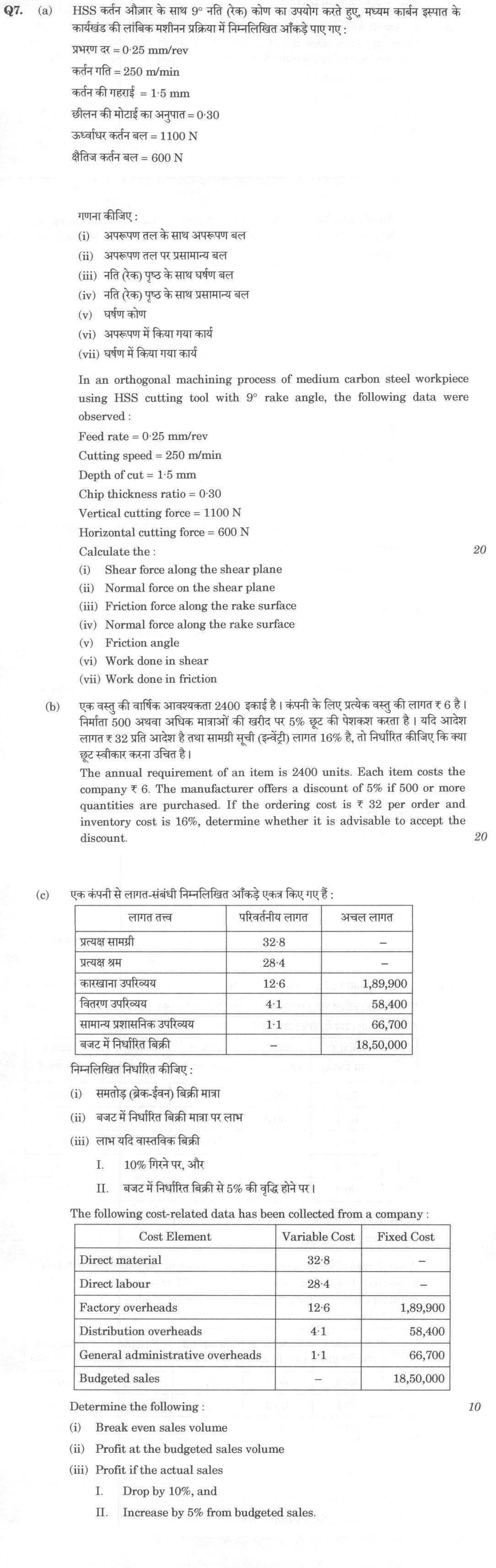
HSS cutting tool with 9° rake angle, the following data were observed in an orthogonal machining process of medium carbon steel workpiece: Feed rate = 0·25 mm/rev Cutting speed = 250 m/min Depth of cut = 1·5 mm Chip thickness ratio = 0·30 Vertical cutting force = 1100 N Horizontal cutting force = 600 N Calculate the: Shear force along the shear plane
Normal force on the shear plane
Friction force along the rake surface
Normal force along the rake surface
Friction angle
Work done in shear
Work done in friction 20 marks
The annual requirement of an item is 2400 units. Each item costs the company ₹ 6. The manufacturer offers a discount of 5% if 500 or more quantities are purchased. If the ordering cost is ₹ 32 per order and inventory cost is 16%, determine whether it is advisable to accept the discount. 20 marks
The following cost-related data has been collected from a company:
| Cost Element | Variable Cost | Fixed Cost |
|---|---|---|
| Direct material | 32·8 | – |
| Direct labour | 28·4 | – |
| Factory overheads | 12·6 | 1,89,900 |
| Distribution overheads | 4·1 | 58,400 |
| General administrative overheads | 1·1 | 66,700 |
| Budgeted sales | – | 18,50,000 |
Determine the following: Break even sales volume
Profit at the budgeted sales volume
Profit if the actual sales I. Drop by 10%, and II. Increase by 5% from budgeted sales. 10 marks
हिंदी में प्रश्न पढ़ें
HSS कतन औजार के साथ 9° नति (रैक) कोण का उपयोग करते हुए, मध्यम कार्बन इस्पात के कार्यखंड की लांबिक मशीन प्रक्रिया में निम्नलिखित आँकड़े पाए गए: प्रभरण दर = 0·25 mm/rev कतन गति = 250 m/min कतन की गहराई = 1·5 mm छीलन की मोटाई का अनुपात = 0·30 उर्ध्वाधर कतन बल = 1100 N क्षैतिज कतन बल = 600 N गणना कीजिए: अपरूपण तल के साथ अपरूपण बल
अपरूपण तल पर प्रसामान्य बल
नति (रैक) पृष्ठ के साथ घर्षण बल
नति (रैक) पृष्ठ के साथ प्रसामान्य बल
घर्षण कोण
अपरूपण में किया गया कार्य
घर्षण में किया गया कार्य 20 marks
एक वस्तु की वार्षिक आवश्यकता 2400 इकाई है। कंपनी के लिए प्रत्येक वस्तु की लागत ₹ 6 है। निर्माता 500 अथवा अधिक मात्राओं की खरीद पर 5% छूट की पेशकश करता है। यदि आदेश लागत ₹ 32 प्रति आदेश है तथा सामग्री सूची (इन्वेंट्री) लागत 16% है, तो निर्धारित कीजिए कि क्या छूट स्वीकार करना उचित है। 20 marks
एक कंपनी से लागत-संबंधी निम्नलिखित आंकड़े एकत्र किए गए हैं:
| लागत तत्व | परिवर्तनीय लागत | अचल लागत |
|---|---|---|
| प्रत्यक्ष सामग्री | 32·8 | – |
| प्रत्यक्ष श्रम | 28·4 | – |
| कारखाना उपरिव्य | 12·6 | 1,89,900 |
| वितरण उपरिव्य | 4·1 | 58,400 |
| सामान्य प्रशासनिक उपरिव्य | 1·1 | 66,700 |
| बजट में निर्धारित बिक्री | – | 18,50,000 |
निम्नलिखित निर्धारित कीजिए: समतोड़ (ब्रेक-ईवन) बिक्री मात्रा
बजट में निर्धारित बिक्री मात्रा पर लाभ
लाभ यदि वास्तविक बिक्री I. 10% गिरने पर, और II. बजट में निर्धारित बिक्री से 5% की वृद्धि होने पर। 10 marks
Model answer
Written by UPSC Answer Check against this question's marking rubric, to the expected length. UPSC does not publish answers for Mains — this is one way to score well, not an official key.
(a) Assuming steady orthogonal cutting, take the main cutting force Fc = vertical force = 1100 N and thrust force Ft = horizontal force = 600 N. Rake angle α = 9°, chip thickness ratio r = 0·30.
Using tan φ = r cos α / (1 − r sin α): tan φ = 0·30 × 0·987688 / (1 − 0·30 × 0·156434) = 0·310897 φ = tan⁻¹(0·310897) = 17·271° Hence sin φ = 0·29688, cos φ = 0·95491.
(a)(i) Shear force along shear plane: Fs = Fc cos φ − Ft sin φ = 1100 × 0·95491 − 600 × 0·29688 = 872·28 N
(a)(ii) Normal force on shear plane: Fn = Fc sin φ + Ft cos φ = 1100 × 0·29688 + 600 × 0·95491 = 899·52 N
(a)(iii) Friction force along rake surface: F = Fc sin α + Ft cos α = 1100 × 0·15643 + 600 × 0·98769 = 764·69 N
(a)(iv) Normal force along rake surface: N = Fc cos α − Ft sin α = 1100 × 0·98769 − 600 × 0·15643 = 992·60 N
(a)(v) Friction angle: β = tan⁻¹(F/N) = tan⁻¹(764·69/992·60) = 37·61°
(a)(vi) Shear velocity: Vs = V cos α / cos(φ − α) = 250 × 0·98769 / cos(8·271°) = 249·52 m/min Work done in shear = Fs Vs = 872·28 × 249·52 = 2·176 × 10⁵ J/min = 3·627 kW
(a)(vii) Chip velocity: Vc = r V = 0·30 × 250 = 75 m/min Work done in friction = F Vc = 764·69 × 75 = 5·735 × 10⁴ J/min = 0·956 kW
(b) Assuming constant demand and no stockouts. D = 2400 units/year, C = ₹6, Co = ₹32, i = 16% = 0·16.
EOQ without discount: Q0 = √(2DCo / iC) = √(2 × 2400 × 32 / (0·16 × 6)) = √160000 = 400 units.
Since 400 < 500, the discount is not available at EOQ. With 5% discount, C′ = 6 × 0·95 = ₹5·70. Discounted EOQ = √(2 × 2400 × 32 / (0·16 × 5·70)) = √168421·05 = 410·39 units < 500. So the best discounted order is the minimum quantity Q = 500 units.
Total annual cost at Q = 400, no discount: Purchase = 2400 × 6 = ₹14,400 Ordering = (2400/400) × 32 = ₹192 Carrying = (400/2) × 0·16 × 6 = ₹192 Total = ₹14,784
Total annual cost at Q = 500, with discount: Purchase = 2400 × 5·70 = ₹13,680 Ordering = (2400/500) × 32 = ₹153·60 Carrying = (500/2) × 0·16 × 5·70 = ₹228 Total = ₹14,061·60
Saving = 14,784 − 14,061·60 = ₹722·40 per year. Hence it is advisable to accept the discount and order 500 units.
(c) Taking the variable-cost entries as percentages of sales: Total variable cost ratio = 32·8 + 28·4 + 12·6 + 4·1 + 1·1 = 79·0%. P/V ratio = 100 − 79·0 = 21% = 0·21. Fixed cost = 1,89,900 + 58,400 + 66,700 = ₹3,15,000. Budgeted sales = ₹18,50,000.
(c)(i) Break-even sales volume: = Fixed cost / P/V ratio = 3,15,000 / 0·21 = ₹15,00,000
(c)(ii) Profit at budgeted sales volume: = Sales × P/V ratio − Fixed cost = 18,50,000 × 0·21 − 3,15,000 = 3,88,500 − 3,15,000 = ₹73,500
(c)(iii) I Sales drop by 10%: Sales = 18,50,000 × 0·90 = ₹16,65,000 Profit = 16,65,000 × 0·21 − 3,15,000 = 3,49,650 − 3,15,000 = ₹34,650
(c)(iii) II Sales increase by 5%: Sales = 18,50,000 × 1·05 = ₹19,42,500 Profit = 19,42,500 × 0·21 − 3,15,000 = 4,07,925 − 3,15,000 = ₹92,925
What "Calculate" is asking you to do
Apply the standard formula or schedule to data the question has already supplied — a table of readings, cost records, a balance sheet — and produce the number. The method is rarely in doubt; the marks sit in the named intermediate quantities, each of which has to appear as a labelled line.
Structure that answers it
Data as given → formula or standard treatment, named → substitution → each intermediate, labelled → result with units
Where marks are lost
Omitting an intermediate the marking scheme pays for separately, or rounding at an intermediate line so the final figure drifts. In commerce and accountancy, any figure in a statement that no numbered working note supports is treated as unearned.
How this answer will be evaluated
Approach
(a) calculate: given > formula > substitution > result with units > interpretation | (b) calculate: given > formula > substitution > result with units > interpretation | (c) calculate: given > formula > substitution > result with units > interpretation Full marks: Correct method, clear steps, accurate calculations, proper units, and physical interpretation.
Key points expected
- Resolve forces into shear and rake components
- Calculate shear angle from chip thickness ratio
- Determine friction angle from force components
- Compute work done in shear and friction
- Calculate EOQ at original price
- Calculate total cost at EOQ
- Calculate total cost at discount quantity (500)
- Compare costs to justify decision
Evaluation rubric
Each sub-part is marked on its own, against the marks and word limit printed on the paper.
- (a) Compute shear, friction, and work parameters for orthogonal machining. 20 marks
calculate— given → formula → substitution → result with units → interpretation
Must cover
- Resolve forces into shear and rake components
- Calculate shear angle from chip thickness ratio
- Determine friction angle from force components
- Compute work done in shear and friction
Loses marks
- Plugging numbers without governing equations
- Confusing rake angle with shear angle
- Omitting units in final results
Earns more
- Draws orthogonal cutting force diagram
- States assumptions (steady state, no built-up edge)
- Checks dimensional consistency of work terms
Extra mark
- Calculates specific energy or cutting ratio
- (b) Determine if accepting the quantity discount is cost-effective. 20 marks
calculate— given → formula → substitution → result with units → interpretation
Must cover
- Calculate EOQ at original price
- Calculate total cost at EOQ
- Calculate total cost at discount quantity (500)
- Compare costs to justify decision
Loses marks
- Ignoring the purchase cost component in comparison
- Using wrong holding cost percentage
- No final recommendation based on calculation
Earns more
- Explicitly calculates holding cost per unit
- Shows total cost formula (ordering + holding + purchase)
Extra mark
- Calculates EOQ at discounted price to verify validity
- (c) Determine break-even sales and profit at varying sales volumes. 10 marks
calculate— given → formula → substitution → result with units → interpretation
Must cover
- Calculate total variable cost per unit
- Calculate total fixed cost
- Compute break-even sales volume
- Calculate profit at budgeted, -10%, and +5% sales
Loses marks
- Misclassifying fixed vs variable costs
- Arithmetic errors in profit calculation
- Failing to adjust sales volume correctly
Earns more
- Calculates P/V ratio or contribution margin
- Clearly separates variable and fixed costs
Extra mark
- Calculates margin of safety
Practice this exact question
Write your answer and it is marked point by point against the model answer above — what you covered, what you missed, what you got wrong.
Evaluate my answer →More from Mechanical Engineering 2025 Paper I
- Q4 (a) A car is moving in a straight line with a velocity of v = (0·6t² + 2t) m/s for a shor…
- Q5 (a) A low carbon steel stock of thickness 25 mm is to be rolled in two stages. In the fir…
- Q6 (a) (i) If the power source characteristic in a Metal Inert Arc welding process is V_P =…
- Q7 (a) HSS cutting tool with 9° rake angle, the following data were observed in an orthogona…
- Q8 (a) What are the various computer languages used for NC machines? Explain the merits and…