Paper I — Q6
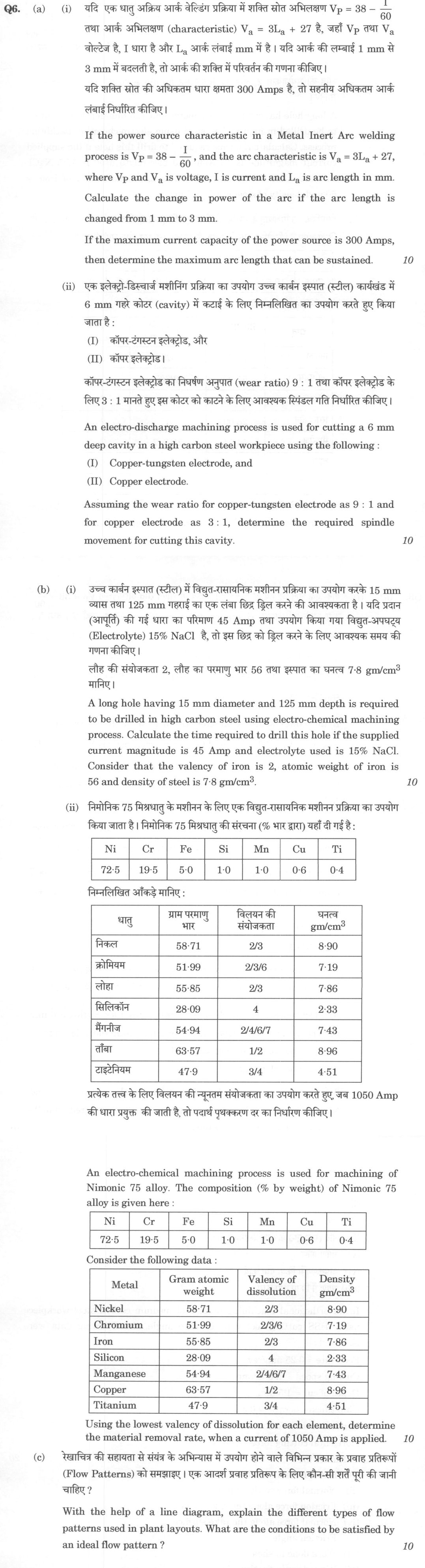
(a) (i) If the power source characteristic in a Metal Inert Arc welding process is V_P = 38 - I/60, and the arc characteristic is…
If the power source characteristic in a Metal Inert Arc welding process is V_P = 38 - I/60, and the arc characteristic is V_a = 3L_a + 27, where V_P and V_a is voltage, I is current and L_a is arc length in mm. Calculate the change in power of the arc if the arc length is changed from 1 mm to 3 mm.
If the maximum current capacity of the power source is 300 Amps, then determine the maximum arc length that can be sustained. 10 marks
An electro-discharge machining process is used for cutting a 6 mm deep cavity in a high carbon steel workpiece using the following:
(I) Copper-tungsten electrode, and
(II) Copper electrode.
Assuming the wear ratio for copper-tungsten electrode as 9 : 1 and for copper electrode as 3 : 1, determine the required spindle movement for cutting this cavity. 10 marks
A long hole having 15 mm diameter and 125 mm depth is required to be drilled in high carbon steel using electro-chemical machining process. Calculate the time required to drill this hole if the supplied current magnitude is 45 Amp and electrolyte used is 15% NaCl. Consider that the valency of iron is 2, atomic weight of iron is 56 and density of steel is 7·8 gm/cm³. 10 marks
An electro-chemical machining process is used for machining of Nimonic 75 alloy. The composition (% by weight) of Nimonic 75 alloy is given here:
| Ni | Cr | Fe | Si | Mn | Cu | Ti |
|---|---|---|---|---|---|---|
| 72·5 | 19·5 | 5·0 | 1·0 | 1·0 | 0·6 | 0·4 |
Consider the following data:
| Metal | Gram atomic weight | Valency of dissolution | Density gm/cm³ |
|---|---|---|---|
| Nickel | 58·71 | 2/3 | 8·90 |
| Chromium | 51·99 | 2/3/6 | 7·19 |
| Iron | 55·85 | 2/3 | 7·86 |
| Silicon | 28·09 | 4 | 2·33 |
| Manganese | 54·94 | 2/4/6/7 | 7·43 |
| Copper | 63·57 | 1/2 | 8·96 |
| Titanium | 47·9 | 3/4 | 4·51 |
Using the lowest valency of dissolution for each element, determine the material removal rate, when a current of 1050 Amp is applied. 10 marks
With the help of a line diagram, explain the different types of flow patterns used in plant layouts. What are the conditions to be satisfied by an ideal flow pattern ? 10 marks
हिंदी में प्रश्न पढ़ें
यदि एक धातु अक्रिय आर्क वेल्डिंग प्रक्रिया में शक्ति स्रोत अभिलक्षण V_P = 38 - I/60 तथा आर्क अभिलक्षण (characteristic) V_a = 3L_a + 27 है, जहाँ V_P तथा V_a वोल्टेज है, I धारा है और L_a आर्क लंबाई mm में है। यदि आर्क की लंबाई 1 mm से 3 mm में बदलती है, तो आर्क की शक्ति में परिवर्तन की गणना कीजिए।
यदि शक्ति स्रोत की अधिकतम धारा क्षमता 300 Amps है, तो सहनीय अधिकतम आर्क लंबाई निर्धारित कीजिए। 10
एक इलेक्ट्रो-डिस्चार्ज मशीनिंग प्रक्रिया का उपयोग उच्च कार्बन इस्पात (स्टील) कार्यखंड में 6 mm गहरे कोटर (cavity) में कटाई के लिए निम्नलिखित का उपयोग करते हुए किया जाता है :
(I) कॉपर-टंगस्टन इलेक्ट्रोड, और
(II) कॉपर इलेक्ट्रोड।
कॉपर-टंगस्टन इलेक्ट्रोड का निष्कर्षण अनुपात (wear ratio) 9 : 1 तथा कॉपर इलेक्ट्रोड के लिए 3 : 1 मानते हुए इस कोटर को काटने के लिए आवश्यक स्पिंडल गति निर्धारित कीजिए। 10
उच्च कार्बन इस्पात (स्टील) में विद्युत-रासायनिक मशीनिंग प्रक्रिया का उपयोग करके 15 mm व्यास तथा 125 mm गहराई का एक लंबा छिद्र ड्रिल करने की आवश्यकता है। यदि प्रदान (आपूर्ति) की गई धारा का परिमाण 45 Amp तथा उपयोग किया गया विद्युत-अपघट्य (Electrolyte) 15% NaCl है, तो इस छिद्र को ड्रिल करने के लिए आवश्यक समय की गणना कीजिए।
लोह की संयोजकता 2, लोह का परमाणु भार 56 तथा इस्पात का घनत्व 7·8 gm/cm³ मानिए। 10
निमोनिक 75 मिश्रधातु के मशीनिंग के लिए एक विद्युत-रासायनिक मशीनिंग प्रक्रिया का उपयोग किया जाता है। निमोनिक 75 मिश्रधातु की संरचना (% भार द्वारा) यहाँ दी गई है:
निम्नलिखित आँकड़े मानिए :
| धातु | ग्राम परमाणु भार | विलयन की संयोजकता | घनत्व gm/cm³ |
|---|---|---|---|
| निकल | 58·71 | 2/3 | 8·90 |
| क्रोमियम | 51·99 | 2/3/6 | 7·19 |
| लोहा | 55·85 | 2/3 | 7·86 |
| सिलिकॉन | 28·09 | 4 | 2·33 |
| मैंगनीज | 54·94 | 2/4/6/7 | 7·43 |
| ताँबा | 63·57 | 1/2 | 8·96 |
| टाइटेनियम | 47·9 | 3/4 | 4·51 |
प्रत्येक तत्व के लिए विलयन की न्यूनतम संयोजकता का उपयोग करते हुए, जब 1050 Amp की धारा प्रयुक्त की जाती है, तो पदार्थ पृथक्करण दर का निर्धारण कीजिए। 10
रेखाचित्र की सहायता से संयंत्र के अभिन्यास में उपयोग होने वाले विभिन्न प्रकार के प्रवाह प्रतिरूपों (Flow Patterns) को समझाइए । एक आदर्श प्रवाह प्रतिरूप के लिए कौन-सी शर्तें पूरी की जानी चाहिए ? 10 marks
Model answer
Written by UPSC Answer Check against this question's marking rubric, to the expected length. UPSC does not publish answers for Mains — this is one way to score well, not an official key.
(a)(i) For stable arc, V_P = V_a. V_P = 38 − I/60, V_a = 3L_a + 27. Thus 38 − I/60 = 3L_a + 27 ⇒ I = 60(11 − 3L_a).
At L_a = 1 mm: V_a = 30 V, I = 60(11 − 3) = 480 A. P_1 = V_a I = 30 × 480 = 14,400 W = 14.4 kW.
At L_a = 3 mm: V_a = 36 V, I = 60(11 − 9) = 120 A. P_3 = 36 × 120 = 4,320 W = 4.32 kW.
Change in arc power: ΔP = P_3 − P_1 = 4,320 − 14,400 = −10,080 W. ΔP = −10.08 kW (decrease by 10.08 kW).
If maximum current capacity is 300 A: I ≤ 300 ⇒ 60(11 − 3L_a) ≤ 300 ⇒ 11 − 3L_a ≤ 5 ⇒ L_a ≥ 2 mm. So 300 A sets the minimum sustainable arc length at 2 mm. The theoretical maximum sustainable arc length is set by open-circuit voltage at I → 0: 38 = 3L_a + 27 ⇒ L_a = 11/3 mm ≈ 3.67 mm. Maximum arc length = 11/3 mm ≈ 3.67 mm; minimum due to 300 A limit = 2 mm. Note: L_a = 1 mm would require 480 A, so it is not sustainable if the source is limited to 300 A.
(a)(ii) Let wear ratio = workpiece volume removed : electrode volume worn. For constant cross-section, this equals cavity depth : electrode wear length. Electrode wear w = cavity depth / wear ratio. Spindle movement = cavity depth + w = 6 + w.
Copper-tungsten electrode, wear ratio 9 : 1: w = 6/9 = 2/3 mm. Spindle movement = 6 + 2/3 = 20/3 = 6.667 mm.
Copper electrode, wear ratio 3 : 1: w = 6/3 = 2 mm. Spindle movement = 6 + 2 = 8 mm.
Assumption: uniform end wear and same cross-section of electrode and cavity.
(b)(i) Volume of hole: V = (π/4)d²h = (π/4)(1.5 cm)²(12.5 cm) = 7.03125π cm³ ≈ 22.089 cm³. Mass removed: m = ρV = 7.8 × 22.089 ≈ 172.294 g.
By Faraday’s law for ECM: dm/dt = A I/(z F) = 56 × 45 / (2 × 96500) = 0.013057 g/s.
Time: t = m / (dm/dt) = 172.294 / 0.013057 ≈ 13,195.8 s = 3.665 h ≈ 3 h 40 min. t = (940875π/224) s ≈ 1.32 × 10⁴ s ≈ 3.67 h. Assumption: 100% current efficiency and uniform dissolution.
(b)(ii) Using lowest valency: Ni = 2, Cr = 2, Fe = 2, Si = 4, Mn = 2, Cu = 1, Ti = 3. For alloy, S = Σ(w_i z_i / A_i).
Ni: 0.725 × 2/58.71 = 0.02470 Cr: 0.195 × 2/51.99 = 0.00750 Fe: 0.05 × 2/55.85 = 0.00179 Si: 0.01 × 4/28.09 = 0.00142 Mn: 0.01 × 2/54.94 = 0.000364 Cu: 0.006 × 1/63.57 = 0.000094 Ti: 0.004 × 3/47.9 = 0.000251
S ≈ 0.03612.
Mass removal rate: dm/dt = I/(F S) = 1050/(96500 × 0.03612) = 0.3012 g/s = 18.07 g/min.
Alloy density by inverse rule: 1/ρ = Σ(w_i/ρ_i) ≈ 0.12214 cm³/g ρ ≈ 8.19 g/cm³.
Volume removal rate: MRR = 0.3012 / 8.19 = 0.0368 cm³/s = 2.21 cm³/min = 2207 mm³/min.
MRR ≈ 0.301 g/s = 18.07 g/min = 2.21 cm³/min (≈2207 mm³/min).
(c) Common flow patterns in plant layouts:
- Straight-line flow: → □ → □ → □ →
- U-flow: → □ → □ → ↓ ↑ ↓ ← □ ← □ ←
- S-flow or zig-zag: → □ → □ → ↓ ← □ ← □ ←
- L-flow: → □ → □ ↓ □ → □
- Circular flow: → □ → □ → ↑ ↓ ← □ ← □ ←
- Comb flow: a main aisle with branches: □ □ □ ↑ ↑ ↑ → → → → →
Conditions to be satisfied by an ideal flow pattern:
- Operations must follow the required sequence.
- No backtracking, cross-movement or congestion.
- Shortest possible travel distance and time.
- Unidirectional, continuous and smooth flow.
- Minimum material handling and work-in-process.
- Flexibility for product/volume changes.
- Safe working, good space utilisation and easy supervision.
What "Calculate" is asking you to do
Apply the standard formula or schedule to data the question has already supplied — a table of readings, cost records, a balance sheet — and produce the number. The method is rarely in doubt; the marks sit in the named intermediate quantities, each of which has to appear as a labelled line.
Structure that answers it
Data as given → formula or standard treatment, named → substitution → each intermediate, labelled → result with units
Where marks are lost
Omitting an intermediate the marking scheme pays for separately, or rounding at an intermediate line so the final figure drifts. In commerce and accountancy, any figure in a statement that no numbered working note supports is treated as unearned.
How this answer will be evaluated
Approach
(a(i)) calculate: given > formula > substitution > result with units > interpretation | (a(ii)) calculate: given > formula > substitution > result with units > interpretation | (b(i)) calculate: given > formula > substitution > result with units > interpretation | (b(ii)) calculate: given > formula > substitution > result with units > interpretation | (c) explain: definition/context > points in order > small example > short close Full marks: All calculations correct with clear steps; diagrams labelled; physical interpretation included.
Key points expected
- Equate power source and arc voltage equations
- Calculate current for L_a = 1 mm and 3 mm
- Compute power change using P = VI
- Solve for L_a when I = 300 A
- Define wear ratio as Workpiece:Electrode
- Calculate electrode wear for Cu-W (9:1)
- Calculate electrode wear for Cu (3:1)
- Add cavity depth to electrode wear
Evaluation rubric
Each sub-part is marked on its own, against the marks and word limit printed on the paper.
- (a(i)) Determine change in arc power and maximum sustainable arc length. 10 marks
calculate— given → formula → substitution → result with units → interpretation
Must cover
- Equate power source and arc voltage equations
- Calculate current for L_a = 1 mm and 3 mm
- Compute power change using P = VI
- Solve for L_a when I = 300 A
Loses marks
- Using P = I^2R instead of P = VI
- Ignoring the constant term in arc equation
Earns more
- Explicitly state V_P = V_a condition
- Show substitution steps for both lengths
- Verify units for voltage and current
Extra mark
- Sketch of V-I characteristic curves
- (a(ii)) Determine required spindle movement for EDM cavity cutting. 10 marks
calculate— given → formula → substitution → result with units → interpretation
Must cover
- Define wear ratio as Workpiece:Electrode
- Calculate electrode wear for Cu-W (9:1)
- Calculate electrode wear for Cu (3:1)
- Add cavity depth to electrode wear
Loses marks
- Inverting the wear ratio (Electrode:Workpiece)
- Forgetting to add the initial cavity depth
Earns more
- Explicit calculation of 6mm/9 and 6mm/3
- Clear distinction between the two electrode cases
Extra mark
- Note on why Cu-W is preferred for deep cavities
- (b(i)) Calculate time required to drill a hole via ECM. 10 marks
calculate— given → formula → substitution → result with units → interpretation
Must cover
- Calculate volume of material to be removed
- Apply Faraday's law of electrolysis
- Substitute valency (2) and atomic weight (56)
- Solve for time in seconds
Loses marks
- Using wrong valency for iron
- Unit mismatch in volume (mm^3 vs cm^3)
Earns more
- Correct conversion of volume to mass using density
- Use of Faraday's constant (96500 C/mol)
Extra mark
- Mention of efficiency factor if applicable
- (b(ii)) Determine material removal rate for Nimonic 75 alloy. 10 marks
calculate— given → formula → substitution → result with units → interpretation
Must cover
- Identify lowest valency for each element
- Calculate equivalent weight for each component
- Apply Faraday's law for the alloy mixture
- Sum contributions to find total MRR
Loses marks
- Using highest valency instead of lowest
- Ignoring the weight percentage of minor elements
Earns more
- Tabulated calculation of equivalent weights
- Correct handling of weight percentages
Extra mark
- Comparison of MRR with pure iron
- (c) Explain flow patterns in plant layouts and ideal conditions. 10 marks
explain— definition/context → points in order → small example → short close
Must cover
- Define flow pattern in context of layout
- Describe different types (e.g., linear, U-shaped)
- Provide a line diagram for at least one type
- List conditions for an ideal flow pattern
Loses marks
- No diagram provided
- Vague description of 'ideal' conditions
Earns more
- Clear distinction between process and product layout
- Mention of backtracking or cross-traffic issues
Extra mark
- Example of a specific industry layout
Practice this exact question
Write your answer and it is marked point by point against the model answer above — what you covered, what you missed, what you got wrong.
Evaluate my answer →More from Mechanical Engineering 2025 Paper I
- Q3 (a) (i) The recoil mechanism of a gun consists of a critically damped spring-damper syste…
- Q4 (a) A car is moving in a straight line with a velocity of v = (0·6t² + 2t) m/s for a shor…
- Q5 (a) A low carbon steel stock of thickness 25 mm is to be rolled in two stages. In the fir…
- Q6 (a) (i) If the power source characteristic in a Metal Inert Arc welding process is V_P =…
- Q7 (a) HSS cutting tool with 9° rake angle, the following data were observed in an orthogona…
- Q8 (a) What are the various computer languages used for NC machines? Explain the merits and…