Paper I — Q4
(a) A car is moving in a straight line with a velocity of v = (0·6t² + 2t) m/s for a short duration, where t is in seconds. Take…
A car is moving in a straight line with a velocity of v = (0·6t² + 2t) m/s for a short duration, where t is in seconds. Take initial time t = 0, s = 0. Find : distance travelled in 4 s, and
acceleration at 4 s. 10 marks
A solid shaft AB rotates at 450 rpm and transmits 20 kW from the motor M to machine tools connected to gears F and G. A power of 8 kW is taken off at gear F and 12 kW is taken off at gear G. The allowable shear stress is 55 MPa. Determine the smallest permissible diameter of the shaft AB. 20 marks
In an epicyclic gear train of the sun and planet type shown in the figure below, the annular gear 'A' meshes internally. The three identical planet wheels 'P' of equal size, mesh with annular gear 'A' and the sun wheel 'S'. The planet wheels are carried by a star shaped spider 'C'. The size of the different toothed wheels are such that the spider 'C' which carries the planet wheels is to make one revolution for every 5 rotations of the spindle carrying the sun wheel 'S', when the gear 'A' is stationary. If the minimum number of teeth on any wheel is 14, determine the number of teeth for all the wheels. Further, if the driving torque on the sun wheel is 200 N-m, determine the fixing torque required to keep the annular gear 'A' stationary. 10 marks
In a four cylinder symmetrical engine, the intermediate cranks are at 90° and each has a reciprocating mass of 500 kg. The engine is in complete primary balance. The centre distance between intermediate cranks is 600 mm and between extreme cranks is 1800 mm. The lengths of the connecting rods and cranks are 800 mm and 200 mm, respectively. Determine the masses fixed to the extreme cranks along with their relative angular positions. If the engine speed is 150 rpm, find the magnitude of secondary unbalanced forces. 10 marks
हिंदी में प्रश्न पढ़ें
अल्पकाल के लिए एक कार सीधी रेखा में v = (0·6t² + 2t) m/s के वेग से चल रही है, जहाँ t सेकेंड में है। प्रारंभिक समय t = 0, s = 0 लीजिए। ज्ञात कीजिए : 4 s में तय की गई दूरी, और
4 s पर त्वरण। (10 अंक)
एक ठोस शाफ्ट AB 450 rpm पर घूमता है तथा मोटर M से गियर F एवं G द्वारा जुड़े मशीन टूल्स को 20 kW संचारित करता है। गियर F पर 8 kW की शक्ति हटाई गई है तथा गियर G पर 12 kW की शक्ति हटाई गई है। अनुमेय (स्वीकार्य) अपरूपण प्रतिबल 55 MPa है। शाफ्ट AB का सबसे छोटा अनुमेय व्यास निर्धारित कीजिए। (20 अंक)
सूर्य और ग्रह प्रकार की एक अधिचक्रिक गियर माला नीचे चित्र में दर्शाई गई है। वलयाकार गियर 'A' आंतरिक रूप से अन्तयोजित है। तीन समान आकार के एकसमान ग्रह चक्र 'P', वलयाकार गियर 'A' तथा सूर्य (सन) चक्र 'S' के साथ अन्तयोजित है। ग्रह चक्रों को एक तारे (स्टार) के आकार के लूता (स्पाइडर) 'C' द्वारा ले जाया जाता है। विभिन्न दांतदार चक्रों के आकार इस प्रकार हैं कि सूर्य चक्र 'S' को ले जाने वाले तर्कु (स्पिंडल) के प्रत्येक 5 घूर्णन पर, ग्रह चक्रों को ले जाने वाला लूता 'C' एक परिक्रमण करता है, जबकि गियर 'A' स्थिर होता है। यदि किसी भी चक्र पर दांतों की न्यूनतम संख्या 14 हो, तो सभी चक्रों पर दांतों की संख्या निर्धारित कीजिए। यदि सूर्य चक्र पर चालन बल-आघूर्ण 200 N-m हो, तो वलयाकार गियर 'A' को स्थिर बनाए रखने के लिए आवश्यक स्थिरीकरण बल-आघूर्ण (फिक्सिंग टार्क) निर्धारित कीजिए। (10 अंक)
एक चार सिलिंडर सममित इंजन में, मध्यवर्ती क्रैंक 90° पर है तथा प्रत्येक का प्रत्यागामी द्रव्यमान 500 kg है। इंजन पूर्ण प्राथमिक संतुलन में है। मध्यवर्ती क्रैंकों के बीच केंद्र दूरी 600 mm तथा चरम क्रैंकों के बीच 1800 mm है। कनेक्टिंग रॉडों तथा क्रैंकों की लंबाई क्रमशः: 800 mm तथा 200 mm है। चरम क्रैंकों पर निर्धारित द्रव्यमानों को उनकी सापेक्ष कोणीय स्थितियों के साथ निर्धारित कीजिए। यदि इंजन की गति 150 rpm है, तो द्वितीयक असंतुलित बलों का परिमाण ज्ञात कीजिए। (10 अंक)
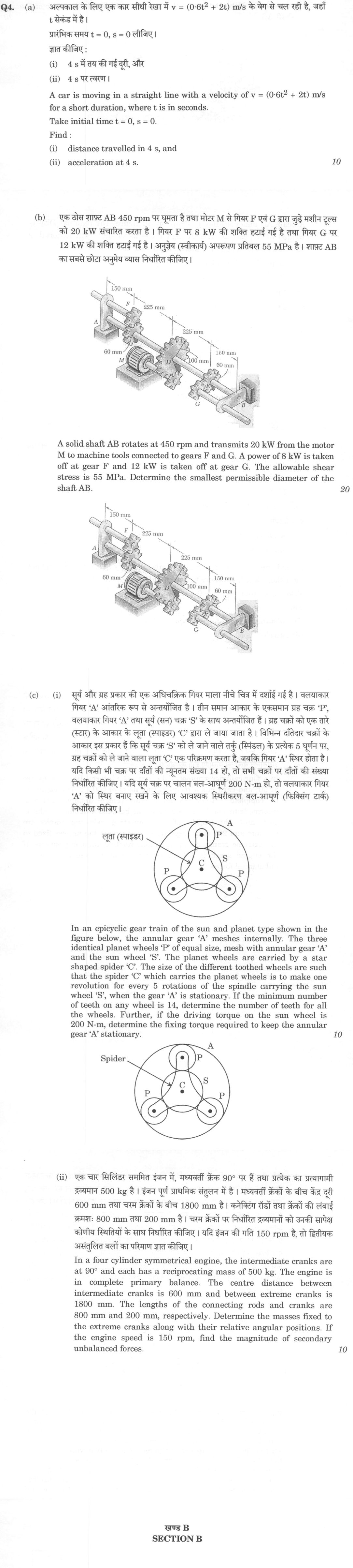
The figure this question refers to, in words
The question paper is a scan and the diagram did not survive as text. This is the figure as read from the original page — every component, value and label — so the question can be worked from the text below.
(b) A 3D isometric view of a mechanical shaft assembly. A solid horizontal shaft is supported at its left end by a bearing labeled 'A' and at its right end by a bearing labeled 'B'. A motor labeled 'M' is mounted on a base below the shaft, driving a large gear labeled 'D' which is mounted on the shaft. To the left of gear D, a smaller gear labeled 'F' is mounted on the shaft. To the right of gear D, a smaller gear labeled 'G' is mounted on the shaft. Gear F meshes with a gear on a parallel upper shaft, and gear G meshes with a gear on a parallel lower shaft. Dimensions are provided along the shaft: 150 mm from support A to gear F, 225 mm from gear F to gear D, 225 mm from gear D to gear G, and 150 mm from gear G to support B. Vertical dimensions indicate the distance from the shaft axis to the center of the upper parallel shaft is 100 mm, and the distance from the shaft axis to the center of the lower parallel shaft is 60 mm. The motor M is positioned below the shaft, with a vertical dimension of 60 mm indicated from the shaft axis to the motor centerline.
(c) A schematic diagram of an epicyclic gear train. A central circle represents the sun wheel, labeled 'S'. Three identical planet wheels, labeled 'P', are arranged symmetrically around the sun wheel, each meshing with it. These planet wheels are also meshing with a large outer annular gear, labeled 'A', which encloses the entire assembly. The centers of the three planet wheels are connected by a star-shaped carrier or spider, labeled 'C'. An arrow points to the spider with the label 'Spider' (or 'लूता (स्पाइडर)' in the Hindi version). The diagram shows the relative positions of the sun, planets, annular gear, and the carrier.
What "Solve" is asking you to do
Choose the method, then carry it through to a final answer. Identifying what kind of problem this is and why that method applies is the first thing marked; a correct figure arrived at invisibly earns almost nothing.
Structure that answers it
Given data and what is required → method chosen, with the reason it applies → set-up (equation, circuit, free body, trial balance) → working, step by step → answer with units and any condition of validity
Where marks are lost
Doing the middle steps mentally and writing only the result. In mathematics papers, a further loss comes from giving a decimal where the exact value in surds or fractions was wanted, or from skipping the justification a part explicitly asks for.
How this answer will be evaluated
Approach
(a) calculate: given > formula > substitution > result with units > interpretation | (b) calculate: given > formula > substitution > result with units > interpretation | (c(i)) calculate: given > formula > substitution > result with units > interpretation | (c(ii)) calculate: given > formula > substitution > result with units > interpretation Full marks: Complete method with all steps, units, and physical interpretation
Key points expected
- Integrate v(t) to find displacement s(t)
- Differentiate v(t) to find acceleration a(t)
- Substitute t=4s into s(t) and a(t)
- State final answers with correct units
- Calculate torque in each shaft segment
- Identify segment with maximum torque
- Apply torsion formula τ = 16T/πd³
- Solve for d using τ_allow = 55 MPa
Evaluation rubric
Each sub-part is marked on its own, against the marks and word limit printed on the paper.
- (a) Distance in 4s and acceleration at 4s from v(t). 10 marks
calculate— given → formula → substitution → result with units → interpretation
Must cover
- Integrate v(t) to find displacement s(t)
- Differentiate v(t) to find acceleration a(t)
- Substitute t=4s into s(t) and a(t)
- State final answers with correct units
Loses marks
- Differentiating v(t) to find distance
- Omitting units in final answers
Earns more
- Explicitly states initial conditions t=0, s=0
- Shows integration constant determination
Extra mark
- Sketches v-t graph showing area under curve
- (b) Smallest permissible diameter of shaft AB. 20 marks
calculate— given → formula → substitution → result with units → interpretation
Must cover
- Calculate torque in each shaft segment
- Identify segment with maximum torque
- Apply torsion formula τ = 16T/πd³
- Solve for d using τ_allow = 55 MPa
Loses marks
- Using total 20kW for all segments
- Omitting units in torque calculation
Earns more
- Draws free body diagram of shaft
- Shows power-to-torque conversion explicitly
Extra mark
- Checks diameter against standard sizes
- (c(i)) Number of teeth for all wheels and fixing torque. 10 marks
calculate— given → formula → substitution → result with units → interpretation
Must cover
- Apply tabular method for epicyclic train
- Use condition: 1 rev C per 5 revs S
- Solve for teeth numbers with min 14
- Calculate fixing torque on gear A
Loses marks
- Guessing teeth numbers without derivation
- Omitting torque balance equation
Earns more
- Shows complete tabular method working
- Verifies gear meshing condition
Extra mark
- Draws labelled gear train diagram
- (c(ii)) Masses on extreme cranks and secondary unbalanced force. 10 marks
calculate— given → formula → substitution → result with units → interpretation
Must cover
- Apply primary balance conditions
- Determine masses and angular positions
- Calculate secondary unbalanced force
- Use given engine speed 150 rpm
Loses marks
- Ignoring secondary force calculation
- Omitting angular position specification
Earns more
- Draws crank position diagram
- Shows force polygon construction
Extra mark
- States balance factor explicitly
Model answer coming soon
Every evaluation on this site is marked against a verified model answer. This question's answer is still being written; evaluation opens the moment it lands.
More from Mechanical Engineering 2025 Paper I
- Q1 (a) A gripper is shown in the figure. A horizontal force F = 50 N is applied to the handl…
- Q2 (a) (i) A cylinder C weighing 1000 N is supported by two cylinders A and B weighing 500 N…
- Q3 (a) (i) The recoil mechanism of a gun consists of a critically damped spring-damper syste…
- Q4 (a) A car is moving in a straight line with a velocity of v = (0·6t² + 2t) m/s for a shor…
- Q5 (a) A low carbon steel stock of thickness 25 mm is to be rolled in two stages. In the fir…
- Q6 (a) (i) If the power source characteristic in a Metal Inert Arc welding process is V_P =…
- Q7 (a) HSS cutting tool with 9° rake angle, the following data were observed in an orthogona…