Paper II — Q1
(a) A lump of ice with a mass of 1·5 kg at an initial temperature of 260 K melts at the pressure of 1 bar as a result of heat…
A lump of ice with a mass of 1·5 kg at an initial temperature of 260 K melts at the pressure of 1 bar as a result of heat transfer from the environment. After some time, the resulting water attains the temperature of environment, 293 K. Calculate the entropy production associated with this process. The latent heat of fusion of ice is 334 kJ/kg, the specific heat of ice and water are 2·07 kJ/kg-K and 4·2 kJ/kg-K, respectively. Assume that ice melts at 273·15 K. 10 marks
Downstream of a normal shock wave, the characteristic Mach number M*_y = 0·5 and the stagnation pressure is 2 bar. Determine the following: The Mach number M_y downstream of the shock
The stagnation pressure upstream of the shock The fluid is air and γ = 1·4, and R = 0·287 kJ/kg-K. Normal shock table and Isentropic flow table provided at the end, may be used. 10 marks
Show, in the form of a table, how the following parameters change (increase/decrease/remain constant) across a normal shock wave: Static pressure, Static temperature, Stagnation pressure, Stagnation temperature, Stagnation density, Mach number, Entropy and Stagnation enthalpy 10 marks
At a certain instant of time, the temperature across a large wall of thickness 50 cm is given as T(x) = 90 - 80x + 16x² + 32x³ - 25x⁴ where x is in metres and measured from the left face of the wall as shown in the figure below and T is in °C. If the area of the wall is 10 m² and there is no generation of heat in the wall, compute the following: The rate of heat entering and leaving the wall
The rate of heat energy stored in the wall
The rate of temperature change with time at x = 0 and x = 0·5 m 10 marks
A 120 W electric bulb has a filament temperature of 3005 °C. Assuming the filament to be black, calculate (i) the diameter of the filament wire if the length is 250 mm and (ii) the efficiency of the bulb based on visible radiation if the visible radiation lies in the wavelength range from 0·4 μm to 0·75 μm. Assume Stefan-Boltzmann constant (σ) as 5.67×10⁻⁸ W/m²-K⁴. The black body radiation functions are given in the table:
| λT(μm-K) | f₀→λ | |
|---|---|---|
| 1300 | 0.004317 | |
| 1400 | 0.007791 | |
| 2400 | 0.140266 | |
| 2500 | 0.161366 | (10 marks) |
हिंदी में प्रश्न पढ़ें
एक बर्फ का टुकड़ा, जिसका द्रव्यमान 1·5 kg और प्रारंभिक तापमान 260 K है, वातावरण से ऊष्मा स्थानांतरण के कारण 1 bar दाब पर पिघलता है। कुछ समय पश्चात्, परिणामी जल वातावरण के तापमान 293 K को प्राप्त करता है। इस प्रक्रिया से संबंधित एंट्रॉपी उत्पादन की गणना कीजिए। बर्फ के पिघलने की गुप्त ऊष्मा (लैटेंट हीट) 334 kJ/kg है, बर्फ और पानी की विशिष्ट ऊष्माएँ (स्पेसिफिक हीट) क्रमशः: 2·07 kJ/kg-K तथा 4·2 kJ/kg-K हैं। मान लीजिए कि बर्फ 273·15 K पर पिघलती है। (10 अंक)
सामान्य प्रयात-तरंग (शॉक वेव) के अनुप्रवाह (डाउनस्ट्रीम) में अभिलक्षणिक मैक संख्या M*_y = 0·5 तथा स्थगन दाब (स्टैग्नेशन प्रेशर) 2 bar है। निम्नलिखित को निर्धारित कीजिए: प्रयात (शॉक) के अनुप्रवाह में मैक संख्या M_y
प्रयात के प्रतिप्रवाह (अपस्ट्रीम) में स्थगन दाब तरल, वायु है और γ = 1·4 तथा R = 0·287 kJ/kg-K है। अंत में दिये गये सामान्य प्रयात (शॉक) तालिका तथा आइसेंट्रॉपिक प्रवाह तालिका का उपयोग किया जा सकता है। (10 अंक)
सारणी के रूप में दर्शाइये कि निम्नलिखित प्राचल सामान्य प्रयात तरंग (शॉक वेव) के लिए कैसे परिवर्तित होते हैं (बढ़ते हैं/घटते हैं/स्थिर रहते हैं): स्थैतिक दाब, स्थैतिक तापमान, स्थगन दाब, स्थगन तापमान, स्थगन घनत्व, मैक संख्या, एंट्रॉपी और स्थगन एन्थैल्पी (10 अंक)
किसी एक निश्चित समय पर 50 cm मोटाई की एक बड़ी दीवार पर तापमान को निम्न प्रकार दर्शाया गया है: T(x) = 90 - 80x + 16x² + 32x³ - 25x⁴ जहाँ x मीटर में है तथा नीचे चित्र में दर्शाये अनुसार दीवार के बायें पृष्ठ से मापा गया है एवं T डिग्री सेल्सियस में है। यदि दीवार का क्षेत्रफल 10 m² है और दीवार में ऊष्मा का कोई उत्पादन नहीं हो रहा है, तो निम्नलिखित की गणना कीजिये: दीवार में प्रवेश करने और दीवार से बाहर निकलने वाली ऊष्मा की दर
दीवार में संग्रहीत ऊष्मा ऊर्जा (हीट एनर्जी) की दर
x = 0 तथा x = 0.5 m पर समय के साथ तापमान परिवर्तन की दर (10 अंक)
एक 120 W विद्युत बल्ब के तंतु (फिलामेंट) का तापमान 3005 °C है। तंतु को काला मानते हुए निम्नलिखित की गणना कीजिये: तंतु तार का व्यास, यदि उसकी लम्बाई 250 mm है
बल्ब की दक्षता, दृश्यमान विकिरण (विजिबल रेडिएशन) के आधार पर, यदि दृश्यमान विकिरण की तरंगदैर्ध्य सीमा (वेवलेंथ रेंज) 0.4 μm से 0.75 μm के बीच है स्टीफन-बोल्ट्ज़मान नियतांक (σ) को 5.67×10⁻⁸ W/m²-K⁴ मानिये। कृष्णिका (ब्लैक बॉडी) विकिरण फलन (रेडिएशन फंक्शन) सारणी में दिये गये हैं:
| λT(μm-K) | f₀→λ | |
|---|---|---|
| 1300 | 0.004317 | |
| 1400 | 0.007791 | |
| 2400 | 0.140266 | |
| 2500 | 0.161366 | (10 अंक) |
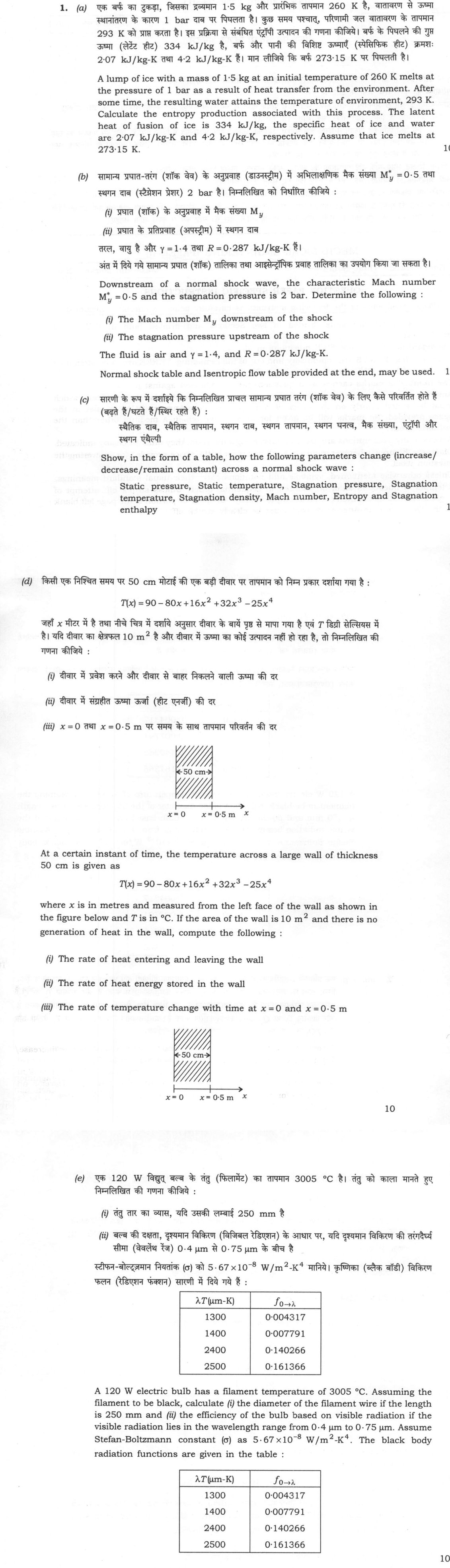
The figure this question refers to, in words
The question paper is a scan and the diagram did not survive as text. This is the figure as read from the original page — every component, value and label — so the question can be worked from the text below.
(b) Table titled 'Normal Shocks in Perfect Gases (gamma = 1.4)' with columns: Mx, My, py / px, Ty / Tx, p0y / p0x, p0y / px: 1.00, 1.000, 1.000, 1.000, 1.000, 1.893 1.05, 0.953, 1.119, 1.033, 0.999, 2.008 1.10, 0.912, 1.245, 1.065, 0.999, 2.133 1.12, 0.896, 1.297, 1.077, 0.998, 2.185 1.14, 0.882, 1.349, 1.090, 0.997, 2.239 1.16, 0.868, 1.403, 1.103, 0.996, 2.294 1.18, 0.855, 1.458, 1.115, 0.995, 2.350 1.20, 0.842, 1.513, 1.128, 0.993, 2.407 1.22, 0.829, 1.569, 1.140, 0.991, 2.466 1.24, 0.818, 1.627, 1.153, 0.988, 2.526 1.26, 0.807, 1.686, 1.166, 0.985, 2.587 1.28, 0.796, 1.745, 1.178, 0.983, 2.650 1.30, 0.786, 1.805, 1.191, 0.979, 2.714 1.32, 0.776, 1.866, 1.203, 0.976, 2.778 1.34, 0.766, 1.928, 1.216, 0.972, 2.844 1.36, 0.757, 1.991, 1.229, 0.967, 2.911 1.38, 0.748, 2.055, 1.242, 0.963, 2.979 1.40, 0.739, 2.120, 1.255, 0.958, 3.049 1.42, 0.731, 2.186, 1.267, 0.953, 3.119 1.44, 0.723, 2.253, 1.281, 0.947, 3.192 1.46, 0.716, 2.320, 1.294, 0.942, 3.264 1.48, 0.708, 2.389, 1.307, 0.936, 3.338 1.50, 0.701, 2.458, 1.320, 0.929, 3.413 1.52, 0.694, 2.529, 1.333, 0.923, 3.489 1.54, 0.687, 2.600, 1.347, 0.916, 3.567 1.56, 0.681, 2.672, 1.361, 0.907, 3.645 1.58, 0.675, 2.746, 1.374, 0.903, 3.725 1.60, 0.668, 2.820, 1.388, 0.895, 3.805 1.70, 0.641, 3.205, 1.458, 0.856, 4.224 1.75, 0.628, 3.406, 1.495, 0.834, 4.443 1.80, 0.616, 3.613, 1.532, 0.813, 4.669 1.85, 0.605, 3.826, 1.569, 0.790, 4.902 1.90, 0.595, 4.045, 1.608, 0.767, 5.142 2.00, 0.577, 4.500, 1.687, 0.721, 5.641 2.50, 0.513, 7.125, 2.137, 0.499, 8.526 3.00, 0.475, 10.333, 2.679, 0.328, 12.061 3.50, 0.451, 14.125, 3.315, 0.213, 16.242 4.00, 0.435, 18.500, 4.047, 0.138, 21.068 4.50, 0.423, 23.548, 4.875, 0.0917, 26.539 5.00, 0.415, 29.000, 5.800, 0.0617, 32.654
(b) Table titled 'Isentropic Flow of Perfect Gases (gamma = 1.4)' for Question Nos. 1(b) and 2(b): Columns: M, M*, T/T0, p/p0, A/A*, F/F*, Ap / A* p0 Row values: 0.00, 0.000, 1.000, 1.000, infinity, infinity, infinity 0.05, 0.0548, 0.999, 0.998, 11.592, 9.158, 11.571 0.10, 0.1094, 0.998, 0.993, 5.822, 4.624, 5.781 0.15, 0.1640, 0.996, 0.984, 3.910, 3.132, 3.849 0.20, 0.218, 0.992, 0.973, 2.964, 2.400, 2.882 0.25, 0.272, 0.987, 0.957, 2.403, 1.973, 2.301 0.30, 0.326, 0.982, 0.939, 2.035, 1.698, 1.912 0.35, 0.378, 0.976, 0.918, 1.778, 1.509, 1.634 0.40, 0.431, 0.969, 0.895, 1.590, 1.375, 1.424 0.45, 0.483, 0.961, 0.870, 1.448, 1.276, 1.261 0.50, 0.534, 0.954, 0.843, 1.339, 1.203, 1.129 0.55, 0.585, 0.943, 0.814, 1.255, 1.147, 1.022 0.60, 0.635, 0.933, 0.784, 1.188, 1.105, 0.932 0.65, 0.684, 0.922, 0.753, 1.135, 1.073, 0.855 0.70, 0.732, 0.910, 0.721, 1.094, 1.049, 0.789 0.75, 0.779, 0.898, 0.688, 1.062, 1.031, 0.731 0.80, 0.825, 0.886, 0.656, 1.038, 1.018, 0.681 0.85, 0.870, 0.874, 0.623, 1.020, 1.009, 0.636 0.90, 0.914, 0.860, 0.591, 1.009, 1.004, 0.596 0.95, 0.958, 0.847, 0.559, 1.002, 1.001, 0.560 1.00, 1.000, 0.833, 0.528, 1.000, 1.000, 0.528 1.10, 1.081, 0.805, 0.468, 1.008, 1.003, 0.472 1.20, 1.158, 0.776, 0.412, 1.030, 1.011, 0.425 1.30, 1.231, 0.747, 0.361, 1.066, 1.022, 0.385 1.40, 1.300, 0.718, 0.314, 1.115, 1.034, 0.350 1.50, 1.364, 0.689, 0.272, 1.176, 1.048, 0.320 1.60, 1.425, 0.661, 0.235, 1.250, 1.063, 0.294 1.70, 1.482, 0.634, 0.202, 1.337, 1.078, 0.271 1.80, 1.536, 0.607, 0.174, 1.439, 1.093, 0.250 1.90, 1.586, 0.581, 0.149, 1.555, 1.108, 0.232 2.00, 1.633, 0.555, 0.128, 1.687, 1.123, 0.215 2.25, 1.737, 0.497, 0.0865, 2.096, 1.156, 0.181 2.50, 1.826, 0.444, 0.0585, 2.637, 1.187, 0.154 2.75, 1.900, 0.398, 0.0397, 3.337, 1.213, 0.133 3.00, 1.964, 0.357, 0.027, 4.234, 1.236, 0.115 3.50, 2.064, 0.289, 0.013, 6.789, 1.274, 0.089 4.00, 2.138, 0.238, 0.00658, 10.719, 1.303, 0.0706 4.50, 2.194, 0.198, 0.00346, 16.562, 1.325, 0.057 5.00, 2.236, 0.166, 0.00189, 25.000, 1.341, 0.047
(d) A cross-sectional diagram of a wall shown as a vertically oriented hatched rectangular slab. An x-axis is drawn horizontally along the bottom, pointing to the right. The left face of the wall is located at x = 0, and the right face is located at x = 0.5 m, corresponding to the wall thickness marked inside the slab by a horizontal double-headed arrow labeled '50 cm'.
(e) Table of black body radiation functions: Column headers: lambda T (micrometer-K), f_0->lambda Row 1: 1300, 0.004317 Row 2: 1400, 0.007791 Row 3: 2400, 0.140266 Row 4: 2500, 0.161366
Model answer
Written by UPSC Answer Check against this question's marking rubric, to the expected length. UPSC does not publish answers for Mains — this is one way to score well, not an official key.
(a) Take the environment as a reservoir at T₀ = 293 K. The ice warms from 260 K to 273.15 K, melts at 273.15 K, then the resulting water warms from 273.15 K to 293 K.
- ΔS_ice = m c_i ln(T_m/T_i) = 1.5 × 2.07 × ln(273.15/260) = 0.1532 kJ/K
- ΔS_melt = m L/T_m = 1.5 × 334/273.15 = 1.8342 kJ/K
- ΔS_water = m c_w ln(293/273.15) = 1.5 × 4.2 × ln(293/273.15) = 0.4420 kJ/K
Thus, ΔS_system = 0.1532 + 1.8342 + 0.4420 = 2.4293 kJ/K.
Heat taken from the environment: Q = 1.5 × 2.07 × (273.15 − 260) + 1.5 × 334 + 1.5 × 4.2 × (293 − 273.15) Q = 40.8308 + 501 + 125.055 = 666.8858 kJ
Entropy change of the environment: ΔS_env = −Q/T₀ = −666.8858/293 = −2.2761 kJ/K
Entropy production: S_gen = ΔS_system + ΔS_env = 2.4293 − 2.2761 = 0.1532 kJ/K
Final: S_gen ≈ 0.153 kJ/K, or 0.1533 kJ/K to four decimal places.
(b)(i) For a normal shock, the characteristic Mach numbers satisfy M*ₓ M*ᵧ = 1. Given M*ᵧ = 0.5, therefore M*ₓ = 2.0.
The relation between M and M* is: M*² = 2.4 M²/(2 + 0.4 M²)
For downstream: 0.25 = 2.4 Mᵧ²/(2 + 0.4 Mᵧ²) 0.5 + 0.1 Mᵧ² = 2.4 Mᵧ² Mᵧ² = 0.5/2.3 = 5/23 = 0.21739 Mᵧ = √(5/23) = 0.4663
Final: Mᵧ = 0.4663.
(b)(ii) For upstream, M*ₓ = 2, so: 4 = 2.4 Mₓ²/(2 + 0.4 Mₓ²) 8 + 1.6 Mₓ² = 2.4 Mₓ² Mₓ² = 10 Mₓ = √10 = 3.1623
Using the normal-shock stagnation-pressure ratio: p₀ᵧ/p₀ₓ = [2.4 Mₓ²/(2 + 0.4 Mₓ²)]^3.5 × [2.4/(2γMₓ² − 0.4)]^2.5
For Mₓ² = 10: p₀ᵧ/p₀ₓ = [24/6]^3.5 × [2.4/27.6]^2.5 = 4^3.5 × (2/23)^2.5 = 0.28541
Given p₀ᵧ = 2 bar: p₀ₓ = 2/0.28541 = 7.0075 bar
Final: p₀ₓ ≈ 7.008 bar.
(c) Across a normal shock wave:
- Static pressure: increases
- Static temperature: increases
- Stagnation pressure: decreases
- Stagnation temperature: remains constant
- Stagnation density: decreases
- Mach number: decreases
- Entropy: increases
- Stagnation enthalpy: remains constant
(d) The temperature profile is: T(x) = 90 − 80x + 16x² + 32x³ − 25x⁴ °C
Differentiating: dT/dx = −80 + 32x + 96x² − 100x³ °C/m d²T/dx² = 32 + 192x − 300x² °C/m²
At x = 0: dT/dx = −80 K/m d²T/dx² = 32 K/m²
At x = 0.5 m: dT/dx = −80 + 16 + 24 − 12.5 = −52.5 K/m d²T/dx² = 32 + 96 − 75 = 53 K/m²
Using Fourier’s law, Q = −kA dT/dx.
(d)(i) Rate of heat entering at left face: Q_in = −k(10)(−80) = 800k W
Rate of heat leaving at right face: Q_out = −k(10)(−52.5) = 525k W
Here k is the thermal conductivity in W/m-K. Since k is not supplied in the question, the numerical W values cannot be fixed without it.
(d)(ii) Rate of heat energy stored: Q_stored = Q_in − Q_out = 800k − 525k = 275k W
(d)(iii) For no heat generation: ∂T/∂t = α d²T/dx²
At x = 0: ∂T/∂t = 32α °C/s
At x = 0.5 m: ∂T/∂t = 53α °C/s
Here α = k/(ρc) is the thermal diffusivity in m²/s. Since α is not supplied, numerical °C/s values cannot be computed.
Final: Q_in = 800k W, Q_out = 525k W, Q_stored = 275k W; ∂T/∂t at x = 0 is 32α °C/s and at x = 0.5 m is 53α °C/s.
(e)(i) Filament temperature: T = 3005 + 273.15 = 3278.15 K
For a black filament: P = σA_s T⁴ = σπdL T⁴
T⁴ = 1.15482 × 10¹⁴ K⁴ σT⁴ = 5.67 × 10⁻⁸ × 1.15482 × 10¹⁴ = 6.5478 × 10⁶ W/m²
A_s = 120/(6.5478 × 10⁶) = 1.8327 × 10⁻⁵ m²
L = 250 mm = 0.25 m
d = A_s/(πL) = 1.8327 × 10⁻⁵/(π × 0.25) d = 2.333 × 10⁻⁵ m = 0.02333 mm = 23.33 μm
Final: d ≈ 2.33 × 10⁻⁵ m.
(e)(ii) Visible range: 0.4 μm to 0.75 μm.
λ₁T = 0.4 × 3278.15 = 1311.26 μm-K λ₂T = 0.75 × 3278.15 = 2458.61 μm-K
Interpolating from the given blackbody radiation functions: f₁ ≈ 0.004317 + (11.26/100)(0.007791 − 0.004317) = 0.004708 f₂ ≈ 0.140266 + (58.61/100)(0.161366 − 0.140266) = 0.152633
Fraction of radiation in visible range: f_visible = f₂ − f₁ = 0.152633 − 0.004708 = 0.147925
Efficiency = 0.147925 × 100 = 14.79%
Visible power = 0.147925 × 120 = 17.75 W
Final: visible-radiation efficiency ≈ 14.79%.
What "Calculate" is asking you to do
Apply the standard formula or schedule to data the question has already supplied — a table of readings, cost records, a balance sheet — and produce the number. The method is rarely in doubt; the marks sit in the named intermediate quantities, each of which has to appear as a labelled line.
Structure that answers it
Data as given → formula or standard treatment, named → substitution → each intermediate, labelled → result with units
Where marks are lost
Omitting an intermediate the marking scheme pays for separately, or rounding at an intermediate line so the final figure drifts. In commerce and accountancy, any figure in a statement that no numbered working note supports is treated as unearned.
How this answer will be evaluated
Approach
(a) calculate: given > formula > substitution > result with units > interpretation | (b) calculate: given > formula > substitution > result with units > interpretation | (c) describe: define > structure or process in order > labelled diagram > significance | (d) calculate: given > formula > substitution > result with units > interpretation | (e) calculate: given > formula > substitution > result with units > interpretation Full marks: All parts show complete method with correct equations, units, and physical interpretation.
Key points expected
- System entropy change via ice, fusion, water steps
- Surroundings entropy change using environment temperature
- Entropy production as sum of system and surroundings
- Correct units and final value
- Determine M_y from characteristic Mach number M*_y
- Use normal shock relations for pressure ratio
- Calculate upstream stagnation pressure from downstream
- Correct application of γ = 1.4
Evaluation rubric
Each sub-part is marked on its own, against the marks and word limit printed on the paper.
- (a) Entropy production for ice melting and heating to environment temperature. 10 marks
calculate— given → formula → substitution → result with units → interpretation
Must cover
- System entropy change via ice, fusion, water steps
- Surroundings entropy change using environment temperature
- Entropy production as sum of system and surroundings
- Correct units and final value
Loses marks
- Using environment T for system entropy change
- Omitting latent heat contribution
Earns more
- Explicit T-s diagram of process
- Clear separation of three heat transfer stages
Extra mark
- Comment on irreversibility due to finite ΔT
- (b) Mach number and upstream stagnation pressure for normal shock. 10 marks
calculate— given → formula → substitution → result with units → interpretation
Must cover
- Determine M_y from characteristic Mach number M*_y
- Use normal shock relations for pressure ratio
- Calculate upstream stagnation pressure from downstream
- Correct application of γ = 1.4
Loses marks
- Confusing stagnation and static pressure
- Incorrect Mach number relation
Earns more
- Reference to normal shock table values
- Clear definition of characteristic Mach number
Extra mark
- Sketch of flow with shock location
- (c) Table showing parameter changes across normal shock wave. 10 marks
describe— define → structure or process in order → labelled diagram → significance
Must cover
- Table format with all 8 parameters listed
- Correct increase/decrease/constant for each
- Static pressure and temperature increase
- Stagnation pressure decrease, entropy increase
Loses marks
- Incorrect change for stagnation temperature
- Missing parameters from the list
Earns more
- Brief physical reasoning for each change
- Mention of adiabatic nature of shock
Extra mark
- Note on stagnation enthalpy remaining constant
- (d) Heat rates and temperature change for wall with given T(x). 10 marks
calculate— given → formula → substitution → result with units → interpretation
Must cover
- Fourier's law for heat flux at x=0 and x=0.5
- Heat entering and leaving rates with area
- Energy storage rate from heat balance
- Temperature change rate using heat equation
Loses marks
- Incorrect derivative of T(x)
- Ignoring area in heat rate calculation
Earns more
- Correct differentiation of T(x) polynomial
- Clear sign convention for heat flow
Extra mark
- Sketch of temperature profile across wall
- (e) Filament diameter and visible radiation efficiency for bulb. 10 marks
calculate— given → formula → substitution → result with units → interpretation
Must cover
- Stefan-Boltzmann law for total radiation
- Diameter calculation from power and area
- Visible fraction from black body table
- Efficiency as visible power over total power
Loses marks
- Using Celsius in Stefan-Boltzmann law
- Incorrect wavelength range for visible light
Earns more
- Correct interpolation from radiation table
- Clear conversion of temperature to Kelvin
Extra mark
- Note on assumption of black body behavior
Practice this exact question
Write your answer and it is marked point by point against the model answer above — what you covered, what you missed, what you got wrong.
Evaluate my answer →More from Mechanical Engineering 2025 Paper II
- Q1 (a) A lump of ice with a mass of 1·5 kg at an initial temperature of 260 K melts at the p…
- Q2 (a) (i) A reversible power cycle engine is used to drive a reversible heat pump. The powe…
- Q3 (a) A long cylindrical rod of radius 10 cm consists of a nuclear reacting material (k = 0…
- Q4 (a) A shell and tube type condenser is employed in a steam power plant to handle 35000 kg…