Paper II — Q2
(a) (i) A reversible power cycle engine is used to drive a reversible heat pump. The power cycle takes in Q₁ heat units at…
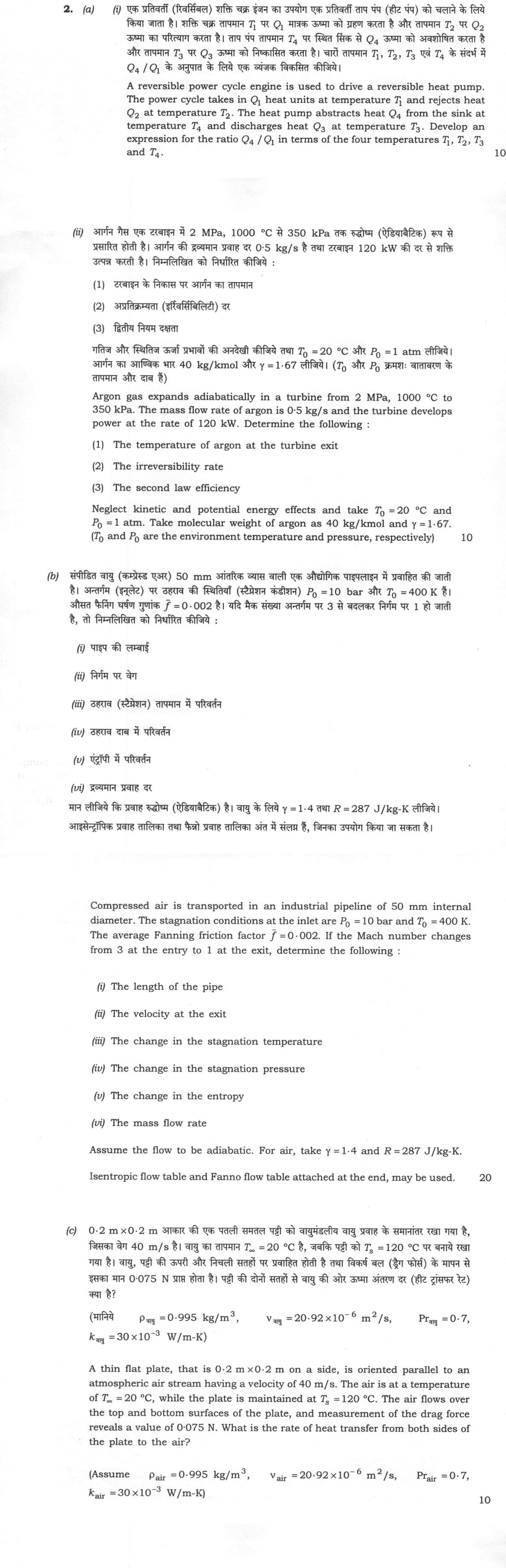
A reversible power cycle engine is used to drive a reversible heat pump. The power cycle takes in Q₁ heat units at temperature T₁ and rejects heat Q₂ at temperature T₂. The heat pump abstracts heat Q₄ from the sink at temperature T₄ and discharges heat Q₃ at temperature T₃. Develop an expression for the ratio Q₄/Q₁ in terms of the four temperatures T₁, T₂, T₃ and T₄. 10 marks
Argon gas expands adiabatically in a turbine from 2 MPa, 1000 °C to 350 kPa. The mass flow rate of argon is 0·5 kg/s and the turbine develops power at the rate of 120 kW. Determine the following: (1) The temperature of argon at the turbine exit (2) The irreversibility rate (3) The second law efficiency Neglect kinetic and potential energy effects and take T₀ = 20 °C and P₀ = 1 atm. Take molecular weight of argon as 40 kg/kmol and γ = 1·67. (T₀ and P₀ are the environment temperature and pressure, respectively) 10 marks
Compressed air is transported in an industrial pipeline of 50 mm internal diameter. The stagnation conditions at the inlet are P₀ = 10 bar and T₀ = 400 K. The average Fanning friction factor f̄ = 0·002. If the Mach number changes from 3 at the entry to 1 at the exit, determine the following: The length of the pipe
The velocity at the exit
The change in the stagnation temperature
The change in the stagnation pressure
The change in the entropy
The mass flow rate Assume the flow to be adiabatic. For air, take γ = 1·4 and R = 287 J/kg-K. Isentropic flow table and Fanno flow table attached at the end, may be used. 20 marks
A thin flat plate, that is 0·2 m×0·2 m on a side, is oriented parallel to an atmospheric air stream having a velocity of 40 m/s. The air is at a temperature of T∞ = 20 °C, while the plate is maintained at Ts = 120 °C. The air flows over the top and bottom surfaces of the plate, and measurement of the drag force reveals a value of 0·075 N. What is the rate of heat transfer from both sides of the plate to the air? (Assume ρair = 0·995 kg/m³, νair = 20·92×10⁻⁶ m²/s, Prair = 0·7, kair = 30×10⁻³ W/m-K) 10 marks
हिंदी में प्रश्न पढ़ें
एक प्रतिवर्ती (रिवर्सिबल) शक्ति चक्र इंजन का उपयोग एक प्रतिवर्ती ताप पंप (हीट पंप) को चलाने के लिये किया जाता है। शक्ति चक्र तापमान T₁ पर Q₁ मात्रक ऊष्मा को ग्रहण करता है और तापमान T₂ पर Q₂ ऊष्मा का परित्याग करता है। ताप पंप तापमान T₄ पर स्थित सिंक से Q₄ ऊष्मा को अवशोषित करता है और तापमान T₃ पर Q₃ ऊष्मा को निष्कासित करता है। चारों तापमान T₁, T₂, T₃ एवं T₄ के संदर्भ में Q₄/Q₁ के अनुपात के लिये एक व्यंजक विकसित कीजिये। (10 अंक)
आर्गन गैस एक टरबाइन में 2 MPa, 1000 °C से 350 kPa तक रूद्धोष्म (एडियाबैटिक) रूप से प्रसारित होती है। आर्गन की द्रव्यमान प्रवाह दर 0·5 kg/s है तथा टरबाइन 120 kW की दर से शक्ति उत्पन्न करती है। निम्नलिखित को निर्धारित कीजिए: (1) टरबाइन के निकास पर आर्गन का तापमान (2) अप्रतिक्रमता (इरिवर्सिबिलिटी) दर (3) द्वितीय नियम दक्षता गतिज और स्थितिज ऊर्जा प्रभावों की अनदेखी कीजिए तथा T₀ = 20 °C और P₀ = 1 atm लीजिए। आर्गन का आण्विक भार 40 kg/kmol और γ = 1·67 लीजिए। (T₀ और P₀ क्रमशः वातावरण के तापमान और दाब हैं) (10 अंक)
संपीडित वायु (कम्प्रेस्ड एयर) 50 mm आंतरिक व्यास वाली एक औद्योगिक पाइपलाइन में प्रवाहित की जाती है। अंतर्गम (इनलेट) पर ठहराव की स्थितियाँ (स्टेशन कंडीशन) P₀ = 10 bar और T₀ = 400 K हैं। औसत फैनिंग घर्षण गुणांक f̄ = 0·002 है। यदि मैक संख्या अंतर्गम पर 3 से बदलकर निर्गम पर 1 हो जाती है, तो निम्नलिखित को निर्धारित कीजिए: पाइप की लंबाई
निर्गम पर वेग
ठहराव (स्टैग्नेशन) तापमान में परिवर्तन
ठहराव दाब में परिवर्तन
एंट्रॉपी में परिवर्तन
द्रव्यमान प्रवाह दर मान लीजिए कि प्रवाह रूद्धोष्म (एडियाबैटिक) है। वायु के लिये γ = 1·4 तथा R = 287 J/kg-K लीजिए। आइसेंट्रॉपिक प्रवाह तालिका तथा फैनो प्रवाह तालिका अंत में संलग्न हैं, जिनका उपयोग किया जा सकता है। (20 अंक)
0·2 m×0·2 m आकार की एक पतली समतल पट्टी को वायुमंडलीय वायु प्रवाह के समानांतर रखा गया है, जिसका वेग 40 m/s है। वायु का तापमान T∞ = 20 °C है, जबकि पट्टी को Ts = 120 °C पर बनाये रखा गया है। वायु, पट्टी की ऊपरी और निचली सतहों पर प्रवाहित होती है तथा विकर्ष बल (ड्रैग फोर्स) के मापन से इसका मान 0·075 N प्राप्त होता है। पट्टी की दोनों सतहों से वायु की ओर उष्मा अंतरण दर (हीट ट्रांसफर रेट) क्या है? (मानिये ρवायु = 0·995 kg/m³, νवायु = 20·92×10⁻⁶ m²/s, Prवायु = 0·7, kवायु = 30×10⁻³ W/m-K) (10 अंक)
Model answer
Written by UPSC Answer Check against this question's marking rubric, to the expected length. UPSC does not publish answers for Mains — this is one way to score well, not an official key.
(a)(i) For the reversible power cycle, efficiency is η = W/Q₁ = 1 − T₂/T₁. Hence W = Q₁(T₁ − T₂)/T₁.
For the reversible heat pump, Q₃/T₃ = Q₄/T₄ and W = Q₃ − Q₄. Thus W/Q₄ = (T₃ − T₄)/T₄, so Q₄ = W·T₄/(T₃ − T₄).
Substituting W: Q₄/Q₁ = T₄(T₁ − T₂)/[T₁(T₃ − T₄)].
Final: Q₄/Q₁ = T₄(T₁ − T₂)/[T₁(T₃ − T₄)], with all temperatures absolute and T₁ > T₂, T₃ > T₄.
(a)(ii)(1) For argon, R = 8314/40 = 207.85 J/kg·K. c_p = γR/(γ−1) = 1.67×207.85/0.67 = 518.07 J/kg·K. T₁ = 1000 + 273.15 = 1273.15 K.
First law for adiabatic turbine: W_dot = m_dot·c_p(T₁ − T₂). 120×10³ = 0.5×518.07×(1273.15 − T₂). T₂ = 1273.15 − 120000/(0.5×518.07) = 809.90 K.
Final: T₂ = 809.90 K = 536.75 °C.
(a)(ii)(2) Entropy change of argon: s₂ − s₁ = c_p ln(T₂/T₁) − R ln(P₂/P₁). P₂/P₁ = 350/2000 = 0.175, T₂/T₁ = 809.90/1273.15 = 0.63614. s₂ − s₁ = 518.07 ln(0.63614) − 207.85 ln(0.175) = −234.35 + 362.28 = 127.93 J/kg·K.
Irreversibility rate: I_dot = T₀·m_dot·(s₂ − s₁) = 293.15×0.5×127.93 = 18.75×10³ W.
Final: I_dot = 18.75 kW.
(a)(ii)(3) Second-law efficiency is taken as actual work divided by reversible work: η_II = W_dot/(W_dot + I_dot) = 120/(120 + 18.75) = 0.8649.
Final: η_II = 86.49% ≈ 86.5%. P₀ does not enter this turbine irreversibility directly; it only fixes the dead state.
(b)(i) For Fanno flow, 4fL*/D = (1 − M²)/(γM²) + (γ + 1)/(2γ) ln[((γ + 1)M²)/(2 + (γ − 1)M²)]. At M = 3, γ = 1.4: 4fL*/D = (1 − 9)/(1.4×9) + 2.4/2.8 ln[(2.4×9)/(2 + 0.4×9)] = −0.63492 + 0.85714 ln(21.6/5.6) = −0.63492 + 1.15708 = 0.52216. For exit M = 1, L* = 0. Thus L = D(0.52216)/(4f) = 0.05×0.52216/(4×0.002) = 3.263 m.
Final: L = 3.263 m.
(b)(ii) At exit M₂ = 1. Since flow is adiabatic, T₀ = 400 K. T₂ = T₀/[1 + (γ − 1)M₂²/2] = 400/1.2 = 333.33 K. a₂ = √(γRT₂) = √(1.4×287×333.33) = 365.97 m/s. V₂ = M₂a₂ = 365.97 m/s.
Final: V₂ = 365.97 m/s.
(b)(iii) Adiabatic no-work Fanno flow gives T₀ = constant.
Final: ΔT₀ = 0 K.
(b)(iv) For Fanno flow, P₀₁/P₀₂ = (1/M₁)[(2 + (γ − 1)M₁²)/(γ + 1)]^(γ + 1)/[2(γ − 1)]. At M₁ = 3: P₀₁/P₀₂ = (1/3)(5.6/2.4)³ = 343/81 = 4.23457. P₀₂ = 10/4.23457 = 2.3615 bar. ΔP₀ = 2.3615 − 10 = −7.6385 bar.
Final: ΔP₀ = −7.6385 bar = −763.85 kPa.
(b)(v) For adiabatic Fanno flow with constant T₀, Δs = R ln(P₀₁/P₀₂) = 287 ln(343/81) = 414.22 J/kg·K. Total entropy rate = m_dotΔs ≈ 0.9371×414.22 = 388.1 W/K.
Final: Δs = 414.22 J/kg·K (increase).
(b)(vi) At exit M = 1, P₂ = P₀₂/(1.2)^3.5 = 2.3615×10⁵/1.89293 = 1.2475×10⁵ Pa. A = πD²/4 = π(0.05)²/4 = 1.9635×10⁻³ m². m_dot = A P₂ V₂/(RT₂) = 1.9635×10⁻³×1.2475×10⁵×365.97/(287×333.33) = 0.937 kg/s.
Final: m_dot = 0.937 kg/s.
(c) The plate has area per side = 0.2×0.2 = 0.04 m², so wetted area for both sides A_s = 0.08 m². Average wall shear stress: τ_w = F_D/A_s = 0.075/0.08 = 0.9375 Pa.
Dynamic pressure: q = 0.5ρU² = 0.5×0.995×40² = 796 Pa. C_f = τ_w/q = 0.9375/796 = 0.001178.
Using Reynolds–Colburn analogy, h = τ_w c_p/(U Pr^(2/3)). μ = ρν = 0.995×20.92×10⁻⁶ = 2.0815×10⁻⁵ kg/m·s. c_p = Pr·k/μ = 0.7×0.030/(2.0815×10⁻⁵) = 1008.9 J/kg·K. Pr^(2/3) = 0.7^(2/3) = 0.7884. h = 0.9375×1008.9/(40×0.7884) = 30.0 W/m²·K.
Heat transfer from both sides: Q = hA_s(T_s − T∞) = 30.0×0.08×(120 − 20) = 240 W.
Final: Q = 240 W.
What "Calculate" is asking you to do
Apply the standard formula or schedule to data the question has already supplied — a table of readings, cost records, a balance sheet — and produce the number. The method is rarely in doubt; the marks sit in the named intermediate quantities, each of which has to appear as a labelled line.
Structure that answers it
Data as given → formula or standard treatment, named → substitution → each intermediate, labelled → result with units
Where marks are lost
Omitting an intermediate the marking scheme pays for separately, or rounding at an intermediate line so the final figure drifts. In commerce and accountancy, any figure in a statement that no numbered working note supports is treated as unearned.
How this answer will be evaluated
Approach
(a(i)) derive: given > assumptions > stepwise derivation > result > check | (a(ii)) calculate: given > formula > substitution > result with units > interpretation | (b) calculate: given > formula > substitution > result with units > interpretation | (c) calculate: given > formula > substitution > result with units > interpretation Full marks: All parts solved with correct method, clear steps, and physical interpretation.
Key points expected
- Identify W = Q1 - Q2 for power cycle
- Identify W = Q3 - Q4 for heat pump
- Apply Carnot relations Q1/T1 = Q2/T2 and Q3/T3 = Q4/T4
- Equate work terms to eliminate W
- Energy balance to find T2
- Entropy generation for irreversibility rate
- Second law efficiency definition and calculation
- Use of ideal gas relations for Argon
Evaluation rubric
Each sub-part is marked on its own, against the marks and word limit printed on the paper.
- (a(i)) Expression for Q4/Q1 in terms of T1, T2, T3, T4. 10 marks
derive— given → assumptions → stepwise derivation → result → check
Must cover
- Identify W = Q1 - Q2 for power cycle
- Identify W = Q3 - Q4 for heat pump
- Apply Carnot relations Q1/T1 = Q2/T2 and Q3/T3 = Q4/T4
- Equate work terms to eliminate W
Loses marks
- Using efficiency formulas without derivation
- Confusing heat pump and engine work signs
Earns more
- Schematic of coupled engine and heat pump
- Explicit statement of reversibility assumption
Extra mark
- T-s diagram showing both cycles
- (a(ii)) Exit temperature, irreversibility rate, and second law efficiency. 10 marks
calculate— given → formula → substitution → result with units → interpretation
Must cover
- Energy balance to find T2
- Entropy generation for irreversibility rate
- Second law efficiency definition and calculation
- Use of ideal gas relations for Argon
Loses marks
- Ignoring environment conditions for exergy
- Using wrong gamma value for Argon
Earns more
- Explicit calculation of specific heat cp
- Unit consistency check for power and mass flow
Extra mark
- T-s diagram of turbine process
- (b) Pipe length, exit velocity, and changes in T0, P0, s, and mass flow. 20 marks
calculate— given → formula → substitution → result with units → interpretation
Must cover
- Use of Fanno flow relations for adiabatic flow
- Calculation of pipe length from friction factor
- Determination of exit velocity from Mach number
- Calculation of stagnation property changes
Loses marks
- Using isentropic relations for adiabatic flow
- Ignoring friction factor in length calculation
Earns more
- Reference to Fanno flow table
- Step-by-step calculation of mass flow rate
Extra mark
- Schematic of pipeline with inlet/outlet states
- (c) Rate of heat transfer from both sides of the plate. 10 marks
calculate— given → formula → substitution → result with units → interpretation
Must cover
- Calculation of Reynolds number
- Determination of Nusselt number
- Calculation of heat transfer coefficient
- Application of Newton's law of cooling
Loses marks
- Ignoring both sides of the plate
- Using wrong formula for Nusselt number
Earns more
- Explicit calculation of drag coefficient
- Use of given air properties correctly
Extra mark
- Schematic of plate with flow direction
Practice this exact question
Write your answer and it is marked point by point against the model answer above — what you covered, what you missed, what you got wrong.
Evaluate my answer →More from Mechanical Engineering 2025 Paper II
- Q1 (a) A lump of ice with a mass of 1·5 kg at an initial temperature of 260 K melts at the p…
- Q2 (a) (i) A reversible power cycle engine is used to drive a reversible heat pump. The powe…
- Q3 (a) A long cylindrical rod of radius 10 cm consists of a nuclear reacting material (k = 0…
- Q4 (a) A shell and tube type condenser is employed in a steam power plant to handle 35000 kg…
- Q5 (a) With the help of P-θ (pressure-crank angle) diagram, compare the knock in SI and CI e…