Paper II — Q3
(a) A long cylindrical rod of radius 10 cm consists of a nuclear reacting material (k = 0·5 W/m-K) generating 24000 W/m³…
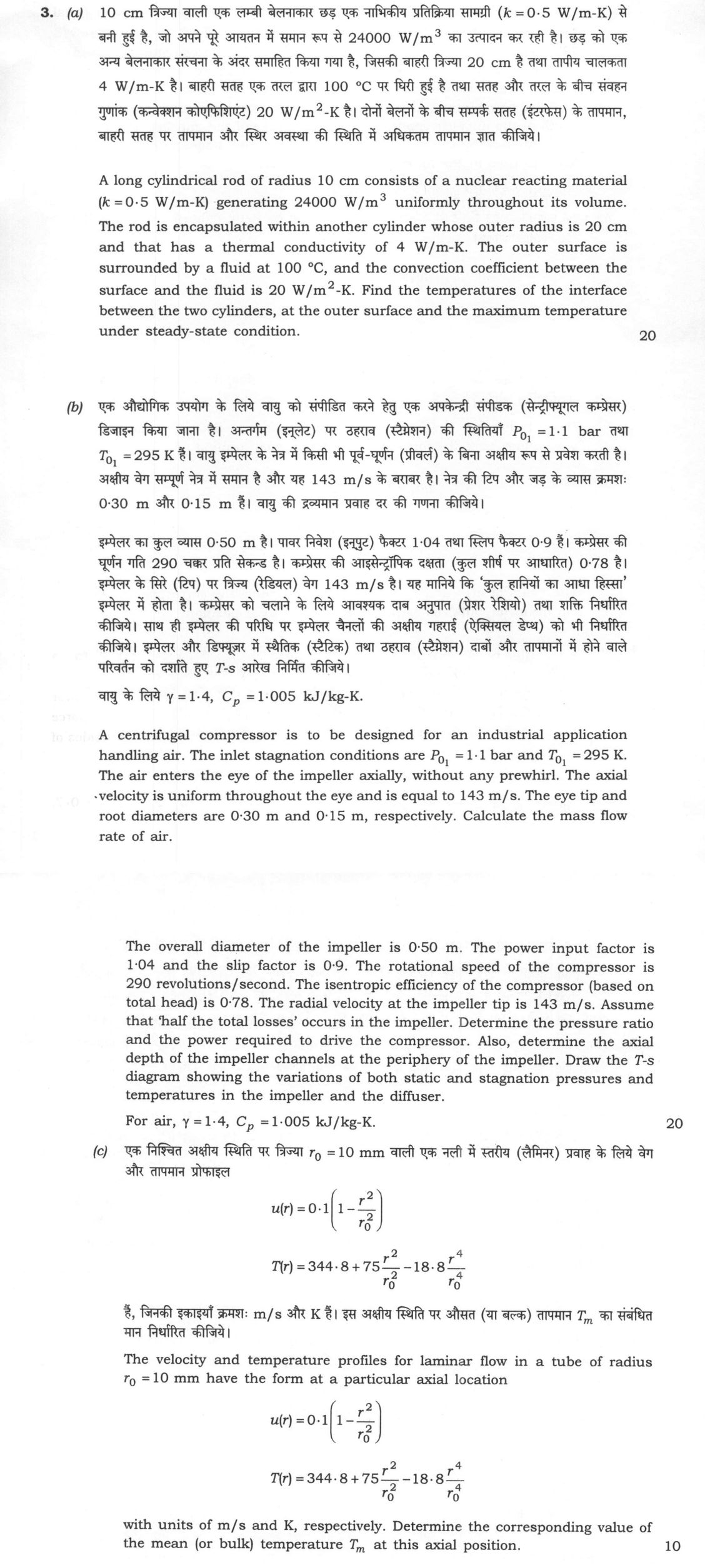
A long cylindrical rod of radius 10 cm consists of a nuclear reacting material (k = 0·5 W/m-K) generating 24000 W/m³ uniformly throughout its volume. The rod is encapsulated within another cylinder whose outer radius is 20 cm and that has a thermal conductivity of 4 W/m-K. The outer surface is surrounded by a fluid at 100 °C, and the convection coefficient between the surface and the fluid is 20 W/m²-K. Find the temperatures of the interface between the two cylinders, at the outer surface and the maximum temperature under steady-state condition. 20 marks
A centrifugal compressor is to be designed for an industrial application handling air. The inlet stagnation conditions are P₀₁ = 1·1 bar and T₀₁ = 295 K. The air enters the eye of the impeller axially, without any prewhirl. The axial velocity is uniform throughout the eye and is equal to 143 m/s. The eye tip and root diameters are 0·30 m and 0·15 m, respectively. Calculate the mass flow rate of air.
The overall diameter of the impeller is 0·50 m. The power input factor is 1·04 and the slip factor is 0·9. The rotational speed of the compressor is 290 revolutions/second. The isentropic efficiency of the compressor (based on total head) is 0·78. The radial velocity at the impeller tip is 143 m/s. Assume that 'half the total losses' occurs in the impeller. Determine the pressure ratio and the power required to drive the compressor. Also, determine the axial depth of the impeller channels at the periphery of the impeller. Draw the T-s diagram showing the variations of both static and stagnation pressures and temperatures in the impeller and the diffuser.
For air, γ = 1·4, Cp = 1·005 kJ/kg-K. 20 marks
The velocity and temperature profiles for laminar flow in a tube of radius r0 = 10 mm have the form at a particular axial location
u(r) = 0·1(1 - r²/r0²)
T(r) = 344·8 + 75 r²/r0² - 18·8 r⁴/r0⁴
with units of m/s and K, respectively. Determine the corresponding value of the mean (or bulk) temperature Tm at this axial position. 10 marks
हिंदी में प्रश्न पढ़ें
10 cm त्रिज्या वाली एक लंबी बेलनाकार छड़ एक नाभिकीय प्रतिक्रिया सामग्री (k = 0·5 W/m-K) से बनी हुई है, जो अपने पूरे आयतन में समान रूप से 24000 W/m³ का उत्पादन कर रही है। छड़ को एक अन्य बेलनाकार संरचना के अंदर समाहित किया गया है, जिसकी बाहरी त्रिज्या 20 cm है तथा तापीय चालकता 4 W/m-K है। बाहरी सतह एक तरल द्वारा 100 °C पर धिरी हुई है तथा सतह और तरल के बीच संवहन गुणांक (कन्वेक्शन कोएफिशिएंट) 20 W/m²-K है। दोनों बेलनों के बीच सम्पर्क सतह (इंटरफेस) के तापमान, बाहरी सतह पर तापमान और स्थिर अवस्था की स्थिति में अधिकतम तापमान ज्ञात कीजिये। 20 marks
एक औद्योगिक उपयोग के लिये वायु को संपीडित करने हेतु एक अपकेन्द्री संपीडक (सेंट्रीफ्यूगल कंप्रेसर) डिजाइन किया जाना है। अन्तर्गाम (इनलेट) पर ठहराव (स्टेगनेशन) की स्थितियाँ P₀₁ = 1·1 bar तथा T₀₁ = 295 K हैं। वायु इम्पेलर के नेत्र में किसी भी पूर्व-घूर्णन (प्रीव्हर्ल) के बिना अक्षीय रूप से प्रवेश करती है। अक्षीय वेग सम्पूर्ण नेत्र में समान है और यह 143 m/s के बराबर है। नेत्र की टिप और जड़ के व्यास क्रमशः 0·30 m और 0·15 m हैं। वायु की द्रव्यमान प्रवाह दर की गणना कीजिये।
इम्पेलर का कुल व्यास 0·50 m है। पावर निवेश (इनपुट) फैक्टर 1·04 तथा स्लिप फैक्टर 0·9 है। कंप्रेसर की घूर्णन गति 290 चक्कर प्रति सेकंड है। कंप्रेसर की आइसेन्ट्रॉपिक दक्षता (कुल शीर्ष पर आधारित) 0·78 है। इम्पेलर के सिरे (टिप) पर त्रिज्य (रेडियल) वेग 143 m/s है। यह मानिये कि 'कुल हानियों का आधा हिस्सा' इम्पेलर में होता है। कंप्रेसर को चलाने के लिये आवश्यक दाब अनुपात (प्रेशर रेशियो) तथा शक्ति निर्धारित कीजिये। साथ ही इम्पेलर की परिधि पर इम्पेलर चैनलों की अक्षीय गहराई (एक्सियल डेप्थ) को भी निर्धारित कीजिये। इम्पेलर और डिफ्यूजर में स्थैतिक (स्टैटिक) तथा ठहराव (स्टेगनेशन) दाबों और तापमानों में होने वाले परिवर्तन को दर्शाते हुए T-s आरेख निर्मित कीजिये।
वायु के लिये γ = 1·4, Cₚ = 1·005 kJ/kg-K. 20 marks
एक निश्चित अक्षीय स्थिति पर त्रिज्या r0 = 10 mm वाली एक नली में स्तरीय (लेमिनर) प्रवाह के लिये वेग और तापमान प्रोफाइल
u(r) = 0·1(1 - r²/r0²)
T(r) = 344·8 + 75 r²/r0² - 18·8 r⁴/r0⁴
हैं, जिनकी इकाइयाँ क्रमशः m/s और K हैं। इस अक्षीय स्थिति पर औसत (या बल्क) तापमान Tm का संबंधित मान निर्धारित कीजिये। 10 marks
What "Calculate" is asking you to do
Apply the standard formula or schedule to data the question has already supplied — a table of readings, cost records, a balance sheet — and produce the number. The method is rarely in doubt; the marks sit in the named intermediate quantities, each of which has to appear as a labelled line.
Structure that answers it
Data as given → formula or standard treatment, named → substitution → each intermediate, labelled → result with units
Where marks are lost
Omitting an intermediate the marking scheme pays for separately, or rounding at an intermediate line so the final figure drifts. In commerce and accountancy, any figure in a statement that no numbered working note supports is treated as unearned.
How this answer will be evaluated
Approach
(a) calculate: given > formula > substitution > result with units > interpretation | (b) calculate: given > formula > substitution > result with units > interpretation | (c) calculate: given > formula > substitution > result with units > interpretation Full marks: Rigorous application of governing equations with clear schematics and T-s diagrams.
Key points expected
- Schematic of concentric cylinders with radii and k values
- Heat generation balance for inner cylinder (q = 24000 W/m³)
- Conduction resistance formula for outer cylinder
- Convection boundary condition at outer surface (h=20, T∞=100)
- Mass flow rate calculation using eye area and axial velocity
- Euler work equation with slip factor (0.9) and power input factor (1.04)
- Isentropic efficiency application to determine actual work/temperature rise
- Axial depth calculation using continuity at impeller tip
Evaluation rubric
Each sub-part is marked on its own, against the marks and word limit printed on the paper.
- (a) Temperatures at interface, outer surface, and maximum (center) under steady state. 20 marks
calculate— given → formula → substitution → result with units → interpretation
Must cover
- Schematic of concentric cylinders with radii and k values
- Heat generation balance for inner cylinder (q = 24000 W/m³)
- Conduction resistance formula for outer cylinder
- Convection boundary condition at outer surface (h=20, T∞=100)
Loses marks
- Missing heat generation term in energy balance
- Confusing radius with diameter in area calculations
- Ignoring convection resistance at outer boundary
Earns more
- Explicit calculation of total heat generation rate
- Verification of steady-state heat flow continuity
- Correct identification of maximum temperature location (center)
Extra mark
- Dimensional consistency check on thermal resistance terms
- (b) Mass flow rate, pressure ratio, power required, and axial depth at periphery. 20 marks
calculate— given → formula → substitution → result with units → interpretation
Must cover
- Mass flow rate calculation using eye area and axial velocity
- Euler work equation with slip factor (0.9) and power input factor (1.04)
- Isentropic efficiency application to determine actual work/temperature rise
- Axial depth calculation using continuity at impeller tip
Loses marks
- Ignoring slip factor in work calculation
- Incorrect area calculation for annular eye
- Missing T-s diagram or unmarked states
Earns more
- T-s diagram showing static and stagnation states
- Explicit calculation of impeller tip velocity (U2)
- Clear distinction between isentropic and actual work
Extra mark
- Labelled velocity triangles at inlet and outlet
- (c) Mean (bulk) temperature Tm at the given axial position. 10 marks
calculate— given → formula → substitution → result with units → interpretation
Must cover
- Definition of bulk temperature as flow-weighted average
- Integration of T(r)u(r) over the cross-sectional area
- Integration of u(r) over the cross-sectional area
- Substitution of given polynomial profiles for u(r) and T(r)
Loses marks
- Using area-weighted average instead of flow-weighted
- Incorrect integration of the r⁴ term
- Forgetting the 2πr factor in the area element
Earns more
- Correct limits of integration (0 to r0)
- Simplification of the resulting polynomial integrals
Extra mark
- Verification of units in the final result
Model answer coming soon
Every evaluation on this site is marked against a verified model answer. This question's answer is still being written; evaluation opens the moment it lands.
More from Mechanical Engineering 2025 Paper II
- Q1 (a) A lump of ice with a mass of 1·5 kg at an initial temperature of 260 K melts at the p…
- Q2 (a) (i) A reversible power cycle engine is used to drive a reversible heat pump. The powe…
- Q3 (a) A long cylindrical rod of radius 10 cm consists of a nuclear reacting material (k = 0…
- Q4 (a) A shell and tube type condenser is employed in a steam power plant to handle 35000 kg…
- Q5 (a) With the help of P-θ (pressure-crank angle) diagram, compare the knock in SI and CI e…
- Q6 (a) A single-cylinder, two-stroke, high-speed diesel engine working on 'dual cycle' has a…