Paper II — Q5
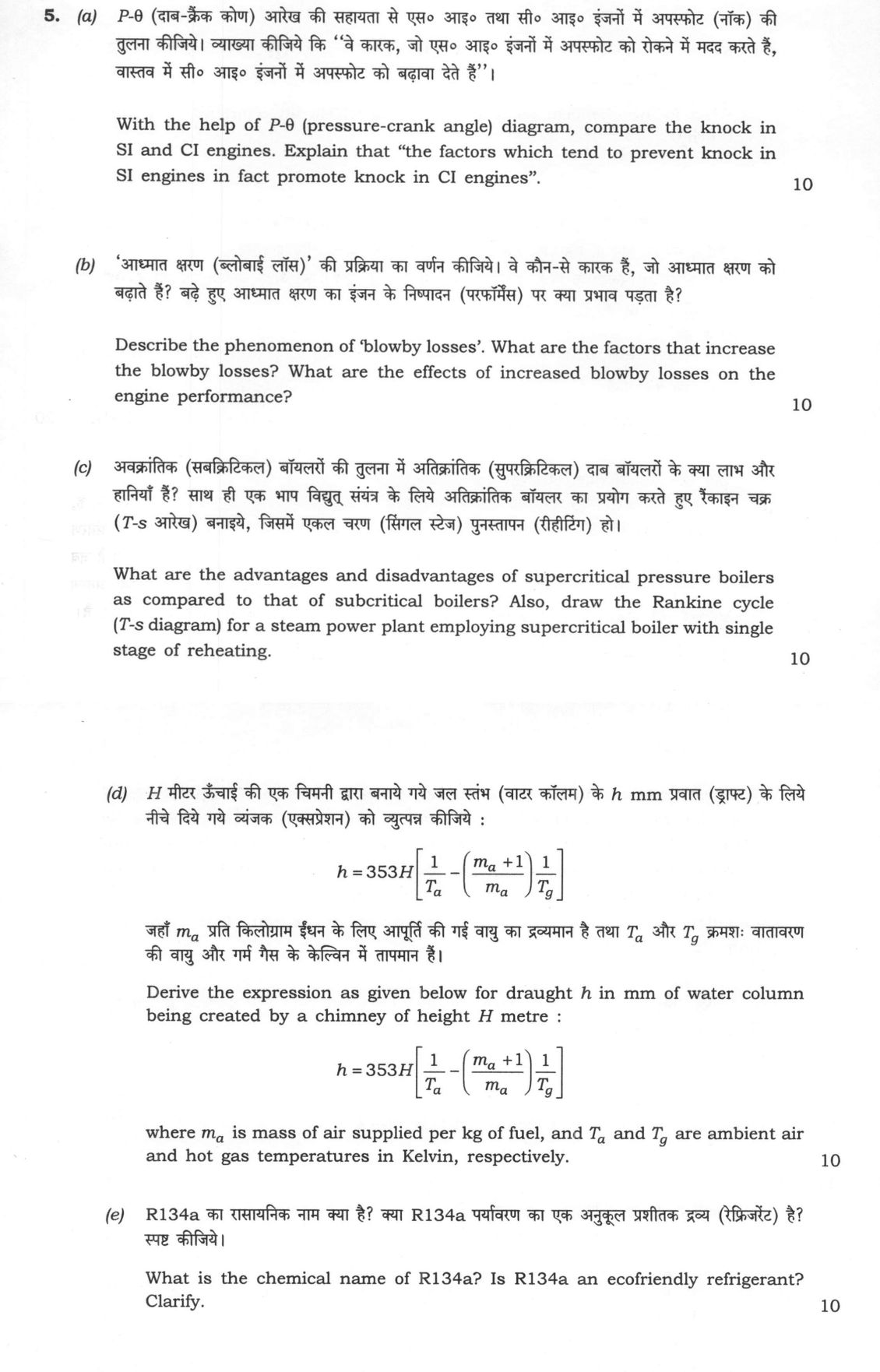
(a) With the help of P-θ (pressure-crank angle) diagram, compare the knock in SI and CI engines. Explain that "the factors which…
With the help of P-θ (pressure-crank angle) diagram, compare the knock in SI and CI engines. Explain that "the factors which tend to prevent knock in SI engines in fact promote knock in CI engines". 10 marks
Describe the phenomenon of 'blowby losses'. What are the factors that increase the blowby losses? What are the effects of increased blowby losses on the engine performance? 10 marks
What are the advantages and disadvantages of supercritical pressure boilers as compared to that of subcritical boilers? Also, draw the Rankine cycle (T-s diagram) for a steam power plant employing supercritical boiler with single stage of reheating. 10 marks
Derive the expression as given below for draught h in mm of water column being created by a chimney of height H metre:
h = 353H[1/T_a - ((m_a + 1)/m_a)(1/T_g)]
where m_a is mass of air supplied per kg of fuel, and T_a and T_g are ambient air and hot gas temperatures in Kelvin, respectively. 10 marks
What is the chemical name of R134a? Is R134a an ecofriendly refrigerant? Clarify. 10 marks
हिंदी में प्रश्न पढ़ें
P-θ (दाब-क्रैंक कोण) आरेख की सहायता से एस० आइ० तथा सी० आइ० इंजनों में अपस्फोट (नॉक) की तुलना कीजिये। व्याख्या कीजिये कि "वे कारक, जो एस० आइ० इंजनों में अपस्फोट को रोकने में मदद करते हैं, वास्तव में सी० आइ० इंजनों में अपस्फोट को बढ़ावा देते हैं"। (10 अंक)
'आधात क्षरण (ब्लोबाई लॉस)' की प्रक्रिया का वर्णन कीजिये। वे कौन-से कारक हैं, जो आधात क्षरण को बढ़ाते हैं? बढ़े हुए आधात क्षरण का इंजन के निष्पादन (परफॉर्मेंस) पर क्या प्रभाव पड़ता है? (10 अंक)
अवकांतिक (सबक्रिटिकल) बॉयलरों की तुलना में अतिकांतिक (सुपरक्रिटिकल) दाब बॉयलरों के क्या लाभ और हानियाँ हैं? साथ ही एक भाप विद्युत संयंत्र के लिये अतिकांतिक बॉयलर का प्रयोग करते हुए रैंकाइन चक्र (T-s आरेख) बनाइये, जिसमें एकल चरण (सिंगल स्टेज) पुनःस्थापन (रिहीटिंग) हो। (10 अंक)
H मीटर ऊँचाई की एक चिमनी द्वारा बनाये गये जल स्तंभ (वाटर कॉलम) के h mm प्रवात (ड्राफ्ट) के लिये नीचे दिये गये व्यंजक (एक्सप्रेशन) को व्युत्पन्न कीजिये:
h = 353H[1/T_a - ((m_a + 1)/m_a)(1/T_g)]
जहाँ m_a प्रति किलोग्राम ईंधन के लिए आपूर्ति की गई वायु का द्रव्यमान है तथा T_a और T_g क्रमशः वातावरण की वायु और गर्म गैस के कैल्विन में तापमान हैं। (10 अंक)
R134a का रासायनिक नाम क्या है? क्या R134a पर्यावरण का एक अनुकूल प्रशीतक द्रव्य (रेफ्रिजरेंट) है? स्पष्ट कीजिये। (10 अंक)
The figure this question refers to, in words
The question paper is a scan and the diagram did not survive as text. This is the figure as read from the original page — every component, value and label — so the question can be worked from the text below.
(d) A schematic diagram of a vertical wall section. The wall is represented by a rectangle with diagonal hatching. A horizontal double-headed arrow inside the rectangle indicates the thickness, labeled '50 cm'. Below the wall, a horizontal axis labeled 'x' points to the right. The left edge of the wall aligns with a tick mark labeled 'x = 0'. The right edge of the wall aligns with a tick mark labeled 'x = 0.5 m'.
(e) Table of properties for R134a. Columns: T (°C), P (bar), Specific volume of saturated vapour vg (m3/kg), Enthalpy hf (kJ/kg), Enthalpy hg (kJ/kg), Entropy sf (kJ/kg-K), Entropy sg (kJ/kg-K). Row 1: -10, 2.014, 0.0994, 186.7, 392.4, 0.9512, 1.733. Row 2: 35, 8.870, —, 249.1, 417.6, 1.1680, 1.715. Text below table: Assume specific heat of liquid and vapour at 8.87 bar as 1.458 kJ/kg-K and 1.1 kJ/kg-K, respectively. The refrigerant at entry to compressor is in dry saturated state.
What "Derive" is asking you to do
Reach the stated expression from a starting relation, justifying every step. The destination is printed in the question, so only the route earns marks, and the assumptions you work under are part of that route.
Structure that answers it
Assumptions and notation defined → starting relation or governing equation → each step with its justification → the required expression → limiting case or boundary check
Where marks are lost
Writing the standard result first and fitting three lines to it, which an examiner reads at a glance. Marks also go on assumptions left unstated — lossless medium, small amplitude, errors independent with zero mean — and on symbols used before they are defined, even when the question says usual notations.
How this answer will be evaluated
Approach
(a) compare: paired headings or table > key differences > significance > conclusion | (b) describe: define > structure or process in order > labelled diagram > significance | (c) compare: paired headings or table > key differences > significance > conclusion | (d) derive: given > assumptions > stepwise derivation > result > check | (e) define: precise definition > the distinguishing feature > one example Full marks: All parts with correct diagrams, derivations, and precise technical terms.
Key points expected
- P-θ diagram showing pressure rise for SI and CI
- SI knock: rapid pressure rise before TDC
- CI knock: late ignition causing pressure spike
- Explanation of factor reversal (e.g., high CR)
- Definition of blowby (gas leakage past rings)
- Factors: ring wear, high pressure, high temp
- Effect: reduced power output
- Effect: increased oil consumption/emissions
Evaluation rubric
Each sub-part is marked on its own, against the marks and word limit printed on the paper.
- (a) P-θ diagram comparison of knock in SI vs CI engines and explanation of factor reversal. 10 marks
compare— paired headings or table → key differences → significance → conclusion
Must cover
- P-θ diagram showing pressure rise for SI and CI
- SI knock: rapid pressure rise before TDC
- CI knock: late ignition causing pressure spike
- Explanation of factor reversal (e.g., high CR)
Loses marks
- Confusing SI and CI knock mechanisms
- Missing P-θ diagram or unmarked states
- Failing to explain the 'reversal' of factors
Earns more
- Mention of auto-ignition in SI vs delayed in CI
- Reference to octane vs cetane numbers
- Clear distinction between 'pre-ignition' and 'knock'
Extra mark
- Mention of specific fuel properties (e.g., RON/CN)
- (b) Description of blowby losses, factors increasing them, and effects on performance. 10 marks
describe— define → structure or process in order → labelled diagram → significance
Must cover
- Definition of blowby (gas leakage past rings)
- Factors: ring wear, high pressure, high temp
- Effect: reduced power output
- Effect: increased oil consumption/emissions
Loses marks
- Confusing blowby with exhaust leakage
- Missing factors or effects
- No mention of performance impact
Earns more
- Mention of PCV system role
- Link to ring end gap or oil dilution
- Quantitative impact on volumetric efficiency
Extra mark
- Mention of specific emission standards (e.g., Euro 6)
- (c) Advantages/disadvantages of supercritical vs subcritical boilers and T-s diagram with reheat. 10 marks
compare— paired headings or table → key differences → significance → conclusion
Must cover
- Advantage: higher thermal efficiency
- Disadvantage: material/cost constraints
- T-s diagram: supercritical cycle with reheat
- Marked states on T-s diagram
Loses marks
- Missing T-s diagram or unmarked states
- Confusing supercritical with ultra-supercritical
- No mention of reheat in diagram
Earns more
- Mention of no drum (once-through)
- Reference to critical point (22.1 MPa)
- Comparison of steam quality at turbine exit
Extra mark
- Mention of specific plant (e.g., NTPC supercritical)
- (d) Derivation of chimney draught expression h = 353H[1/Ta - ((ma+1)/ma)(1/Tg)]. 10 marks
derive— given → assumptions → stepwise derivation → result → check
Must cover
- Pressure difference: h = (ρa - ρg)H
- Ideal gas law application for densities
- Mass balance: ma + 1 = total gas mass
- Final expression with 353 constant
Loses marks
- Missing mass balance step
- Incorrect density expression
- No final expression or wrong constant
Earns more
- Step-by-step algebraic manipulation
- Clear definition of variables (Ta, Tg, ma)
- Unit consistency check (mm of water)
Extra mark
- Mention of standard atmospheric pressure (101.325 kPa)
- (e) Chemical name of R134a and clarification of its eco-friendliness. 10 marks
define— precise definition → the distinguishing feature → one example
Must cover
- Chemical name: 1,1,1,2-tetrafluoroethane
- GWP value: 1430 (IPCC AR4)
- Ozone Depletion Potential (ODP): 0
- Clarification: not fully eco-friendly due to GWP
Loses marks
- Wrong chemical name
- Claiming R134a is fully eco-friendly
- Missing GWP or ODP values
Earns more
- Mention of HFC classification
- Comparison with CFCs (ODP)
- Reference to Kigali Amendment
Extra mark
- Mention of specific alternative (e.g., R-513A)
Model answer coming soon
Every evaluation on this site is marked against a verified model answer. This question's answer is still being written; evaluation opens the moment it lands.
More from Mechanical Engineering 2025 Paper II
- Q2 (a) (i) A reversible power cycle engine is used to drive a reversible heat pump. The powe…
- Q3 (a) A long cylindrical rod of radius 10 cm consists of a nuclear reacting material (k = 0…
- Q4 (a) A shell and tube type condenser is employed in a steam power plant to handle 35000 kg…
- Q5 (a) With the help of P-θ (pressure-crank angle) diagram, compare the knock in SI and CI e…
- Q6 (a) A single-cylinder, two-stroke, high-speed diesel engine working on 'dual cycle' has a…
- Q7 (a) A two-stage turbine receives steam at 50 bar and 350 °C. At 1·5 bar, the high-pressur…
- Q8 (a) The following data refers to a single-stage vapour compression refrigeration system :…