Paper II — Q7
(a) A two-stage turbine receives steam at 50 bar and 350 °C. At 1·5 bar, the high-pressure stage exhausts and 12000 kg of steam…
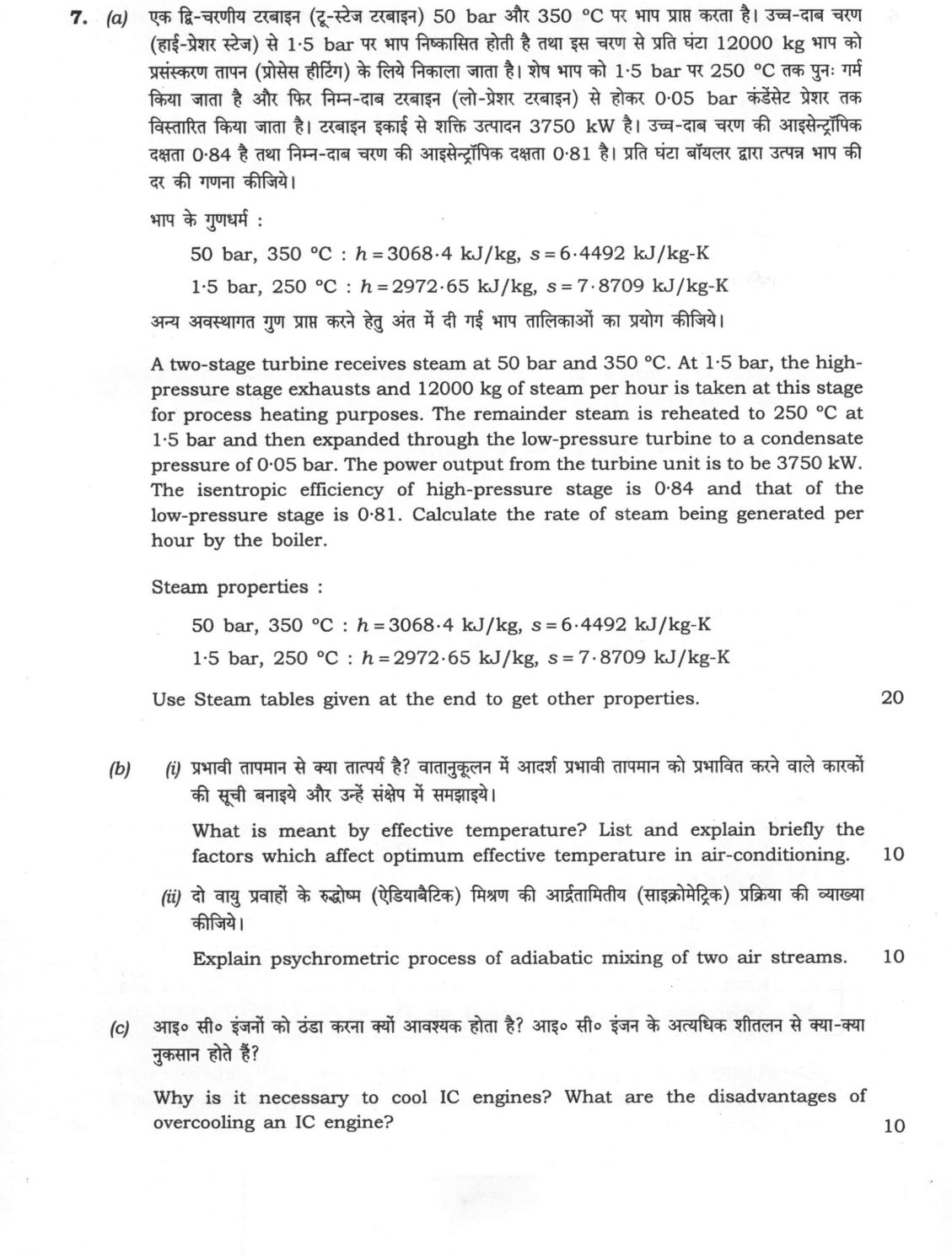
A two-stage turbine receives steam at 50 bar and 350 °C. At 1·5 bar, the high-pressure stage exhausts and 12000 kg of steam per hour is taken at this stage for process heating purposes. The remainder steam is reheated to 250 °C at 1·5 bar and then expanded through the low-pressure turbine to a condensate pressure of 0·05 bar. The power output from the turbine unit is to be 3750 kW. The isentropic efficiency of high-pressure stage is 0·84 and that of the low-pressure stage is 0·81. Calculate the rate of steam being generated per hour by the boiler.
Steam properties : 50 bar, 350 °C : h = 3068·4 kJ/kg, s = 6·4492 kJ/kg-K 1·5 bar, 250 °C : h = 2972·65 kJ/kg, s = 7·8709 kJ/kg-K
Use Steam tables given at the end to get other properties. 20 marks
What is meant by effective temperature? List and explain briefly the factors which affect optimum effective temperature in air-conditioning. 10 marks
Explain psychrometric process of adiabatic mixing of two air streams. 10 marks
Why is it necessary to cool IC engines? What are the disadvantages of overcooling an IC engine? 10 marks
हिंदी में प्रश्न पढ़ें
एक द्वि-चरणीय टरबाइन (टू-स्टेज टरबाइन) 50 bar और 350 °C पर भाप प्राप्त करता है। उच्च-दाब चरण (हाई-प्रेशर स्टेज) से 1·5 bar पर भाप निष्कासित होती है तथा इस चरण से प्रति घंटा 12000 kg भाप को प्रसंस्करण तापन (प्रोसेस हीटिंग) के लिये निकाला जाता है। शेष भाप को 1·5 bar पर 250 °C तक पुनः गर्म किया जाता है और फिर निम्न-दाब टरबाइन (लो-प्रेशर टरबाइन) से होकर 0·05 bar कंडेंसेट प्रेशर तक विस्तारित किया जाता है। टरबाइन इकाई से शक्ति उत्पादन 3750 kW है। उच्च-दाब चरण की आइसेन्ट्रॉपिक दक्षता 0·84 है तथा निम्न-दाब चरण की आइसेन्ट्रॉपिक दक्षता 0·81 है। प्रति घंटा बॉयलर द्वारा उत्पन्न भाप की दर की गणना कीजिये।
भाप के गुणधर्म : 50 bar, 350 °C : h = 3068·4 kJ/kg, s = 6·4492 kJ/kg-K 1·5 bar, 250 °C : h = 2972·65 kJ/kg, s = 7·8709 kJ/kg-K अन्य अवस्थागत गुण प्राप्त करने हेतु अंत में दी गई भाप तालिकाओं का प्रयोग कीजिये। (20 अंक)
प्रभावी तापमान से क्या तात्पर्य है? वातानुकूलन में आदर्श प्रभावी तापमान को प्रभावित करने वाले कारकों की सूची बनाइये और उन्हें संक्षेप में समझाइये। (10 अंक)
दो वायु प्रवाहों के रूद्रोष्म (एडियाबैटिक) मिश्रण की आर्द्रतामितीय (साइक्रोमैट्रिक) प्रक्रिया की व्याख्या कीजिये। (10 अंक)
आइ० सी० इंजनों को ठंडा करना क्यों आवश्यक होता है? आइ० सी० इंजन के अत्यधिक शीतलन से क्या-क्या नुकसान होते हैं? (10 अंक)
What "Calculate" is asking you to do
Apply the standard formula or schedule to data the question has already supplied — a table of readings, cost records, a balance sheet — and produce the number. The method is rarely in doubt; the marks sit in the named intermediate quantities, each of which has to appear as a labelled line.
Structure that answers it
Data as given → formula or standard treatment, named → substitution → each intermediate, labelled → result with units
Where marks are lost
Omitting an intermediate the marking scheme pays for separately, or rounding at an intermediate line so the final figure drifts. In commerce and accountancy, any figure in a statement that no numbered working note supports is treated as unearned.
How this answer will be evaluated
Approach
(a) calculate: given > formula > substitution > result with units > interpretation | (b(i)) explain: definition/context > points in order > small example > short close | (b(ii)) explain: definition/context > points in order > small example > short close | (c) explain: definition/context > points in order > small example > short close Full marks: Complete working with all states identified and correct final values
Key points expected
- Identify state 1 properties (50 bar, 350°C) from data
- Calculate isentropic enthalpy drop for HP stage
- Apply HP efficiency to find actual exhaust enthalpy
- Calculate mass flow split and LP stage work
- Define effective temperature as thermal sensation
- List at least 3 factors (humidity, velocity, radiation)
- Explain how each factor influences comfort
- Relate factors to optimum temperature range
Evaluation rubric
Each sub-part is marked on its own, against the marks and word limit printed on the paper.
- (a) Determine the total steam generation rate for the boiler. 20 marks
calculate— given → formula → substitution → result with units → interpretation
Must cover
- Identify state 1 properties (50 bar, 350°C) from data
- Calculate isentropic enthalpy drop for HP stage
- Apply HP efficiency to find actual exhaust enthalpy
- Calculate mass flow split and LP stage work
Loses marks
- Using isentropic work instead of actual work
- Ignoring the 12000 kg/h extraction flow
- Unit errors in power or mass flow
Earns more
- Correctly determine enthalpy at 1.5 bar, 250°C
- Apply LP efficiency to find final exhaust enthalpy
- Sum work outputs to match 3750 kW power
- Solve for total mass flow rate in kg/h
Extra mark
- Labelled T-s diagram showing both stages
- Explicit statement of steady-flow energy equation
- (b(i)) Define effective temperature and list factors affecting it. 10 marks
explain— definition/context → points in order → small example → short close
Must cover
- Define effective temperature as thermal sensation
- List at least 3 factors (humidity, velocity, radiation)
- Explain how each factor influences comfort
- Relate factors to optimum temperature range
Loses marks
- Confusing effective with dry-bulb temperature
- Listing factors without explaining their effect
- Ignoring the 'optimum' aspect of the question
Earns more
- Mention dry-bulb temperature as baseline
- Note that optimum varies with season
- Reference standard comfort ranges (e.g., 21-26°C)
- Distinguish between summer and winter factors
Extra mark
- Reference ASHRAE or ISO comfort standards
- Mention metabolic rate as a variable
- (b(ii)) Describe the psychrometric process of adiabatic mixing. 10 marks
explain— definition/context → points in order → small example → short close
Must cover
- State that no heat is exchanged with surroundings
- Apply conservation of mass for dry air
- Apply conservation of energy (enthalpy balance)
- Locate mixture state on psychrometric chart
Loses marks
- Assuming temperature is weighted average
- Ignoring the enthalpy balance equation
- Confusing adiabatic mixing with cooling
Earns more
- Show that mixture point lies on straight line
- Mention mass ratio determines position
- Note that humidity ratio is weighted average
- State that no condensation occurs in mixing
Extra mark
- Sketch of psychrometric chart with mixing line
- Mention application in air-conditioning systems
- (c) Explain why IC engines need cooling and overcooling effects. 10 marks
explain— definition/context → points in order → small example → short close
Must cover
- State that combustion generates excess heat
- Explain that cooling prevents engine damage
- List disadvantages of overcooling (efficiency loss)
- Mention increased friction and wear from overcooling
Loses marks
- Saying cooling is for power output only
- Ignoring the 'disadvantages' part of the question
- Confusing cooling with lubrication functions
Earns more
- Note that ~30% of heat is rejected
- Explain that overcooling increases fuel consumption
- Mention that cold engine runs rich mixture
- State that thermal efficiency decreases with cooling
Extra mark
- Mention specific cooling system types (air/water)
- Reference thermal stress as a failure mode
Model answer coming soon
Every evaluation on this site is marked against a verified model answer. This question's answer is still being written; evaluation opens the moment it lands.
More from Mechanical Engineering 2025 Paper II
- Q4 (a) A shell and tube type condenser is employed in a steam power plant to handle 35000 kg…
- Q5 (a) With the help of P-θ (pressure-crank angle) diagram, compare the knock in SI and CI e…
- Q6 (a) A single-cylinder, two-stroke, high-speed diesel engine working on 'dual cycle' has a…
- Q7 (a) A two-stage turbine receives steam at 50 bar and 350 °C. At 1·5 bar, the high-pressur…
- Q8 (a) The following data refers to a single-stage vapour compression refrigeration system :…