Paper II — Q4
(a) A shell and tube type condenser is employed in a steam power plant to handle 35000 kg/h of dry and saturated steam at 50 °C…
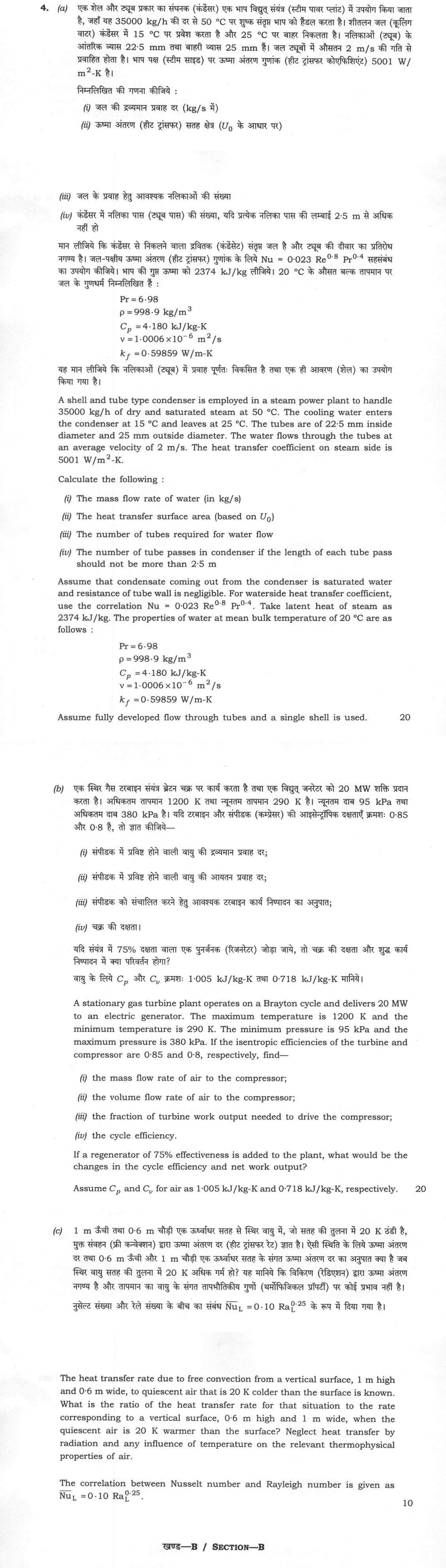
A shell and tube type condenser is employed in a steam power plant to handle 35000 kg/h of dry and saturated steam at 50 °C. The cooling water enters the condenser at 15 °C and leaves at 25 °C. The tubes are of 22·5 mm inside diameter and 25 mm outside diameter. The water flows through the tubes at an average velocity of 2 m/s. The heat transfer coefficient on steam side is 5001 W/m²-K.
Calculate the following :
The mass flow rate of water (in kg/s)
The heat transfer surface area (based on U₀)
The number of tubes required for water flow
The number of tube passes in condenser if the length of each tube pass should not be more than 2·5 m
Assume that condensate coming out from the condenser is saturated water and resistance of tube wall is negligible. For waterside heat transfer coefficient, use the correlation Nu = 0·023 Re⁰·⁸ Pr⁰·⁴. Take latent heat of steam as 2374 kJ/kg. The properties of water at mean bulk temperature of 20 °C are as follows :
Pr = 6·98 ρ = 998·9 kg/m³ Cₚ = 4·180 kJ/kg-K ν = 1·0006 × 10⁻⁶ m²/s kƒ = 0·59859 W/m-K
Assume fully developed flow through tubes and a single shell is used. 20 marks
A stationary gas turbine plant operates on a Brayton cycle and delivers 20 MW to an electric generator. The maximum temperature is 1200 K and the minimum temperature is 290 K. The minimum pressure is 95 kPa and the maximum pressure is 380 kPa. If the isentropic efficiencies of the turbine and compressor are 0·85 and 0·8, respectively, find—
the mass flow rate of air to the compressor;
the volume flow rate of air to the compressor;
the fraction of turbine work output needed to drive the compressor;
the cycle efficiency.
If a regenerator of 75% effectiveness is added to the plant, what would be the changes in the cycle efficiency and net work output?
Assume Cp and Cv for air as 1·005 kJ/kg-K and 0·718 kJ/kg-K, respectively. 20 marks
The heat transfer rate due to free convection from a vertical surface, 1 m high and 0·6 m wide, to quiescent air that is 20 K colder than the surface is known. What is the ratio of the heat transfer rate for that situation to the rate corresponding to a vertical surface, 0·6 m high and 1 m wide, when the quiescent air is 20 K warmer than the surface? Neglect heat transfer by radiation and any influence of temperature on the relevant thermophysical properties of air.
The correlation between Nusselt number and Rayleigh number is given as NūL = 0·10 RaL^0·25. 10 marks
हिंदी में प्रश्न पढ़ें
एक शेल और ट्यूब प्रकार का संयंत्रक (कंडेंसर) एक भाप विद्युत संयंत्र (स्टीम पावर प्लांट) में उपयोग किया जाता है, जहाँ यह 35000 kg/h की दर से 50 °C पर शुष्क संतृप्त भाप को हैंडल करता है। शीतलन जल (कूलिंग वाटर) कंडेंसर में 15 °C पर प्रवेश करता है और 25 °C पर बाहर निकलता है। नलिकाओं (ट्यूबों) के आंतरिक व्यास 22·5 mm तथा बाहरी व्यास 25 mm हैं। जल ट्यूबों में औसतन 2 m/s की गति से प्रवाहित होता है। भाप पक्ष (स्टीम साइड) पर उष्मा अंतरण गुणांक (हीट ट्रांसफर कोएफिशिएंट) 5001 W/m²-K है।
निम्नलिखित की गणना कीजिये :
जल की द्रव्यमान प्रवाह दर (kg/s में)
उष्मा अंतरण (हीट ट्रांसफर) सतह क्षेत्र (U0 के आधार पर)
जल के प्रवाह हेतु आवश्यक नलिकाओं की संख्या
कंडेंसर में नलिका पास (ट्यूब पास) की संख्या, यदि प्रत्येक नलिका पास की लंबाई 2·5 m से अधिक नहीं हो
मान लीजिये कि कंडेंसर से निकलने वाला द्रवितक (कंडेंसेट) संतृप्त जल है और ट्यूब की दीवार का प्रतिरोध नगण्य है। जल-पक्षीय उष्मा अंतरण (हीट ट्रांसफर) गुणांक के लिये Nu = 0·023 Re⁰·⁸ Pr⁰·⁴ सहसंबंध का उपयोग कीजिये। भाप की गुप्त उष्मा को 2374 kJ/kg लीजिये। 20 °C के औसत बल्क तापमान पर जल के गुणधर्म निम्नलिखित हैं :
Pr = 6·98 ρ = 998·9 kg/m³ Cₚ = 4·180 kJ/kg-K ν = 1·0006 × 10⁻⁶ m²/s kƒ = 0·59859 W/m-K
यह मान लीजिये कि नलिकाओं (ट्यूब) में प्रवाह पूर्णतः विकसित है तथा एक ही आवरण (शेल) का उपयोग किया गया है। 20 marks
एक स्थिर गैस टरबाइन संयंत्र ब्रेटन चक्र पर कार्य करता है तथा एक विद्युत जनरेटर को 20 MW शक्ति प्रदान करता है। अधिकतम तापमान 1200 K तथा न्यूनतम तापमान 290 K है। न्यूनतम दाब 95 kPa तथा अधिकतम दाब 380 kPa है। यदि टरबाइन और संपीडक (कंप्रेसर) की आइसेंट्रॉपिक दक्षताएँ क्रमशः 0·85 और 0·8 हैं, तो ज्ञात कीजिए—
संपीडक में प्रविष्ट होने वाली वायु की द्रव्यमान प्रवाह दर;
संपीडक में प्रविष्ट होने वाली वायु की आयतन प्रवाह दर;
संपीडक को संचालित करने हेतु आवश्यक टरबाइन कार्य निष्पादन का अनुपात;
चक्र की दक्षता।
यदि संयंत्र में 75% दक्षता वाला एक पुनर्जनक (रिजनरेटर) जोड़ा जाये, तो चक्र की दक्षता और शुद्ध कार्य निष्पादन में क्या परिवर्तन होगा?
वायु के लिये Cp और Cv क्रमशः 1·005 kJ/kg-K तथा 0·718 kJ/kg-K मानिये। 20 marks
1 m ऊँची तथा 0·6 m चौड़ी एक उष्णोद्धर सतह से स्थिर वायु में, जो सतह की तुलना में 20 K ठंडी है, मुक्त संवहन (फ्री कन्वेक्शन) द्वारा उष्मा अंतरण दर (हीट ट्रांसफर रेट) ज्ञात है। ऐसी स्थिति के लिये उष्मा अंतरण दर तथा 0·6 m ऊँची और 1 m चौड़ी एक उष्णोद्धर सतह के संगत उष्मा अंतरण दर का अनुपात क्या है जब स्थिर वायु सतह की तुलना में 20 K अधिक गर्म हो? यह मानिये कि विकिरण (रेडिएशन) द्वारा उष्मा अंतरण नगण्य है और तापमान का वायु के संगत तापभौतिकीय गुणों (थर्मोफिजिकल प्रॉपर्टी) पर कोई प्रभाव नहीं है।
नुसेल्ट संख्या और रेले संख्या के बीच का संबंध NūL = 0·10 RaL^0·25 के रूप में दिया गया है। 10 marks
Model answer
Written by UPSC Answer Check against this question's marking rubric, to the expected length. UPSC does not publish answers for Mains — this is one way to score well, not an official key.
(a)(i) By steady-flow energy balance on the steam side: Q = (35000/3600) kg/s × 2374 kJ/kg = 23080.56 kW. Water flow rate: mw = Q/(Cp ΔT) = 23080.56/(4.180 × 10) = 552.17 kg/s.
(a)(ii) Using the Dittus–Boelter correlation for the water side: Re = V Di/ν = 2 × 0.0225/(1.0006 × 10⁻⁶) = 4.497 × 10⁴. Nu = 0.023 Re⁰·⁸ Pr⁰·⁴ = 0.023 × (4.497 × 10⁴)⁰·⁸ × 6.98⁰·⁴ = 264.0. hi = Nu kf/Di = 264.0 × 0.59859/0.0225 = 7024 W/m²K.
Using the LMTD method, overall coefficient based on outside area, wall resistance negligible: 1/U₀ = 1/5001 + (25/22.5)/7024 = 3.581 × 10⁻⁴. U₀ = 2792 W/m²K.
LMTD = (35 − 25)/ln(35/25) = 29.72 K. Area: A₀ = Q/(U₀ LMTD) = 23080556/(2792 × 29.72) = 278.1 m².
(a)(iii) Volume flow of water: V̇ = mw/ρ = 552.17/998.9 = 0.5528 m³/s. Area per tube: At = π Di²/4 = π(0.0225)²/4 = 3.976 × 10⁻⁴ m². Number of tubes: N = V̇/(V At) = 0.5528/(2 × 3.976 × 10⁻⁴) = 695.1. Use integer next higher: N = 696 tubes.
(a)(iv) Total tube length required: Ltot = A₀/(π D₀) = 278.1/(π × 0.025) = 3541 m. For 696 tubes per pass, length per pass with p passes is L = 3541/(696p). For p = 2, L = 2.544 m > 2.5 m; hence p = 3 gives L = 1.696 m. Number of tube passes = 3.
(b)(i) Using air-standard Brayton cycle analysis: Pressure ratio: rp = 380/95 = 4. R = Cp − Cv = 0.287 kJ/kg-K; exponent = R/Cp = 0.287/1.005 = 0.28557. T2s = 290 × 4^0.28557 = 430.85 K. ηc = (T2s − T1)/(T2 − T1), so T2 = 290 + (430.85 − 290)/0.8 = 466.07 K. wc = Cp(T2 − T1) = 1.005(466.07 − 290) = 176.95 kJ/kg.
T4s = 1200/4^0.28557 = 807.70 K. ηt = (T3 − T4)/(T3 − T4s), so T4 = 1200 − 0.85(1200 − 807.70) = 866.55 K. wt = Cp(T3 − T4) = 1.005(1200 − 866.55) = 335.12 kJ/kg. wnet = wt − wc = 158.18 kJ/kg. Mass flow: m = 20000/158.18 = 126.44 kg/s.
(b)(ii) At compressor inlet, P1 = 95 kPa, T1 = 290 K: V̇ = m R T1/P1 = 126.44 × 0.287 × 290/95 = 110.78 m³/s.
(b)(iii) Back-work ratio = wc/wt = 176.95/335.12 = 0.528 = 52.8%.
(b)(iv) Heat added: qin = Cp(T3 − T2) = 1.005(1200 − 466.07) = 737.60 kJ/kg. η = wnet/qin = 158.18/737.60 = 0.2145 = 21.45%.
Regenerator effectiveness ε = 0.75: T2r = T2 + ε(T4 − T2) = 466.07 + 0.75(866.55 − 466.07) = 766.43 K. qin,r = 1.005(1200 − 766.43) = 435.74 kJ/kg. ηr = 158.18/435.74 = 0.3630 = 36.30%. Change in efficiency = +14.85 percentage points. Net work per kg is unchanged, so net work output remains 20 MW for the same pressure ratio and mass flow; change in net work output = 0.
(c) Using the free-convection correlation NūL = 0.10 RaL^0.25: Q = h A ΔT = (Nu k/L)A ΔT. Nu = 0.10 Ra^0.25, with Ra ∝ L³ |ΔT|. Thus Q ∝ L⁻¹/⁴ A |ΔT|^1.25. Here A and |ΔT| = 20 K are the same for both cases. Q₁/Q₂ = (L₁/L₂)⁻¹/⁴ = (1/0.6)⁻¹/⁴ = 0.6¹/⁴ = (3/5)¹/⁴. Q₁/Q₂ = 0.880 approximately, taking heat-transfer rates as magnitudes. If signed surface-to-air heat transfer is used, the second rate has opposite sign.
What "Calculate" is asking you to do
Apply the standard formula or schedule to data the question has already supplied — a table of readings, cost records, a balance sheet — and produce the number. The method is rarely in doubt; the marks sit in the named intermediate quantities, each of which has to appear as a labelled line.
Structure that answers it
Data as given → formula or standard treatment, named → substitution → each intermediate, labelled → result with units
Where marks are lost
Omitting an intermediate the marking scheme pays for separately, or rounding at an intermediate line so the final figure drifts. In commerce and accountancy, any figure in a statement that no numbered working note supports is treated as unearned.
How this answer will be evaluated
Approach
Framework: Mechanical Engineering, Paper 2. (a) calculate: given > formula > substitution > result with units > interpretation | (b) calculate: given > formula > substitution > result with units > interpretation | (c) calculate: given > formula > substitution > result with units > interpretation Full marks: Rigorous application of governing equations with clear assumptions and physical interpretation.
Key points expected
- Energy balance for steam condensation and water heating
- Darcy-Weisbach or Dittus-Boelter correlation for Nu
- Overall heat transfer coefficient U_o calculation
- Tube count derived from flow velocity and area
- T-s diagram with states 1-2-3-4 marked
- Isentropic relations for compressor and turbine
- Regenerator effectiveness applied to heat input
- Net work output and cycle efficiency calculation
Evaluation rubric
Each sub-part is marked on its own, against the marks and word limit printed on the paper.
- (a) Determine water flow, surface area, tube count, and passes for a shell-and-tube condenser. 20 marks
calculate— given → formula → substitution → result with units → interpretation
Must cover
- Energy balance for steam condensation and water heating
- Darcy-Weisbach or Dittus-Boelter correlation for Nu
- Overall heat transfer coefficient U_o calculation
- Tube count derived from flow velocity and area
Loses marks
- Omitting the steam-side heat transfer coefficient
- Incorrect conversion of steam mass flow rate
- Ignoring the tube wall resistance assumption
Earns more
- Explicit statement of negligible wall resistance
- Unit consistency check for heat transfer terms
- Calculation of Reynolds number for water flow
- Interpretation of tube pass length constraint
Extra mark
- Schematic of condenser with flow directions
- Table of water properties used
- (b) Analyze a Brayton cycle with regeneration, finding flow rates, work, and efficiency. 20 marks
calculate— given → formula → substitution → result with units → interpretation
Must cover
- T-s diagram with states 1-2-3-4 marked
- Isentropic relations for compressor and turbine
- Regenerator effectiveness applied to heat input
- Net work output and cycle efficiency calculation
Loses marks
- Ignoring isentropic efficiencies in work calculation
- Incorrect application of regenerator effectiveness
- Missing the volume flow rate calculation
Earns more
- Explicit calculation of isentropic work terms
- Comparison of efficiency with and without regeneration
- Use of specific heat values for air
- Physical interpretation of work fraction
Extra mark
- p-V diagram of the Brayton cycle
- Sensitivity analysis on pressure ratio
- (c) Determine the ratio of heat transfer rates for two vertical surface configurations. 10 marks
calculate— given → formula → substitution → result with units → interpretation
Must cover
- Rayleigh number calculation for both cases
- Nusselt number correlation application
- Ratio of heat transfer coefficients derived
- Final ratio of heat transfer rates
Loses marks
- Using the wrong characteristic length for Ra
- Ignoring the change in surface orientation
- Incorrect exponent in the Nusselt correlation
Earns more
- Explicit statement of neglecting radiation
- Assumption of constant thermophysical properties
- Correct identification of characteristic length
- Dimensional analysis of the correlation
Extra mark
- Schematic of the two surface orientations
- Discussion of natural convection boundary layers
Practice this exact question
Write your answer and it is marked point by point against the model answer above — what you covered, what you missed, what you got wrong.
Evaluate my answer →More from Mechanical Engineering 2025 Paper II
- Q1 (a) A lump of ice with a mass of 1·5 kg at an initial temperature of 260 K melts at the p…
- Q2 (a) (i) A reversible power cycle engine is used to drive a reversible heat pump. The powe…
- Q3 (a) A long cylindrical rod of radius 10 cm consists of a nuclear reacting material (k = 0…
- Q4 (a) A shell and tube type condenser is employed in a steam power plant to handle 35000 kg…
- Q5 (a) With the help of P-θ (pressure-crank angle) diagram, compare the knock in SI and CI e…
- Q6 (a) A single-cylinder, two-stroke, high-speed diesel engine working on 'dual cycle' has a…
- Q7 (a) A two-stage turbine receives steam at 50 bar and 350 °C. At 1·5 bar, the high-pressur…