Paper I — Q2
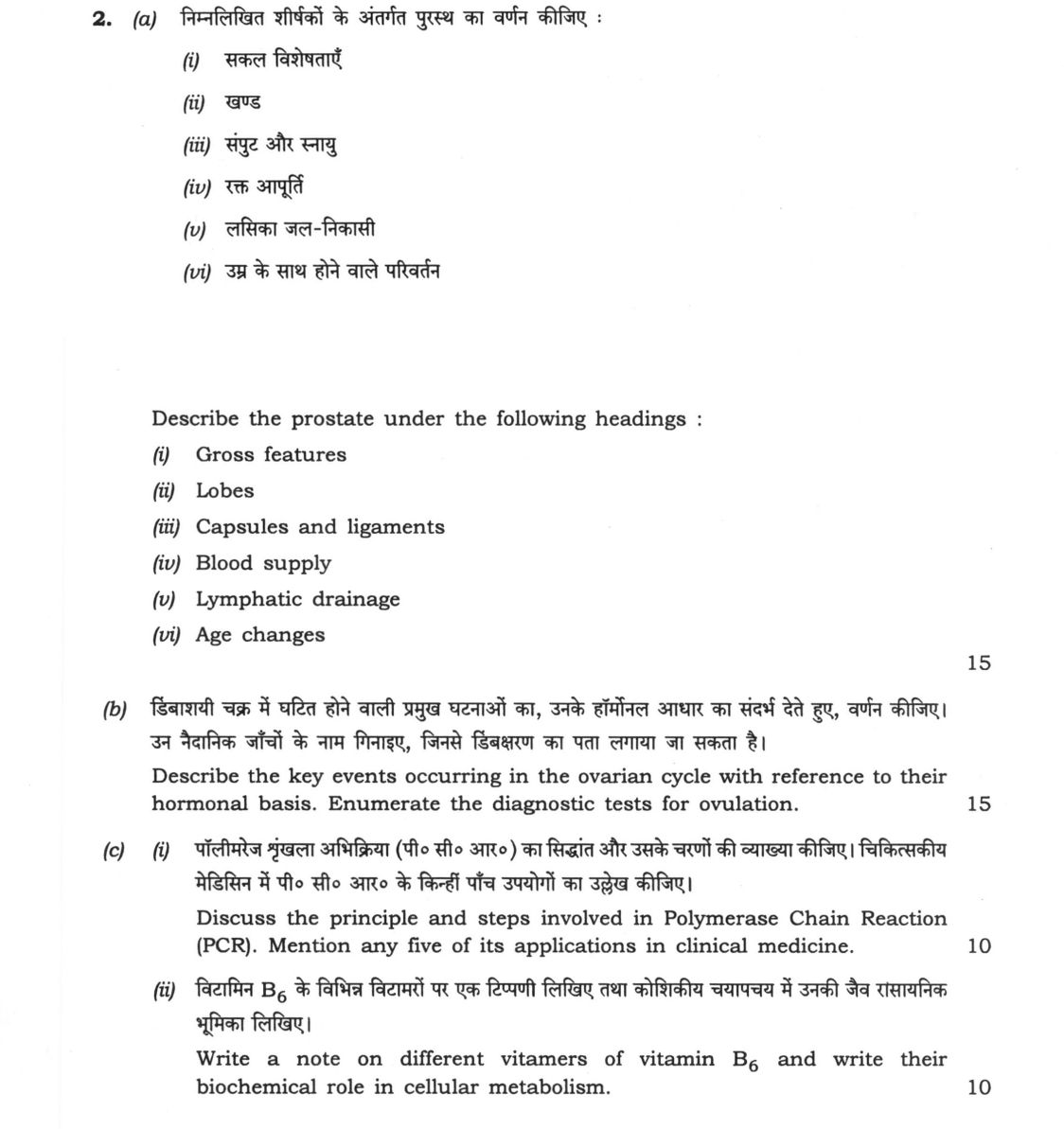
(a) Describe the prostate under the following headings: (i) Gross features (ii) Lobes (iii) Capsules and ligaments (iv) Blood…
Describe the prostate under the following headings: Gross features
Lobes
Capsules and ligaments
Blood supply
Lymphatic drainage
Age changes 15 marks
Describe the key events occurring in the ovarian cycle with reference to their hormonal basis. Enumerate the diagnostic tests for ovulation. 15 marks
Discuss the principle and steps involved in Polymerase Chain Reaction (PCR). Mention any five of its applications in clinical medicine. 10 marks
Write a note on different vitamers of vitamin B₆ and write their biochemical role in cellular metabolism. 10 marks
हिंदी में प्रश्न पढ़ें
निम्नलिखित शीर्षकों के अंतर्गत पुरःस्थ का वर्णन कीजिए : सकल विशेषताएं
खंड
संपुट और स्नायु
रक्त आपूर्ति
लसिका जल-निकासी
उम्र के साथ होने वाले परिवर्तन 15
डिंबाशयी चक्र में घटित होने वाली प्रमुख घटनाओं का, उनके हार्मोनल आधार का संदर्भ देते हुए, वर्णन कीजिए। उन नैदानिक जाँचों के नाम गिनाइए, जिनसे डिंबसरण का पता लगाया जा सकता है। 15
पॉलीमेरेज़ मृदुकला अभिक्रिया (पी० सी० आर०) का सिद्धांत और उसके चरणों की व्याख्या कीजिए। चिकित्सकीय मेडिसिन में पी० सी० आर० के किन्हीं पाँच उपयोगों का उल्लेख कीजिए। 10
विटामिन B₆ के विभिन्न विटामरों पर एक टिप्पणी लिखिए तथा कोशिकीय चयापचय में उनकी जैव रासायनिक भूमिका लिखिए। 10
Model answer
Written by UPSC Answer Check against this question's marking rubric, to the expected length. UPSC does not publish answers for Mains — this is one way to score well, not an official key.
Prostate. The prostate is a walnut-sized, 20–30 g gland below the bladder, anterior to the rectum, through which the prostatic urethra passes. Grossly it has a base at the bladder neck, an apex at the urogenital diaphragm, an anterior surface, a posterior surface with a median sulcus, and lateral surfaces; the seminal vesicles lie posterolaterally. The posterior surface is related to the rectal ampulla and is palpable on digital rectal examination. Historically it is divided into five lobes: anterior, posterior, middle, right lateral and left lateral; the middle lobe surrounds the prostatic urethra between the ejaculatory ducts and is the common site of benign prostatic hyperplasia causing bladder outlet obstruction. Clinically, zones are more useful: peripheral, central, transitional and anterior fibromuscular stroma. The true capsule is the inner fibromuscular capsule; the false capsule is the outer periprostatic/endopelvic fascia. It is supported by puboprostatic ligaments to the pubic symphysis and vesicoprostatic ligaments to the bladder neck. Blood supply is mainly from the inferior vesical artery, with contributions from middle rectal and internal pudendal arteries; venous drainage is through the prostatic venous plexus of Santorini to internal iliac veins. Lymphatics drain to internal iliac, external iliac, sacral and obturator nodes, with upper prostatic lymphatics to external iliac and lower to internal iliac. Age changes include pubertal growth under androgens, benign prostatic hyperplasia after 50 years, carcinoma commonly in the peripheral zone, and prostatic calculi.
Ovarian cycle. The ovarian cycle is the 28-day sequence of follicular development, ovulation and luteal formation, controlled by hypothalamic GnRH and pituitary gonadotropins. In the follicular phase, pituitary FSH dominance stimulates granulosa cells to aromatise theca-cell androgens into estradiol; rising estradiol first gives negative feedback and later, with a dominant follicle, positive feedback. The preovulatory LH surge, triggered by sustained high estradiol and permissive progesterone, causes follicle rupture and ovulation. Ovulation is usually around day 14 in a 28-day cycle. In the luteal phase, the corpus luteum secretes progesterone dominance with estradiol, preparing the endometrium; if fertilisation does not occur, it regresses, while hCG maintains it in pregnancy. Diagnostic tests for ovulation include basal body temperature showing a postovulatory rise, urinary LH kit detecting the LH surge, ultrasound follicular tracking, serum progesterone on day 21, and endometrial biopsy showing secretory changes.
PCR. Polymerase chain reaction amplifies a defined DNA segment using two primers, dNTPs, Mg2+ and a thermostable DNA polymerase in a thermal cycler. The steps are denaturation at 94–95°C to separate strands, annealing at 50–65°C for primer binding, and extension at 72°C with Taq polymerase; repeated cycles yield exponential product, detectable by gel electrophoresis or fluorescence. Specificity depends on primer design and annealing temperature. Clinical applications include HIV viral load monitoring, tuberculosis diagnosis, COVID-19 RT-PCR, genetic screening and forensic DNA profiling.
Vitamin B6. Vitamin B6 exists as pyridoxine, pyridoxal and pyridoxamine, and their phosphorylated forms pyridoxine-5'-phosphate, pyridoxal-5'-phosphate and pyridoxamine-5'-phosphate; pyridoxal-5'-phosphate (PLP) is the active coenzyme. PLP forms a Schiff base with enzyme lysine and participates in cellular metabolism through amino acid transamination, decarboxylation, racemisation and transsulfuration. It is required for glycogenolysis as a cofactor of glycogen phosphorylase, for heme synthesis by ALA synthase, for niacin synthesis from tryptophan, for neurotransmitter synthesis such as dopamine, serotonin, GABA and histamine, and for sphingolipid metabolism through serine palmitoyltransferase.
Thus, the prostate is described by its gross anatomy, lobes, capsules, vascular and lymphatic drainage, and age-related changes; the ovarian cycle is governed by FSH, estradiol, LH and progesterone; PCR is a stepwise amplification technique with major clinical uses; and vitamin B6 vitamers function chiefly through PLP in amino acid, glycogen, heme, niacin, neurotransmitter and sphingolipid metabolism.
What "Describe" is asking you to do
Give a full, ordered account of the thing named — its parts, stages or mechanism — in the sequence in which it actually exists or occurs. Most describe questions come from the science optionals, where the marks sit in correct technical detail and, where the stem says so, a labelled diagram.
Structure that answers it
One-line identification of the subject → the parts or stages in their real order, each with its defining detail → labelled diagram where the subject is structural → closing line on function or significance
Where marks are lost
Loose general prose where the examiner is ticking named parts, correct terminology and their sequence; and in the General Studies papers, turning to evaluation before the description is finished.
How this answer will be evaluated
Approach
Framework: Medical Science, Paper 1. (a) describe: define > structure or process in order > labelled diagram > significance | (b) describe: define > structure or process in order > labelled diagram > significance | (c(i)) discuss: intro > 3-4 dimensions > example > balanced close | (c(ii)) write short notes: define > 3-4 key features > one example > one-line significance Full marks: Comprehensive anatomical/physiological detail with precise terminology and clinical relevance.
Key points expected
- Gross features: size, weight, shape, and relation to bladder/rectum
- Lobes: identification of anterior, middle, and posterior lobes
- Capsules: description of fibrous and fibromuscular layers
- Blood supply: specific arteries (inferior vesical, middle rectal) and venous plexus
- Phases: Follicular, Ovulatory, and Luteal phases clearly defined
- Hormonal basis: FSH/LH roles in follicle recruitment and ovulation
- Hormonal basis: Estrogen and Progesterone secretion patterns
- Diagnostic tests: at least 3 methods (e.g., BBT, LH surge, ultrasound)
Evaluation rubric
Each sub-part is marked on its own, against the marks and word limit printed on the paper.
- (a) Systematic anatomical description of the prostate gland under six specific headings. 15 marks
describe— define → structure or process in order → labelled diagram → significance
Must cover
- Gross features: size, weight, shape, and relation to bladder/rectum
- Lobes: identification of anterior, middle, and posterior lobes
- Capsules: description of fibrous and fibromuscular layers
- Blood supply: specific arteries (inferior vesical, middle rectal) and venous plexus
Loses marks
- Confusing lobes with histological zones
- Omitting the fibromuscular capsule
- Vague description of blood supply without naming arteries
Earns more
- Lymphatic drainage: specific nodes (internal iliac, sacral)
- Age changes: distinction between BPH and atrophy
- Ligaments: puboprostatic ligaments
- Labelled diagram of prostate cross-section
Extra mark
- Mention of prostatic urethra zones (periurethral, central, peripheral)
- Reference to surgical implications of the capsule
- (b) Chronological account of the ovarian cycle phases linked to hormonal changes and diagnostic tests. 15 marks
describe— define → structure or process in order → labelled diagram → significance
Must cover
- Phases: Follicular, Ovulatory, and Luteal phases clearly defined
- Hormonal basis: FSH/LH roles in follicle recruitment and ovulation
- Hormonal basis: Estrogen and Progesterone secretion patterns
- Diagnostic tests: at least 3 methods (e.g., BBT, LH surge, ultrasound)
Loses marks
- Describing the uterine cycle instead of the ovarian cycle
- Listing hormones without linking them to specific phases
- Omitting the hormonal basis for ovulation (LH surge)
Earns more
- Mention of the Corpus Luteum formation and function
- Explanation of the negative/positive feedback loops
- Details on cervical mucus changes (spinnbarkeit)
- Mention of serum progesterone levels as a marker
Extra mark
- Reference to specific LH surge timing (36-40 hours pre-ovulation)
- Mention of basal body temperature shift magnitude (0.2-0.5°C)
- (c(i)) Explanation of PCR mechanism (principle/steps) and five clinical applications. 10 marks
discuss— intro → 3-4 dimensions → example → balanced close
Must cover
- Principle: DNA amplification via thermal cycling
- Steps: Denaturation, Annealing, and Extension (polymerization)
- Components: Taq polymerase, primers, dNTPs, template DNA
- Applications: 5 distinct clinical uses (e.g., HIV, TB, genetic disorders)
Loses marks
- Confusing PCR with DNA sequencing
- Listing applications without specifying the disease/organism
- Omitting the role of primers in the process
Earns more
- Mention of specific temperatures for each step (e.g., 94°C, 55°C, 72°C)
- Distinction between real-time PCR and standard PCR
- Mention of specific genetic markers (e.g., BRCA1/2)
- Reference to sensitivity/specificity in diagnosis
Extra mark
- Mention of RT-PCR for RNA viruses
- Reference to specific guidelines (e.g., WHO) for TB diagnosis
- (c(ii)) Identification of Vitamin B6 vitamers and their specific biochemical roles. 10 marks
write short notes— define → 3-4 key features → one example → one-line significance
Must cover
- Vitamers: Pyridoxine, Pyridoxal, and Pyridoxine phosphate
- Active form: Identification of Pyridoxal 5'-phosphate (PLP)
- Role: Coenzyme in amino acid metabolism (transamination)
- Role: Coenzyme in neurotransmitter synthesis (e.g., GABA, Serotonin)
Loses marks
- Confusing Vitamin B6 with B12 or B9
- Listing roles without naming the active coenzyme (PLP)
- Vague description of 'metabolism' without specific pathways
Earns more
- Role in heme synthesis (ALA synthase)
- Role in glycogenolysis (glycogen phosphorylase)
- Mention of PLP as a 'universal coenzyme'
- Brief mention of deficiency symptoms (sideroblastic anemia)
Extra mark
- Mention of specific enzymes (e.g., D-amino acid oxidase)
- Reference to the role in DNA methylation
Practice this exact question
Write your answer and it is marked point by point against the model answer above — what you covered, what you missed, what you got wrong.
Evaluate my answer →More from Medical Science 2021 Paper I
- Q1 (a) Describe the formation, course, tributaries and termination of coronary sinus. 10 mar…
- Q2 (a) Describe the prostate under the following headings: (i) Gross features (ii) Lobes (ii…
- Q3 (a) Elaborate on the hormonal regulation of blood glucose level. Explain in brief the sig…
- Q4 (a) Explain in detail the absorption and hormonal regulation of blood calcium in body. Di…
- Q5 (a) Define 'metastasis'. Enumerate the steps involved in metastasis. Write briefly about…