Paper I — Q5
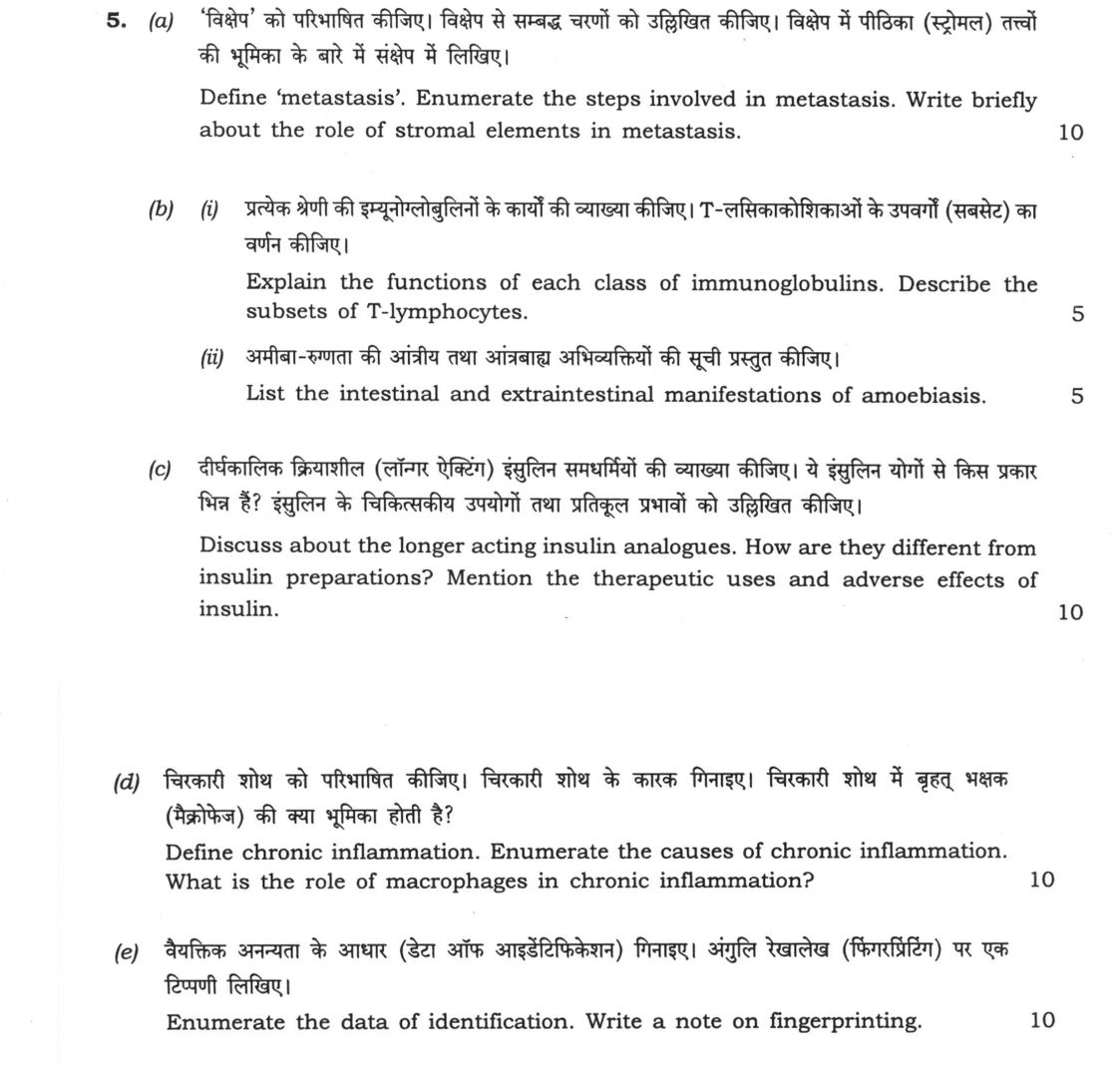
(a) Define 'metastasis'. Enumerate the steps involved in metastasis. Write briefly about the role of stromal elements in…
Define 'metastasis'. Enumerate the steps involved in metastasis. Write briefly about the role of stromal elements in metastasis. 10 marks
Explain the functions of each class of immunoglobulins. Describe the subsets of T-lymphocytes. 5 marks
List the intestinal and extraintestinal manifestations of amoebiasis. 5 marks
Discuss about the longer acting insulin analogues. How are they different from insulin preparations? Mention the therapeutic uses and adverse effects of insulin. 10 marks
Define chronic inflammation. Enumerate the causes of chronic inflammation. What is the role of macrophages in chronic inflammation? 10 marks
Enumerate the data of identification. Write a note on fingerprinting. 10 marks
हिंदी में प्रश्न पढ़ें
'विशेष' को परिभाषित कीजिए। विशेष से सम्बद्ध चरणों को उल्लिखित कीजिए। विशेष में पीठिका (स्ट्रोमल) तत्वों की भूमिका के बारे में संक्षेप में लिखिए। 10
प्रत्येक श्रेणी की इम्यूनोग्लोबुलिनों के कार्यों की व्याख्या कीजिए। T-लसिकाकोशिकाओं के उपवर्गों (सबसेट) का वर्णन कीजिए। 5
अमीबा-रणता की आंत्रीय तथा अनांत्रीय अभिव्यक्तियों की सूची प्रस्तुत कीजिए। 5
दीर्घकालिक क्रियाशील (लांगर एक्टिंग) इंसुलिन समधर्मियों की व्याख्या कीजिए। ये इंसुलिन योगों से किस प्रकार भिन्न हैं? इंसुलिन के चिकित्सकीय उपयोगों तथा प्रतिकूल प्रभावों को उल्लिखित कीजिए। 10
चिरकारी शोथ को परिभाषित कीजिए। चिरकारी शोथ के कारक गिनाइए। चिरकारी शोथ में बृहत् भक्षक (मैक्रोफेज) की क्या भूमिका होती है? 10 marks
वैयक्तिक अनन्यता के आधार (डेटा ऑफ आइडेंटिफिकेशन) गिनाइए। अंगुली रेखालेख (फिंगरप्रिंटिंग) पर एक टिप्पणी लिखिए। 10
Model answer
Written by UPSC Answer Check against this question's marking rubric, to the expected length. UPSC does not publish answers for Mains — this is one way to score well, not an official key.
(a) Metastasis Metastasis is the spread of malignant cells from the primary tumour to a distant organ, where they survive and form a secondary tumour. It is the main cause of cancer death. The steps are: (1) local invasion, in which cancer cells detach, undergo epithelial-mesenchymal transition, degrade basement membrane and extracellular matrix, and invade surrounding tissue; (2) intravasation, in which they enter lymphatic or blood vessels; (3) survival in circulation, resisting shear stress and anoikis; (4) extravasation, in which they exit vessels at a distant site; and (5) colonization and outgrowth, in which they adapt to the new microenvironment and form a macroscopic tumour. Stromal elements are essential. Cancer-associated fibroblasts activate tumour cells, remodel the extracellular matrix, and secrete growth factors. Matrix metalloproteinases and collagen remodelling create tracks for invasion. Tumour cells induce angiogenesis through VEGF, providing oxygen and nutrients. Hypoxia, HIF-1α, cytokines and exosomes prepare a pre-metastatic niche in distant organs, especially bone marrow and liver, allowing circulating tumour cells to arrest, survive and grow. Endothelial cells and bone-marrow stroma provide adhesion molecules and growth factors.
(b)(i) Immunoglobulins and T-cell subsets Immunoglobulins are glycoproteins that mediate humoral immunity. IgG is the major serum antibody, crosses the placenta, and is important in secondary responses, opsonization, neutralization and complement activation. IgM is the first antibody in primary responses, exists mainly as a pentamer, fixes complement strongly, and is present on B-cell surfaces. IgA is the main mucosal antibody, occurs as a dimer with secretory component, and prevents attachment of microbes to mucosae. IgE binds mast cells and basophils and mediates immediate hypersensitivity and defence against helminths. IgD is mainly a B-cell receptor and helps B-cell maturation. T-lymphocytes are divided into CD4+ helper cells and CD8+ cytotoxic cells. CD4+ subsets include Th1 cells, which secrete IFN-γ and activate macrophages; Th2 cells, which secrete IL-4, IL-5 and IL-13 and support IgE and eosinophil responses; Th17 cells, which secrete IL-17 and IL-22 and recruit neutrophils at mucosal barriers; and Treg cells, which secrete IL-10 and TGF-β and maintain tolerance. CD8+ cytotoxic T lymphocytes kill infected or malignant cells by perforin, granzyme and Fas-FasL pathways.
(b)(ii) Amoebiasis Amoebiasis, caused mainly by Entamoeba histolytica, has intestinal and extraintestinal forms. Intestinal manifestations include asymptomatic carriage, amoebic dysentery with blood and mucus, flask-shaped ulcers in the caecum and colon, amoeboma, toxic megacolon, perforation and peritonitis. Extraintestinal manifestations occur after trophozoites spread through the portal circulation. The liver abscess is the most common and presents with fever, right upper abdominal pain and tender hepatomegaly. Other sites include lung, brain, peritoneum, cutaneous tissue, parotid and other rare organs.
(c) Insulin analogues Longer-acting insulin analogues are modified insulins designed to provide basal insulin over a prolonged period. The main agents are insulin glargine, insulin detemir and insulin degludec. They differ from conventional human insulin preparations because amino acid substitutions or structural modifications alter solubility, hexamer formation and binding to albumin. Glargine forms soluble hexamers at acidic pH and slowly precipitates at neutral pH; detemir binds albumin after fatty-acid modification; degludec forms multi-needle structures and has an ultralong duration. Compared with NPH or regular human insulin, they have a flatter, more predictable profile, less peak effect, and reduced nocturnal hypoglycaemia. Glargine and detemir provide about 24-hour basal cover, while degludec is ultralong and may be given at flexible times. They are used as basal insulin in type 1 diabetes, type 2 diabetes when oral agents are insufficient, and gestational diabetes. Adverse effects include hypoglycaemia, weight gain, lipohypertrophy or lipoatrophy at injection sites, local reactions, rare allergy, and, with insulin therapy generally, fluid retention.
(d) Chronic inflammation Chronic inflammation is a prolonged inflammatory response, usually lasting weeks to years, characterized by infiltration with mononuclear cells, tissue destruction, and attempts at repair by fibrosis and angiogenesis. Causes include persistent infections such as tuberculosis, leprosy, syphilis, fungal and viral infections; autoimmune diseases such as rheumatoid arthritis, systemic lupus erythematosus and inflammatory bowel disease; foreign bodies such as sutures, talc, asbestos and silica; chronic exposure to toxic agents; and idiopathic conditions such as sarcoidosis. Macrophages are the central cells. They phagocytose debris and microbes, present antigen to T cells, secrete IL-1, TNF-α, IL-6, IL-12 and chemokines, recruit other leukocytes, release reactive oxygen and nitrogen species, stimulate fibroblasts, and produce growth factors that cause tissue remodelling and fibrosis. In granulomatous inflammation, macrophages fuse into multinucleated giant cells and form epithelioid granulomas.
(e) Data of identification and fingerprinting Data of identification are objective features used to establish identity. They include anthropometric measurements (Bertillon system), dactylography or fingerprints, DNA profiling, odontology, iris recognition, voice analysis, handwriting, photographs, scars, tattoos, moles, personal effects and circumstantial evidence. Fingerprinting is the study of friction-skin ridges on fingers and palms. The main ridge patterns are arch, loop and whorl. Identification depends on minutiae, also called Galton details, such as ridge endings, bifurcations, dots, short ridges, lakes, islands and enclosures. Modern systems use AFIS to compare digital impressions, and poroscopy examines the pore pattern for individualization. In India, FSL and state forensic laboratories use AFIS in criminal investigations. Fingerprinting is valuable because it is rapid, inexpensive, durable, and can identify a person even when other features are damaged. In Indian forensic practice, fingerprints are collected under the Fingerprint Act, 1898 and Section 53A of the Code of Criminal Procedure, and are admitted as expert opinion under Section 45 of the Indian Evidence Act. The Indian Evidence Act does not prescribe a fixed number of matching minutiae; the court considers the number, quality and clarity of points, absence of unexplained discrepancies, and the opinion of a forensic expert. Thus, identification in forensic medicine rests on cumulative objective data, and fingerprinting remains a rapid, durable and legally admissible method in Indian criminal procedure.
What "Enumerate" is asking you to do
Produce the complete set of items asked for, countable and correctly named. The examiner marks against a checklist, so a missing item costs and an elaborated one gains nothing — where discussion is wanted the stem asks for it as a separate sub-part.
Structure that answers it
One line naming the basis on which the set is drawn → items numbered, each in a phrase or a single line → the discussion sub-part taken up separately, after the list is complete
Where marks are lost
Treating it as an essay. Six items named in six lines score better than three items explained at length.
How this answer will be evaluated
Approach
Framework: Medical Science, Paper 1. (a) define: precise definition > the distinguishing feature > one example | (b(i)) explain: definition/context > points in order > small example > short close | (b(ii)) enumerate: list the items in order > one line each > no commentary | (c) discuss: intro > 3-4 dimensions > example > balanced close | (d) define: precise definition > the distinguishing feature > one example | (e) enumerate: list the items in order > one line each > no commentary Full marks: Comprehensive, accurate, and well-structured answers with specific examples and mechanisms.
Key points expected
- Precise definition of metastasis
- Steps: detachment, invasion, intravasation, survival, extravasation, colonization
- Role of stromal elements (e.g., fibroblasts, ECM)
- Mechanism of stromal interaction
- Functions of IgG, IgM, IgA, IgE, IgD
- T-cell subsets: CD4+ (Th1, Th2, Treg) and CD8+ (CTL)
- Specific function of each subset
- Intestinal: dysentery, amoebic colitis, amoeboma
Evaluation rubric
Each sub-part is marked on its own, against the marks and word limit printed on the paper.
- (a) Definition of metastasis, steps involved, and role of stromal elements. 10 marks
define— precise definition → the distinguishing feature → one example
Must cover
- Precise definition of metastasis
- Steps: detachment, invasion, intravasation, survival, extravasation, colonization
- Role of stromal elements (e.g., fibroblasts, ECM)
- Mechanism of stromal interaction
Loses marks
- Listing steps without mechanism
- Ignoring the stromal component
Earns more
- Mention of EMT (Epithelial-Mesenchymal Transition)
- Specific stromal factors (e.g., TGF-beta, VEGF)
Extra mark
- Diagram of metastatic cascade
- (b(i)) Functions of immunoglobulin classes and T-lymphocyte subsets. 5 marks
explain— definition/context → points in order → small example → short close
Must cover
- Functions of IgG, IgM, IgA, IgE, IgD
- T-cell subsets: CD4+ (Th1, Th2, Treg) and CD8+ (CTL)
- Specific function of each subset
Loses marks
- Confusing T-cell subsets
- Vague descriptions of Ig functions
Earns more
- Mention of IgG subclasses
- Role of Th17 cells
Extra mark
- Table format for Ig classes
- (b(ii)) List intestinal and extraintestinal manifestations of amoebiasis. 5 marks
enumerate— list the items in order → one line each → no commentary
Must cover
- Intestinal: dysentery, amoebic colitis, amoeboma
- Extraintestinal: liver abscess, lung abscess, brain abscess
- Clear distinction between the two categories
Loses marks
- Mixing intestinal and extraintestinal lists
- Omitting liver abscess
Earns more
- Mention of cutaneous amoebiasis
- Mention of amoebic peritonitis
Extra mark
- Mention of 'anchovy paste' pus in liver abscess
- (c) Longer acting insulin analogues, differences from regular insulin, uses, and adverse effects. 10 marks
discuss— intro → 3-4 dimensions → example → balanced close
Must cover
- Examples of long-acting analogues (e.g., Glargine, Detemir, Degludec)
- Mechanism of prolonged action (e.g., pH-dependent precipitation)
- Therapeutic uses (basal insulin therapy)
- Adverse effects (hypoglycemia, weight gain)
Loses marks
- Confusing long-acting with rapid-acting analogues
- Omitting adverse effects
Earns more
- Comparison with NPH insulin
- Mention of specific analogues' duration
Extra mark
- Mention of 'peakless' profile of Glargine
- (d) Definition of chronic inflammation, causes, and role of macrophages. 10 marks
define— precise definition → the distinguishing feature → one example
Must cover
- Definition: persistent inflammation, tissue destruction, repair
- Causes: persistent infection, autoimmune, foreign bodies
- Macrophage role: phagocytosis, cytokine release, tissue remodeling
- Distinction from acute inflammation
Loses marks
- Confusing acute and chronic features
- Ignoring the macrophage's dual role (destruction/repair)
Earns more
- Mention of granuloma formation
- Specific cytokines (TNF-alpha, IL-1)
Extra mark
- Mention of fibrosis as a consequence
- (e) Data of identification and a note on fingerprinting. 10 marks
enumerate— list the items in order → one line each → no commentary
Must cover
- Data: name, age, address, occupation, physical features
- Fingerprinting: definition, types (loops, whorls, arches)
- Application in forensic identification
- Uniqueness of fingerprints
Loses marks
- Vague description of fingerprinting
- Omitting key identification data
Earns more
- Mention of DNA profiling as modern alternative
- Specific fingerprint patterns (e.g., radial loop)
Extra mark
- Mention of AFIS (Automated Fingerprint Identification System)
Practice this exact question
Write your answer and it is marked point by point against the model answer above — what you covered, what you missed, what you got wrong.
Evaluate my answer →More from Medical Science 2021 Paper I
- Q2 (a) Describe the prostate under the following headings: (i) Gross features (ii) Lobes (ii…
- Q3 (a) Elaborate on the hormonal regulation of blood glucose level. Explain in brief the sig…
- Q4 (a) Explain in detail the absorption and hormonal regulation of blood calcium in body. Di…
- Q5 (a) Define 'metastasis'. Enumerate the steps involved in metastasis. Write briefly about…
- Q6 (a) Define ischemic heart disease. Enumerate four ischemic syndromes. Discuss the pathoge…
- Q7 (a) Define poison and classify it. Describe the treatment of venomous snakebite. Write a…
- Q8 (a) (i) Describe the uniqueness of Pulse Polio Programme in India. 10 marks (ii) A 28-yea…