Paper I — Q7
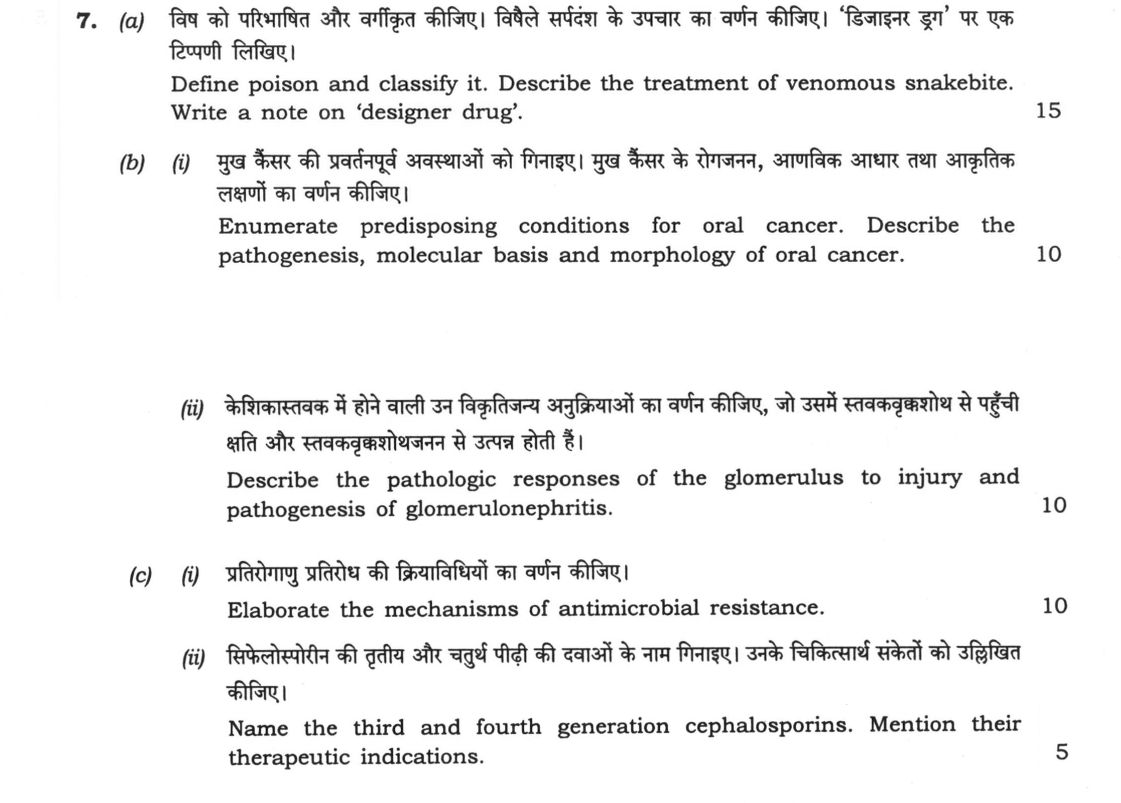
(a) Define poison and classify it. Describe the treatment of venomous snakebite. Write a note on 'designer drug'. 15 marks (b)…
Define poison and classify it. Describe the treatment of venomous snakebite. Write a note on 'designer drug'. 15 marks
Enumerate predisposing conditions for oral cancer. Describe the pathogenesis, molecular basis and morphology of oral cancer. 10 marks
Describe the pathologic responses of the glomerulus to injury and pathogenesis of glomerulonephritis. 10 marks
Elaborate the mechanisms of antimicrobial resistance. 10 marks
Name the third and fourth generation cephalosporins. Mention their therapeutic indications. 5 marks
हिंदी में प्रश्न पढ़ें
विष को परिभाषित और वर्गीकृत कीजिए। विषैले सर्पदंश के उपचार का वर्णन कीजिए। 'डिजाइनर ड्रग' पर एक टिप्पणी लिखिए। 15
मुख कैंसर की प्रवर्तनपूर्व अवस्थाओं को गिनाइए। मुख कैंसर के रोगजनन, आणविक आधार तथा आकृतिक लक्षणों का वर्णन कीजिए। 10
केशिकात्वक में होने वाली उन विकृतिजन्य अनुक्रियाओं का वर्णन कीजिए, जो उसमें स्तवकबुकशोथ से पहुँची क्षति और स्तवकबुकशोथजनन से उत्पन्न होती हैं। 10
प्रतिरोगाणु प्रतिरोध की क्रियाविधियों का वर्णन कीजिए। 10
सिफेलोस्पोरिन की तृतीय और चतुर्थ पीढ़ी की दवाओं के नाम गिनाइए। उनके चिकित्सार्थ संकेतों को उल्लिखित कीजिए। 5
Model answer
Written by UPSC Answer Check against this question's marking rubric, to the expected length. UPSC does not publish answers for Mains — this is one way to score well, not an official key.
(a) Poison, Snakebite Management, and Designer Drugs
A poison is any substance (solid, liquid, or gas) which, when administered, inhaled, or absorbed into a living organism, causes sickness, structural damage, or death through its local or systemic chemical action.
Poisons are classified based on origin into animal (venoms, cantharides), vegetable (strychnine, opium, ricin), and mineral/synthetic (arsenic, lead, organophosphates); based on target organ into neurotoxic, cardiotoxic, nephrotoxic, and hepatotoxic; and clinically/forensically into corrosives (strong acids/alkalis), irritants (metallic, mechanical), and systemic poisons (cerebral, spinal, peripheral, cardiac).
Treatment of Venomous Snakebite: In India, most envenomations are caused by the "Big Four" (Russell’s viper, Saw-scaled viper, Common krait, Spectacled cobra). Management comprises:
- First Aid: Reassure the patient, immobilize the affected limb with a splint at heart level, and avoid incisions, suction, or arterial tourniquets. Pressure immobilization is reserved for neurotoxic elapids.
- Antivenom Therapy: Lyophilized polyvalent Anti-Snake Venom (ASV) is the definitive antidote, administered via intravenous infusion (10 vials initially) guided by the 20-minute Whole Blood Clotting Test (20WBCT) for vipers or neuroparalytic signs for elapids.
- Complications and Adjuncts: Immediate anaphylaxis is managed with intramuscular adrenaline (0.5 mg, 1:1000) and hydrocortisone. Delayed serum sickness is treated with oral corticosteroids. Neurotoxicity responds to neostigmine with atropine and mechanical ventilation; acute kidney injury secondary to hemotoxicity requires hemodialysis.
Designer Drugs: These are synthetic structural or functional analogues of controlled psychoactive substances synthesized to circumvent drug enforcement legislation. Major classes include synthetic cannabinoids (Spice, K2), synthetic cathinones ("bath salts", mephedrone), and synthetic opioids (fentanyl analogues). In India, extensive seizures by the Narcotics Control Bureau (NCB) of mephedrone ("meow-meow") under the NDPS Act highlight their rapid emergence, high addiction liability, and fatal toxicity.
(b)(i) Oral Cancer: Predisposing Conditions, Pathogenesis, and Morphology
Predisposing factors include chronic consumption of tobacco (khaini, gutkha), betel quid with areca nut causing oral submucous fibrosis (OSMF), chronic alcohol consumption, high-risk Human Papillomavirus (HPV-16, HPV-18), Plummer-Vinson syndrome, and chronic mechanical irritation from jagged teeth.
Pathogenesis and Molecular Basis: Follows the multistep model of field cancerization, wherein carcinogen exposure produces widespread genetic alterations across the aerodigestive mucosa. Key molecular drivers include inactivation of tumor suppressor genes (TP53, CDKN2A/p16), amplification of EGFR and CCND1 (Cyclin D1), and activation of the PI3K/AKT/mTOR signaling pathway, driving progression from hyperplasia and dysplasia to invasive carcinoma.
Morphology: Macroscopically, lesions present as exophytic/fungating masses, endophytic ulcerations with indurated borders, or diffuse leukoplakic/erythroplakic plaques. Microscopically, the predominant type is Squamous Cell Carcinoma (SCC) and its variant, verrucous carcinoma. SCC shows nests and cords of malignant squamous cells displaying pleomorphism, mitotic figures, intercellular bridges, and concentric keratin pearls, graded into well, moderately, and poorly differentiated forms.
(b)(ii) Glomerular Responses to Injury and Pathogenesis of Glomerulonephritis
The glomerulus exhibits four primary pathologic responses:
- Hypercellularity: Proliferation of mesangial or endothelial cells, parietal epithelial cell proliferation forming "crescents", and leukocytic infiltration.
- Basement Membrane Thickening: Deposition of immune complexes (subepithelial, subendothelial, or intramembranous) or increased matrix synthesis (diabetic glomerulosclerosis).
- Hyalinization: Extracellular accumulation of eosinophilic, amorphous plasma-protein-derived material.
- Sclerosis: Accumulation of extracellular collagenous scar tissue obliterating capillary loops.
Pathogenesis: Immune-mediated injury is the primary driver. It occurs via:
- In situ immune complex deposition: Antibodies directed against endogenous glomerular antigens, such as anti-GBM antibodies in Goodpasture syndrome or anti-PLA2R antibodies in primary membranous nephropathy.
- Circulating immune complex entrapment: Subendothelial/subepithelial trapping of antigen-antibody complexes (post-streptococcal GN, lupus nephritis).
- Cell-mediated and ANCA-associated injury: Pauci-immune mechanisms driven by anti-neutrophil cytoplasmic antibodies (granulomatosis with polyangiitis). These immune triggers recruit complement cascades (C3a, C5a, C5b-9 membrane attack complex), releasing chemotactic factors, reactive oxygen species, and cytokines (TGF-beta, TNF-alpha) that mediate glomerular destruction.
(c)(i) Mechanisms of Antimicrobial Resistance
Antimicrobial resistance (AMR) operates through several biochemical and genetic mechanisms:
- Enzymatic Inactivation: Production of beta-lactamases, Extended-Spectrum Beta-Lactamases (ESBLs), and carbapenemases (e.g., New Delhi metallo-beta-lactamase-1, NDM-1), which hydrolyze the beta-lactam ring.
- Target Modification: Structural alteration of drug binding sites, such as PBP2a production in Methicillin-Resistant Staphylococcus aureus (MRSA encoded by mecA), D-Ala-D-Lac cell-wall remodeling in Vancomycin-Resistant Enterococci (VRE via vanA), and topoisomerase/gyrase mutations in fluoroquinolone resistance.
- Reduced Permeability: Downregulation or loss of outer membrane porins (e.g., OprD loss in Pseudomonas aeruginosa).
- Active Efflux Pumps: Upregulation of energy-dependent multidrug efflux systems (e.g., AcrAB-TolC in Enterobacteriaceae).
- Biofilm Formation: Production of an extracellular polymeric matrix preventing drug penetration.
- Horizontal Gene Transfer: Dissemination of resistance determinants via conjugative plasmids, transposons, and integrons across bacterial populations.
(c)(ii) Third and Fourth Generation Cephalosporins
Third Generation: Parenteral agents include Ceftriaxone, Cefotaxime, Ceftazidime, and Cefoperazone; oral agents include Cefixime and Cefpodoxime proxetil. Fourth Generation: Cefepime and Cefpirome.
Therapeutic Indications:
- Bacterial Meningitis: Ceftriaxone and Cefotaxime due to superior blood-brain barrier penetration.
- Enteric/Typhoid Fever and Gonorrhea: Ceftriaxone as standard first-line therapy.
- Pseudomonal and Nosocomial Infections: Ceftazidime, Cefoperazone, and Cefepime against Pseudomonas aeruginosa.
- Febrile Neutropenia and Severe Sepsis: Cefepime and Cefpirome offer broad, balanced gram-positive and gram-negative coverage with resistance to common AmpC beta-lactamases.
What "Describe" is asking you to do
Give a full, ordered account of the thing named — its parts, stages or mechanism — in the sequence in which it actually exists or occurs. Most describe questions come from the science optionals, where the marks sit in correct technical detail and, where the stem says so, a labelled diagram.
Structure that answers it
One-line identification of the subject → the parts or stages in their real order, each with its defining detail → labelled diagram where the subject is structural → closing line on function or significance
Where marks are lost
Loose general prose where the examiner is ticking named parts, correct terminology and their sequence; and in the General Studies papers, turning to evaluation before the description is finished.
How this answer will be evaluated
Approach
Framework: Medical Science, Paper 1. (a) define: precise definition > the distinguishing feature > one example | (b(i)) enumerate: list the items in order > one line each > no commentary | (b(ii)) describe: define > structure or process in order > labelled diagram > significance | (c(i)) explain: definition/context > points in order > small example > short close | (c(ii)) enumerate: list the items in order > one line each > no commentary Full marks: Comprehensive, accurate, and well-structured answers with specific examples and mechanisms.
Key points expected
- Precise definition of poison
- Classification of poisons (e.g., by source)
- Immediate and definitive treatment of snakebite
- Definition and examples of designer drugs
- List of predisposing conditions (e.g., tobacco, alcohol)
- Description of pathogenesis (dysplasia to carcinoma)
- Molecular basis (e.g., p53, HPV)
- Morphology (gross and microscopic features)
Evaluation rubric
Each sub-part is marked on its own, against the marks and word limit printed on the paper.
- (a) Definition, classification, snakebite management, and note on designer drugs. 15 marks
define— precise definition → the distinguishing feature → one example
Must cover
- Precise definition of poison
- Classification of poisons (e.g., by source)
- Immediate and definitive treatment of snakebite
- Definition and examples of designer drugs
Loses marks
- Listing snakebite symptoms without management
- Confusing poison with toxin
- Vague description of designer drugs
Earns more
- Mention of specific antivenom types
- Mechanism of action of designer drugs
- Differentiation of venomous vs non-venomous snakebite
Extra mark
- Reference to National Snakebite Management Guidelines
- Mention of specific designer drug names (e.g., MDAI)
- (b(i)) List predisposing factors and describe pathogenesis, molecular basis, and morphology. 10 marks
enumerate— list the items in order → one line each → no commentary
Must cover
- List of predisposing conditions (e.g., tobacco, alcohol)
- Description of pathogenesis (dysplasia to carcinoma)
- Molecular basis (e.g., p53, HPV)
- Morphology (gross and microscopic features)
Loses marks
- Listing symptoms without pathogenesis
- Omitting molecular basis
- Confusing oral cancer with other head/neck cancers
Earns more
- Mention of specific molecular markers
- Description of pre-malignant lesions (leukoplakia)
- Staging of oral cancer
Extra mark
- Reference to specific molecular pathways (e.g., RAS)
- Mention of specific histological subtypes
- (b(ii)) Describe glomerular injury responses and glomerulonephritis pathogenesis. 10 marks
describe— define → structure or process in order → labelled diagram → significance
Must cover
- Pathologic responses of glomerulus to injury
- Pathogenesis of glomerulonephritis
- Mechanisms of immune complex deposition
- Types of glomerulonephritis (e.g., post-streptococcal)
Loses marks
- Listing symptoms without pathogenesis
- Confusing glomerulonephritis with other renal diseases
- Omitting immune mechanisms
Earns more
- Mention of specific immune complexes
- Description of complement activation
- Mention of specific glomerular cell types
Extra mark
- Reference to specific glomerular diseases (e.g., IgA nephropathy)
- Mention of specific histological patterns
- (c(i)) Elaborate mechanisms of antimicrobial resistance. 10 marks
explain— definition/context → points in order → small example → short close
Must cover
- Mechanisms of resistance (e.g., enzymatic degradation)
- Target modification
- Efflux pumps
- Reduced permeability
Loses marks
- Listing symptoms without mechanisms
- Confusing resistance with tolerance
- Omitting specific mechanisms
Earns more
- Mention of specific resistance genes
- Description of horizontal gene transfer
- Mention of specific resistant organisms
Extra mark
- Reference to specific resistance mechanisms (e.g., beta-lactamase)
- Mention of specific resistant bacteria (e.g., MRSA)
- (c(ii)) Name 3rd and 4th gen cephalosporins and their indications. 5 marks
enumerate— list the items in order → one line each → no commentary
Must cover
- Names of 3rd generation cephalosporins
- Names of 4th generation cephalosporins
- Therapeutic indications for 3rd gen
- Therapeutic indications for 4th gen
Loses marks
- Listing drugs without indications
- Confusing generations of cephalosporins
- Omitting specific drug names
Earns more
- Mention of specific drug names (e.g., Ceftriaxone)
- Description of specific infections treated
- Mention of specific patient populations
Extra mark
- Reference to specific clinical guidelines
- Mention of specific dosing regimens
Practice this exact question
Write your answer and it is marked point by point against the model answer above — what you covered, what you missed, what you got wrong.
Evaluate my answer →More from Medical Science 2021 Paper I
- Q4 (a) Explain in detail the absorption and hormonal regulation of blood calcium in body. Di…
- Q5 (a) Define 'metastasis'. Enumerate the steps involved in metastasis. Write briefly about…
- Q6 (a) Define ischemic heart disease. Enumerate four ischemic syndromes. Discuss the pathoge…
- Q7 (a) Define poison and classify it. Describe the treatment of venomous snakebite. Write a…
- Q8 (a) (i) Describe the uniqueness of Pulse Polio Programme in India. 10 marks (ii) A 28-yea…