Paper I — Q6
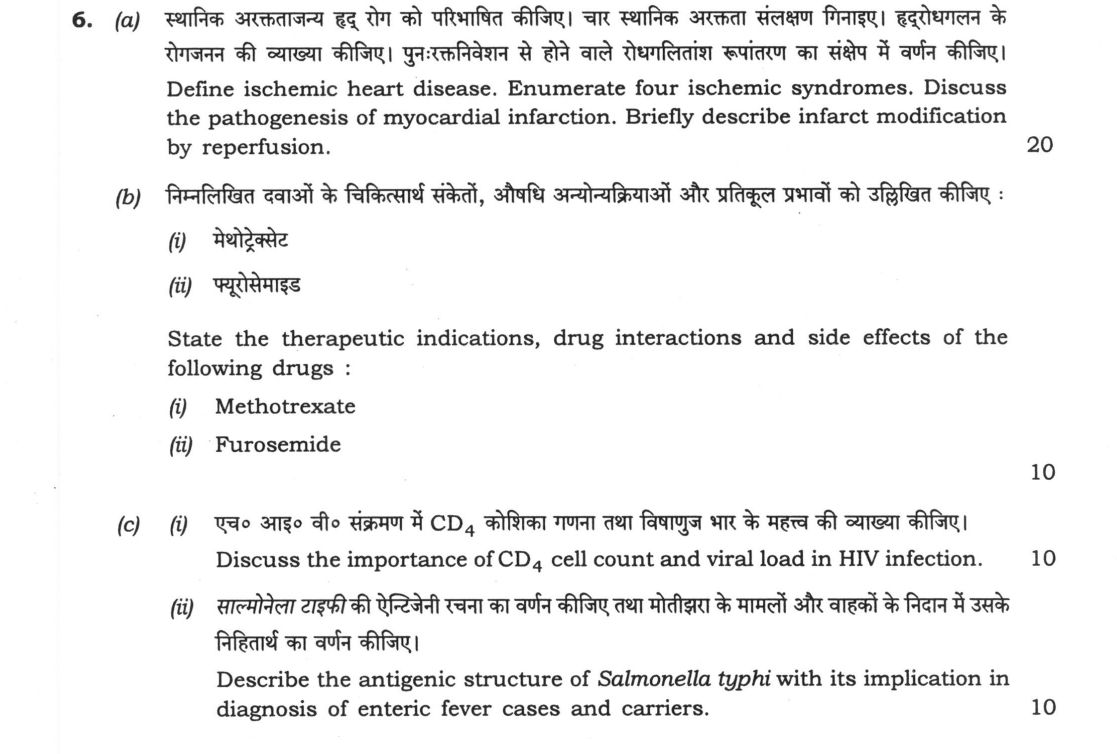
(a) Define ischemic heart disease. Enumerate four ischemic syndromes. Discuss the pathogenesis of myocardial infarction. Briefly…
Define ischemic heart disease. Enumerate four ischemic syndromes. Discuss the pathogenesis of myocardial infarction. Briefly describe infarct modification by reperfusion. 20 marks
State the therapeutic indications, drug interactions and side effects of the following drugs: Methotrexate
Furosemide 10 marks
Discuss the importance of CD₄ cell count and viral load in HIV infection. 10 marks
Describe the antigenic structure of Salmonella typhi with its implication in diagnosis of enteric fever cases and carriers. 10 marks
हिंदी में प्रश्न पढ़ें
स्थानिक अरक्तताजन्य हृद् रोग को परिभाषित कीजिए। चार स्थानिक अरक्तता संलक्षण गिनाइए। हृद्रोधगलन के रोगजनन की व्याख्या कीजिए। पुनःरक्तनिवेशन से होने वाले रोधगलितांश रूपांतरण का संक्षेप में वर्णन कीजिए। 20
निम्नलिखित दवाओं के चिकित्सार्थ संकेतों, औषधि अन्योन्यक्रियाओं और प्रतिकूल प्रभावों को उल्लिखित कीजिए : मेथोट्रेक्सेट
फ्यूरोसेमाइड 10
एच० आइ० वी० संक्रमण में CD₄ कोशिका गणना तथा विषाणुज भार के महत्व की व्याख्या कीजिए। 10
साल्मोनेला टाइफी की एंटिजेनी रचना का वर्णन कीजिए तथा मोतीझरा के मामलों और वाहकों के निदान में उसके निहितार्थ का वर्णन कीजिए। 10
Model answer
Written by UPSC Answer Check against this question's marking rubric, to the expected length. UPSC does not publish answers for Mains — this is one way to score well, not an official key.
Ischemic Heart Disease (IHD) is defined as a state of myocardial impairment resulting from an imbalance between myocardial oxygen supply and demand, most frequently precipitated by coronary atherosclerotic narrowing. The four major clinical ischemic syndromes are chronic stable angina, unstable angina, non-ST elevation myocardial infarction (NSTEMI), and ST-elevation myocardial infarction (STEMI).
Pathogenesis of Myocardial Infarction Myocardial infarction (MI) is initiated when an unstable atheromatous plaque undergoes sudden disruption via fissure, erosion, or intraplaque hemorrhage. Exposure of the thrombogenic subendothelial core triggers immediate platelet adhesion via von Willebrand factor, followed by platelet activation and release of thromboxane A2 and ADP. Concurrently, exposed tissue factor activates the extrinsic coagulation cascade, generating thrombin and cross-linked fibrin. This culminates in an occlusive luminal thrombus. Critical cessation of coronary blood flow halts aerobic glycolysis within seconds. If ischemia persists beyond 20 to 30 minutes, irreversible cellular injury begins in the subendocardium and progresses as a wavefront of coagulative necrosis toward the epicardium over 6 to 12 hours.
Infarct Modification by Reperfusion Timely reperfusion via primary percutaneous coronary intervention or fibrinolytic therapy halts the wavefront of necrosis, preserving ventricular function. However, restoration of blood flow can induce reperfusion injury. Mechanisms include:
- Generation of toxic reactive oxygen species upon reoxygenation.
- Intracellular and mitochondrial calcium overload causing hypercontraction band necrosis.
- Neutrophil infiltration exacerbating microvascular occlusion and inflammation.
- Endothelial swelling and microvascular damage manifesting as the "no-reflow" phenomenon.
- Myocardial stunning (prolonged post-ischemic mechanical dysfunction) and reperfusion arrhythmias.
Pharmacology of Methotrexate and Furosemide Methotrexate: A folate antimetabolite inhibiting dihydrofolate reductase.
- Indications: Autoimmune diseases (rheumatoid arthritis, severe psoriasis), hematological malignancies (acute lymphoblastic leukemia), and solid tumors (choriocarcinoma, osteosarcoma).
- Drug interactions: NSAIDs, probenecid, and penicillins reduce renal tubular clearance of methotrexate, markedly increasing systemic toxicity; co-administration with trimethoprim increases antifolate toxicity.
- Side effects: Bone marrow suppression, oral mucositis, hepatotoxicity, pulmonary fibrosis, and teratogenicity.
Furosemide: A loop diuretic inhibiting the luminal Na+-K+-2Cl- cotransporter in the thick ascending limb of Henle.
- Indications: Acute pulmonary edema, congestive heart failure, nephrotic edema, chronic kidney disease, hypertension, and acute hypercalcemia.
- Drug interactions: Synergistic ototoxicity with aminoglycosides; blunted natriuresis with NSAIDs; hypokalemia potentiates digoxin toxicity and impairs renal lithium clearance.
- Side effects: Hypokalemia, hyponatremia, hypomagnesemia, dehydration, hyperuricemia, and ototoxicity.
Role of CD4 Count and Viral Load in HIV Infection CD4+ T-lymphocyte count is the standard surrogate marker for host immune competence. It determines clinical staging under WHO and CDC systems, defines the risk of opportunistic infections, and dictates the initiation and discontinuation of chemoprophylaxis (such as cotrimoxazole for Pneumocystis jirovecii when CD4 falls below 200 cells/µL).
Plasma viral load (HIV-1 RNA quantitative PCR) reflects the rate of active viral replication and serves as the most accurate predictor of disease progression. Under National AIDS Control Organisation (NACO) guidelines, routine viral load monitoring is the definitive gold standard to evaluate adherence, confirm therapeutic response, and detect early virological failure before immunological or clinical decline occurs.
Antigenic Structure and Diagnosis of Salmonella typhi Salmonella typhi possesses three principal antigens:
- Somatic (O) Antigen: Lipopolysaccharide component of the outer membrane (factors 9 and 12); heat-stable.
- Flagellar (H) Antigen: Proteinaceous flagellin (phase 1 'd'); heat-labile.
- Capsular (Vi) Antigen: Acidic polysaccharide surface antigen enveloping the O antigen; heat-labile.
Diagnostic Implications: The Widal tube agglutination test assesses antibody responses against O and H antigens. A single baseline diagnostic titre (anti-O > 1:160, anti-H > 1:160 in endemic settings) or a four-fold rise in paired sera confirms active enteric fever. Anti-O appears early and wanes quickly, signifying acute infection, whereas anti-H appears later and persists. Surface Vi antigen can mask O agglutination, producing false-negative O titres. Detecting high-titre anti-Vi antibodies by ELISA or agglutination is vital for identifying chronic asymptomatic carriers who harbor the bacilli in the gallbladder.
A comprehensive public health approach requires integrating emergency myocardial reperfusion networks to curb India's escalating cardiovascular burden, sustaining universal viral load surveillance under NACO for HIV, and deploying Typhoid Conjugate Vaccines (TCV) combined with strict carrier surveillance to disrupt endemic enteric transmission.
What "Discuss" is asking you to do
Lay the issue out from more than one side — how it arose, what is claimed for it, what is held against it, and where it now stands. UPSC attaches discuss to broad topics with several live dimensions, so coverage of the dimensions earns more than the strength of your opinion.
Structure that answers it
Set the issue up → the case as it is made → the case against → the dimension both sides leave out → where the balance now lies
Where marks are lost
Listing facts with no thread between them, or arguing one side throughout and calling it a discussion.
How this answer will be evaluated
Approach
Framework: Clinical Sequence (Definition > Aetiology/Pathophysiology > Features > Investigation/Management). (a) discuss: intro > 3-4 dimensions > example > balanced close | (b) enumerate: list the items in order > one line each > no commentary | (c(i)) discuss: intro > 3-4 dimensions > example > balanced close | (c(ii)) describe: define > structure or process in order > labelled diagram > significance Full marks: Comprehensive, clinically accurate, uses flow diagrams, references current guidelines, and clearly distinguishes between pathogenesis and management.
Key points expected
- Precise definition of Ischemic Heart Disease
- Four distinct ischemic syndromes enumerated
- Pathogenesis of MI linked to plaque rupture/thrombosis
- Mechanism of reperfusion injury (ROS/Calcium)
- Indications for Methotrexate (e.g., RA, Psoriasis)
- Indications for Furosemide (e.g., Edema, HF)
- Key side effects for both (e.g., Myelosuppression, Ototoxicity)
- Specific drug interactions (e.g., NSAIDs, Aminoglycosides)
Evaluation rubric
Each sub-part is marked on its own, against the marks and word limit printed on the paper.
- (a) Define IHD, list 4 syndromes, explain MI pathogenesis, and describe reperfusion injury. 20 marks
discuss— intro → 3-4 dimensions → example → balanced close
Must cover
- Precise definition of Ischemic Heart Disease
- Four distinct ischemic syndromes enumerated
- Pathogenesis of MI linked to plaque rupture/thrombosis
- Mechanism of reperfusion injury (ROS/Calcium)
Loses marks
- Listing syndromes without definition
- Pathogenesis without mechanism (just 'blockage')
- Omitting reperfusion injury details
Earns more
- Flow diagram of pathogenesis
- Mention of 'no-reflow' phenomenon
- Differentiation of stable vs unstable angina
- Reference to current reperfusion guidelines
Extra mark
- Mention of specific reperfusion time windows
- Reference to specific clinical trials (e.g., TIMI)
- (b) Provide indications, interactions, and side effects for Methotrexate and Furosemide. 10 marks
enumerate— list the items in order → one line each → no commentary
Must cover
- Indications for Methotrexate (e.g., RA, Psoriasis)
- Indications for Furosemide (e.g., Edema, HF)
- Key side effects for both (e.g., Myelosuppression, Ototoxicity)
- Specific drug interactions (e.g., NSAIDs, Aminoglycosides)
Loses marks
- Confusing Methotrexate with other antimetabolites
- Omitting drug interactions
- Listing side effects without clinical context
Earns more
- Mention of Leucovorin rescue for MTX
- Mention of electrolyte monitoring for Furosemide
- Table format for comparison
- Mention of specific contraindications
Extra mark
- Mention of specific dosage adjustments
- Reference to specific drug interaction mechanisms
- (c(i)) Explain the clinical significance of CD4 count and viral load in HIV. 10 marks
discuss— intro → 3-4 dimensions → example → balanced close
Must cover
- Role of CD4 count in staging disease
- Role of viral load in monitoring treatment
- Link between CD4 count and opportunistic infections
- Impact of viral load on transmission risk
Loses marks
- Confusing CD4 count with total WBC
- Omitting the role of viral load in treatment
- Failing to link CD4 to clinical outcomes
Earns more
- Mention of specific CD4 thresholds (e.g., <200)
- Reference to 'Undetectable = Untransmittable' (U=U)
- Mention of immune reconstitution
- Comparison of CD4 vs Viral load trends
Extra mark
- Mention of specific opportunistic infections by CD4 level
- Reference to specific guidelines (e.g., WHO, NACO)
- (c(ii)) Detail Salmonella typhi antigenic structure and its diagnostic use. 10 marks
describe— define → structure or process in order → labelled diagram → significance
Must cover
- Description of O, H, and Vi antigens
- Role of O antigen in Widal test
- Role of Vi antigen in carrier detection
- Implication in diagnosis of enteric fever
Loses marks
- Confusing Salmonella typhi with other Salmonella
- Omitting Vi antigen
- Failing to link antigens to specific tests
Earns more
- Mention of specific serotypes (e.g., D1, D2)
- Reference to culture as gold standard
- Mention of PCR for diagnosis
- Explanation of Vi capsule function
Extra mark
- Mention of specific diagnostic kits
- Reference to specific carrier states (e.g., gallbladder)
Practice this exact question
Write your answer and it is marked point by point against the model answer above — what you covered, what you missed, what you got wrong.
Evaluate my answer →More from Medical Science 2021 Paper I
- Q3 (a) Elaborate on the hormonal regulation of blood glucose level. Explain in brief the sig…
- Q4 (a) Explain in detail the absorption and hormonal regulation of blood calcium in body. Di…
- Q5 (a) Define 'metastasis'. Enumerate the steps involved in metastasis. Write briefly about…
- Q6 (a) Define ischemic heart disease. Enumerate four ischemic syndromes. Discuss the pathoge…
- Q7 (a) Define poison and classify it. Describe the treatment of venomous snakebite. Write a…
- Q8 (a) (i) Describe the uniqueness of Pulse Polio Programme in India. 10 marks (ii) A 28-yea…