Paper I — Q8
(a) (i) Describe the uniqueness of Pulse Polio Programme in India. 10 marks (ii) A 28-year-old man with history of HIV antibody…
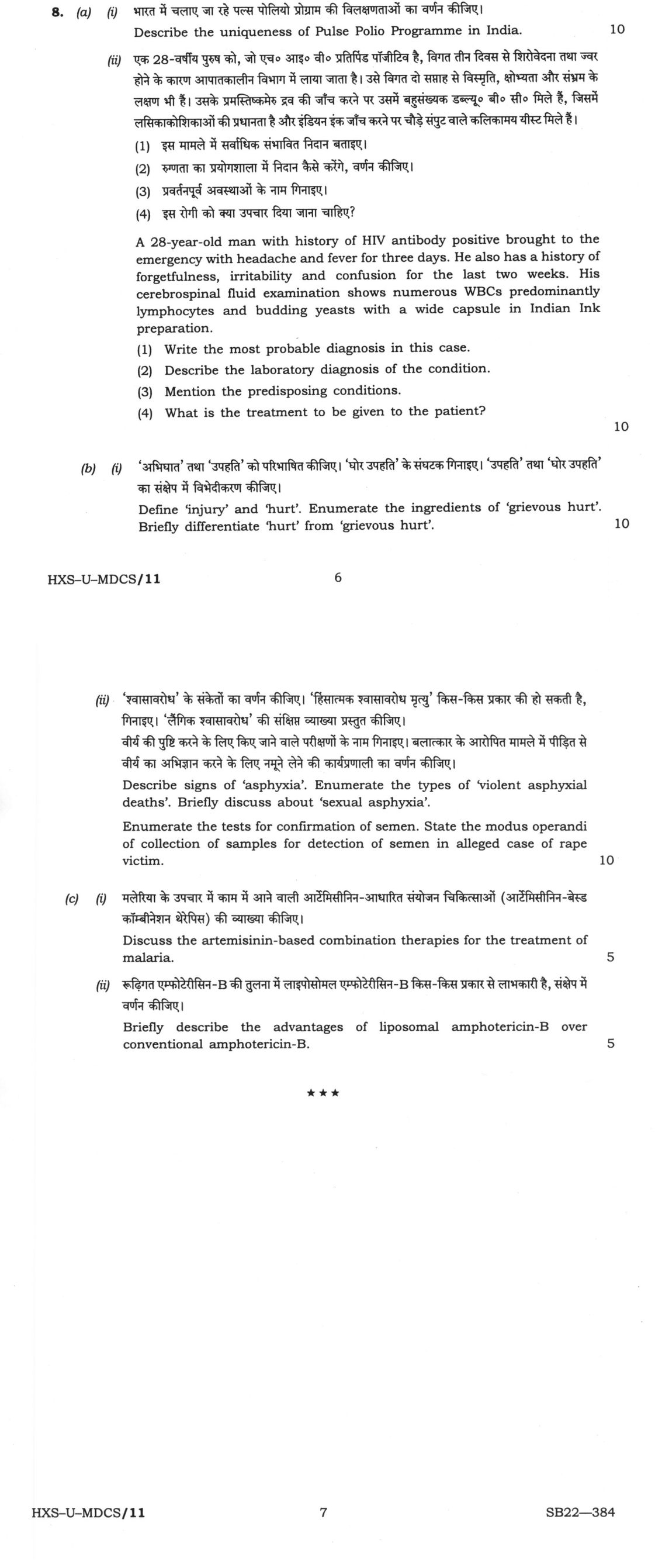
Describe the uniqueness of Pulse Polio Programme in India. 10 marks
A 28-year-old man with history of HIV antibody positive brought to the emergency with headache and fever for three days. He also has a history of forgetfulness, irritability and confusion for the last two weeks. His cerebrospinal fluid examination shows numerous WBCs predominantly lymphocytes and budding yeasts with a wide capsule in Indian Ink preparation. (1) Write the most probable diagnosis in this case. (2) Describe the laboratory diagnosis of the condition. (3) Mention the predisposing conditions. (4) What is the treatment to be given to the patient? 10 marks
Define 'injury' and 'hurt'. Enumerate the ingredients of 'grievous hurt'. Briefly differentiate 'hurt' from 'grievous hurt'. 10 marks
Describe signs of 'asphyxia'. Enumerate the types of 'violent asphyxial deaths'. Briefly discuss about 'sexual asphyxia'. Enumerate the tests for confirmation of semen. State the modus operandi of collection of samples for detection of semen in alleged case of rape victim. 10 marks
Discuss the artemisinin-based combination therapies for the treatment of malaria. 5 marks
Briefly describe the advantages of liposomal amphotericin-B over conventional amphotericin-B. 5 marks
हिंदी में प्रश्न पढ़ें
भारत में चलाए जा रहे पल्स पोलियो प्रोग्राम की विशिष्टताओं का वर्णन कीजिए। 10
एक 28-वर्षीय पुरुष को, जो एच० आइ० वी० प्रतिपिंड पॉजिटिव है, विगत तीन दिवस से शिरोवेदना तथा ज्वर होने के कारण आपातकालीन विभाग में लाया जाता है। उसे विगत दो सप्ताह से विस्मृति, क्रोध्यता और संभ्रम के लक्षण भी हैं। उसके प्रमस्तिष्कमेरु द्रव की जाँच करने पर उसमें बहुसंख्यक डब्ल्यू० बी० सी० मिले हैं, जिसमें लसिकाकोशिकाओं की प्रधानता है और इंडियन इंक जाँच करने पर चौड़े सैपुट वाले कलिकामय यीस्ट मिलते हैं। (1) इस मामले में सर्वाधिक संभावित निदान बताइए। (2) रुग्णता का प्रयोगशाला में निदान कैसे करेंगे, वर्णन कीजिए। (3) प्रवर्तनपूर्व अवस्थाओं के नाम गिनाइए। (4) इस रोगी को क्या उपचार दिया जाना चाहिए? 10 marks
'अभिघात' तथा 'उपहति' को परिभाषित कीजिए। 'घोर उपहति' के संघटक गिनाइए। 'उपहति' तथा 'घोर उपहति' का संक्षेप में विभेदीकरण कीजिए। 10
'श्वासावरोध' के संकेतों का वर्णन कीजिए। 'हिंसात्मक श्वासावरोध मृत्यु' किस-किस प्रकार की हो सकती है, गिनाइए। 'लैंगिक श्वासावरोध' की संक्षिप्त व्याख्या प्रस्तुत कीजिए। वीर्य की पुष्टि करने के लिए किए जाने वाले परीक्षणों के नाम गिनाइए। बलात्कार के आरोपित मामले में पीड़ित से वीर्य का अभिज्ञान करने के लिए नमूने लेने की कार्यप्रणाली का वर्णन कीजिए। 10
मलेरिया के उपचार में काम में आने वाली आर्टेमिसीनिन-आधारित संयोजन चिकित्साओं (आर्टेमिसीनिन-बेस्ड कॉम्बिनेशन थेरेपिस) की व्याख्या कीजिए। 5
रूढ़िगत एम्फोटेरिसिन-बी की तुलना में लाइपोसोमल एम्फोटेरिसिन-बी किस-किस प्रकार से लाभकारी है, संक्षेप में वर्णन कीजिए। 5
Model answer
Written by UPSC Answer Check against this question's marking rubric, to the expected length. UPSC does not publish answers for Mains — this is one way to score well, not an official key.
This question integrates Community Medicine, Microbiology, Forensic Medicine and Pharmacology, requiring a link between prevention, laboratory diagnosis, medico-legal interpretation and rational drug therapy.
Pulse Polio Programme. The uniqueness of India’s Pulse Polio Programme lies in its mass, house-to-house immunisation through National Immunisation Days, booth-based and mobile teams, repeated mop-up rounds, strong cold-chain maintenance, and integration with acute flaccid paralysis surveillance. Booth-based and mobile teams reached remote and mobile populations, while mop-up rounds targeted missed children and cold-chain maintenance preserved vaccine potency. This strategy interrupted transmission, enabled India to be declared polio-free in 2014, and later allowed the switch from trivalent OPV to bivalent OPV in 2016, while continued surveillance remains necessary for VDPV and cVDPV.
Cryptococcal meningitis. The most probable diagnosis is cryptococcal meningitis, supported by HIV positivity, subacute confusion, lymphocytic CSF, and India ink showing budding yeasts with a wide capsule. Laboratory diagnosis includes India ink preparation, cryptococcal antigen detection in CSF or serum, culture on Sabouraud dextrose agar, and supportive microscopy/culture confirmation. CSF cryptococcal antigen is highly sensitive and can support diagnosis before culture, while culture remains the reference method. Predisposing conditions are HIV/AIDS, immunosuppressive therapy, and malignancy. Treatment is induction with amphotericin-B plus flucytosine, followed by fluconazole maintenance, with monitoring of renal function and CSF pressure.
Injury, hurt and grievous hurt. Under Section 44 IPC, injury means harm of any kind illegally caused to body, mind, reputation or property. Under Section 319 IPC, hurt means causing bodily pain, disease or infirmity to any person. Section 320 IPC defines grievous hurt as emasculation; permanent privation of sight of either eye; permanent privation of hearing of either ear; permanent privation of power of any limb or joint; destruction of permanent power of speech; causing disease or infirmity endangering life; causing hurt endangering life; and causing hurt disabling a person for twenty days or preventing ordinary pursuits for twenty days. Hurt is general and may be transient; grievous hurt is specifically serious, involving permanent disability, danger to life or prolonged incapacity. The legal distinction matters because hurt is punishable under Section 325 with imprisonment up to one year or fine up to Rs 1000 or both, while grievous hurt is punishable under Section 326 with life imprisonment or imprisonment up to ten years and fine.
Asphyxia and semen evidence. Signs of asphyxia include petechial haemorrhages, cyanosis, congestion, and fluidity of blood. Violent asphyxial deaths include hanging, strangulation, throttling, suffocation, drowning, smothering, choking, and traumatic asphyxia. Sexual asphyxia, or autoerotic asphyxia, occurs when a person voluntarily applies pressure to the neck or airway to enhance sexual stimulation; deaths are usually accidental, and ligature marks, bruising or petechiae may be found. For semen, presumptive screening tests include acid phosphatase, Florence and Barberio tests; confirmatory tests are microscopic identification of spermatozoa, prostate-specific antigen detection, and DNA profiling. In an alleged rape case, the victim should be examined without washing; samples are collected by vaginal swabs, pubic hair combing, fingernail scrapings, clothing, and a reference blood sample. All samples are labelled, air-dried, packed in paper bags, and maintained under chain of custody.
Malaria and antifungal therapy. Artemisinin-based combination therapies include artemether-lumefantrine, artesunate-amodiaquine, artesunate-mefloquine, and dihydroartemisinin-piperaquine. The combination rapidly clears parasites with artemisinin and uses a longer-acting partner to prevent resistance, as recommended by WHO and adopted in India’s national malaria drug policy. Liposomal amphotericin-B has advantages over conventional amphotericin-B: reduced nephrotoxicity, fewer infusion-related reactions, a higher therapeutic index, ability to use higher doses, better tissue penetration, and particular utility in cryptococcal meningitis and visceral leishmaniasis. The lipid formulation reduces exposure of kidneys to free amphotericin-B, making it safer in renal impairment.
Together, these answers show how public-health immunisation, laboratory diagnosis, medico-legal interpretation and rational pharmacotherapy combine in integrated clinical and forensic management.
What "Describe" is asking you to do
Give a full, ordered account of the thing named — its parts, stages or mechanism — in the sequence in which it actually exists or occurs. Most describe questions come from the science optionals, where the marks sit in correct technical detail and, where the stem says so, a labelled diagram.
Structure that answers it
One-line identification of the subject → the parts or stages in their real order, each with its defining detail → labelled diagram where the subject is structural → closing line on function or significance
Where marks are lost
Loose general prose where the examiner is ticking named parts, correct terminology and their sequence; and in the General Studies papers, turning to evaluation before the description is finished.
How this answer will be evaluated
Approach
Framework: Clinical Sequence (Definition > Aetiology > Features > Investigation > Management). (a(i)) describe: define > structure or process in order > labelled diagram > significance | (a(ii)) explain: definition/context > points in order > small example > short close | (b(i)) define: precise definition > the distinguishing feature > one example | (b(ii)) describe: define > structure or process in order > labelled diagram > significance | (c(i)) discuss: intro > 3-4 dimensions > example > balanced close | (c(ii)) describe: define > structure or process in order > labelled diagram > significance Full marks: Accurate diagnosis, specific lab tests, correct treatment, clear differentiation, and specific advantages mentioned.
Key points expected
- Mention the National Immunisation Day (NID) strategy
- Describe the 'drop' technique (oral vaccine)
- Highlight the 'zero polio' goal and certification
- Mention the role of the 'Pulse' (massive simultaneous drive)
- Diagnosis: Cryptococcal Meningitis (based on Indian Ink)
- Lab Diagnosis: CSF India Ink, culture, antigen test
- Predisposing: HIV/AIDS (CD4 < 100), immunosuppression
- Treatment: Amphotericin B + Flucytosine (induction)
Evaluation rubric
Each sub-part is marked on its own, against the marks and word limit printed on the paper.
- (a(i)) Explain the unique features of the Pulse Polio Programme in India. 10 marks
describe— define → structure or process in order → labelled diagram → significance
Must cover
- Mention the National Immunisation Day (NID) strategy
- Describe the 'drop' technique (oral vaccine)
- Highlight the 'zero polio' goal and certification
- Mention the role of the 'Pulse' (massive simultaneous drive)
Loses marks
- Confusing Pulse Polio with routine immunisation
- Failing to mention the oral drop method
- Listing general polio symptoms instead of programme features
Earns more
- Reference to the 'Pulse Polio' vs 'Routine' immunisation
- Mention of the 'Pulse' as a unique mass vaccination event
- Reference to the 'Pulse' as a unique mass vaccination event
- Mention of the 'Pulse' as a unique mass vaccination event
Extra mark
- Mention of the 'Pulse' as a unique mass vaccination event
- Mention of the 'Pulse' as a unique mass vaccination event
- (a(ii)) Diagnose the case and outline lab diagnosis, predisposing factors, and treatment. 10 marks
explain— definition/context → points in order → small example → short close
Must cover
- Diagnosis: Cryptococcal Meningitis (based on Indian Ink)
- Lab Diagnosis: CSF India Ink, culture, antigen test
- Predisposing: HIV/AIDS (CD4 < 100), immunosuppression
- Treatment: Amphotericin B + Flucytosine (induction)
Loses marks
- Diagnosing as TB meningitis (wrong organism)
- Omitting the specific lab test (India Ink)
- Prescribing only oral fluconazole for induction
Earns more
- Mentioning 'budding yeasts with wide capsule' as key finding
- Mentioning 'lymphocytic pleocytosis' in CSF
- Mentioning 'maintenance therapy' with Fluconazole
- Mentioning 'HIV antibody positive' as the predisposing factor
Extra mark
- Mentioning 'Cryptococcal antigen' in serum/CSF
- Mentioning 'Amphotericin B' as the drug of choice
- (b(i)) Define injury/hurt, list ingredients of grievous hurt, and differentiate. 10 marks
define— precise definition → the distinguishing feature → one example
Must cover
- Define 'Injury' (IPC Sec 319)
- Define 'Hurt' (IPC Sec 320)
- List ingredients of 'Grievous Hurt' (IPC Sec 320)
- Differentiate 'Hurt' vs 'Grievous Hurt' (severity)
Loses marks
- Confusing 'Injury' with 'Hurt' (Injury is broader)
- Failing to list the specific ingredients of Grievous Hurt
- Not differentiating based on severity/duration
Earns more
- Mentioning 'IPC Section 319' for Injury
- Mentioning 'IPC Section 320' for Hurt
- Mentioning 'IPC Section 320' for Grievous Hurt
- Mentioning 'IPC Section 320' for Grievous Hurt
Extra mark
- Mentioning 'IPC Section 320' for Grievous Hurt
- Mentioning 'IPC Section 320' for Grievous Hurt
- (b(ii)) Describe asphyxia signs, types, sexual asphyxia, and semen tests. 10 marks
describe— define → structure or process in order → labelled diagram → significance
Must cover
- Signs of Asphyxia: Cyanosis, petechiae, congestion
- Types of Violent Asphyxial Deaths: Hanging, strangulation, etc.
- Sexual Asphyxia: Definition and mechanism
- Semen Tests: Acid Phosphatase, PSA, Spermatozoa
Loses marks
- Confusing 'Asphyxia' with 'Anoxia'
- Failing to mention 'Petechial haemorrhages'
- Omitting 'Sexual Asphyxia' from the discussion
Earns more
- Mentioning 'Petechial haemorrhages' (Tardieu's spots)
- Mentioning 'Cyanosis' of face and lips
- Mentioning 'Acid Phosphatase' as a specific test
- Mentioning 'PSA' (Prostate Specific Antigen) as a specific test
Extra mark
- Mentioning 'Spermatozoa' as a specific test
- Mentioning 'Acid Phosphatase' as a specific test
- (c(i)) Discuss Artemisinin-based Combination Therapies (ACTs) for malaria. 5 marks
discuss— intro → 3-4 dimensions → example → balanced close
Must cover
- Define ACTs (Artemisinin + partner drug)
- Mention the 'Artemisinin' component (e.g., Artesunate)
- Mention the 'Partner Drug' (e.g., Mefloquine, Lumefantrine)
- Explain the rationale (synergy, resistance prevention)
Loses marks
- Confusing ACTs with monotherapy
- Failing to mention the 'Partner Drug'
- Not explaining the rationale for combination
Earns more
- Mentioning 'Artesunate' as the artemisinin derivative
- Mentioning 'Mefloquine' as a partner drug
- Mentioning 'Lumefantrine' as a partner drug
- Mentioning 'Synergy' as the rationale
Extra mark
- Mentioning 'Artesunate' as the artemisinin derivative
- Mentioning 'Mefloquine' as a partner drug
- (c(ii)) Describe advantages of liposomal amphotericin-B over conventional. 5 marks
describe— define → structure or process in order → labelled diagram → significance
Must cover
- Mention 'Reduced Nephrotoxicity' (key advantage)
- Mention 'Improved Tolerability' (fewer side effects)
- Mention 'Better Pharmacokinetics' (targeted delivery)
- Mention 'Higher Dose' can be given safely
Loses marks
- Confusing 'Liposomal' with 'Conventional' (reversed)
- Failing to mention 'Nephrotoxicity' as the key advantage
- Not mentioning 'Improved Tolerability'
Earns more
- Mentioning 'Nephrotoxicity' as the main side effect of conventional
- Mentioning 'Liposomal' formulation as the key difference
- Mentioning 'Targeted delivery' to infected cells
- Mentioning 'Higher Dose' can be given safely
Extra mark
- Mentioning 'Nephrotoxicity' as the main side effect of conventional
- Mentioning 'Liposomal' formulation as the key difference
Practice this exact question
Write your answer and it is marked point by point against the model answer above — what you covered, what you missed, what you got wrong.
Evaluate my answer →More from Medical Science 2021 Paper I
- Q5 (a) Define 'metastasis'. Enumerate the steps involved in metastasis. Write briefly about…
- Q6 (a) Define ischemic heart disease. Enumerate four ischemic syndromes. Discuss the pathoge…
- Q7 (a) Define poison and classify it. Describe the treatment of venomous snakebite. Write a…
- Q8 (a) (i) Describe the uniqueness of Pulse Polio Programme in India. 10 marks (ii) A 28-yea…