Paper I — Q3
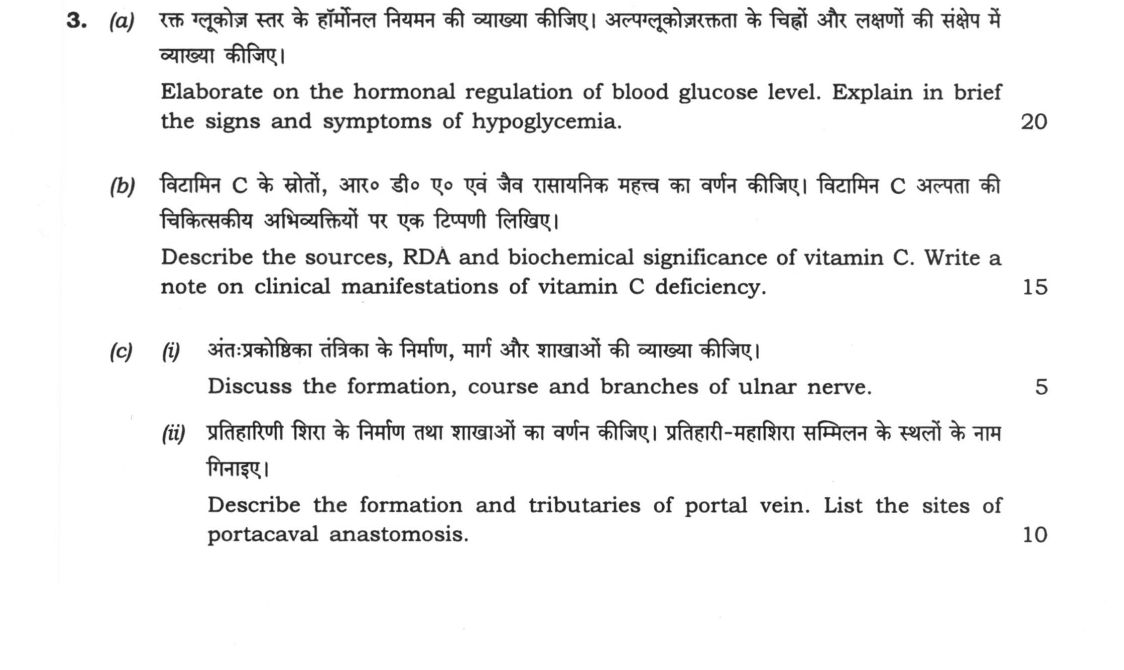
(a) Elaborate on the hormonal regulation of blood glucose level. Explain in brief the signs and symptoms of hypoglycemia. 20…
Elaborate on the hormonal regulation of blood glucose level. Explain in brief the signs and symptoms of hypoglycemia. 20 marks
Describe the sources, RDA and biochemical significance of vitamin C. Write a note on clinical manifestations of vitamin C deficiency. 15 marks
Discuss the formation, course and branches of ulnar nerve. 5 marks
Describe the formation and tributaries of portal vein. List the sites of portacaval anastomosis. 10 marks
हिंदी में प्रश्न पढ़ें
रक्त ग्लूकोज़ स्तर के हार्मोनल नियमन की व्याख्या कीजिए। अल्पग्लूकोज़रक्तता के चिह्नों और लक्षणों की संक्षेप में व्याख्या कीजिए। 20
विटामिन C के स्रोतों, आर० डी० ए० एवं जैव रासायनिक महत्व का वर्णन कीजिए। विटामिन C अल्पता की चिकित्सकीय अभिव्यक्तियों पर एक टिप्पणी लिखिए। 15
अंतःप्रकोष्ठिका तंत्रिका के निर्माण, मार्ग और शाखाओं की व्याख्या कीजिए। 5
प्रतिहारिणी शिरा के निर्माण तथा शाखाओं का वर्णन कीजिए। प्रतिहारी-महाशिरा सम्मिलन के स्थलों के नाम गिनाइए। 10
Model answer
Written by UPSC Answer Check against this question's marking rubric, to the expected length. UPSC does not publish answers for Mains — this is one way to score well, not an official key.
Part (a) Blood glucose is kept near 70–110 mg/dL by opposing hormones. Insulin, secreted by pancreatic β-cells after a meal, lowers glucose by promoting cellular uptake of glucose, especially in muscle and adipose tissue, and by stimulating glycogenesis, lipogenesis and protein synthesis while inhibiting glycogenolysis, gluconeogenesis and lipolysis. Glucagon, from α-cells, raises glucose during fasting by hepatic glycogenolysis and gluconeogenesis. Catecholamines (epinephrine/norepinephrine) act rapidly in stress by glycogenolysis and lipolysis; cortisol and growth hormone provide slower counter-regulation by increasing gluconeogenesis, reducing peripheral glucose use and mobilising amino acids and fatty acids. This balance prevents both hyperglycaemia and hypoglycaemia. Clinical hypoglycaemia is conventionally defined as plasma glucose <70 mg/dL; Whipple’s triad requires symptoms, a low plasma glucose, and relief after glucose. Symptoms are neurogenic autonomic—tachycardia, palpitations, sweating, tremor, anxiety and hunger—and neuroglycopenic—confusion, dizziness, blurred vision, slurred speech, seizures and coma. In India, hypoglycaemia may occur in insulinoma, sulfonylurea overdose, severe malaria, sepsis or malnutrition.
Part (b) Vitamin C (ascorbic acid) is a water-soluble vitamin obtained from citrus fruits, amla, guava, capsicum, tomato and leafy greens. ICMR-NIN 2020 RDA is 65 mg/day for adult men and 55 mg/day for adult women, rising to 80 mg/day in pregnancy and 120 mg/day in lactation. Biochemically, it is essential for hydroxylation of proline and lysine in collagen synthesis, making it vital for skin, bone, cartilage, blood vessels and wound repair. It also acts as an antioxidant, protects against oxidative damage, enhances non-haem iron absorption, and is required for carnitine synthesis and some neurotransmitter pathways. Deficiency causes scurvy. Early signs are fatigue, anorexia and malaise; later, gingival swelling and bleeding, petechiae, ecchymoses, perifollicular haemorrhage, corkscrew hair, poor wound healing, arthralgia and impaired immunity. In malnourished populations, elderly people and those with limited fruit intake, subclinical deficiency may contribute to poor healing and infection risk.
Part (c)(i) The ulnar nerve arises from the medial cord of the brachial plexus, mainly C8–T1. It passes through the cubital tunnel behind the medial epicondyle, between the two heads of flexor carpi ulnaris, descends in the forearm, and enters the hand through Guyon’s canal. Its branches include the dorsal cutaneous branch (sensory to the medial dorsal hand and 1½ fingers), palmar cutaneous branch (sensory to the hypothenar eminence), muscular branches to flexor carpi ulnaris and medial half of flexor digitorum profundus, and superficial and deep palmar branches supplying the hypothenar muscles, all interossei, medial two lumbricals, adductor pollicis, deep head of flexor pollicis brevis and palmaris brevis. Sensory supply is the medial 1½ fingers and corresponding palm; motor loss causes claw hand, weak grip and loss of thumb adduction.
Part (c)(ii) The portal vein is formed behind the neck of the pancreas by the union of the superior mesenteric vein and splenic vein. Its other tributaries include the left gastric vein, cystic vein, right gastric vein and paraumbilical veins; the inferior mesenteric vein usually drains into the splenic vein, and short gastric and left gastroepiploic veins also join the splenic vein. Portacaval anastomoses occur at four sites: (1) oesophageal, where left gastric veins communicate with azygos/hemiazygos veins; (2) rectal, where superior rectal veins anastomose with middle and inferior rectal veins; (3) paraumbilical, where paraumbilical veins connect with superficial epigastric and thoracoepigastric veins; and (4) retroperitoneal, where colic and duodenal veins communicate with lumbar and renal veins, and the bare area of the liver with phrenic veins. In portal hypertension, common in Indian cirrhosis from alcohol, viral hepatitis or non-alcoholic fatty liver disease, these anastomoses dilate and cause oesophageal varices, haemorrhoids and caput medusae. Thus, glucose homeostasis, vitamin C metabolism and portal circulation show how normal physiology becomes clinically significant when disrupted.
What "Elaborate" is asking you to do
Give the full detailed account the question has compressed into a line — every dimension of it, with specifics. Elaborate rewards completeness and detail rather than clarification or argument: the examiner is checking whether you can fill out a topic without being told what its parts are.
Structure that answers it
State the proposition → first dimension in detail → second dimension in detail → the part the statement leaves implicit → the consolidated picture
Where marks are lost
Repeating the statement at greater length instead of adding substance. Elaborate also punishes narrowness: omitting a whole dimension costs more here than anywhere else in this family.
How this answer will be evaluated
Approach
Framework: Medical Science, Paper 1. (a) explain: definition/context > points in order > small example > short close | (b) describe: define > structure or process in order > labelled diagram > significance | (c(i)) discuss: intro > 3-4 dimensions > example > balanced close | (c(ii)) describe: define > structure or process in order > labelled diagram > significance Full marks: Comprehensive, accurate, and well-structured answers with all required details and clinical relevance.
Key points expected
- Insulin and glucagon roles in glucose homeostasis
- Counter-regulatory hormones (cortisol, GH, catecholamines)
- Signs and symptoms of hypoglycemia
- Pathophysiology of hypoglycemic episodes
- Dietary sources of Vitamin C
- Recommended Dietary Allowance (RDA)
- Biochemical significance (collagen synthesis, antioxidant)
- Clinical manifestations of deficiency (scurvy)
Evaluation rubric
Each sub-part is marked on its own, against the marks and word limit printed on the paper.
- (a) Mechanism of hormonal control of blood glucose and clinical features of hypoglycemia. 20 marks
explain— definition/context → points in order → small example → short close
Must cover
- Insulin and glucagon roles in glucose homeostasis
- Counter-regulatory hormones (cortisol, GH, catecholamines)
- Signs and symptoms of hypoglycemia
- Pathophysiology of hypoglycemic episodes
Loses marks
- Listing symptoms without explaining the mechanism
- Omitting the role of counter-regulatory hormones
- Confusing hyperglycemia and hypoglycemia symptoms
Earns more
- Mention of pancreatic islet cell function
- Distinction between neuroglycopenic and adrenergic symptoms
- Reference to Whipple's triad
Extra mark
- Mention of specific diagnostic criteria for hypoglycemia
- Reference to specific clinical guidelines for management
- (b) Sources, RDA, biochemical role, and clinical deficiency of Vitamin C. 15 marks
describe— define → structure or process in order → labelled diagram → significance
Must cover
- Dietary sources of Vitamin C
- Recommended Dietary Allowance (RDA)
- Biochemical significance (collagen synthesis, antioxidant)
- Clinical manifestations of deficiency (scurvy)
Loses marks
- Omitting the biochemical role in collagen synthesis
- Confusing Vitamin C deficiency with other vitamin deficiencies
- Failing to mention specific clinical signs of scurvy
Earns more
- Mention of specific foods rich in Vitamin C
- Explanation of prolyl hydroxylase role
- Description of gingival bleeding and petechiae
Extra mark
- Mention of specific RDA values for different age groups
- Reference to specific clinical trials on Vitamin C supplementation
- (c(i)) Anatomy of the ulnar nerve: formation, course, and branches. 5 marks
discuss— intro → 3-4 dimensions → example → balanced close
Must cover
- Formation from medial cord of brachial plexus
- Course through the arm and forearm
- Major branches (medial cutaneous nerve of forearm, dorsal cutaneous branch)
- Terminal branches in the hand
Loses marks
- Omitting the formation of the ulnar nerve
- Confusing the ulnar nerve with the median nerve
- Failing to describe the course of the nerve
Earns more
- Mention of the ulnar nerve's relationship to the ulna
- Description of the nerve's path through Guyon's canal
- Identification of specific muscles innervated
Extra mark
- Mention of specific clinical tests for ulnar nerve function
- Reference to specific anatomical landmarks
- (c(ii)) Anatomy of the portal vein and sites of portacaval anastomosis. 10 marks
describe— define → structure or process in order → labelled diagram → significance
Must cover
- Formation from superior mesenteric and splenic veins
- Major tributaries of the portal vein
- Sites of portacaval anastomosis (esophageal, rectal, paracolic)
- Clinical significance of portacaval anastomosis
Loses marks
- Omitting the formation of the portal vein
- Confusing the portal vein with the hepatic vein
- Failing to list the sites of portacaval anastomosis
Earns more
- Mention of the portal vein's relationship to the liver
- Description of the portal venous system
- Identification of specific anastomotic sites
Extra mark
- Mention of specific clinical conditions associated with portacaval anastomosis
- Reference to specific anatomical landmarks
Practice this exact question
Write your answer and it is marked point by point against the model answer above — what you covered, what you missed, what you got wrong.
Evaluate my answer →More from Medical Science 2021 Paper I
- Q1 (a) Describe the formation, course, tributaries and termination of coronary sinus. 10 mar…
- Q2 (a) Describe the prostate under the following headings: (i) Gross features (ii) Lobes (ii…
- Q3 (a) Elaborate on the hormonal regulation of blood glucose level. Explain in brief the sig…
- Q4 (a) Explain in detail the absorption and hormonal regulation of blood calcium in body. Di…
- Q5 (a) Define 'metastasis'. Enumerate the steps involved in metastasis. Write briefly about…
- Q6 (a) Define ischemic heart disease. Enumerate four ischemic syndromes. Discuss the pathoge…