Paper II — Q1
(a) Discuss in brief the role of ultrasound in the investigation of pain in right hypochondrium. (10 marks) (b) Outline the…
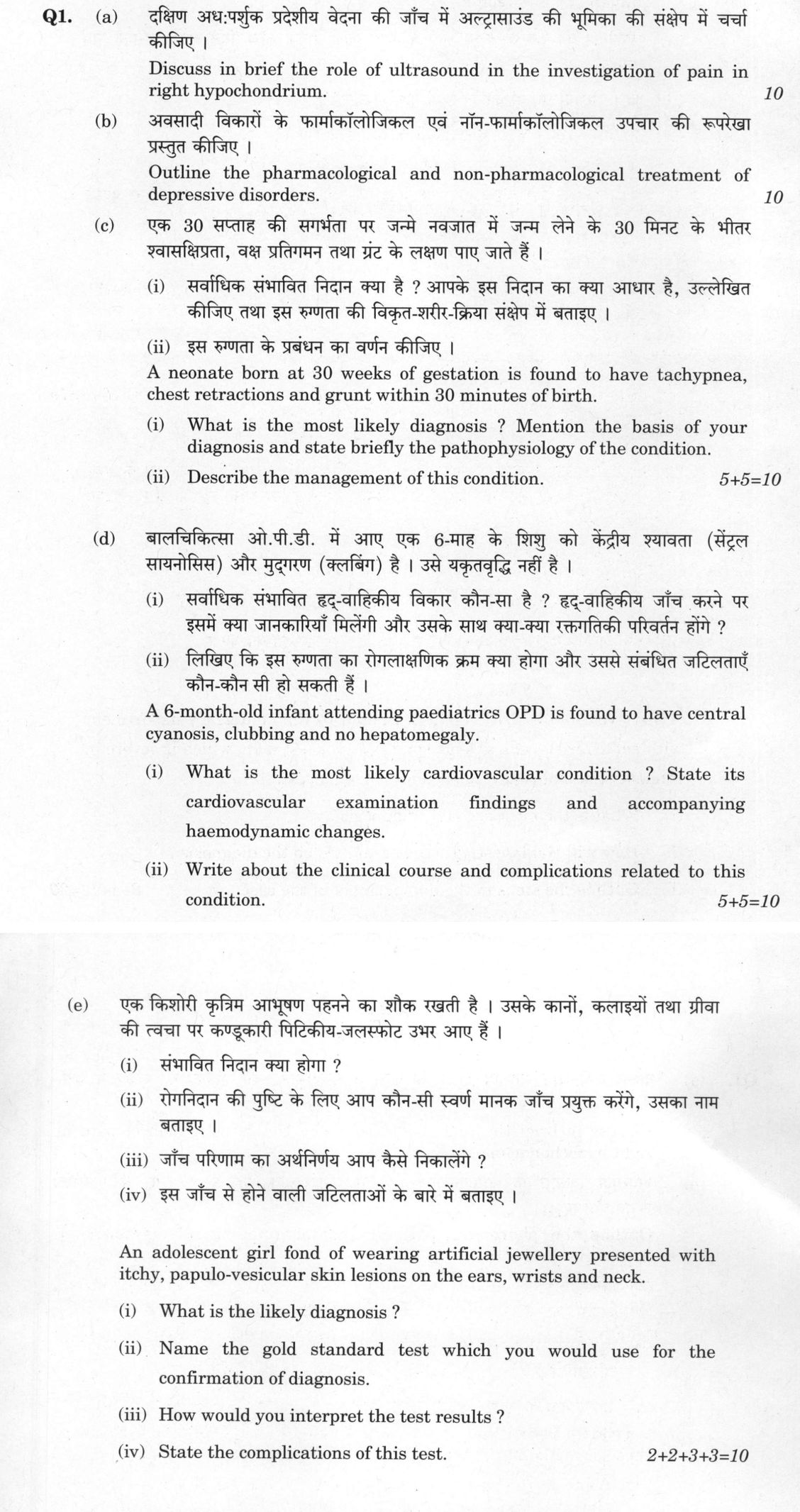
Discuss in brief the role of ultrasound in the investigation of pain in right hypochondrium. 10 marks
Outline the pharmacological and non-pharmacological treatment of depressive disorders. 10 marks
A neonate born at 30 weeks of gestation is found to have tachypnea, chest retractions and grunt within 30 minutes of birth. What is the most likely diagnosis? Mention the basis of your diagnosis and state briefly the pathophysiology of the condition.
Describe the management of this condition. (5+5=10 marks)
A 6-month-old infant attending paediatrics OPD is found to have central cyanosis, clubbing and no hepatomegaly. What is the most likely cardiovascular condition? State its cardiovascular examination findings and accompanying haemodynamic changes.
Write about the clinical course and complications related to this condition. (5+5=10 marks)
An adolescent girl fond of wearing artificial jewellery presented with itchy, papulo-vesicular skin lesions on the ears, wrists and neck. What is the likely diagnosis?
Name the gold standard test which you would use for the confirmation of diagnosis.
How would you interpret the test results?
State the complications of this test. (2+2+3+3=10 marks)
हिंदी में प्रश्न पढ़ें
दक्षिण अधःपशुक प्रदेशीय वेदना की जाँच में अल्ट्रासाउंड की भूमिका की संक्षेप में चर्चा कीजिए। (10 अंक)
अवसादी विकारों के फार्माकोलॉजिकल एवं नॉन-फार्माकोलॉजिकल उपचार की रूपरेखा प्रस्तुत कीजिए। (10 अंक)
एक 30 सप्ताह की गर्भावस्था पर जन्मे नवजात में जन्म लेने के 30 मिनट के भीतर श्वासदीर्घता, वक्ष प्रतिगमन तथा ग्रंट के लक्षण पाए जाते हैं। सर्वाधिक संभावित निदान क्या है? आपके इस निदान का क्या आधार है, उल्लेखित कीजिए तथा इस रुग्णता की विकृत-शरीर-क्रिया संक्षेप में बताइए।
इस रुग्णता के प्रबंधन का वर्णन कीजिए। (5+5=10 अंक)
बालचिकित्सा ओ.पी.डी. में आए एक 6-माह के शिशु को केंद्रीय श्यावता (सेंट्रल सायनोसिस) और मुद्रागण (क्लबिंग) है। उसे यकृतवृद्धि नहीं है। सर्वाधिक संभावित हृद्-वाहिकीय विकार कौन-सा है? हृद्-वाहिकीय जाँच करने पर इसमें क्या जानकारियाँ मिलेंगी और उसके साथ क्या-क्या रक्तगतिकी परिवर्तन होंगे?
लिखिए कि इस रुग्णता का रोगलाक्षणिक क्रम क्या होगा और उससे संबंधित जटिलताएँ कौन-कौन सी हो सकती हैं। (5+5=10 अंक)
एक किशोरी कृत्रिम आभूषण पहनने का शौक रखती है। उसके कानों, कलाइयों तथा ग्रीवा की त्वचा पर कण्डूकारी पिटिकीय-जलस्फोट उभर आए हैं। संभावित निदान क्या होगा?
रोगनिदान की पुष्टि के लिए आप कौन-सी स्वर्ण मानक जाँच प्रयुक्त करेंगे, उसका नाम बताइए।
जाँच परिणाम का अर्थनिर्णय आप कैसे निकालेंगे?
इस जाँच से होने वाली जटिलताओं के बारे में बताइए। (2+2+3+3=10 अंक)
Model answer
Written by UPSC Answer Check against this question's marking rubric, to the expected length. UPSC does not publish answers for Mains — this is one way to score well, not an official key.
Right hypochondrial pain, depressive illness, neonatal respiratory distress, cyanotic congenital heart disease and allergic contact dermatitis require organ-system and age-specific reasoning, but each can be approached with a focused diagnostic and therapeutic plan.
(a) Ultrasound in right hypochondrial pain. Ultrasound is the first-line investigation because it is non-invasive, inexpensive, repeatable, radiation-free and useful at the bedside. In biliary disease it identifies gallstones, gallbladder wall thickening, pericholecystic fluid, a positive sonographic Murphy sign and common bile duct dilatation; Doppler can assess hepatic and portal vascular flow. In hepatic disease it detects hepatomegaly, focal masses, abscesses, cirrhosis and portal vein thrombosis. It also evaluates the right kidney and ureter for calculi, hydronephrosis or perinephric collections, and can distinguish renal colic from biliary pain. It is especially useful in acute right upper quadrant pain because it can be repeated to monitor gallbladder and hepatic lesions, and in chronic or atypical pain it helps identify fatty liver, hepatic masses, renal pathology and biliary dilatation. Its limitations are operator dependence, reduced views in obesity or bowel gas, and incomplete assessment of distal common bile duct stones; MRCP or ERCP may be needed when ultrasound is equivocal. It can also guide percutaneous drainage of a liver or perinephric collection.
(b) Depressive disorders. Pharmacological treatment is guided by severity, comorbidity, previous response and safety. SSRIs such as fluoxetine, sertraline and escitalopram are usually first-line because of tolerability. SNRIs such as venlafaxine and duloxetine are useful in resistant or painful depression. TCAs such as amitriptyline and nortriptyline are effective but have anticholinergic effects and cardiotoxicity in overdose, so they require caution in the elderly and cardiac patients. MAOIs such as tranylcypromine or moclobemide are reserved for atypical or refractory depression; non-selective MAOIs require a low-tyramine diet, and all MAOIs require avoidance of serotonergic drugs because of hypertensive crisis and serotonin syndrome. ECT is indicated in severe, psychotic, catatonic or suicidal depression, or when rapid response is needed. Treatment should be individualised, with monitoring for side effects, adherence, suicidal ideation and relapse. In mild depression, watchful waiting, psychotherapy and lifestyle measures may be sufficient; in moderate to severe cases, antidepressants are usually started early. Non-pharmacological treatment includes CBT, interpersonal therapy, psychoeducation, problem-solving therapy, regular exercise, sleep hygiene, social support and avoidance of alcohol. Combination of antidepressant and psychotherapy is often more effective than either alone in moderate to severe depression.
(c) Neonatal respiratory distress. (i) The most likely diagnosis is respiratory distress syndrome, also called hyaline membrane disease. The basis is a 30-week preterm infant developing tachypnea, chest retractions and grunting within 30 minutes of birth, a classic presentation of surfactant deficiency. Pathophysiology is immaturity of type II pneumocytes, reduced surfactant, increased alveolar surface tension, progressive alveolar collapse, decreased lung compliance, ventilation-perfusion mismatch, hypoxaemia and pulmonary hypertension. (ii) Management is in a NICU with thermoregulation, correction of hypoglycaemia, fluid and electrolyte balance, and antibiotics if sepsis is suspected. If preterm birth was anticipated, antenatal corticosteroids reduce the severity of RDS. After birth, maintaining normal body temperature is critical because hypothermia worsens acidosis and oxygen demand. Respiratory support starts with CPAP; if the infant deteriorates, intubation and mechanical ventilation with lung-protective settings are used. Surfactant replacement therapy is given through the endotracheal tube; minimally invasive surfactant therapy (MIST) or less invasive surfactant administration (LISA) may be used where available. Surfactant is usually repeated if oxygen requirements remain high, and the infant is weaned as lung maturity improves. Follow-up includes oxygen titration, monitoring for apnoea, bronchopulmonary dysplasia and retinopathy of prematurity. Caffeine may be used for apnoea of prematurity.
(d) Cyanotic infant. (i) The most likely condition is tetralogy of Fallot, a cyanotic congenital heart defect with pulmonary stenosis, ventricular septal defect, overriding aorta and right ventricular hypertrophy. Examination shows central cyanosis, clubbing, a loud ejection systolic murmur at the left upper sternal border due to right ventricular outflow obstruction, and a single or soft second heart sound because pulmonary flow is reduced. The absence of hepatomegaly argues against congestive heart failure from a large left-to-right shunt. Pulses are usually normal unless there is associated aortic coarctation. Haemodynamically, right ventricular pressure approaches systemic pressure, and deoxygenated blood crosses the VSD into the aorta, causing right-to-left shunting, reduced pulmonary blood flow and cyanosis. Cyanosis is often more evident during crying or feeding, when right-to-left shunting increases. (ii) The clinical course may be stable in mild pulmonary stenosis but severe disease causes hypercyanotic “tet” spells, often relieved by squatting. Squatting increases systemic vascular resistance and reduces the shunt, thereby improving oxygenation. Complications include polycythaemia, brain abscess from septic emboli or bacteraemia shunted right-to-left, infective endocarditis, paradoxical embolic stroke, and iron deficiency that can worsen hypoxaemia. Corrective surgery is usually planned in infancy; a palliative systemic-to-pulmonary shunt may be needed in very young or low-weight infants. Long-term follow-up after repair includes arrhythmias, residual pulmonary regurgitation and exercise limitation.
(e) Allergic contact dermatitis. (i) The likely diagnosis is allergic contact dermatitis to nickel, suggested by artificial jewellery and itchy papulo-vesicular lesions on ears, wrists and neck. Avoidance of nickel-containing items is the main preventive measure. (ii) The gold standard confirmatory test is patch testing with a standardised nickel allergen applied to intact skin, usually on the back. Patch testing should be performed when the acute dermatitis has settled, to avoid false-negative or irritant confounding. (iii) Results are read at 48 and 96 hours. A positive reaction shows erythema, papules, vesicles, induration or crusting at the application site, graded from doubtful to strongly positive; a negative result shows no reaction, while an irritant reaction is non-specific and may occur in sensitive skin. (iv) Complications of patch testing include active sensitisation to new allergens, irritant reactions, persistent hyperpigmentation or hypopigmentation, and rare anaphylactoid reactions.
Thus, the way forward in each case is a structured, evidence-based response: targeted imaging for right hypochondrial pain, combined biological and psychological treatment for depression, surfactant and respiratory support for preterm RDS, early cardiac correction for tetralogy of Fallot, and allergen avoidance with patch-test confirmation for nickel dermatitis.
What "Discuss" is asking you to do
Lay the issue out from more than one side — how it arose, what is claimed for it, what is held against it, and where it now stands. UPSC attaches discuss to broad topics with several live dimensions, so coverage of the dimensions earns more than the strength of your opinion.
Structure that answers it
Set the issue up → the case as it is made → the case against → the dimension both sides leave out → where the balance now lies
Where marks are lost
Listing facts with no thread between them, or arguing one side throughout and calling it a discussion.
How this answer will be evaluated
Approach
Framework: Clinical Sequence (Definition > Aetiology/Pathophysiology > Features > Investigation/Management). (a) discuss: intro > 3-4 dimensions > example > balanced close | (b) enumerate: list the items in order > one line each > no commentary | (c(i)) explain: definition/context > points in order > small example > short close | (c(ii)) describe: define > structure or process in order > labelled diagram > significance | (d(i)) explain: definition/context > points in order > small example > short close | (d(ii)) describe: define > structure or process in order > labelled diagram > significance | (e(i)) define: precise definition > the distinguishing feature > one example | (e(ii)) define: precise definition > the distinguishing feature > one example | (e(iii)) explain: definition/context > points in order > small example > short close | (e(iv)) enumerate: list the items in order > one line each > no commentary Full marks: Accurate diagnosis, clear pathophysiology, prioritized management, specific guidelines cited.
Key points expected
- Identify gallbladder pathology (cholelithiasis/cholecystitis)
- Identify biliary tree pathology (choledocholithiasis)
- Identify hepatic pathology (abscess, masses)
- Mention role in renal/pancreatic causes
- List pharmacological agents (SSRIs, SNRIs, TCAs)
- List non-pharmacological (CBT, IPT, ECT)
- Mention treatment duration/maintenance
- Mention monitoring for side effects
Evaluation rubric
Each sub-part is marked on its own, against the marks and word limit printed on the paper.
- (a) Role of ultrasound in investigating right hypochondrium pain. 10 marks
discuss— intro → 3-4 dimensions → example → balanced close
Must cover
- Identify gallbladder pathology (cholelithiasis/cholecystitis)
- Identify biliary tree pathology (choledocholithiasis)
- Identify hepatic pathology (abscess, masses)
- Mention role in renal/pancreatic causes
Loses marks
- Listing symptoms without linking to USG findings
- Ignoring extra-hepatic causes
Earns more
- Mention Murphy's sign on USG
- Mention Doppler for vascular causes
- Mention limitations (gas, obesity)
Extra mark
- Mention MRCP as next step if USG inconclusive
- (b) Pharmacological and non-pharmacological treatment of depressive disorders. 10 marks
enumerate— list the items in order → one line each → no commentary
Must cover
- List pharmacological agents (SSRIs, SNRIs, TCAs)
- List non-pharmacological (CBT, IPT, ECT)
- Mention treatment duration/maintenance
- Mention monitoring for side effects
Loses marks
- Listing drugs without mechanism or class
- Ignoring non-pharmacological options
Earns more
- Mention specific guidelines (e.g., NICE, APA)
- Mention role of psychoeducation
- Mention treatment resistance management
Extra mark
- Mention specific national health programme initiatives
- (c(i)) Diagnosis, basis, and pathophysiology of neonatal respiratory distress. 5 marks
explain— definition/context → points in order → small example → short close
Must cover
- Diagnose Respiratory Distress Syndrome (RDS)
- State basis: Prematurity (30 weeks) + onset <30 mins
- Explain surfactant deficiency pathophysiology
- Mention alveolar collapse/atelectasis
Loses marks
- Diagnosing TTN without differentiating
- Vague pathophysiology without surfactant mention
Earns more
- Mention 'ground glass' appearance on X-ray
- Mention risk factors (diabetes, C-section)
Extra mark
- Mention specific surfactant types (Dipalmitoylphosphatidylcholine)
- (c(ii)) Management of the diagnosed neonatal condition. 5 marks
describe— define → structure or process in order → labelled diagram → significance
Must cover
- Immediate: Thermal support, oxygen, CPAP
- Definitive: Surfactant replacement therapy
- Supportive: IV fluids, glucose monitoring
- Follow-up: Monitor for BPD/IVH
Loses marks
- Management without priority (immediate vs definitive)
- Ignoring surfactant therapy
Earns more
- Mention specific surfactant brands (e.g., Curosurf)
- Mention ventilation settings if intubated
Extra mark
- Mention specific NICU level of care required
- (d(i)) Cardiovascular condition, exam findings, and haemodynamics. 5 marks
explain— definition/context → points in order → small example → short close
Must cover
- Diagnose Transposition of Great Arteries (TGA)
- State exam findings: Single S2, normal pulses
- Explain parallel circulation (no mixing)
- Mention need for shunt (PDA/ASD/VSD)
Loses marks
- Diagnosing Tetralogy of Fallot (usually has hepatomegaly)
- Ignoring haemodynamic explanation
Earns more
- Mention 'egg on a string' X-ray appearance
- Mention differential diagnosis (Truncus)
Extra mark
- Mention specific surgical repair (Arterial switch)
- (d(ii)) Clinical course and complications of the condition. 5 marks
describe— define → structure or process in order → labelled diagram → significance
Must cover
- Describe natural history (cyanosis worsening)
- Mention complications: Heart failure, Polycythemia
- Mention risk of thrombosis
- Mention need for early surgery
Loses marks
- Listing complications without linking to pathophysiology
- Ignoring clinical course progression
Earns more
- Mention Eisenmenger syndrome if VSD present
- Mention specific timing of surgery (first week)
Extra mark
- Mention specific long-term outcomes post-repair
- (e(i)) Likely diagnosis of the skin condition. 2 marks
define— precise definition → the distinguishing feature → one example
Must cover
- Diagnose Allergic Contact Dermatitis
- Identify cause: Nickel in artificial jewellery
Loses marks
- Diagnosing eczema without contact history
- Ignoring the specific trigger (jewellery)
Earns more
- Mention specific distribution (ears, wrists, neck)
Extra mark
- Mention specific type of reaction (Type IV hypersensitivity)
- (e(ii)) Gold standard test for confirmation. 2 marks
define— precise definition → the distinguishing feature → one example
Must cover
- Name Patch Test
- Mention application on back
Loses marks
- Naming blood test (IgE) as gold standard
- Naming skin prick test
Earns more
- Mention specific allergens tested (Nickel sulfate)
Extra mark
- Mention specific reading times (48h, 72h)
- (e(iii)) Interpretation of the test results. 3 marks
explain— definition/context → points in order → small example → short close
Must cover
- Define positive reaction (papule, vesicle, induration)
- Mention grading scale (e.g., +, ++, ++++)
- Mention negative reaction (no change)
Loses marks
- Vague description of 'redness'
- Ignoring the grading system
Earns more
- Mention irritant vs allergic reaction
- Mention specific timing of peak reaction
Extra mark
- Mention specific criteria for 'strong positive'
- (e(iv)) Complications of the test. 3 marks
enumerate— list the items in order → one line each → no commentary
Must cover
- Mention allergic reaction to test vehicle
- Mention irritant dermatitis
- Mention 'angry back' syndrome
Loses marks
- Listing general skin complications
- Ignoring specific test-related risks
Earns more
- Mention risk of systemic reaction
- Mention scarring (rare)
Extra mark
- Mention specific management of test complications
Practice this exact question
Write your answer and it is marked point by point against the model answer above — what you covered, what you missed, what you got wrong.
Evaluate my answer →More from Medical Science 2021 Paper II
- Q1 (a) Discuss in brief the role of ultrasound in the investigation of pain in right hypocho…
- Q2 (a) A sixty-year-old diabetic male presented to the emergency department with acute onset…
- Q3 (a) A 40-year-old male who was bedridden for the last two months following a fracture in…
- Q4 (a) Discuss in short the etiology, diagnosis, treatment and complications of cirrhosis of…