Paper II — Q5
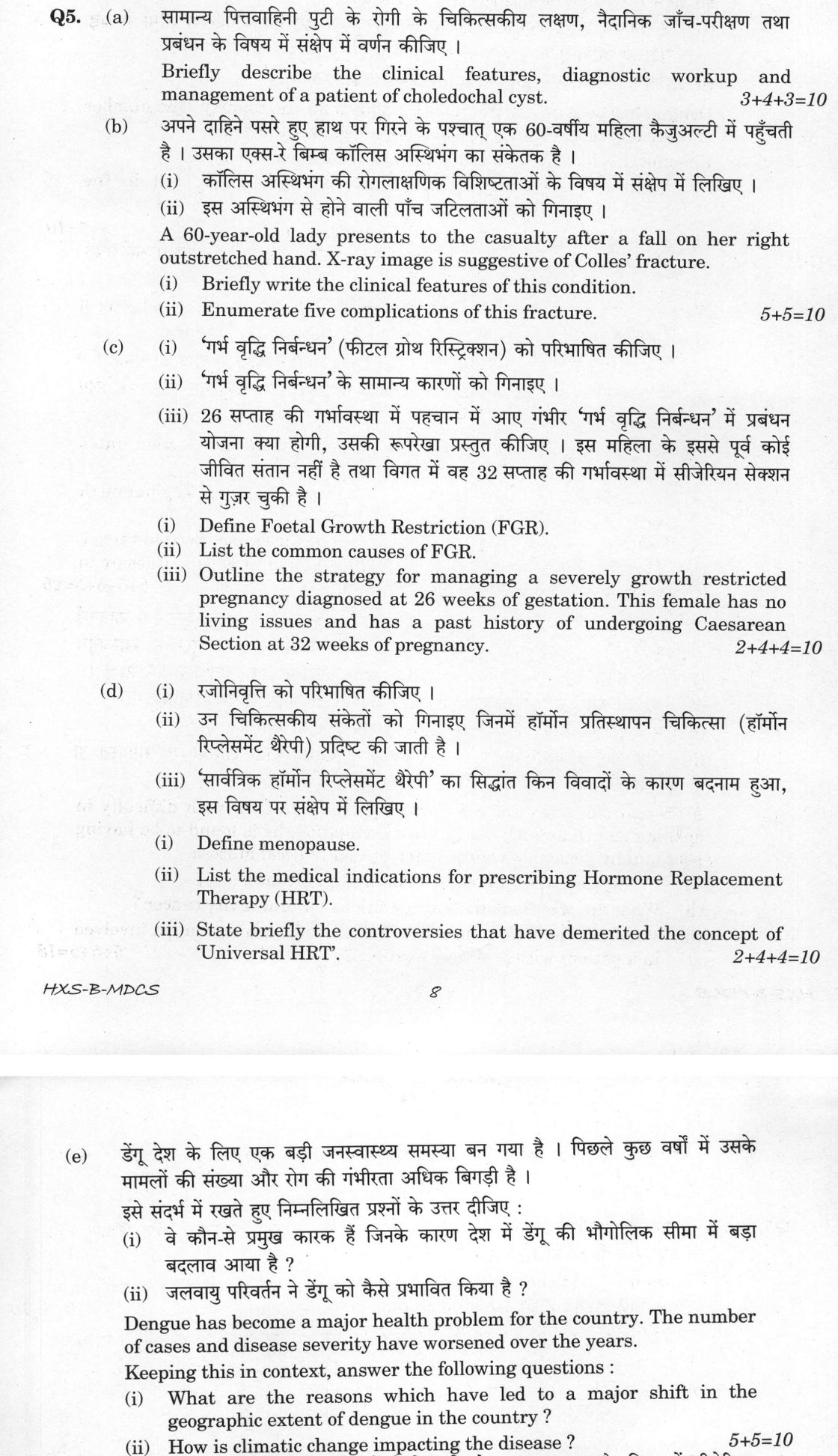
(a) Briefly describe the clinical features, diagnostic workup and management of a patient of choledochal cyst. (3+4+3=10…
Briefly describe the clinical features, diagnostic workup and management of a patient of choledochal cyst. (3+4+3=10 marks)
A 60-year-old lady presents to the casualty after a fall on her right outstretched hand. X-ray image is suggestive of Colles' fracture. Briefly write the clinical features of this condition. 5 marks
Enumerate five complications of this fracture. (5 marks) (5+5=10 marks)
Define Foetal Growth Restriction (FGR). 2 marks
List the common causes of FGR. 4 marks
Outline the strategy for managing a severely growth restricted pregnancy diagnosed at 26 weeks of gestation. This female has no living issues and has a past history of undergoing Caesarean Section at 32 weeks of pregnancy. (4 marks) (2+4+4=10 marks)
Define menopause. 2 marks
List the medical indications for prescribing Hormone Replacement Therapy (HRT). 4 marks
State briefly the controversies that have demerited the concept of 'Universal HRT'. (4 marks) (2+4+4=10 marks)
Dengue has become a major health problem for the country. The number of cases and disease severity have worsened over the years. Keeping this in context, answer the following questions: What are the reasons which have led to a major shift in the geographic extent of dengue in the country? 5 marks
How is climatic change impacting the disease? (5 marks) (5+5=10 marks)
हिंदी में प्रश्न पढ़ें
सामान्य पित्तवाहिनी पूटी के रोगी के चिकित्सकीय लक्षण, नैदानिक जाँच-परीक्षण तथा प्रबंधन के विषय में संक्षेप में वर्णन कीजिए। (3+4+3=10)
अपने दाहिने पसरे हुए हाथ पर गिरने के पश्चात् एक 60-वर्षीय महिला कैजुअल्टी में पहुँचती है। उसका एक्स-रे बिम्ब कॉलिस अस्थिभंग का संकेतक है। कॉलिस अस्थिभंग की रोगलाक्षणिक विशिष्टताओं के विषय में संक्षेप में लिखिए। 5 marks
इस अस्थिभंग से होने वाली पाँच जटिलताओं को गिनाइए। (5) (5+5=10)
'गर्भ वृद्धि निर्बंधन' (फीटल ग्रोथ रिस्ट्रिक्शन) को परिभाषित कीजिए। 2 marks
'गर्भ वृद्धि निर्बंधन' के सामान्य कारणों को गिनाइए। 4 marks
26 सप्ताह की गर्भावस्था में पहचान में आए गंभीर 'गर्भ वृद्धि निर्बंधन' में प्रबंधन योजना क्या होगी, उसकी रूपरेखा प्रस्तुत कीजिए। इस महिला के इससे पूर्व कोई जीवित संतान नहीं है तथा विगत में वह 32 सप्ताह की गर्भावस्था में सीजेरियन सेक्शन से गुजर चुकी है। (4) (2+4+4=10)
रजोनिवृत्ति को परिभाषित कीजिए। 2 marks
उन चिकित्सकीय संकेतों को गिनाइए जिनमें हार्मोन प्रतिस्थापन चिकित्सा (हार्मोन रिप्लेसमेंट थेरैपी) प्रदत्त की जाती है। 4 marks
'सार्वत्रिक हार्मोन रिप्लेसमेंट थेरैपी' का सिद्धांत किन विवादों के कारण बदनाम हुआ, इस विषय पर संक्षेप में लिखिए। (4) (2+4+4=10)
डेंगू देश के लिए एक बड़ी जनस्वास्थ्य समस्या बन गया है। पिछले कुछ वर्षों में उसके मामलों की संख्या और रोग की गंभीरता अधिक बिगड़ी है। इसे संदर्भ में रखते हुए निम्नलिखित प्रश्नों के उत्तर दीजिए: वे कौन-से प्रमुख कारक हैं जिनके कारण देश में डेंगू की भौगोलिक सीमा में बड़ा बदलाव आया है? 5 marks
जलवायु परिवर्तन ने डेंगू को कैसे प्रभावित किया है? (5) (5+5=10)
Model answer
Written by UPSC Answer Check against this question's marking rubric, to the expected length. UPSC does not publish answers for Mains — this is one way to score well, not an official key.
(a) Choledochal cyst. Choledochal cyst is a congenital dilatation of the biliary tree, classically classified by Todani into type I (saccular or fusiform common bile duct dilatation), type II (diverticulum), type III (choledochocele), type IV (multiple intrahepatic and extrahepatic dilatations), and type V (Caroli disease). It presents in children or adults with the classic triad of abdominal pain, jaundice and a palpable mass, though many patients have recurrent cholangitis, pancreatitis, biliary colic, or are asymptomatic. The pain is often colicky, jaundice may be intermittent, and the mass is usually in the right hypochondrium; recurrent cholangitis may produce fever, rigors and sepsis. Diagnostic workup begins with ultrasound showing cystic biliary dilatation, liver function tests showing an obstructive pattern, amylase/lipase if pancreatitis is suspected, and complete blood count if cholangitis is present. MRCP is the preferred non-invasive test to define anatomy and Todani type; ERCP is reserved for therapeutic drainage, stone removal, or when MRCP is equivocal, and cholangiography may be used intraoperatively. Management is surgical excision of the cyst with cholecystectomy and Roux-en-Y hepaticojejunostomy, because retained cyst wall carries a risk of cholangiocarcinoma; in unfit or septic patients, temporary biliary drainage by ERCP or percutaneous transhepatic cholangiography may precede definitive repair, and long-term surveillance for biliary malignancy is advised.
(b) Colles’ fracture. Colles’ fracture is a distal radius fracture with posterior (dorsal) displacement and dorsal angulation, usually after a fall on an outstretched hand. Clinically the wrist is painful, swollen and tender over the distal radius, with limited active and passive motion. The distal fragment is displaced dorsally and may be angulated, producing a step deformity at the wrist. The characteristic ‘dinner fork’ deformity is seen in lateral view due to dorsal displacement, and the hand may appear bayonet-shaped in anteroposterior view because of radial shortening and ulnar styloid prominence. There may be crepitus, local tenderness, and neurovascular assessment is essential to exclude median nerve compression. Five important complications are malunion with persistent dorsal angulation and loss of grip, carpal tunnel syndrome from median nerve compression, Sudeck’s atrophy or complex regional pain syndrome, post-traumatic wrist arthritis, and extensor tendon rupture, especially extensor pollicis longus; stiffness and avascular necrosis of the scaphoid may also occur.
(c) FGR. Foetal growth restriction is defined as estimated foetal weight below the 10th percentile for gestational age, or serial abdominal circumference lagging behind the expected centile, after excluding multiple pregnancy, wrong dates and congenital anomalies. Common causes include placental insufficiency, maternal malnutrition or anaemia, TORCH infections, chromosomal anomalies, maternal hypertension or pre-eclampsia, diabetes with vascular disease, smoking, and chronic maternal illness. In a severely growth-restricted pregnancy diagnosed at 26 weeks with a previous caesarean section at 32 weeks and no living children, management must balance the risks of prematurity against intrauterine death. Severe FGR is often associated with oligohydramnios, reduced biophysical profile score, and abnormal umbilical artery Doppler; serial non-stress tests or biophysical profiles may be used. The patient should be admitted for serial growth ultrasound and Doppler surveillance of the umbilical artery, middle cerebral artery and ductus venosus. Antenatal corticosteroids are given for fetal lung maturity, and magnesium sulphate for neuroprotection if delivery is anticipated before 32 weeks. If the umbilical artery shows absent or reversed end-diastolic flow, or if the ductus venosus shows absent or reversed a-wave, delivery should be planned after steroids and neuroprotection where feasible. If Dopplers remain reassuring, expectant management with close surveillance, fetal testing, and treatment of any maternal cause is continued. Timed delivery is planned at the point where the risk of intrauterine death outweighs the risks of prematurity. Because of the previous lower-segment caesarean section and prior preterm birth, the uterus is scarred and the risk of uterine rupture during labour is higher; if delivery becomes necessary for fetal compromise, a planned caesarean section is reasonable, while vaginal delivery may be considered only if the fetus is stable, labour is controlled, and there is no fetal distress. The aim is to prolong pregnancy safely until fetal maturity improves, but not to delay delivery when Doppler deterioration indicates imminent fetal risk.
(d) Menopause and HRT. Menopause is the permanent cessation of menstruation due to loss of ovarian follicular activity, diagnosed retrospectively after 12 months of amenorrhoea in a woman of appropriate age without other cause. Medical indications for HRT include moderate to severe vasomotor symptoms such as hot flushes and night sweats, genitourinary syndrome of menopause when local oestrogen is insufficient or systemic therapy is needed, prevention or treatment of osteoporosis in early menopause or oestrogen-deficient women, and selected cases of early ovarian failure where bone protection and symptom control are required. HRT is not recommended for routine primary prevention of cardiovascular disease in older women, and systemic therapy is avoided in unexplained vaginal bleeding, active thromboembolism, liver disease, or known breast cancer. The concept of universal HRT has been demerited by controversies arising mainly from the Women’s Health Initiative, which reported increased risks of breast cancer, venous thromboembolism, stroke and cardiovascular events in some age and timing groups. These findings, together with concerns about dose, duration, route and individual risk factors, led to the current view that HRT should not be prescribed universally but should be individualised, using the lowest effective dose for the shortest necessary period, with informed consent and regular review.
(e) Dengue in India. The geographic expansion of dengue in India is linked to rapid unplanned urbanisation, peri-urban expansion, water storage practices, poor drainage, and the domestic adaptation of Aedes aegypti, which thrives in artificial containers. Serotype shifts, with DEN-2 historically dominant in many Indian outbreaks and later circulation of DEN-1, DEN-3 and DEN-4, have altered severity and secondary infection risk. Delayed reporting, inadequate larval source reduction, and movement of people and goods have also facilitated spread from endemic urban cores to suburban and rural belts. Climate change is impacting the disease by widening the temperature range suitable for vector breeding and viral replication, shortening the extrinsic incubation period, increasing vector survival and biting frequency, and extending the transmission season. Altered rainfall patterns, flooding and drought create more breeding sites, while warming allows Aedes to expand into higher altitudes and new districts. In India, this has been reflected in repeated outbreaks in cities such as Delhi, Mumbai, Chennai, Bengaluru and parts of Karnataka, Kerala and the Northeast, prompting ICMR surveillance, National Vector Borne Disease Control Programme interventions, and the National Dengue Guidelines for case management, vector control and reporting.
What "Describe" is asking you to do
Give a full, ordered account of the thing named — its parts, stages or mechanism — in the sequence in which it actually exists or occurs. Most describe questions come from the science optionals, where the marks sit in correct technical detail and, where the stem says so, a labelled diagram.
Structure that answers it
One-line identification of the subject → the parts or stages in their real order, each with its defining detail → labelled diagram where the subject is structural → closing line on function or significance
Where marks are lost
Loose general prose where the examiner is ticking named parts, correct terminology and their sequence; and in the General Studies papers, turning to evaluation before the description is finished.
How this answer will be evaluated
Approach
Framework: Clinical Sequence (Definition > Aetiology > Features > Investigation > Management). (a) describe: definition > structure or process in order > labelled diagram > significance | (b) describe: definition > structure or process in order > labelled diagram > significance | (c) describe: definition > structure or process in order > labelled diagram > significance | (d) describe: definition > structure or process in order > labelled diagram > significance | (e) describe: definition > structure or process in order > labelled diagram > significance Full marks: Comprehensive, accurate, and well-structured with all required elements.
Key points expected
- Choledochal cyst: Triad, USG/MRCP, Excision + Roux-en-Y
- Colles' fracture: Dinner fork deformity, Volkmann's, Malunion
- FGR: <10th percentile, Placental causes, Serial monitoring
- Menopause: 12 months amenorrhea, Vasomotor symptoms, Cancer risk
- Dengue: Urbanization, Vector migration, Temperature, Rainfall
Evaluation rubric
Each sub-part is marked on its own, against the marks and word limit printed on the paper.
- (a) Clinical features, diagnostic workup, and management of choledochal cyst. 10 marks
describe— definition → structure or process in order → labelled diagram → significance
Must cover
- Triad: pain, jaundice, mass
- Imaging: USG, MRCP, ERCP
- Management: Complete excision
- Reconstruction: Roux-en-Y hepaticojejunostomy
Loses marks
- Listing symptoms without mechanism
- Management without priority
Earns more
- Mention of Todani classification
- Cholangiocarcinoma risk in residual cyst
- Role of PTC if ERCP fails
Extra mark
- Labelled diagram of cyst anatomy
- Mention of specific surgical guidelines
- (b) Clinical features and five complications of Colles' fracture. 10 marks
describe— definition → structure or process in order → labelled diagram → significance
Must cover
- Dorsal angulation ('dinner fork' deformity)
- Tenderness at distal radius
- Complication: Volkmann's ischemic contracture
- Complication: Malunion
Loses marks
- Listing symptoms without mechanism
- Management without priority
Earns more
- Complication: Sudeck's atrophy
- Complication: Median nerve palsy
- Complication: Stiffness
Extra mark
- Labelled X-ray description
- Mention of specific fixation methods
- (c) Definition, causes, and management strategy for severe FGR at 26 weeks. 10 marks
describe— definition → structure or process in order → labelled diagram → significance
Must cover
- Definition: AC/EFW <10th percentile
- Causes: Placental, maternal, fetal
- Monitoring: Serial USG, Doppler, CTG
- Delivery: Timing based on fetal status
Loses marks
- Listing symptoms without mechanism
- Management without priority
Earns more
- Mention of IUGR vs FGR distinction
- Specifics of Doppler parameters
- Corticosteroids for lung maturity
Extra mark
- Labelled flowchart of management
- Mention of specific delivery guidelines
- (d) Definition of menopause, HRT indications, and controversies. 10 marks
describe— definition → structure or process in order → labelled diagram → significance
Must cover
- Definition: 12 months amenorrhea
- Indications: Vasomotor symptoms
- Indications: Osteoporosis prevention
- Controversy: Breast cancer risk
Loses marks
- Listing symptoms without mechanism
- Management without priority
Earns more
- Controversy: Cardiovascular risk
- Controversy: Venous thromboembolism
- Mention of 'window of opportunity'
Extra mark
- Labelled diagram of hormonal changes
- Mention of specific HRT guidelines
- (e) Reasons for geographic shift of dengue and impact of climatic change. 10 marks
describe— definition → structure or process in order → labelled diagram → significance
Must cover
- Reason: Urbanization and water storage
- Reason: Vector migration
- Climate: Temperature affects vector
- Climate: Rainfall affects breeding
Loses marks
- Listing symptoms without mechanism
- Management without priority
Earns more
- Mention of Aedes aegypti
- Mention of specific geographic regions
- Mention of specific climatic factors
Extra mark
- Labelled map of geographic shift
- Mention of specific climatic data
Practice this exact question
Write your answer and it is marked point by point against the model answer above — what you covered, what you missed, what you got wrong.
Evaluate my answer →More from Medical Science 2021 Paper II
- Q2 (a) A sixty-year-old diabetic male presented to the emergency department with acute onset…
- Q3 (a) A 40-year-old male who was bedridden for the last two months following a fracture in…
- Q4 (a) Discuss in short the etiology, diagnosis, treatment and complications of cirrhosis of…
- Q5 (a) Briefly describe the clinical features, diagnostic workup and management of a patient…
- Q6 (a) (i) Write in brief the reasons for rising Caesarean Section rates globally and in Ind…
- Q7 (a) A 60-year-old male presents with progressively increasing jaundice for 2 months. He i…
- Q8 (a) (i) Summarise the spectrum of Iodine Deficiency Disorders. (10 marks) (ii) State the…