Paper II — Q7
(a) A 60-year-old male presents with progressively increasing jaundice for 2 months. He is having clay coloured stools and…
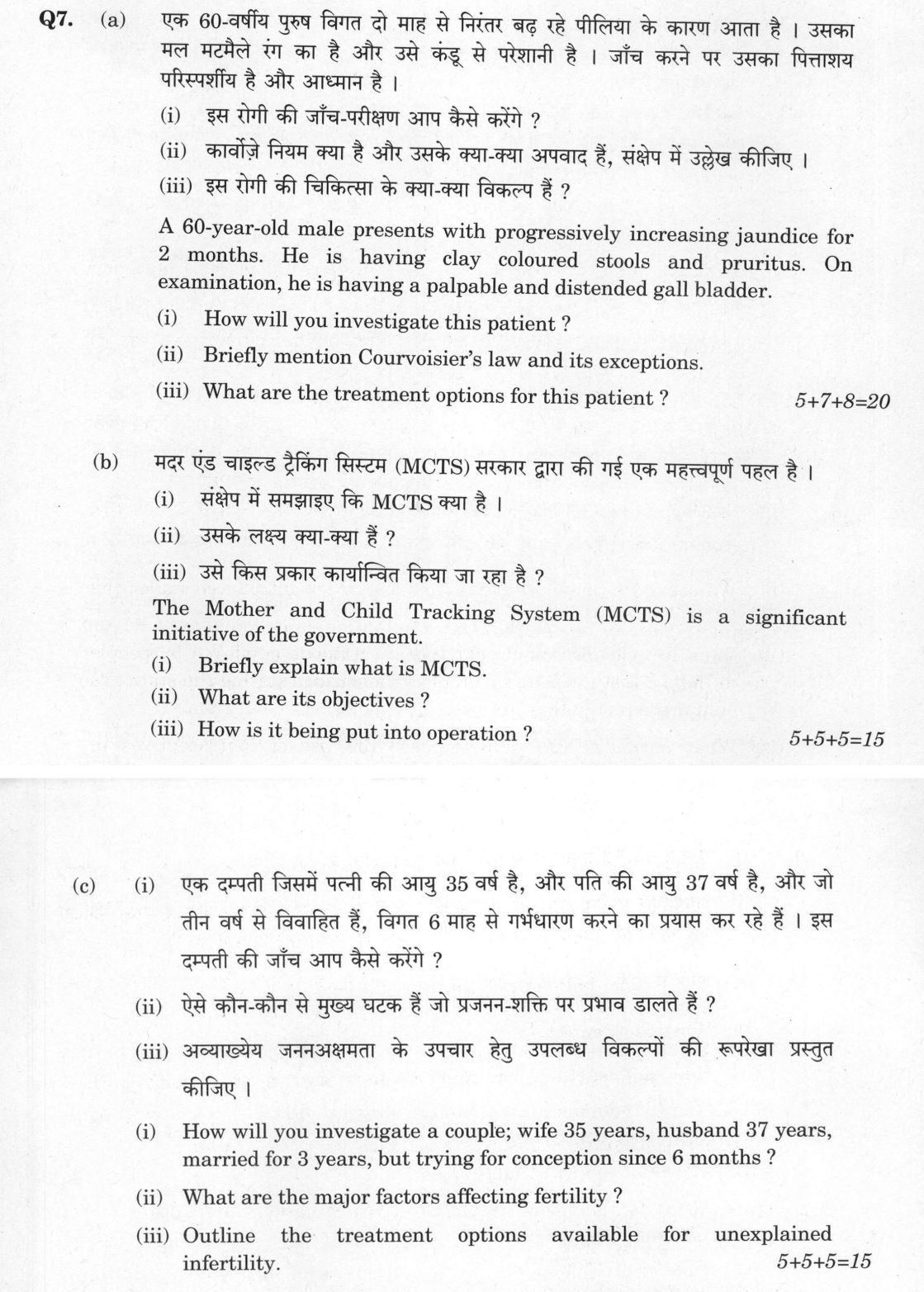
A 60-year-old male presents with progressively increasing jaundice for 2 months. He is having clay coloured stools and pruritus. On examination, he is having a palpable and distended gall bladder.
How will you investigate this patient? 5 marks
Briefly mention Courvoisier's law and its exceptions. 7 marks
What are the treatment options for this patient? 8 marks
The Mother and Child Tracking System (MCTS) is a significant initiative of the government.
Briefly explain what is MCTS. 5 marks
What are its objectives? 5 marks
How is it being put into operation? 5 marks
How will you investigate a couple; wife 35 years, husband 37 years, married for 3 years, but trying for conception since 6 months? 5 marks
What are the major factors affecting fertility? 5 marks
Outline the treatment options available for unexplained infertility. 5 marks
हिंदी में प्रश्न पढ़ें
एक 60-वर्षीय पुरुष विगत दो माह से निरंतर बढ़ रहे पीलिया के कारण आता है । उसका मल मटमैले रंग का है और उसे कंटक से परेशानी है । जाँच करने पर उसका पित्ताशय परिस्पर्शीय है और आध्मान है ।
इस रोगी की जाँच-परीक्षण आप कैसे करेंगे ? (5 अंक)
काव्वाजे नियम क्या है और उसके क्या-क्या अपवाद हैं, संक्षेप में उल्लेख कीजिए । (7 अंक)
इस रोगी की चिकित्सा के क्या-क्या विकल्प हैं ? (8 अंक)
मदर एंड चाइल्ड ट्रैकिंग सिस्टम (MCTS) सरकार द्वारा की गई एक महत्वपूर्ण पहल है ।
संक्षेप में समझाइए कि MCTS क्या है । (5 अंक)
उसके लक्ष्य क्या-क्या हैं ? (5 अंक)
उसे किस प्रकार कार्यान्वित किया जा रहा है ? (5 अंक)
एक दम्पति जिसमें पत्नी की आयु 35 वर्ष है, और पति की आयु 37 वर्ष है, और जो तीन वर्ष से विवाहित हैं, विगत 6 माह से गर्भधारण करने का प्रयास कर रहे हैं । इस दम्पति की जाँच आप कैसे करेंगे ? (5 अंक)
ऐसे कौन-कौन से मुख्य घटक हैं जो प्रजनन-शक्ति पर प्रभाव डालते हैं ? (5 अंक)
अव्याख्येय जननअक्षमता के उपचार हेतु उपलब्ध विकल्पों की रूपरेखा प्रस्तुत कीजिए । (5 अंक)
Model answer
Written by UPSC Answer Check against this question's marking rubric, to the expected length. UPSC does not publish answers for Mains — this is one way to score well, not an official key.
Obstructive Jaundice Workup and Management
Investigations: The clinical picture of painless progressive jaundice, clay-coloured stools, pruritus, and a palpable gallbladder in an elderly male suggests extrahepatic biliary obstruction, highly suspicious for periampullary or head-of-pancreas carcinoma. Initial workup requires Liver Function Tests (LFTs), which demonstrate conjugated hyperbilirubinemia with disproportionate elevation of Alkaline Phosphatase (ALP) and Gamma-Glutamyl Transferase (GGT). Ultrasonography (USG) of the abdomen is the initial imaging modality to confirm biliary ductal dilatation and a distended gallbladder. Contrast-Enhanced Computed Tomography (CECT) of the abdomen with pancreatic protocol, supplemented by Magnetic Resonance Cholangiopancreatography (MRCP), accurately delineates tumor size, local vascular invasion, and ductal architecture. Endoscopic Ultrasound (EUS) or Endoscopic Retrograde Cholangiopancreatography (ERCP) allows tissue diagnosis via brush cytology or fine-needle biopsy. Serum CA 19-9 and CEA assist in baseline assessment and prognostication. Coagulation profile (PT/INR) and renal panels are essential prior to intervention.
Courvoisier’s Law and Exceptions: Courvoisier’s law states that in the presence of obstructive jaundice, a palpable, non-tender, distended gallbladder indicates a non-calculous pathology, typically a malignant biliary obstruction, because pre-existing gallstone disease usually causes chronic inflammation and fibrosis, rendering the gallbladder non-distensible. Exceptions include: choledocholithiasis associated with acute cystic duct obstruction or without prior chronic cholecystitis; Mirizzi syndrome (extrinsic common bile duct compression by an impacted cystic duct stone); double impaction of stones (simultaneous stones in cystic duct and distal CBD); pancreatic stone or inflammatory mass of the pancreatic head (chronic pancreatitis); and congenital choledochal cysts.
Treatment Options: Resectability guides management. For resectable periampullary or pancreatic head malignancies, classic or pylorus-preserving pancreaticoduodenectomy (Whipple’s procedure) with regional lymphadenectomy offers curative potential. For borderline resectable lesions, neoadjuvant chemotherapy (FOLFIRINOX or Gemcitabine plus nab-Paclitaxel) precedes reassessment for surgery. For unresectable or metastatic disease, palliative management is initiated to relieve biliary obstruction via endoscopic biliary stenting (using self-expanding metal stents) or Percutaneous Transhepatic Biliary Drainage (PTBD). Systemic palliative chemotherapy, celiac plexus neurolysis for intractable pain, pancreatic enzyme replacement, and nutritional support constitute the best supportive care.
Mother and Child Tracking System (MCTS)
Definition and Objectives: MCTS is a centralized, name-based Information and Communication Technology (ICT) system introduced under the National Rural Health Mission (NRHM), now integrated into the Reproductive and Child Health (RCH) portal by the Ministry of Health and Family Welfare. Its primary objectives are ensuring universal early Antenatal Care (ANC) registration, tracking scheduled ANC/PNC visits, promoting 100% institutional deliveries, verifying complete childhood immunization up to five years, and reducing the Maternal Mortality Ratio (MMR) and Infant Mortality Rate (IMR) through active service delivery tracking.
Operationalization: Auxiliary Nurse Midwives (ANMs) and Accredited Social Health Activists (ASHAs) identify beneficiaries at the village level and record their data with unique identification numbers into the online portal. The system generates individualized, automated workplans for healthcare workers and delivers two-way SMS alerts to beneficiaries regarding upcoming check-ups, iron-folic acid supplementation, and vaccination schedules. State and district health administrators utilize the web-based monitoring dashboard to track dropouts, identify service gaps, and implement targeted field-level interventions.
Infertility Assessment and Management
Investigations: Since the female partner is 35 years old, workup is initiated after 6 months of unprotected intercourse. Male evaluation begins with comprehensive Semen Analysis (WHO criteria for count, motility, and morphology). Female evaluation comprises: assessment of ovarian reserve via Day 2–3 Serum FSH, LH, Estradiol, and Anti-Müllerian Hormone (AMH); transvaginal ultrasound for Antral Follicle Count (AFC) and serial follicular monitoring; tubal and uterine cavity evaluation via Hysterosalpingography (HSG) or HyCoSy; and thyroid profile with serum prolactin. Diagnostic laparoscopy with chromopertubation is reserved for suspected endometriosis or pelvic adhesions.
Factors Affecting Fertility: Advanced maternal age with physiological decline in oocyte quality and quantity, ovulatory dysfunction (polycystic ovarian syndrome, hyperprolactinemia), tubal damage secondary to pelvic inflammatory disease, endometriosis, uterine abnormalities (submucosal fibroids, polyps), male factors (varicocele, oligoasthenoteratozoospermia), high or low BMI, and lifestyle variables such as smoking and alcohol consumption significantly diminish fecundity.
Treatment for Unexplained Infertility: The outline of treatment follows a stepwise escalation: first, ovarian stimulation using oral agents (Letrozole or Clomiphene Citrate) combined with timed intercourse or Intrauterine Insemination (IUI) for 3 to 4 cycles; second, ovarian stimulation using low-dose exogenous Gonadotropins with IUI; and third, Assisted Reproductive Technology (ART), specifically In Vitro Fertilization (IVF) or Intracytoplasmic Sperm Injection (ICSI), if first-line modalities fail to achieve clinical pregnancy.
What "Outline" is asking you to do
Set out a whole scheme from end to end in its main steps without going into any of them. It is the directive used for protocols and frameworks — a management plan, a reaction mechanism, a statutory scheme — where the mark lies in having the full sequence with nothing missing.
Structure that answers it
What the scheme is for → step one → step two → the remaining steps through to the end point → the condition on which the sequence turns
Where marks are lost
Depth in the wrong place: elaborating the first two steps and never reaching the end of the scheme, which is where completeness is checked.
How this answer will be evaluated
Approach
Framework: Clinical Sequence (Definition > Aetiology > Features > Investigation > Management). (a(i)) explain: definition/context > points in order > small example > short close | (a(ii)) explain: definition/context > points in order > small example > short close | (a(iii)) explain: definition/context > points in order > small example > short close | (b(i)) explain: definition/context > points in order > small example > short close | (b(ii)) explain: definition/context > points in order > small example > short close | (b(iii)) explain: definition/context > points in order > small example > short close | (c(i)) explain: definition/context > points in order > small example > short close | (c(ii)) explain: definition/context > points in order > small example > short close | (c(iii)) explain: definition/context > points in order > small example > short close Full marks: Precise clinical reasoning, correct prioritization of investigations, and accurate application of guidelines/laws.
Key points expected
- Blood work: LFTs, bilirubin, CA 19-9
- Imaging: USG abdomen (first line)
- Advanced imaging: CT/MRCP
- Tissue diagnosis: EUS-FNA or ERCP
- Definition: Palpable GB + jaundice = non-calculous cause
- Mechanism: Chronic fibrosis from stones prevents distension
- Exception: Gallbladder carcinoma
- Exception: Mirizzi syndrome or acute cholecystitis
Evaluation rubric
Each sub-part is marked on its own, against the marks and word limit printed on the paper.
- (a(i)) Prioritized investigation plan for obstructive jaundice. 5 marks
explain— definition/context → points in order → small example → short close
Must cover
- Blood work: LFTs, bilirubin, CA 19-9
- Imaging: USG abdomen (first line)
- Advanced imaging: CT/MRCP
- Tissue diagnosis: EUS-FNA or ERCP
Loses marks
- Listing investigations without priority order
- Omitting tissue diagnosis (biopsy/FNA)
Earns more
- Mention of specific tumor markers
- Distinction between diagnostic and therapeutic ERCP
Extra mark
- Reference to NCCN guidelines for pancreatic cancer
- (a(ii)) Definition of Courvoisier's law and its clinical exceptions. 7 marks
explain— definition/context → points in order → small example → short close
Must cover
- Definition: Palpable GB + jaundice = non-calculous cause
- Mechanism: Chronic fibrosis from stones prevents distension
- Exception: Gallbladder carcinoma
- Exception: Mirizzi syndrome or acute cholecystitis
Loses marks
- Defining the law incorrectly (e.g., saying it applies to stones)
- Failing to explain the pathophysiology of the exception
Earns more
- Mention of 'Courvoisier's sign' terminology
- Explanation of why gallstones usually cause a shrunken GB
Extra mark
- Citing the original 1890 description by Armand Trousseau
- (a(iii)) Treatment options for the patient (likely pancreatic head cancer). 8 marks
explain— definition/context → points in order → small example → short close
Must cover
- Surgical: Whipple procedure (pancreaticoduodenectomy)
- Palliative: Biliary stenting (ERCP) for jaundice
- Systemic: Chemotherapy (FOLFIRINOX or Gemcitabine)
- Supportive: Pain management and nutritional support
Loses marks
- Suggesting surgery without assessing resectability
- Ignoring the need for biliary decompression
Earns more
- Distinction between curative and palliative intent
- Mention of neoadjuvant therapy for borderline resectable cases
Extra mark
- Reference to specific clinical trials (e.g., PRODIGE 4/ACCORD 11)
- (b(i)) Definition and scope of the Mother and Child Tracking System (MCTS). 5 marks
explain— definition/context → points in order → small example → short close
Must cover
- Definition: Digital platform for tracking maternal/child health
- Scope: Covers pregnancy, delivery, and child health
- Integration: Links ASHA, ANM, and hospitals
- Goal: Reducing MMR and IMR
Loses marks
- Confusing MCTS with general RCH programs
- Failing to mention the digital/IT component
Earns more
- Mention of the 'Janani Suraksha Yojana' link
- Reference to the specific app or portal used
Extra mark
- Citing the specific Ministry of Health circular or launch date
- (b(ii)) Specific objectives of the MCTS initiative. 5 marks
explain— definition/context → points in order → small example → short close
Must cover
- Objective: Reduce Maternal Mortality Rate (MMR)
- Objective: Reduce Infant Mortality Rate (IMR)
- Objective: Ensure institutional delivery
- Objective: Track high-risk pregnancies
Loses marks
- Listing generic health goals not specific to MCTS
- Failing to link objectives to the tracking mechanism
Earns more
- Mention of 'Zero preventable maternal deaths'
- Reference to SDG 3.1 targets
Extra mark
- Citing specific baseline vs. target MMR figures
- (b(iii)) Operational mechanism of MCTS implementation. 5 marks
explain— definition/context → points in order → small example → short close
Must cover
- Registration: Unique ID for every pregnant woman
- Tracking: Regular check-ins via app/phone
- Referral: Digital alerts for high-risk cases
- Data: Real-time dashboard for health officials
Loses marks
- Describing the system without mentioning the digital tool
- Failing to explain the feedback loop to health workers
Earns more
- Mention of ASHA worker role in data entry
- Reference to the 'Janani' app or similar tool
Extra mark
- Citing a specific state's successful implementation model
- (c(i)) Investigation protocol for a couple trying to conceive for 6 months. 5 marks
explain— definition/context → points in order → small example → short close
Must cover
- Clarification: Infertility defined as 12 months (or 6 if >35)
- Female: Ovulation assessment (LH, Progesterone)
- Male: Semen analysis (count, motility, morphology)
- Tubal: HSG or Laparoscopy (if indicated)
Loses marks
- Starting invasive tests (HSG) before basic semen analysis
- Ignoring the age factor (35 years) in urgency
Earns more
- Mention of AMH for ovarian reserve
- Reference to WHO criteria for semen analysis
Extra mark
- Citing specific ASRM guidelines for infertility workup
- (c(ii)) Major physiological and lifestyle factors affecting fertility. 5 marks
explain— definition/context → points in order → small example → short close
Must cover
- Female: Age (ovarian reserve decline)
- Male: Sperm quality (heat, toxins, lifestyle)
- Lifestyle: BMI, smoking, alcohol, stress
- Medical: PCOS, endometriosis, varicocele
Loses marks
- Listing only female factors
- Failing to mention lifestyle modifiable factors
Earns more
- Mention of specific toxins (e.g., pesticides, heavy metals)
- Reference to 'oxidative stress' mechanism
Extra mark
- Citing specific studies on heat and sperm count
- (c(iii)) Treatment options for unexplained infertility. 5 marks
explain— definition/context → points in order → small example → short close
Must cover
- Expectant management (wait and see)
- Ovulation induction (Clomiphene/Letrozole)
- IUI (Intrauterine Insemination)
- IVF (In Vitro Fertilization)
Loses marks
- Suggesting IVF as the first line without trying IUI
- Failing to mention expectant management as an option
Earns more
- Mention of 'empirical' treatment approach
- Reference to success rates of IUI vs IVF
Extra mark
- Citing specific guidelines for 'unexplained' category
Practice this exact question
Write your answer and it is marked point by point against the model answer above — what you covered, what you missed, what you got wrong.
Evaluate my answer →More from Medical Science 2021 Paper II
- Q4 (a) Discuss in short the etiology, diagnosis, treatment and complications of cirrhosis of…
- Q5 (a) Briefly describe the clinical features, diagnostic workup and management of a patient…
- Q6 (a) (i) Write in brief the reasons for rising Caesarean Section rates globally and in Ind…
- Q7 (a) A 60-year-old male presents with progressively increasing jaundice for 2 months. He i…
- Q8 (a) (i) Summarise the spectrum of Iodine Deficiency Disorders. (10 marks) (ii) State the…