Paper II — Q6
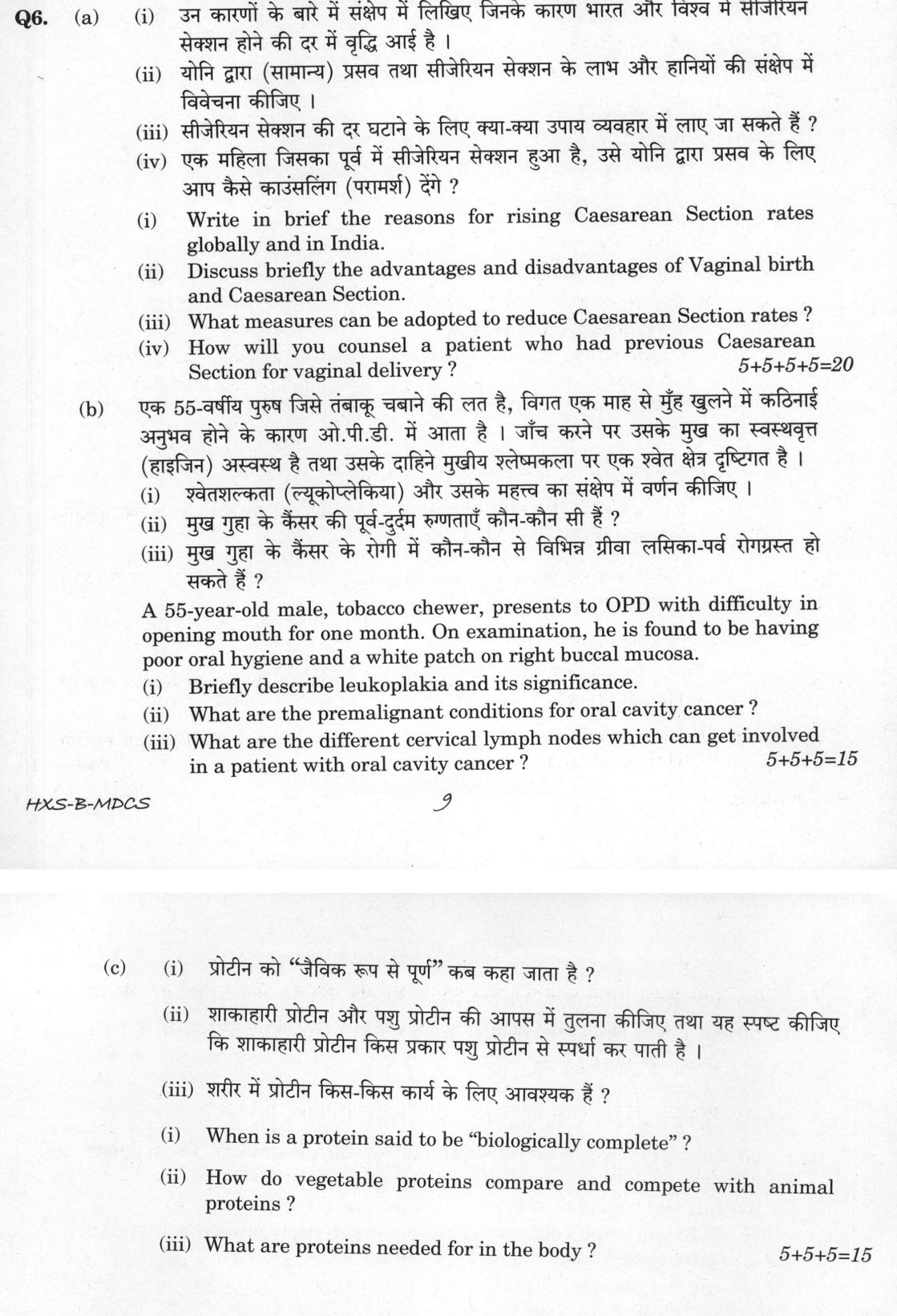
(a) (i) Write in brief the reasons for rising Caesarean Section rates globally and in India. (5 marks) (ii) Discuss briefly the…
Write in brief the reasons for rising Caesarean Section rates globally and in India. 5 marks
Discuss briefly the advantages and disadvantages of Vaginal birth and Caesarean Section. 5 marks
What measures can be adopted to reduce Caesarean Section rates? 5 marks
How will you counsel a patient who had previous Caesarean Section for vaginal delivery? (5 marks) (5+5+5+5=20 marks)
A 55-year-old male, tobacco chewer, presents to OPD with difficulty in opening mouth for one month. On examination, he is found to be having poor oral hygiene and a white patch on right buccal mucosa. Briefly describe leukoplakia and its significance. 5 marks
What are the premalignant conditions for oral cavity cancer? 5 marks
What are the different cervical lymph nodes which can get involved in a patient with oral cavity cancer? (5 marks) (5+5+5=15 marks)
When is a protein said to be "biologically complete"? 5 marks
How do vegetable proteins compare and compete with animal proteins? 5 marks
What are proteins needed for in the body? (5 marks) (5+5+5=15 marks)
हिंदी में प्रश्न पढ़ें
उन कारणों के बारे में संक्षेप में लिखिए जिनके कारण भारत और विश्व में सीजेरियन सेक्शन होने की दर में वृद्धि आई है। 5 marks
योनि द्वारा (सामान्य) प्रसव तथा सीजेरियन सेक्शन के लाभ और हानियों की संक्षेप में विवेचना कीजिए। 5 marks
सीजेरियन सेक्शन की दर घटाने के लिए क्या-क्या उपाय व्यवहार में लाए जा सकते हैं? 5 marks
एक महिला जिसका पूर्व में सीजेरियन सेक्शन हुआ है, उसे योनि द्वारा प्रसव के लिए आप कैसे काउंसलिंग (परामर्श) देंगे? (5) (5+5+5+5=20)
एक 55-वर्षीय पुरुष जिसे तंबाकू चबाने की लत है, विगत एक माह से मुँह खुलने में कठिनाई अनुभव होने के कारण ओ.पी.डी. में आता है। जाँच करने पर उसके मुख का स्वच्छताविहीन (हाइजीन) अवस्था है तथा उसके दाहिने मुखीय स्लेष्मकला पर एक श्वेत क्षेत्र दृष्टिगत है। श्वेतशल्कता (ल्यूकोप्लेकिया) और उसके महत्व का संक्षेप में वर्णन कीजिए। 5 marks
मुख गुहा के कैंसर की पूर्व-दुर्दश्म रुपताएँ कौन-कौन सी हैं? 5 marks
मुख गुहा के कैंसर के रोगी में कौन-कौन से विभिन्न ग्रीवा लसिका-पर्व रोगग्रस्त हो सकते हैं? (5) (5+5+5=15)
प्रोटीन को "जैविक रूप से पूर्ण" कब कहा जाता है? 5 marks
शाकाहारी प्रोटीन और पशु प्रोटीन की आपस में तुलना कीजिए तथा यह स्पष्ट कीजिए कि शाकाहारी प्रोटीन किस प्रकार पशु प्रोटीन से स्पर्धा कर पाती है। 5 marks
शरीर में प्रोटीन किस-किस कार्य के लिए आवश्यक है? (5) (5+5+5=15)
Model answer
Written by UPSC Answer Check against this question's marking rubric, to the expected length. UPSC does not publish answers for Mains — this is one way to score well, not an official key.
Rising Caesarean section rates and oral premalignant lesions need clinical, institutional and nutritional responses.
Maternal care. Globally and in India, Caesarean section rates have risen due to medical and non-medical factors. Medical indications include breech presentation, placenta previa, fetal distress, obstructed labour and previous uterine scar, though many operations are unnecessary. Non-medical drivers include patient/family request, defensive medicine, convenience, private-sector incentives and fee-for-service payment. In India, Janani Suraksha Yojana has increased facility deliveries, but private-sector dominance, urban-rural disparity and weak audit culture allow unnecessary operations, especially in private urban facilities. Robson 10-group classification audits deliveries by parity, presentation, gestational age and mode, identifying groups with high Caesarean rates.
Vaginal birth supports neonatal microbiome colonisation, faster recovery, less blood loss, lower infection/thromboembolic risk and cost. Caesarean section can reduce birth trauma in selected cases and allow planned delivery, but carries haemorrhage, infection, anaesthetic complications, adhesions, longer recovery, higher cost and neonatal respiratory morbidity. Vaginal birth is disadvantageous in obstructed labour, malpresentation or severe fetal compromise. WHO and ICMR-supported Indian studies link high primary Caesarean rates to maternal morbidity without clear neonatal benefit, while low rates may reflect poor skilled-care access.
To reduce unnecessary Caesarean sections, use Robson audit, WHO partograph, midwife-led care for low-risk women, institutional protocols with clear indications, public reporting of facility-level rates, hospital accreditation, and financial disincentives for non-medical operations.
For previous Caesarean section, trial of labour after Caesarean (TOLAC) counselling should be shared decision-making. It is suitable with a previous low transverse incision, no contraindications, and emergency caesarean access. Success rates are 60–80%, uterine rupture risk about 0.5% in low-risk women. NICE-style guidance adapted to India should explain benefits, risks, scar type, interval, labour progress, induction timing, continuous monitoring and immediate theatre availability.
Oral cancer. WHO 2005 defines leukoplakia as a white plaque of questionable risk after excluding known diseases/disorders not associated with increased cancer risk. It is significant because it may show hyperplasia, dysplasia, carcinoma in situ or invasive carcinoma, and is the most common oral potentially malignant disorder; malignant transformation rates vary, often quoted around 1–20%, so biopsy and regular follow-up are essential. Erythroplakia, a red plaque with higher risk, commonly shows dysplasia, carcinoma in situ or invasive carcinoma at biopsy in >80% of cases, with malignant transformation rates about 14–50%. Other premalignant conditions include leukoplakia, erythroplakia, oral submucous fibrosis, lichen planus, syphilitic glossitis, actinic cheilitis and chronic hyperplastic candidiasis. Tobacco, betel quid, alcohol and poor hygiene increase risk.
Oral cavity cancer drains to cervical nodes levels I–V. Submental (Ia) drain floor of mouth, anterior tongue and lower lip; submandibular (Ib) drain anterior mandible, lower lip and floor of mouth; jugulodigastric/upper deep cervical (II) receive posterior tongue, tonsil and oropharynx; lower deep cervical (III–IV) and supraclavicular (V) nodes may be involved in advanced disease.
Protein nutrition. A protein is biologically complete when it supplies all essential amino acids in adequate proportions and is well digested/utilised; assessed by biological value, protein efficiency ratio and net protein utilisation. Animal proteins are usually complete and highly digestible; vegetable proteins are often lower in digestibility and limiting amino acids—cereals low in lysine, pulses low in methionine—so mutual supplementation improves quality. Plant proteins compete with animal proteins on cost, availability, sustainability and preference, though animal proteins remain important for micronutrients and high-quality protein in vulnerable groups, especially children, pregnant women and the elderly.
Proteins are needed for structural tissues, enzymes, hormones, immune antibodies, transport, and energy when carbohydrate/fat are insufficient.
The way forward is integrated public health action: audit maternal care, strengthen oral cancer screening and tobacco control, and improve protein quality through dietary diversification, with community nutrition and tobacco-cessation services, and betel-quid regulation.
What "Discuss" is asking you to do
Lay the issue out from more than one side — how it arose, what is claimed for it, what is held against it, and where it now stands. UPSC attaches discuss to broad topics with several live dimensions, so coverage of the dimensions earns more than the strength of your opinion.
Structure that answers it
Set the issue up → the case as it is made → the case against → the dimension both sides leave out → where the balance now lies
Where marks are lost
Listing facts with no thread between them, or arguing one side throughout and calling it a discussion.
How this answer will be evaluated
Approach
Framework: Clinical Sequence (Definition > Aetiology > Features > Management). (a(i)) write short notes: define > 3-4 key features > one example > one-line significance | (a(ii)) discuss: intro > 3-4 dimensions > example > balanced close | (a(iii)) suggest: the problem in one line > implementable measures > who acts > conclusion | (a(iv)) explain: definition/context > points in order > small example > short close | (b(i)) describe: define > structure or process in order > labelled diagram > significance | (b(ii)) enumerate: list the items in order > one line each > no commentary | (b(iii)) map: locate accurately > label > one line on why it matters | (c(i)) define: precise definition > the distinguishing feature > one example | (c(ii)) compare: paired headings or table > key differences > significance > conclusion | (c(iii)) enumerate: list the items in order > one line each > no commentary Full marks: Comprehensive, accurate, and well-structured answers with specific examples and clinical relevance.
Key points expected
- Maternal request / social factors
- Medical indications (e.g., previous C-section)
- Provider / hospital incentives
- Lack of skilled birth attendants
- Vaginal: faster recovery, lower infection risk
- Vaginal: lower cost, immediate breastfeeding
- C-section: controlled delivery, avoids dystocia
- C-section: surgical risks (infection, hemorrhage)
Evaluation rubric
Each sub-part is marked on its own, against the marks and word limit printed on the paper.
- (a(i)) List reasons for rising C-section rates globally and in India. 5 marks
write short notes— define → 3-4 key features → one example → one-line significance
Must cover
- Maternal request / social factors
- Medical indications (e.g., previous C-section)
- Provider / hospital incentives
- Lack of skilled birth attendants
Loses marks
- Listing symptoms without mechanism
- Vague generalizations without specific causes
Earns more
- Specific Indian data or trends
- Distinction between global and local causes
Extra mark
- WHO recommended rate (10-15%)
- (a(ii)) Compare advantages and disadvantages of Vaginal birth vs C-section. 5 marks
discuss— intro → 3-4 dimensions → example → balanced close
Must cover
- Vaginal: faster recovery, lower infection risk
- Vaginal: lower cost, immediate breastfeeding
- C-section: controlled delivery, avoids dystocia
- C-section: surgical risks (infection, hemorrhage)
Loses marks
- Listing symptoms without mechanism
- Focusing only on one mode of delivery
Earns more
- Impact on neonate (e.g., lung fluid clearance)
Extra mark
- Specific complication rates
- (a(iii)) Measures to reduce Caesarean Section rates. 5 marks
suggest— the problem in one line → implementable measures → who acts → conclusion
Must cover
- Counseling on VBAC (Vaginal Birth after C-section)
- Reducing non-medical indications
- Improving access to skilled midwives
- Hospital audit and feedback systems
Loses marks
- Management without priority
- Vague suggestions like 'better care'
Earns more
- Policy interventions (e.g., banning elective C-sections)
Extra mark
- Specific national health programme initiatives
- (a(iv)) Counseling points for a patient with previous C-section seeking vaginal delivery. 5 marks
explain— definition/context → points in order → small example → short close
Must cover
- Explain risks of VBAC (e.g., uterine rupture)
- Explain benefits of VBAC (e.g., faster recovery)
- Discuss contraindications to VBAC
- Informed consent process
Loses marks
- Failing to mention risks
- Failing to mention benefits
Earns more
- Mentioning specific risk factors for rupture
Extra mark
- Referral to high-risk unit
- (b(i)) Describe leukoplakia and its significance. 5 marks
describe— define → structure or process in order → labelled diagram → significance
Must cover
- Definition: white patch not attributable to other cause
- Significance: premalignant lesion
- Risk factors (tobacco, alcohol)
- Need for biopsy
Loses marks
- Confusing with candidiasis
- Failing to mention premalignant nature
Earns more
- Mentioning specific risk of malignant transformation
Extra mark
- Histological features (dysplasia)
- (b(ii)) List premalignant conditions for oral cavity cancer. 5 marks
enumerate— list the items in order → one line each → no commentary
Must cover
- Leukoplakia
- Erythroplakia
- Submucous fibrosis
- Oral lichen planus
Loses marks
- Listing benign conditions
- Failing to list at least 3 premalignant conditions
Earns more
- Mentioning specific risk factors for each
Extra mark
- Mentioning specific risk of malignant transformation for each
- (b(iii)) Identify cervical lymph nodes involved in oral cavity cancer. 5 marks
map— locate accurately → label → one line on why it matters
Must cover
- Submental nodes
- Submandibular nodes
- Jugulodigastric nodes
- Deep cervical nodes
Loses marks
- Listing nodes not involved in oral cavity drainage
- Failing to list at least 3 relevant nodes
Earns more
- Mentioning specific drainage patterns
Extra mark
- Diagram of lymph node levels
- (c(i)) Define 'biologically complete' protein. 5 marks
define— precise definition → the distinguishing feature → one example
Must cover
- Contains all essential amino acids
- In adequate proportions
- Meets body's requirements
- High biological value
Loses marks
- Confusing with 'complete' protein
- Failing to mention essential amino acids
Earns more
- Mentioning specific examples (e.g., egg, milk)
Extra mark
- Mentioning specific amino acid scores
- (c(ii)) Compare vegetable and animal proteins. 5 marks
compare— paired headings or table → key differences → significance → conclusion
Must cover
- Amino acid profile (limiting amino acids)
- Digestibility
- Biological value
- Cost and availability
Loses marks
- Focusing only on one aspect
- Failing to mention limiting amino acids
Earns more
- Mentioning specific examples (e.g., rice + beans)
Extra mark
- Mentioning specific amino acid scores
- (c(iii)) List functions of proteins in the body. 5 marks
enumerate— list the items in order → one line each → no commentary
Must cover
- Structural support (e.g., collagen)
- Enzymes and hormones
- Transport (e.g., hemoglobin)
- Immune function (e.g., antibodies)
Loses marks
- Listing vague functions
- Failing to list at least 3 specific functions
Earns more
- Mentioning specific examples for each function
Extra mark
- Mentioning specific protein names
Practice this exact question
Write your answer and it is marked point by point against the model answer above — what you covered, what you missed, what you got wrong.
Evaluate my answer →More from Medical Science 2021 Paper II
- Q3 (a) A 40-year-old male who was bedridden for the last two months following a fracture in…
- Q4 (a) Discuss in short the etiology, diagnosis, treatment and complications of cirrhosis of…
- Q5 (a) Briefly describe the clinical features, diagnostic workup and management of a patient…
- Q6 (a) (i) Write in brief the reasons for rising Caesarean Section rates globally and in Ind…
- Q7 (a) A 60-year-old male presents with progressively increasing jaundice for 2 months. He i…
- Q8 (a) (i) Summarise the spectrum of Iodine Deficiency Disorders. (10 marks) (ii) State the…