Paper II — Q2
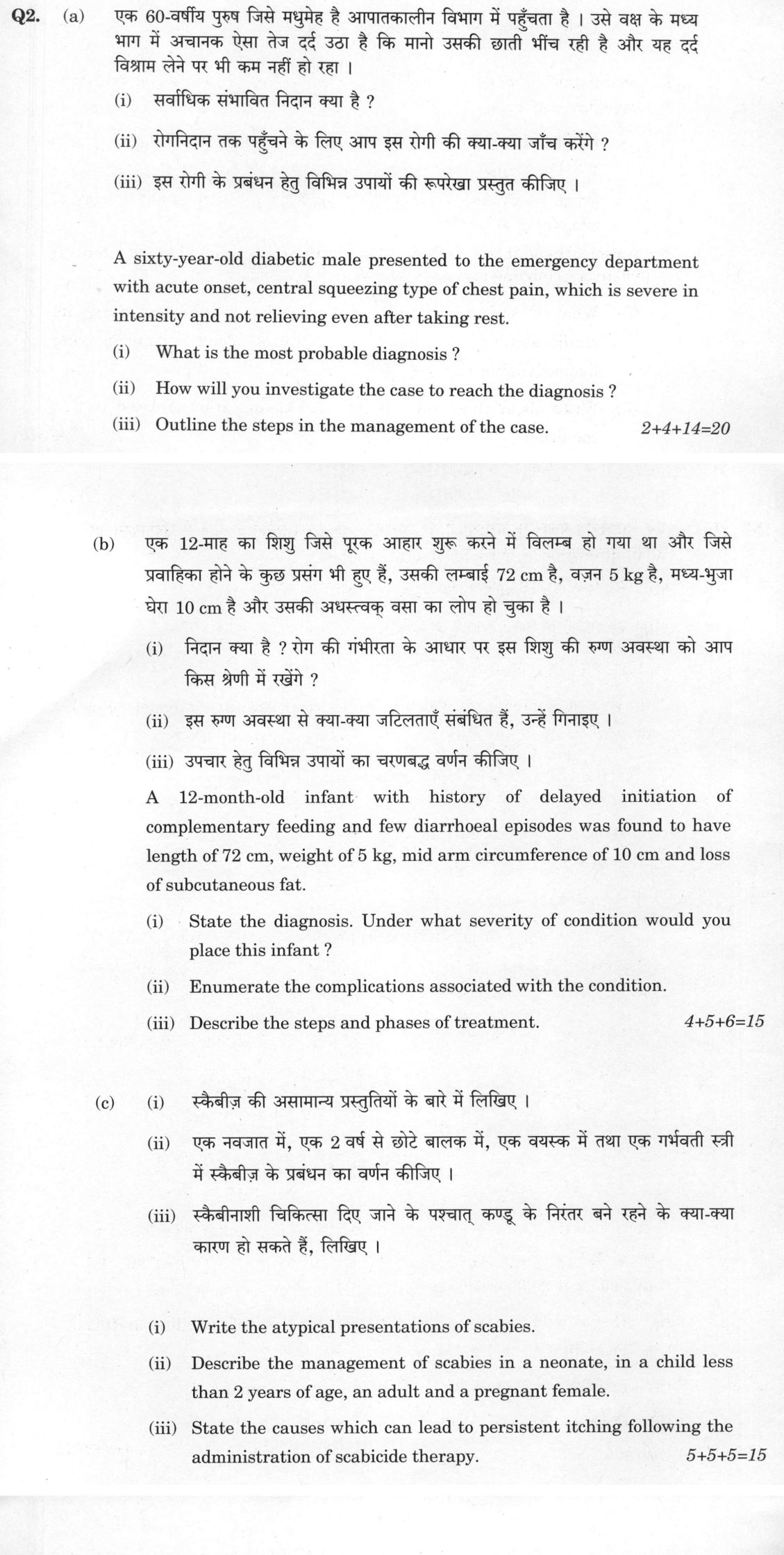
(a) A sixty-year-old diabetic male presented to the emergency department with acute onset, central squeezing type of chest pain…
A sixty-year-old diabetic male presented to the emergency department with acute onset, central squeezing type of chest pain, which is severe in intensity and not relieving even after taking rest. What is the most probable diagnosis?
How will you investigate the case to reach the diagnosis?
Outline the steps in the management of the case. (2+4+14=20 marks)
A 12-month-old infant with history of delayed initiation of complementary feeding and few diarrhoeal episodes was found to have length of 72 cm, weight of 5 kg, mid arm circumference of 10 cm and loss of subcutaneous fat. State the diagnosis. Under what severity of condition would you place this infant?
Enumerate the complications associated with the condition.
Describe the steps and phases of treatment. (4+5+6=15 marks)
Write the atypical presentations of scabies.
Describe the management of scabies in a neonate, in a child less than 2 years of age, an adult and a pregnant female.
State the causes which can lead to persistent itching following the administration of scabicide therapy. (5+5+5=15 marks)
हिंदी में प्रश्न पढ़ें
एक 60-वर्षीय पुरुष जिसे मधुमेह है आपातकालीन विभाग में पहुँचता है। उसे वक्ष के मध्य भाग में अचानक ऐसा तेज दर्द उठा है कि मानो उसकी छाती भींच रही है और यह दर्द विश्राम लेने पर भी कम नहीं हो रहा। सर्वाधिक संभावित निदान क्या है?
रोगनिदान तक पहुँचने के लिए आप इस रोगी की क्या-क्या जाँच करेंगे?
इस रोगी के प्रबंधन हेतु विभिन्न उपायों की रूपरेखा प्रस्तुत कीजिए। (2+4+14=20 अंक)
एक 12-माह का शिशु जिसे पूरक आहार शुरू करने में वि�िलम्ब हो गया था और जिसे प्रवाहिका होने के कुछ प्रसंग भी हुए हैं, उसकी लम्बाई 72 cm है, वजन 5 kg है, मध्य-भुजा घेरा 10 cm है और उसकी अधस्त्वक् वसा का लोप हो चुका है। निदान क्या है? रोग की गम्भीरता के आधार पर इस शिशु की क्षण अवस्था को आप किस श्रेणी में रखेंगे?
इस क्षण अवस्था से क्या-क्या जटिलताएँ सम्बन्धित हैं, उन्हें गिनाइए।
उपचार हेतु विभिन्न उपायों का चरणबद्ध वर्णन कीजिए। (4+5+6=15 अंक)
स्केबीज की असामान्य प्रस्तुतियों के बारे में लिखिए।
एक नवजात में, एक 2 वर्ष से छोटे बालक में, एक वयस्क में तथा एक गर्भवती स्त्री में स्केबीज के प्रबन्धन का वर्णन कीजिए।
स्केबीनाशी चिकित्सा दिए जाने के पश्चात् कण्डू के निरन्तर बने रहने के क्या-क्या कारण हो सकते हैं, लिखिए। (5+5+5=15 अंक)
Model answer
Written by UPSC Answer Check against this question's marking rubric, to the expected length. UPSC does not publish answers for Mains — this is one way to score well, not an official key.
(a) Diagnosis, investigation and management The most probable diagnosis is acute coronary syndrome, most likely acute myocardial infarction; ECG will determine whether it is STEMI or NSTEMI. In a diabetic patient, autonomic neuropathy may blunt or mask pain, but central squeezing pain unrelieved by rest is an emergency. Investigation should begin with a 12-lead ECG within 10 minutes of arrival, looking for ST-segment elevation, new left bundle branch block, or dynamic ST-T changes. Serial cardiac biomarkers, especially high-sensitivity troponin I/T and CK-MB, confirm myocardial necrosis. Echocardiography identifies regional wall-motion abnormalities and complications such as papillary muscle rupture or pericardial effusion. Coronary angiography is the definitive test for coronary anatomy and guides reperfusion.
Management is stepwise. Initial MONA-based care includes aspirin 300 mg chewed, sublingual nitrate if blood pressure permits, oxygen only if hypoxic, and morphine if pain persists. Reperfusion is the priority: primary PCI is preferred if door-to-balloon time can be achieved within 120 minutes; otherwise fibrinolysis with weight-based tenecteplase is given within 12 hours of symptom onset if no contraindication. Dual antiplatelet therapy is started with aspirin plus clopidogrel, particularly when thrombolysis is planned; if primary PCI is performed, a P2Y12 inhibitor is loaded according to the interventional protocol. Beta-blockers are given early unless contraindicated, ACE inhibitors are started for left ventricular dysfunction, anterior infarct, diabetes or hypertension, and high-intensity statins are begun for plaque stabilization. The patient needs continuous monitoring, pain and hypoxia control, and secondary prevention counselling.
(b) Diagnosis, complications and treatment The infant has severe acute malnutrition. At 12 months, MUAC of 10 cm is below 11.5 cm, and weight-for-length is far below −3 SD; loss of subcutaneous fat suggests marasmus. If bilateral pitting oedema or systemic infection is present, it is complicated SAM; otherwise it is severe uncomplicated SAM. Complications include hypoglycaemia, hypothermia, hypokalaemia, dehydration, septic shock, heart failure, refeeding syndrome, anaemia and vitamin A deficiency. Treatment follows WHO phases. In the initial stabilization phase, give F-75 formula at about 100 kcal/kg/day in small frequent feeds, correct hypoglycaemia with glucose, warm the child, treat infection with antibiotics, replace potassium cautiously, and avoid overfeeding. In the transition phase, increase calories and protein gradually to prevent refeeding syndrome. In the rehabilitation phase, give F-100 or ready-to-use therapeutic food at 150–220 kcal/kg/day with adequate protein, micronutrients and vitamin A, while monitoring weight, oedema, appetite and infection. Follow-up includes growth monitoring, counselling on complementary feeding, and immunization.
(c) Atypical scabies, management and persistent itching Atypical presentations include crusted or Norwegian scabies, especially in immunocompromised or elderly patients; scabies incognito after topical steroids; pruritic nodular scabies; bullous scabies in infants; and scalp, face or widespread involvement in neonates, infants, elderly or immunosuppressed patients. Management is age-specific. In a neonate, use 5% permethrin cream or 5–6% precipitated sulfur ointment, applied to the whole body including scalp and soles, repeated after 7 days, with close supervision. In a child under 2 years, 5% permethrin cream is generally used if older than 2 months; for infants under 2 months, 5–6% sulfur is preferred. In adults, 5% permethrin cream is applied overnight for 8–12 hours and repeated after 7 days if needed; oral ivermectin may be used for extensive or crusted disease. In pregnant women, permethrin is first-line and ivermectin is avoided. All household contacts should be treated simultaneously, bedding washed, and clothing disinfected. Persistent itching after scabicide therapy may be due to treatment failure from resistance or incorrect application, reinfection from untreated contacts, post-scabetic pruritic nodules, secondary eczema or dermatitis, and delusional parasitosis. Thus, each case requires a structured outline: rapid ACS reperfusion, phased SAM rehabilitation, and age-specific scabies therapy with contact management.
What "Outline" is asking you to do
Set out a whole scheme from end to end in its main steps without going into any of them. It is the directive used for protocols and frameworks — a management plan, a reaction mechanism, a statutory scheme — where the mark lies in having the full sequence with nothing missing.
Structure that answers it
What the scheme is for → step one → step two → the remaining steps through to the end point → the condition on which the sequence turns
Where marks are lost
Depth in the wrong place: elaborating the first two steps and never reaching the end of the scheme, which is where completeness is checked.
How this answer will be evaluated
Approach
Framework: Clinical Case Analysis (Diagnosis, Investigation, Management). (a(i)) define: precise definition > the distinguishing feature > one example | (a(ii)) explain: definition/context > points in order > small example > short close | (a(iii)) describe: define > structure or process in order > labelled diagram > significance | (b(i)) define: precise definition > the distinguishing feature > one example | (b(ii)) enumerate: list the items in order > one line each > no commentary | (b(iii)) describe: define > structure or process in order > labelled diagram > significance | (c(i)) write short notes: define > 3-4 key features > one example > one-line significance | (c(ii)) describe: define > structure or process in order > labelled diagram > significance | (c(iii)) account for: state the phenomenon > the causes in order of weight > conclusion Full marks: Accurate diagnosis, prioritized investigations, and guideline-based management with specific drug names and phases.
Key points expected
- Diagnosis of Acute Myocardial Infarction (AMI)
- Mention of 'ST elevation' or 'STEMI' if applicable
- 12-lead ECG (immediate)
- Cardiac biomarkers (Troponin I/T, CK-MB)
- Chest X-ray (to rule out other causes)
- Echocardiography (for wall motion abnormalities)
- Immediate: MONA (Morphine, Oxygen, Nitrates, Aspirin)
- Definitive: Reperfusion (Thrombolysis or Primary PCI)
Evaluation rubric
Each sub-part is marked on its own, against the marks and word limit printed on the paper.
- (a(i)) Identify the specific cardiac condition based on symptoms. 2 marks
define— precise definition → the distinguishing feature → one example
Must cover
- Diagnosis of Acute Myocardial Infarction (AMI)
- Mention of 'ST elevation' or 'STEMI' if applicable
Loses marks
- Vague diagnosis like 'heart attack' without medical term
- Diagnosis of Angina Pectoris (stable)
Earns more
- Reference to 'Acute Coronary Syndrome' (ACS)
- (a(ii)) List diagnostic tests in order of clinical priority. 4 marks
explain— definition/context → points in order → small example → short close
Must cover
- 12-lead ECG (immediate)
- Cardiac biomarkers (Troponin I/T, CK-MB)
- Chest X-ray (to rule out other causes)
- Echocardiography (for wall motion abnormalities)
Loses marks
- Listing tests without priority order
- Omitting ECG or Troponin
Earns more
- Mention of 'Coronary Angiography' for definitive diagnosis
Extra mark
- Reference to 'Killip classification' for risk stratification
- (a(iii)) Outline immediate, definitive, and long-term management steps. 14 marks
describe— define → structure or process in order → labelled diagram → significance
Must cover
- Immediate: MONA (Morphine, Oxygen, Nitrates, Aspirin)
- Definitive: Reperfusion (Thrombolysis or Primary PCI)
- Long-term: Secondary prevention (Statin, Beta-blocker, ACEi)
- Lifestyle modification (Diet, Smoking cessation)
Loses marks
- Management without priority (immediate vs long-term)
- Omitting reperfusion strategy
Earns more
- Mention of 'Cardiac Rehabilitation'
- Specific mention of 'Dual Antiplatelet Therapy' (DAPT)
Extra mark
- Reference to 'ACC/AHA guidelines' for STEMI management
- (b(i)) Diagnose the condition and classify its severity. 4 marks
define— precise definition → the distinguishing feature → one example
Must cover
- Diagnosis of Protein-Energy Malnutrition (PEM)
- Classification as 'Moderate' or 'Severe' based on weight-for-age
- Mention of 'Wasting' (low weight-for-height)
Loses marks
- Diagnosis of 'Stunting' (low height-for-age) as primary
- Failure to classify severity
Earns more
- Calculation of Z-scores (e.g., -2 to -3 SD)
Extra mark
- Reference to 'WHO growth charts'
- (b(ii)) List complications associated with the condition. 5 marks
enumerate— list the items in order → one line each → no commentary
Must cover
- Hypoglycemia
- Hypothermia
- Severe Anemia
- Infections (Pneumonia, Diarrhea)
Loses marks
- Listing only 'growth retardation' (which is the condition itself)
- Omitting life-threatening complications like hypoglycemia
Earns more
- Mention of 'Electrolyte imbalances' (Hypokalemia)
- Mention of 'Edema' (Kwashiorkor features)
Extra mark
- Mention of 'Refeeding syndrome' risk
- (b(iii)) Describe the phases of treatment for the condition. 6 marks
describe— define → structure or process in order → labelled diagram → significance
Must cover
- Phase 1: Stabilization (Treat hypoglycemia, hypothermia, infection)
- Phase 2: Re-feeding (Gradual caloric increase, F-75/F-100)
- Phase 3: Catch-up growth (High protein/calorie diet)
- Mention of 'Micronutrient supplementation' (Zinc, Multivitamin)
Loses marks
- Suggesting immediate high-calorie feeding (risk of refeeding syndrome)
- Omitting treatment of complications (hypoglycemia)
Earns more
- Mention of 'Psychosocial stimulation'
- Mention of 'Breastfeeding continuation'
Extra mark
- Reference to 'WHO guidelines for management of severe acute malnutrition'
- (c(i)) List atypical presentations of scabies. 5 marks
write short notes— define → 3-4 key features → one example → one-line significance
Must cover
- Scabies Incognito (masked by steroids)
- Norwegian Scabies (Crusted/Hyperkeratotic)
- Scabies in neonates (palms/soles involvement)
- Scabies in immunocompromised (atypical distribution)
Loses marks
- Listing typical symptoms (burrows, web spaces) as atypical
- Omitting 'Norwegian scabies'
Earns more
- Mention of 'Scabies in elderly' (spinal involvement)
Extra mark
- Mention of 'Scabies in HIV patients'
- (c(ii)) Describe management for specific age groups. 5 marks
describe— define → structure or process in order → labelled diagram → significance
Must cover
- Neonate: Permethrin 5% (avoid head) or Crotamiton
- Child <2 years: Permethrin 5% (avoid head) or Crotamiton
- Adult: Permethrin 5% or Sulfur ointment
- Pregnant female: Sulfur ointment (safe) or Permethrin (2nd trimester)
Loses marks
- Recommending Ivermectin for neonates/pregnancy
- Omitting 'treatment of contacts'
Earns more
- Mention of 'Treat all household contacts'
- Mention of 'Laundering clothes/bedding'
Extra mark
- Mention of 'Ivermectin' (contraindicated in <15kg/pregnancy)
- (c(iii)) Explain causes of persistent itching after treatment. 5 marks
account for— state the phenomenon → the causes in order of weight → conclusion
Must cover
- Post-scabetic pruritus (allergic reaction to mite debris)
- Re-infestation (inadequate treatment of contacts)
- Scabies Incognito (steroid use masking symptoms)
- Eczematization (secondary dermatitis)
Loses marks
- Attributing solely to 'drug failure' without considering allergy
- Omitting 're-infestation' as a cause
Earns more
- Mention of 'Drug resistance' (rare)
- Mention of 'Misdiagnosis' (other pruritic conditions)
Extra mark
- Mention of 'Psychogenic pruritus'
Practice this exact question
Write your answer and it is marked point by point against the model answer above — what you covered, what you missed, what you got wrong.
Evaluate my answer →More from Medical Science 2021 Paper II
- Q1 (a) Discuss in brief the role of ultrasound in the investigation of pain in right hypocho…
- Q2 (a) A sixty-year-old diabetic male presented to the emergency department with acute onset…
- Q3 (a) A 40-year-old male who was bedridden for the last two months following a fracture in…
- Q4 (a) Discuss in short the etiology, diagnosis, treatment and complications of cirrhosis of…
- Q5 (a) Briefly describe the clinical features, diagnostic workup and management of a patient…