Paper II — Q8
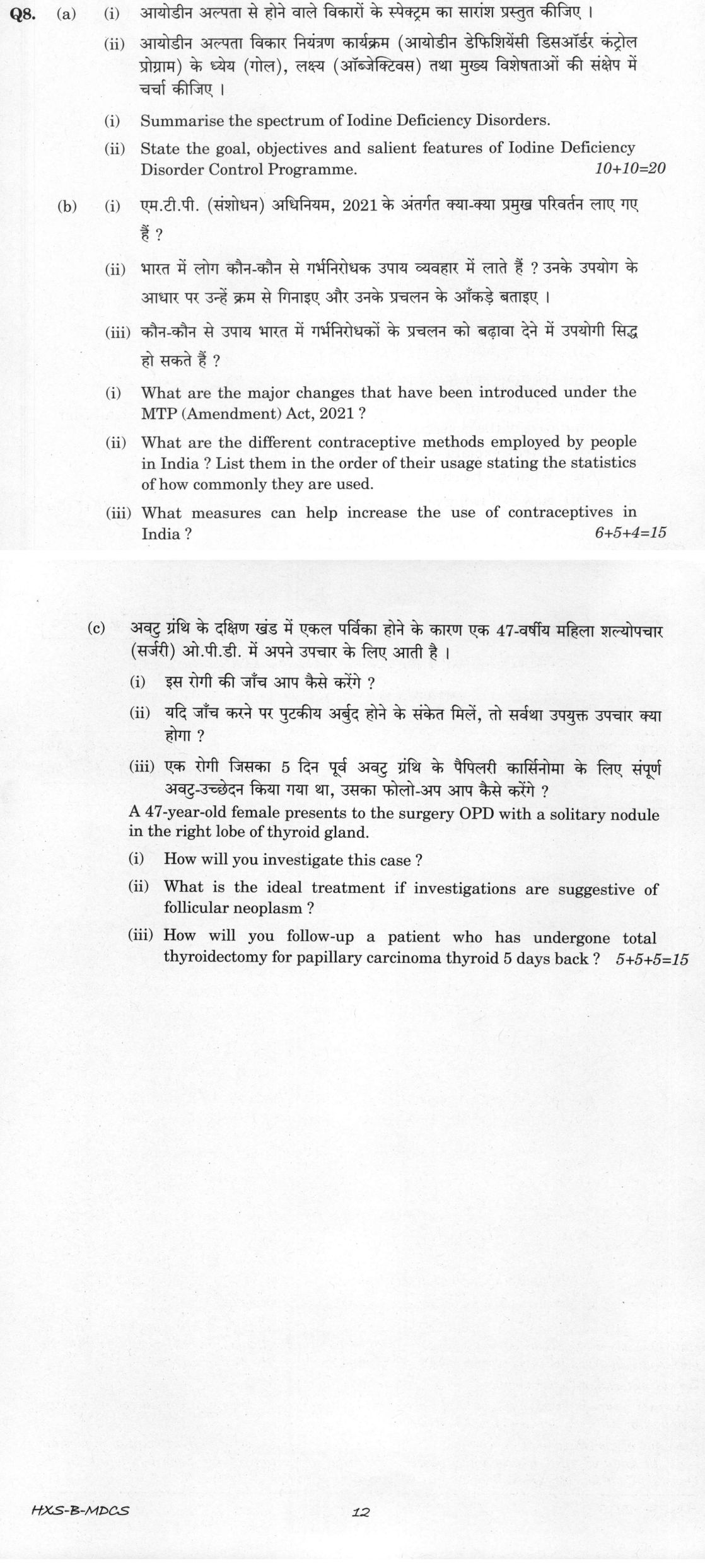
(a) (i) Summarise the spectrum of Iodine Deficiency Disorders. (10 marks) (ii) State the goal, objectives and salient features of…
Summarise the spectrum of Iodine Deficiency Disorders. 10 marks
State the goal, objectives and salient features of Iodine Deficiency Disorder Control Programme. 10 marks
What are the major changes that have been introduced under the MTP (Amendment) Act, 2021? 6 marks
What are the different contraceptive methods employed by people in India? List them in the order of their usage stating the statistics of how commonly they are used. 5 marks
What measures can help increase the use of contraceptives in India? 4 marks
A 47-year-old female presents to the surgery OPD with a solitary nodule in the right lobe of thyroid gland.
How will you investigate this case? 5 marks
What is the ideal treatment if investigations are suggestive of follicular neoplasm? 5 marks
How will you follow-up a patient who has undergone total thyroidectomy for papillary carcinoma thyroid 5 days back? 5 marks
हिंदी में प्रश्न पढ़ें
आयोडीन अल्पता से होने वाले विकारों के स्पेक्ट्रम का सारांश प्रस्तुत कीजिए । (10 अंक)
आयोडीन अल्पता विकार नियंत्रण कार्यक्रम (आयोडीन डेफिशिएंसी डिसऑर्डर कंट्रोल प्रोग्राम) के ध्येय (गोल), लक्ष्य (ऑब्जेक्टिव्स) तथा मुख्य विशेषताओं की संक्षेप में चर्चा कीजिए । (10 अंक)
एम.टी.पी. (संशोधन) अधिनियम, 2021 के अंतर्गत क्या-क्या प्रमुख परिवर्तन लाए गए हैं ? (6 अंक)
भारत में लोग कौन-कौन से गर्भनिरोधक उपाय व्यवहार में लाते हैं ? उनके उपयोग के आधार पर उन्हें क्रम से गिनाइए और उनके प्रचलन के आँकड़े बताइए । (5 अंक)
कौन-कौन से उपाय भारत में गर्भनिरोधकों के प्रचलन को बढ़ावा देने में उपयोगी सिद्ध हो सकते हैं ? (4 अंक)
अवटु ग्रंथि के दक्षिण खंड में एकल पर्विका होने के कारण एक 47-वर्षीय महिला शल्योपचार (सर्जरी) ओ.पी.डी. में अपने उपचार के लिए आती है ।
इस रोगी की जाँच आप कैसे करेंगे ? (5 अंक)
यदि जाँच करने पर पुटकीय अर्बुद होने के संकेत मिलें, तो सर्वथा उपयुक्त उपचार क्या होगा ? (5 अंक)
एक रोगी जिसका 5 दिन पूर्व अवटु ग्रंथि के पैपिलरी कार्सिनोमा के लिए संपूर्ण अवटु-उच्छेदन किया गया था, उसका फोलो-अप आप कैसे करेंगे ? (5 अंक)
Model answer
Written by UPSC Answer Check against this question's marking rubric, to the expected length. UPSC does not publish answers for Mains — this is one way to score well, not an official key.
Iodine deficiency is a preventable public-health problem in India, and its control moves from population-level salt iodization to individual surgical care of thyroid disease.
(a)(i) Spectrum of IDD. The spectrum ranges from mild goitre to severe developmental and reproductive harm. It includes diffuse and nodular goitre, hypothyroidism, neurological and myxedematous cretinism, endemic cretinism, stillbirths, impaired mental function in children, and iodine-induced hyperthyroidism, known as Jod-Basedow phenomenon, especially after iodine exposure in susceptible individuals.
(a)(ii) Iodine Deficiency Disorder Control Programme. The goal of the National Iodine Deficiency Disorders Control Programme (NIDDCP, 1992) is universal salt iodization (USI) and reducing endemic goitre prevalence to less than 5% in all districts. Its objective is eliminating IDD as a public-health problem by 2020. Salient features include promotion and regulation of iodized salt, monitoring salt iodine content and urinary iodine levels, goitre surveillance through district-level monitoring and salt quality checks, nutrition education, integration with the National Nutrition Mission (NNM, 2018), and use of double fortified salt containing iodine and iron.
(b)(i) MTP (Amendment) Act, 2021. The amendment introduces gestation-based categorization, extending termination up to 24 weeks for special categories of women. It removes the marital-status requirement, adds a confidentiality clause, clarifies the definition of registered medical practitioner, and provides for the constitution of a board for cases beyond 24 weeks, particularly where fetal abnormalities or serious risk are involved.
(b)(ii) Contraceptive methods in India. According to NFHS-5, any modern contraceptive method is used by 56.5% of ever-married women aged 15-49. In order of usage, female sterilization is most common at 37.9%, followed by traditional methods at 10.2%, condoms at 9.5%, lactational amenorrhoea method (LAM) at 4.1%, oral contraceptive pills at 2.4%, intrauterine devices at 2.1%, male sterilization at 0.3%, and injectables at 0.2%. This pattern shows reliance on permanent female methods and low uptake of reversible modern methods.
(b)(iii) Increasing contraceptive use. Use can be increased through ASHA-based counselling, active male involvement, social marketing, integration of family planning after postpartum and post-abortion care, removal of method-specific targets, and community-based distribution of commodities, with counselling on side-effect management. These measures strengthen demand generation, method mix, and access.
(c)(i) Investigation of thyroid nodule. A solitary right-lobe thyroid nodule in a 47-year-old woman should be investigated with serum TSH and T4 to assess thyroid function. Ultrasound with TI-RADS classification guides nodule characterization and FNAC, reported on the Bethesda system. If TSH is low, a radionuclide scan is done to identify a hot nodule. Serum calcitonin is checked if medullary carcinoma or MEN2 is suspected, and TPO antibodies are measured when autoimmune thyroiditis is considered.
(c)(ii) Treatment of follicular neoplasm. If investigations suggest follicular neoplasm, the ideal treatment is hemithyroidectomy or lobectomy, which is both diagnostic and therapeutic. Intraoperative frozen section can be requested, but definitive diagnosis depends on capsular or vascular invasion. If invasive follicular carcinoma is confirmed, completion thyroidectomy is performed. Upfront total thyroidectomy is avoided because many follicular neoplasms are benign.
(c)(iii) Follow-up after total thyroidectomy for papillary carcinoma. Five days after surgery, follow-up focuses on early complications such as bleeding and long-term surveillance. Serum calcium and PTH are monitored for hypoparathyroidism, and laryngeal nerve function is assessed for hoarseness or recurrent laryngeal nerve injury. The patient is started on levothyroxine for replacement and TSH suppression. Thyroglobulin is used as a tumour marker, and radioactive iodine ablation is planned according to risk stratification.
This continuum in endocrine care shows that iodine control, reproductive-health law, and surgical thyroid care are linked: prevention at the population level reduces disease burden, while accurate diagnosis and follow-up manage individual risk.
What "Describe" is asking you to do
Give a full, ordered account of the thing named — its parts, stages or mechanism — in the sequence in which it actually exists or occurs. Most describe questions come from the science optionals, where the marks sit in correct technical detail and, where the stem says so, a labelled diagram.
Structure that answers it
One-line identification of the subject → the parts or stages in their real order, each with its defining detail → labelled diagram where the subject is structural → closing line on function or significance
Where marks are lost
Loose general prose where the examiner is ticking named parts, correct terminology and their sequence; and in the General Studies papers, turning to evaluation before the description is finished.
How this answer will be evaluated
Approach
Framework: Clinical Sequence & National Health Programme. (a(i)) describe: define > structure or process in order > labelled diagram > significance | (a(ii)) highlight: name the salient points > one line of substance each > close | (b(i)) highlight: name the salient points > one line of substance each > close | (b(ii)) enumerate: list the items in order > one line each > no commentary | (b(iii)) suggest: the problem in one line > implementable measures > who acts > conclusion | (c(i)) explain: definition/context > points in order > small example > short close | (c(ii)) justify: claim > 3-4 reasons > evidence > conclusion | (c(iii)) explain: definition/context > points in order > small example > short close Full marks: Comprehensive clinical reasoning, accurate statutory references, and clear management protocols.
Key points expected
- Neonatal hypothyroidism and cretinism
- Goitre (endemic and sporadic)
- Impaired intellectual development in children
- Adult hypothyroidism and myxoedema
- Goal: Elimination of IDD as a public health problem
- Universal Salt Iodization (USI) as primary strategy
- Target: 15-30 mcg iodine per kg salt
- Monitoring of salt iodine levels
Evaluation rubric
Each sub-part is marked on its own, against the marks and word limit printed on the paper.
- (a(i)) Spectrum of Iodine Deficiency Disorders (IDD) from mild to severe. 10 marks
describe— define → structure or process in order → labelled diagram → significance
Must cover
- Neonatal hypothyroidism and cretinism
- Goitre (endemic and sporadic)
- Impaired intellectual development in children
- Adult hypothyroidism and myxoedema
Loses marks
- Listing symptoms without pathophysiological link
- Omitting neonatal/childhood effects
Earns more
- Pregnancy complications (abortion, stillbirth)
- Subclinical hypothyroidism
- Thyroid nodules
Extra mark
- Mention of 'Spectrum' as a continuum
- Reference to WHO classification
- (a(ii)) Goal, objectives, and features of the National Iodine Deficiency Disorders Control Programme (NIDDCP). 10 marks
highlight— name the salient points → one line of substance each → close
Must cover
- Goal: Elimination of IDD as a public health problem
- Universal Salt Iodization (USI) as primary strategy
- Target: 15-30 mcg iodine per kg salt
- Monitoring of salt iodine levels
Loses marks
- Confusing NIDDCP with general nutrition programs
- Failing to mention Universal Salt Iodization
Earns more
- Role of State Iodine Deficiency Disorders Control Societies
- Surveillance of goitre prevalence
- Education and awareness campaigns
Extra mark
- Specific mention of NIDDCP launch year (1992)
- Reference to specific salt iodine levels (15-30 mcg/kg)
- (b(i)) Major changes introduced by the MTP (Amendment) Act, 2021. 6 marks
highlight— name the salient points → one line of substance each → close
Must cover
- Extension of gestational limit to 24 weeks for specific categories
- Inclusion of single women and adolescents
- Removal of cap on number of past abortions
- Mandatory registration of clinics and providers
Loses marks
- Confusing 2021 changes with 2003 or 2017 amendments
- Omitting the 24-week extension
Earns more
- Provision for termination in cases of fetal abnormality
- Confidentiality of woman's identity
- Penalties for non-compliance by providers
Extra mark
- Mention of 'specific categories' (survivors of rape, minors, etc.)
- Reference to the 2021 amendment specifically
- (b(ii)) Contraceptive methods in India listed by usage frequency with statistics. 5 marks
enumerate— list the items in order → one line each → no commentary
Must cover
- Sterilization (Tubectomy/Vasectomy) as most common
- Oral Contraceptive Pills (OCPs) usage
- IUDs (Intrauterine Devices) usage
- Barrier methods (Condoms) usage
Loses marks
- Listing methods without order of usage
- Omitting sterilization as the primary method
Earns more
- Approximate percentage for sterilization (e.g., ~40-50%)
- Mention of injectables
- Regional variations in usage
Extra mark
- Citing specific NSO (National Family Health Survey) data
- Mention of 'Modern' vs 'Traditional' methods
- (b(iii)) Measures to increase contraceptive use in India. 4 marks
suggest— the problem in one line → implementable measures → who acts → conclusion
Must cover
- Improving access to diverse methods
- Addressing gender dynamics and spousal consent
- Enhancing quality of care and counseling
- Targeting unmet need in specific demographics
Loses marks
- Vague suggestions without implementation strategy
- Ignoring the role of male participation
Earns more
- Use of technology (telemedicine, apps)
- Community health worker involvement
- Addressing side-effect management
Extra mark
- Reference to 'Reproductive Health' rights
- Mention of specific government initiatives
- (c(i)) Investigation protocol for a solitary thyroid nodule. 5 marks
explain— definition/context → points in order → small example → short close
Must cover
- Thyroid Function Tests (TFTs: TSH, T3, T4)
- Ultrasound of the neck (USG)
- Fine Needle Aspiration Cytology (FNAC)
- Thyroid scan (if indicated)
Loses marks
- Omitting FNAC as the gold standard
- Ordering investigations without clinical context
Earns more
- Calcitonin levels (for medullary carcinoma)
- Thyroglobulin levels
- Assessment of nodule characteristics (size, vascularity)
Extra mark
- Mention of Bethesda classification for FNAC
- Reference to specific USG features (microcalcifications)
- (c(ii)) Ideal treatment for a follicular neoplasm. 5 marks
justify— claim → 3-4 reasons → evidence → conclusion
Must cover
- Diagnostic Hemithyroidectomy (Lobectomy)
- Histopathological examination of the specimen
- Assessment of capsular/vascular invasion
- Decision for completion thyroidectomy based on pathology
Loses marks
- Recommending total thyroidectomy as first line without justification
- Omitting the role of histopathology in final diagnosis
Earns more
- Rationale for avoiding total thyroidectomy initially
- Role of radioactive iodine (RAI) if malignant
- TSH suppression therapy
Extra mark
- Mention of 'Follicular Neoplasm' as indeterminate on FNAC
- Reference to specific surgical guidelines
- (c(iii)) Follow-up protocol for a patient 5 days post-total thyroidectomy for papillary carcinoma. 5 marks
explain— definition/context → points in order → small example → short close
Must cover
- Monitoring for hypocalcemia (serum calcium, PTH)
- Assessment for recurrent laryngeal nerve palsy
- Wound care and infection check
- Initiation of Levothyroxine replacement therapy
Loses marks
- Omitting hypocalcemia monitoring (critical early complication)
- Failing to mention Levothyroxine initiation
Earns more
- Monitoring for hematoma/bleeding
- Planning for Radioactive Iodine (RAI) ablation
- Thyroglobulin monitoring for recurrence
Extra mark
- Specific timeline for RAI (e.g., 4-6 weeks post-op)
- Mention of 'TSH suppression' target levels
Practice this exact question
Write your answer and it is marked point by point against the model answer above — what you covered, what you missed, what you got wrong.
Evaluate my answer →More from Medical Science 2021 Paper II
- Q5 (a) Briefly describe the clinical features, diagnostic workup and management of a patient…
- Q6 (a) (i) Write in brief the reasons for rising Caesarean Section rates globally and in Ind…
- Q7 (a) A 60-year-old male presents with progressively increasing jaundice for 2 months. He i…
- Q8 (a) (i) Summarise the spectrum of Iodine Deficiency Disorders. (10 marks) (ii) State the…