Paper II — Q4
(a) Discuss in short the etiology, diagnosis, treatment and complications of cirrhosis of liver. (5+5+5+5=20 marks) (b) A…
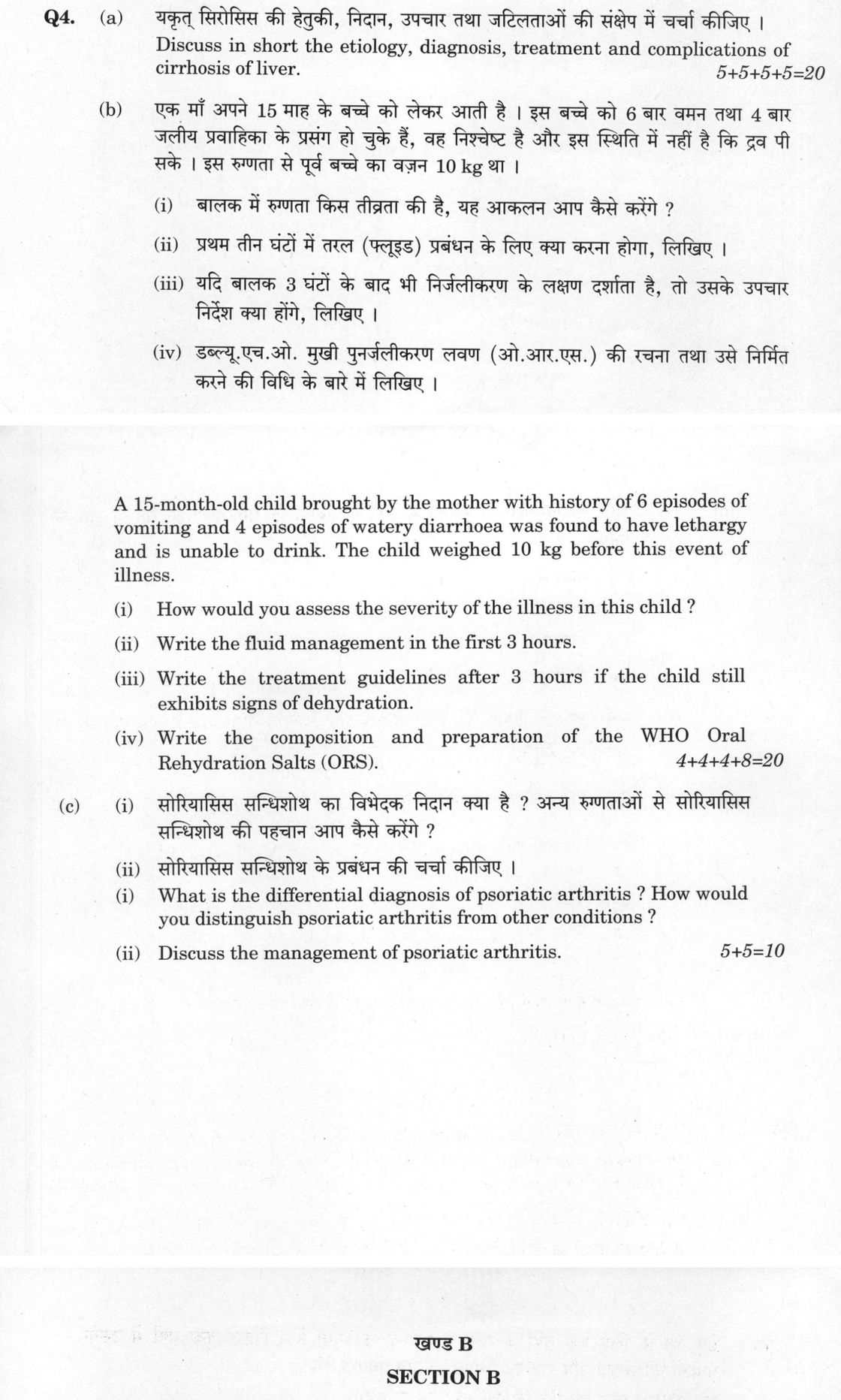
Discuss in short the etiology, diagnosis, treatment and complications of cirrhosis of liver. (5+5+5+5=20 marks)
A 15-month-old child brought by the mother with history of 6 episodes of vomiting and 4 episodes of watery diarrhoea was found to have lethargy and is unable to drink. The child weighed 10 kg before this event of illness. How would you assess the severity of the illness in this child ?
Write the fluid management in the first 3 hours.
Write the treatment guidelines after 3 hours if the child still exhibits signs of dehydration.
Write the composition and preparation of the WHO Oral Rehydration Salts (ORS). (4+4+4+8=20 marks)
What is the differential diagnosis of psoriatic arthritis ? How would you distinguish psoriatic arthritis from other conditions ?
Discuss the management of psoriatic arthritis. (5+5=10 marks)
हिंदी में प्रश्न पढ़ें
यकृत सिरोसिस की हेतुकी, निदान, उपचार तथा जटिलताओं की संक्षेप में चर्चा कीजिए । 5+5+5+5=20
एक माँ अपने 15 माह के बच्चे को लेकर आती है । इस बच्चे को 6 बार वमन तथा 4 बार जलीय प्रवाहिका के प्रसंग हो चुके हैं, वह निर्जलित है और इस स्थिति में नहीं है कि द्रव पी सके । इस क्षणता से पूर्व बच्चे का वजन 10 kg था । बालक में क्षणता किस तीव्रता की है, यह आकलन आप कैसे करेंगे ?
प्रथम तीन घंटों में तरल (फ्लूड) प्रबंधन के लिए क्या करना होगा, लिखिए ।
यदि बालक 3 घंटों के बाद भी निर्जलीकरण के लक्षण दर्शाता है, तो उसके उपचार निर्देश क्या होंगे, लिखिए ।
डब्ल्यू.एच.ओ. मुखी पुनर्जलीकरण लवण (ओ.आर.एस.) की रचना तथा उसे निर्मित करने की विधि के बारे में लिखिए । 4+4+4+8=20
सोरियासिस सन्धिशोथ का विभेदक निदान क्या है ? अन्य रुग्णताओं से सोरियासिस सन्धिशोथ की पहचान आप कैसे करेंगे ?
सोरियासिस सन्धिशोथ के प्रबन्धन की चर्चा कीजिए । 5+5=10
Model answer
Written by UPSC Answer Check against this question's marking rubric, to the expected length. UPSC does not publish answers for Mains — this is one way to score well, not an official key.
Part (a) Cirrhosis of Liver
Etiology: Cirrhosis results from chronic hepatic injury leading to diffuse fibrosis and regenerative nodules. Key etiologies include chronic alcohol abuse, chronic viral hepatitis (Hepatitis B and C), non-alcoholic fatty liver disease (NAFLD/NASH), autoimmune hepatitis, biliary diseases (primary biliary cholangitis, primary sclerosing cholangitis), and metabolic disorders (Wilson's disease, hemochromatosis, alpha-1 antitrypsin deficiency).
Diagnosis: Diagnosis is established through a composite of clinical stigmata (spider angiomas, palmar erythema, jaundice), laboratory findings (thrombocytopenia, elevated PT/INR, hypoalbuminemia, transaminitis), and non-invasive imaging (ultrasound showing nodular liver and portal hypertension; transient elastography/FibroScan). Prognosis is quantified using the Child-Pugh and MELD/MELD-Na scoring systems. Liver biopsy remains the diagnostic gold standard when etiology is uncertain.
Complications: Cirrhosis precipitates portal hypertension leading to esophageal and gastric variceal bleeding, ascites, and splenomegaly. Other major life-threatening sequelae include spontaneous bacterial peritonitis (SBP), hepatic encephalopathy, hepatorenal syndrome (HRS), hepatopulmonary syndrome, and progression to hepatocellular carcinoma (HCC).
Treatment: Management relies on treating the underlying cause (alcohol abstinence, direct-acting antivirals for HCV, nucleoside analogs for HBV, weight loss), lifestyle modifications, and managing complications. Pharmacotherapy includes non-selective beta-blockers (carvedilol, propranolol) or endoscopic band ligation for varices, diuretics (spironolactone and furosemide) for ascites, and lactulose plus rifaximin for encephalopathy. Regular six-monthly ultrasound screening for HCC is mandatory. Liver transplantation offers definitive cure for decompensated end-stage disease.
Part (b) Pediatric Acute Gastroenteritis with Severe Dehydration
(i) Assessment of Severity: According to WHO/IMCI guidelines, the child has Severe Dehydration (Plan C) based on the presence of lethargy and inability to drink, accompanied by sunken eyes and skin pinch retracting very slowly (>2 seconds). This represents a volume deficit exceeding 10% of total body weight (>100 ml/kg, or a weight deficit >1 kg from baseline 10 kg).
(ii) Fluid Management in the First 3 Hours: Initiate immediate intravenous resuscitation using Ringer’s Lactate (or Normal Saline) at 100 ml/kg (1000 ml total for 10 kg) over 3 hours:
- Give 30 ml/kg (300 ml) rapidly over the first 30 minutes.
- Give the remaining 70 ml/kg (700 ml) over the subsequent 2.5 hours. Monitor heart rate, pulse volume, capillary refill, and respiratory rate every 15–30 minutes to ensure hemodynamic recovery and avoid fluid overload.
(iii) Treatment Guidelines Post-3 Hours: Reassess clinical status completely. If signs of severe dehydration persist, repeat the IV fluid regimen. If dehydration is reduced to "Some Dehydration", switch to WHO Plan B (ORS 75 ml/kg over 4 hours). If rehydrated, transition to Plan A. Administer elemental Zinc (20 mg/day orally for 14 days) to promote intestinal epithelial regeneration, resume age-appropriate feeding immediately once awake, and monitor for hypoglycemia, hyper/hyponatremia, and hypokalemia.
(iv) WHO Oral Rehydration Salts (ORS): The WHO reduced-osmolarity formulation (total osmolarity 245 mOsm/L) contains:
- Sodium chloride: 2.6 g/L (Na+: 75 mmol/L, Cl-: 65 mmol/L)
- Glucose, anhydrous: 13.5 g/L (Glucose: 75 mmol/L)
- Potassium chloride: 1.5 g/L (K+: 20 mmol/L)
- Trisodium citrate, dihydrate: 2.9 g/L (Citrate: 10 mmol/L) Preparation: Dissolve the entire contents of one packet in precisely 1 litre of clean drinking water. Stir thoroughly until fully dissolved. Do not add sugar, milk, or boil after mixing; discard unused solution after 24 hours.
Part (c) Psoriatic Arthritis (PsA)
(i) Differential Diagnosis and Distinguishing Features:
- Rheumatoid Arthritis (RA): RA presents with symmetrical, small-joint polyarthritis sparing DIPs, with positive RF and anti-CCP. PsA characteristically involves distal interphalangeal (DIP) joints, exhibits asymmetric oligoarthritis, and is seronegative (RF/anti-CCP negative).
- Ankylosing Spondylitis (AS): AS shows symmetric sacroiliitis with predominant axial involvement; PsA exhibits asymmetric sacroiliitis, prominent peripheral enthesitis, and cutaneous psoriasis.
- Gout: Gout presents as acute monoarthritis with hyperuricemia and birefringent urate crystals; PsA presents with persistent joint inflammation and characteristic "pencil-in-cup" deformities on X-ray.
- Reactive Arthritis: Preceded by genitourinary/enteric infection; PsA features chronic course, dactylitis ("sausage digits"), and psoriatic nail changes (pitting, onycholysis, oil-drop signs).
(ii) Management: Employs a multidisciplinary, treat-to-target strategy addressing both cutaneous and musculoskeletal domains:
- Mild/Peripheral Disease: NSAIDs for symptomatic relief; intra-articular corticosteroid injections for localized synovitis; conventional synthetic DMARDs (Methotrexate, Sulfasalazine, Leflunomide) for persistent peripheral arthritis.
- Moderate-to-Severe / Axial / Refractory Disease: Biologic DMARDs targeting TNF-α (Infliximab, Adalimumab, Etanercept), IL-17 (Secukinumab), or IL-12/23 (Ustekinumab), alongside targeted synthetic DMARDs (JAK inhibitors like Tofacitinib; PDE-4 inhibitor Apremilast). Physical therapy, skin management, and smoking cessation form critical adjuncts.
A systematic approach bridging emergency volume resuscitation, chronic organ-failure staging, and targeted immunomodulatory therapy provides the definitive pathway to optimize clinical outcomes across acute and chronic systemic conditions.
What "Discuss" is asking you to do
Lay the issue out from more than one side — how it arose, what is claimed for it, what is held against it, and where it now stands. UPSC attaches discuss to broad topics with several live dimensions, so coverage of the dimensions earns more than the strength of your opinion.
Structure that answers it
Set the issue up → the case as it is made → the case against → the dimension both sides leave out → where the balance now lies
Where marks are lost
Listing facts with no thread between them, or arguing one side throughout and calling it a discussion.
How this answer will be evaluated
Approach
Framework: Clinical Sequence (Definition > Aetiology > Features > Investigation > Management). (a) discuss: intro > 3-4 dimensions > example > balanced close | (b) explain: definition/context > points in order > small example > short close | (c) discuss: intro > 3-4 dimensions > example > balanced close Full marks: Precise clinical protocols, correct calculations, and clear differentiation of conditions.
Key points expected
- Cirrhosis: Etiology, Diagnosis, Treatment, Complications
- Dehydration: Severe classification, Ringer's Lactate 100ml/kg, ORS composition
- Psoriatic Arthritis: DDx (RA/OA), Dactylitis, Biologics
Evaluation rubric
Each sub-part is marked on its own, against the marks and word limit printed on the paper.
- (a) Structured overview of liver cirrhosis covering etiology, diagnosis, treatment, and complications. 20 marks
discuss— intro → 3-4 dimensions → example → balanced close
Must cover
- Etiology: Viral (B/C), Alcohol, NASH
- Diagnosis: Clinical, Lab (AST/ALT, INR), Imaging
- Treatment: Etiological, Diuretics, TIPS, Transplant
- Complications: Ascites, Varices, Encephalopathy
Loses marks
- Listing symptoms without pathophysiological mechanism
- Management without priority (e.g., transplant before diuretics)
Earns more
- Mention of MELD score for prognosis
- Specific mention of Child-Pugh classification
Extra mark
- Reference to NCD guidelines for liver disease
- (b) Clinical management of severe dehydration in a 10kg child using WHO protocols. 20 marks
explain— definition/context → points in order → small example → short close
Must cover
- Assessment: Lethargy + unable to drink = Severe
- Fluid: Ringer's Lactate 100ml/kg in 3 hours
- Post-3hr: Reassess and switch to Plan A/B
- ORS: 1L water, 20g salt, 200g sugar
Loses marks
- Using Dextrose instead of Ringer's Lactate
- Incorrect ORS composition (e.g., wrong salt ratio)
Earns more
- Calculation of specific volume (1000ml) for 10kg
- Mention of potassium replacement in ORS
Extra mark
- Reference to IMNCI guidelines for dehydration
- (c) Differential diagnosis of psoriatic arthritis and its management strategy. 10 marks
discuss— intro → 3-4 dimensions → example → balanced close
Must cover
- DDx: RA, Osteoarthritis, Reactive Arthritis
- Distinction: Nail pitting, dactylitis, asymmetric
- Management: NSAIDs, DMARDs (Methotrexate)
- Management: Biologics (TNF inhibitors) for refractory
Loses marks
- Confusing PsA with Rheumatoid Arthritis features
- Management without stepwise approach (e.g., biologics first)
Earns more
- Mention of CASPAR criteria for diagnosis
- Specific mention of JAK inhibitors
Extra mark
- Reference to EULAR recommendations for PsA
Practice this exact question
Write your answer and it is marked point by point against the model answer above — what you covered, what you missed, what you got wrong.
Evaluate my answer →More from Medical Science 2021 Paper II
- Q1 (a) Discuss in brief the role of ultrasound in the investigation of pain in right hypocho…
- Q2 (a) A sixty-year-old diabetic male presented to the emergency department with acute onset…
- Q3 (a) A 40-year-old male who was bedridden for the last two months following a fracture in…
- Q4 (a) Discuss in short the etiology, diagnosis, treatment and complications of cirrhosis of…
- Q5 (a) Briefly describe the clinical features, diagnostic workup and management of a patient…
- Q6 (a) (i) Write in brief the reasons for rising Caesarean Section rates globally and in Ind…
- Q7 (a) A 60-year-old male presents with progressively increasing jaundice for 2 months. He i…