Paper II — Q1
(a) Briefly describe the role of lifestyle interventions in prevention of coronary artery disease. 10 (b) Discuss the role of…
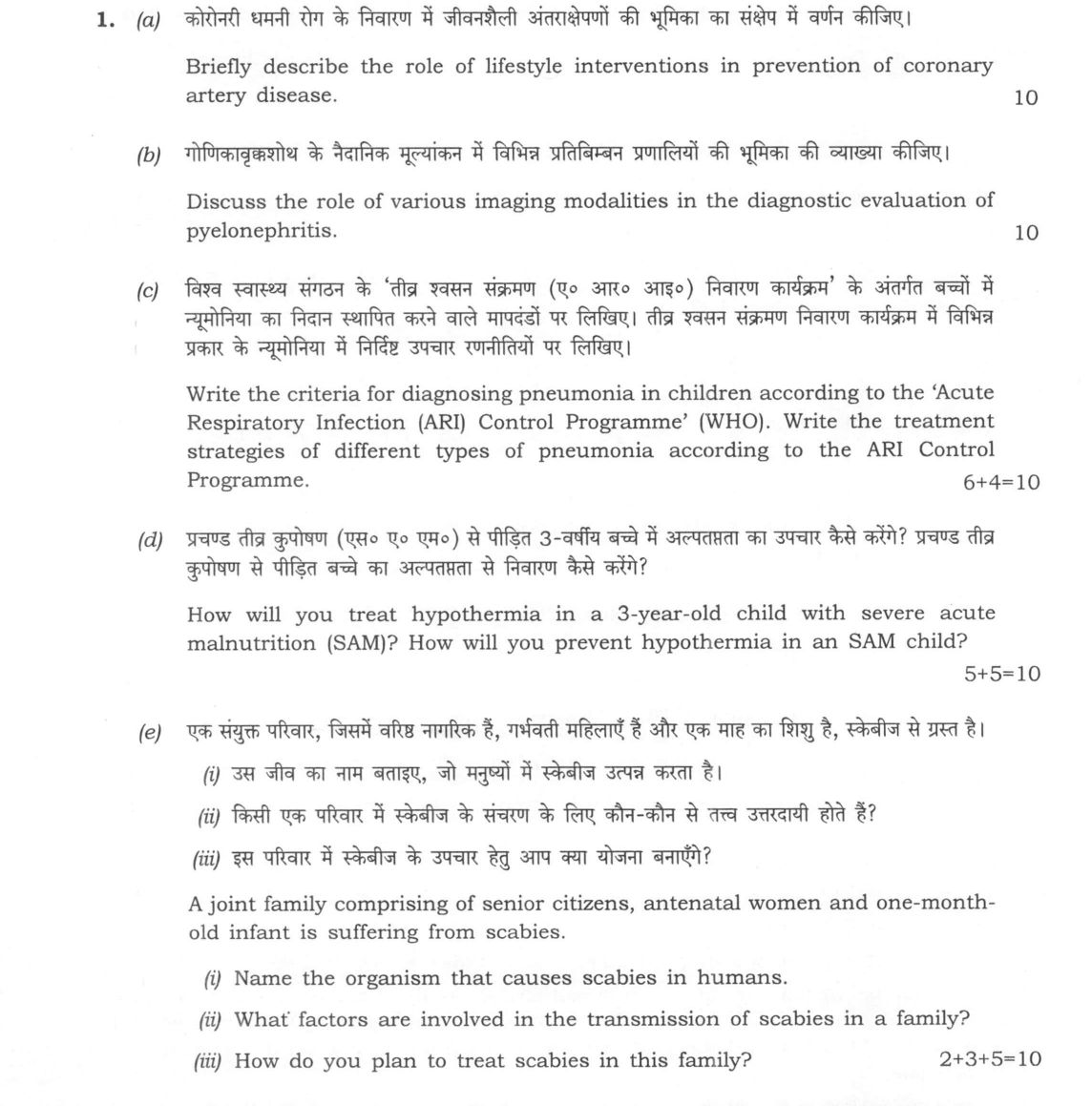
Briefly describe the role of lifestyle interventions in prevention of coronary artery disease. 10 marks
Discuss the role of various imaging modalities in the diagnostic evaluation of pyelonephritis. 10 marks
Write the criteria for diagnosing pneumonia in children according to the 'Acute Respiratory Infection (ARI) Control Programme' (WHO). Write the treatment strategies of different types of pneumonia according to the ARI Control Programme. 6+4=10
How will you treat hypothermia in a 3-year-old child with severe acute malnutrition (SAM)? How will you prevent hypothermia in an SAM child? 5+5=10
A joint family comprising of senior citizens, antenatal women and one-month-old infant is suffering from scabies. Name the organism that causes scabies in humans.
What factors are involved in the transmission of scabies in a family?
How do you plan to treat scabies in this family? 2+3+5=10
हिंदी में प्रश्न पढ़ें
कोरोनरी धमनी रोग के निवारण में जीवनशैली अंतरक्षेपणों की भूमिका का संक्षेप में वर्णन कीजिए। 10
गोणीकाकुक्षशोथ के नैदानिक मूल्यांकन में विभिन्न प्रतिबिंबन प्रणालियों की भूमिका की व्याख्या कीजिए। 10
विश्व स्वास्थ्य संगठन के 'तीव्र स्वसन संक्रमण (ए० आर० आइ०) निवारण कार्यक्रम' के अंतर्गत बच्चों में न्यूमोनिया का निदान स्थापित करने वाले मापदंडों पर लिखिए। तीव्र स्वसन संक्रमण निवारण कार्यक्रम में विभिन्न प्रकार के न्यूमोनिया में निर्दिष्ट उपचार रणनीतियों पर लिखिए। 6+4=10
प्रचंड तीव्र कुपोषण (एस० ए० एम०) से पीड़ित 3-वर्षीय बच्चे में अल्पतापता का उपचार कैसे करेंगे? प्रचंड तीव्र कुपोषण से पीड़ित बच्चे का अल्पतापता से निवारण कैसे करेंगे? 5+5=10
एक संयुक्त परिवार, जिसमें वरिष्ठ नागरिक हैं, गर्भवती महिलाएँ हैं और एक माह का शिशु है, स्केबीज से ग्रस्त है। उस जीव का नाम बताइए, जो मनुष्यों में स्केबीज उत्पन्न करता है।
किसी एक परिवार में स्केबीज के संचरण के लिए कौन-कौन से तत्व उत्तरदायी होते हैं?
इस परिवार में स्केबीज के उपचार हेतु आप क्या योजना बनाएँगे? 2+3+5=10
Model answer
Written by UPSC Answer Check against this question's marking rubric, to the expected length. UPSC does not publish answers for Mains — this is one way to score well, not an official key.
Lifestyle interventions in CAD prevention. Lifestyle modification is the first-line strategy in primary and secondary prevention of coronary artery disease because it modifies the major metabolic and inflammatory drivers of atherosclerosis. Smoking cessation is the single most important intervention, as tobacco use accelerates endothelial injury, thrombosis and plaque instability; counselling, nicotine replacement or pharmacotherapy should be offered. Diet should follow DASH or Mediterranean patterns, emphasising fruits, vegetables, whole grains, legumes, fish and unsaturated fats while limiting saturated fat, trans fat, salt and refined carbohydrates. Physical activity of at least 150 minutes per week of moderate-intensity exercise improves lipid profile, blood pressure, insulin sensitivity and weight. Weight management, aiming for BMI below 25 kg/m², reduces central adiposity and metabolic syndrome. Stress reduction through sleep, relaxation and psychosocial support lowers sympathetic and inflammatory burden. Finally, lifestyle measures must be combined with control of diabetes and hypertension, because sustained glycaemic and blood-pressure control prevents progression from subclinical atherosclerosis to clinical coronary events.
Imaging in pyelonephritis. Imaging is used to confirm diagnosis, detect complications and assess chronic scarring. Contrast-enhanced CT is the gold standard for acute pyelonephritis; it shows striated nephrogram, wedge-shaped hypodensities, perinephric fat stranding, abscess and obstruction, and is especially useful when diagnosis is uncertain or complications are suspected. Ultrasound is often the first-line investigation, particularly in children and pregnancy; it may show an enlarged kidney, altered echogenicity, perinephric fluid and, with power Doppler, perfusion defects. It is less sensitive than CT for early parenchymal changes but is safe and widely available. DMSA scan is the gold standard for detecting chronic renal scarring; it shows cortical defects and reduced uptake, and is useful after acute infection to identify children at risk of hypertension or renal impairment. IVU or CT urography is reserved for evaluating complications such as obstruction, vesicoureteral reflux, abscess or non-functioning segments, and for planning surgical or interventional management. Together, these modalities allow a stepwise approach from initial bedside assessment to definitive complication work-up.
WHO ARI pneumonia criteria and treatment. Under the WHO Acute Respiratory Infection Control Programme, children are assessed for cough or difficult breathing and classified by fast breathing, lower chest wall indrawing, stridor and general danger signs. Fast breathing is defined as respiratory rate more than 50/min in children 2–12 months and more than 40/min in children 1–5 years. Lower chest wall indrawing indicates severe pneumonia; it is diagnosed when cough or difficult breathing is accompanied by lower chest wall indrawing, and fast breathing is not required. Stridor in a calm child and danger signs such as inability to drink, convulsions, lethargy or unconsciousness indicate very severe disease and require urgent referral. A child with cough or difficult breathing but no fast breathing or chest indrawing has no pneumonia and receives home care. A child with fast breathing has pneumonia and should be treated with oral cotrimoxazole as the first-line ARI programme antibiotic, with home care and return precautions. Severe pneumonia requires hospitalization, oxygen if hypoxic, parenteral antibiotics and close monitoring. Very severe pneumonia requires urgent referral, oxygen, intravenous antibiotics and supportive care. This classification keeps management simple, scalable and focused on early recognition of children who need referral.
Hypothermia in SAM. In a 3-year-old child with severe acute malnutrition, hypothermia is a medical emergency because it worsens hypoglycaemia, infection and mortality. The child should be moved to a warming room maintained at 32–34°C, wet or cold clothing removed, and the body dried and covered, especially the head. Skin-to-skin contact or kangaroo mother care with the mother or caregiver is the most effective warming method and should be continued for at least several hours or until stable. The child must be fed immediately in small, frequent volumes if able to feed; if the child is lethargic, unable to feed, or hypoglycaemic, intravenous 10% glucose should be given because of aspiration risk and severity. Warm intravenous fluids may be given if needed for shock or dehydration, but overhydration must be avoided. Temperature, glucose, feeding tolerance and vital signs should be monitored continuously. Prevention in SAM children depends on maintaining a warm ambient environment, immediate and frequent feeding to prevent fasting hypoglycaemia, covering the head, avoiding unnecessary bathing, keeping the child dry and away from drafts, using appropriate clothing and blankets, and continuous temperature monitoring. These measures are especially important during the stabilization phase of SAM management.
Scabies in a joint family. The organism is Sarcoptes scabiei var. hominis. Transmission in a family occurs through prolonged close skin-to-skin contact, sharing of bedding, clothing and towels, and contact with asymptomatic carriers; crowding and close household living increase spread. Treatment must be simultaneous for all household members, including senior citizens, antenatal women and the one-month-old infant, even if some are asymptomatic. For the one-month-old infant, precipitated sulfur 5% ointment is preferred because topical permethrin 5% is not the approved first-line option for infants under 2 months; it should be applied to the whole body, including scalp, palms, soles and nails, and repeated after one week. For the antenatal woman, topical permethrin 5% is generally considered acceptable in pregnancy, or precipitated sulfur 5% can be used if preferred; oral ivermectin should be avoided in pregnancy. For senior citizens and other household members weighing 15 kg or more, permethrin 5% cream applied neck-down and washed off after 8–14 hours, repeated after one week, is appropriate; alternatively, oral ivermectin 200 mcg/kg can be given as a single dose and repeated after two weeks if needed, but it is contraindicated in children weighing less than 15 kg. Secondary bacterial infection should be treated with appropriate topical or oral antibiotics. Clothes, bedding and towels should be washed at 60°C or dry-cleaned, items that cannot be washed should be sealed for 72 hours, and the environment should be cleaned. Itching may persist for some weeks after successful treatment. Thus, effective management requires preventive lifestyle care, rational imaging, protocol-based ARI and SAM care, and household-wide scabies control.
What "Discuss" is asking you to do
Lay the issue out from more than one side — how it arose, what is claimed for it, what is held against it, and where it now stands. UPSC attaches discuss to broad topics with several live dimensions, so coverage of the dimensions earns more than the strength of your opinion.
Structure that answers it
Set the issue up → the case as it is made → the case against → the dimension both sides leave out → where the balance now lies
Where marks are lost
Listing facts with no thread between them, or arguing one side throughout and calling it a discussion.
How this answer will be evaluated
Approach
Framework: Clinical Sequence (Definition > Aetiology > Features > Investigation > Management). (a) describe: define > structure or process in order > labelled diagram > significance | (b) discuss: intro > 3-4 dimensions > example > balanced close | (c) describe: define > structure or process in order > labelled diagram > significance | (d) explain: definition/context > points in order > small example > short close | (e) describe: define > structure or process in order > labelled diagram > significance Full marks: Precise clinical criteria, specific drug names/doses, and clear management hierarchy.
Key points expected
- WHO ARI fast breathing rates by age
- DMSA scan for pyelonephritis scarring
- Sarcoptes scabiei as causative agent
- Simultaneous family treatment for scabies
- Immediate warming for SAM hypothermia
Evaluation rubric
Each sub-part is marked on its own, against the marks and word limit printed on the paper.
- (a) Systematic list of lifestyle changes for CAD prevention with mechanisms. 10 marks
describe— define → structure or process in order → labelled diagram → significance
Must cover
- Smoking cessation and avoidance of second-hand smoke
- Dietary modification (low saturated fat, high fiber)
- Regular physical activity (150 mins/week moderate intensity)
- Weight management and waist circumference control
Loses marks
- Listing drugs without lifestyle context
- Vague advice without specific targets
Earns more
- Blood pressure and lipid control targets
- Stress management and sleep hygiene
- Limitation of alcohol consumption
Extra mark
- Reference to WHO or ICMR guidelines
- Flow diagram of risk factor modification
- (b) Evaluation of imaging modalities for pyelonephritis diagnosis and complications. 10 marks
discuss— intro → 3-4 dimensions → example → balanced close
Must cover
- Role of Ultrasound (USG) in initial screening
- Role of DMSA scan for scarring and acute inflammation
- Role of VCUG for vesicoureteral reflux (VUR)
- Role of CT/MRI in complicated cases or abscess
Loses marks
- Listing modalities without clinical indication
- Ignoring the role of VCUG in children
Earns more
- Indications for each modality (e.g., DMSA at 4-6 months)
- Limitations of each modality (e.g., radiation in CT)
- Differentiation between acute and chronic pyelonephritis
Extra mark
- Mention of MAG-3 scan for renal function
- Reference to AAP or EAU guidelines
- (c) WHO ARI criteria for pneumonia and specific treatment strategies. 10 marks
describe— define → structure or process in order → labelled diagram → significance
Must cover
- Criteria: Fast breathing (age-specific rates)
- Criteria: Chest in-drawing (severe sign)
- Treatment: Oral Amoxicillin for pneumonia
- Treatment: IV antibiotics for severe pneumonia
Loses marks
- Using general pneumonia criteria instead of WHO ARI
- Omitting age-specific respiratory rates
Earns more
- Age-specific fast breathing rates (e.g., <2m: 60, 2-12m: 50, 1-5y: 40)
- Referral criteria for severe cases
- Supportive care (fluids, oxygen, nutrition)
Extra mark
- Mention of IM Ceftriaxone for severe cases
- Reference to IMNCI guidelines
- (d) Management and prevention of hypothermia in SAM children. 10 marks
explain— definition/context → points in order → small example → short close
Must cover
- Immediate warming (skin-to-skin, blankets)
- Warm fluids (ORS, RUTF) to raise core temperature
- Prevention: Avoid cold exposure, maintain warmth
- Prevention: Adequate nutrition and breastfeeding
Loses marks
- Treating hypothermia without addressing underlying SAM
- Vague advice on 'keeping warm' without specifics
Earns more
- Specific temperature targets (e.g., >36.5°C)
- Use of Kangaroo Mother Care (KMC) principles
- Monitoring temperature regularly
Extra mark
- Reference to WHO SAM management guidelines
- Mention of 'Thermoneutral zone' concept
- (e) Scabies etiology, transmission factors, and family treatment plan. 10 marks
describe— define → structure or process in order → labelled diagram → significance
Must cover
- Organism: Sarcoptes scabiei var. hominis
- Transmission: Prolonged skin-to-skin contact
- Treatment: Permethrin 5% cream for all family members
- Treatment: Simultaneous treatment of all household contacts
Loses marks
- Treating only symptomatic individuals
- Ignoring environmental decontamination
Earns more
- Environmental measures (washing clothes, bedding)
- Specific considerations for infants and pregnant women
- Re-treatment schedule if symptoms persist
Extra mark
- Mention of Ivermectin as an alternative
- Reference to National Scabies Control Programme
Practice this exact question
Write your answer and it is marked point by point against the model answer above — what you covered, what you missed, what you got wrong.
Evaluate my answer →More from Medical Science 2025 Paper II
- Q1 (a) Briefly describe the role of lifestyle interventions in prevention of coronary artery…
- Q2 (a) A 23-year-old woman with type I diabetes mellitus presents with nausea, vomiting and…
- Q3 (a) (i) Elaborate the indications for initiating antiviral therapy in a patient with chro…
- Q4 (a) (i) How do you differentiate between acute lymphoblastic leukaemia (ALL) and acute my…