Paper II — Q7
(a) (i) Describe the clinical features and diagnostic workup of a suspected case of peritonitis. (ii) Enumerate the principles of…
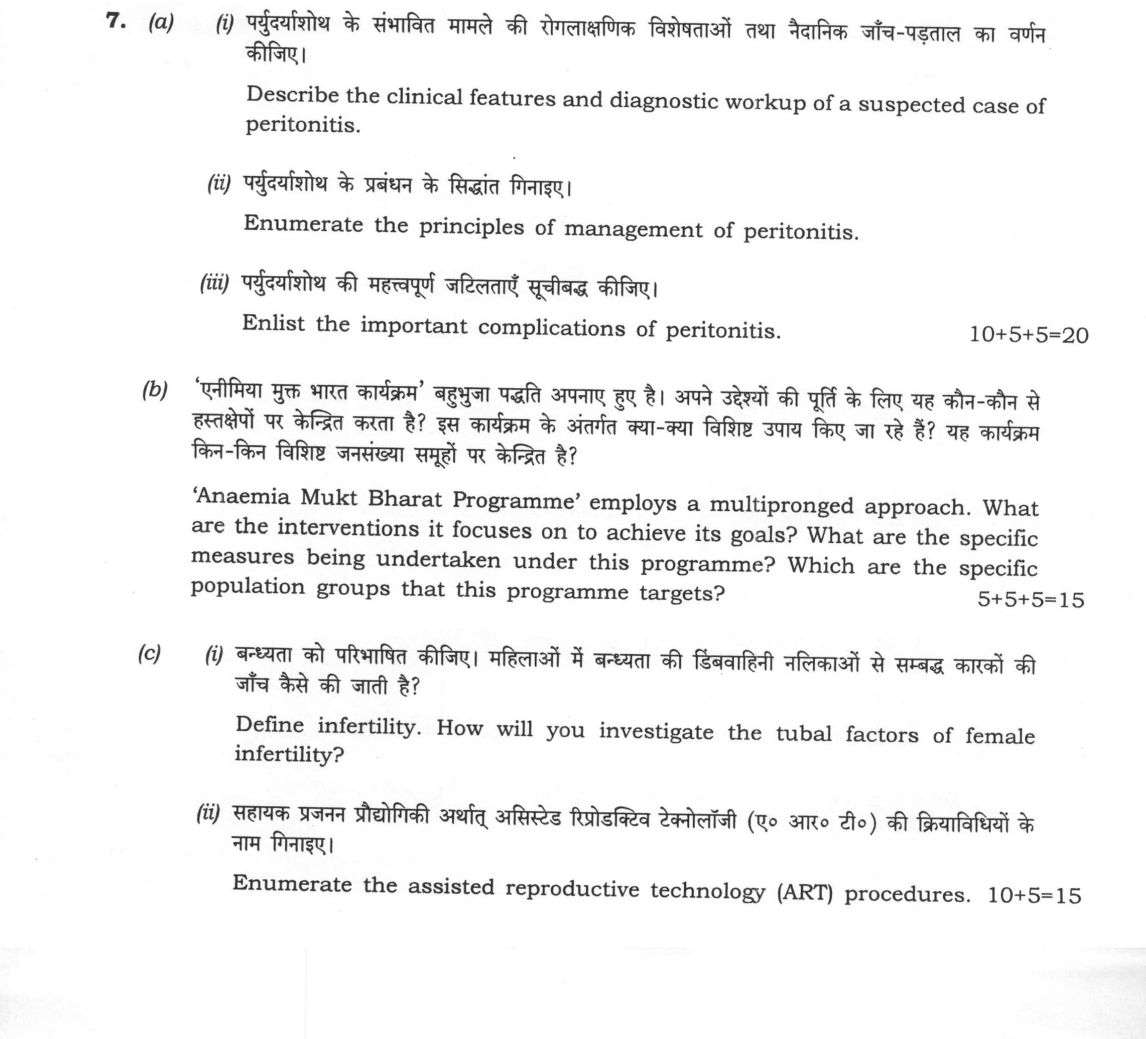
Describe the clinical features and diagnostic workup of a suspected case of peritonitis.
Enumerate the principles of management of peritonitis.
Enlist the important complications of peritonitis. 10+5+5=20
'Anaemia Mukt Bharat Programme' employs a multipronged approach. What are the interventions it focuses on to achieve its goals? What are the specific measures being undertaken under this programme? Which are the specific population groups that this programme targets? 5+5+5=15
Define infertility. How will you investigate the tubal factors of female infertility?
Enumerate the assisted reproductive technology (ART) procedures. 10+5=15
हिंदी में प्रश्न पढ़ें
पेरिटोनाइटिस के संभावित मामले की रोगलाक्षणिक विशेषताओं तथा नैदानिक जाँच-पड़ताल का वर्णन कीजिए।
पेरिटोनाइटिस के प्रबंधन के सिद्धांत गिनाइए।
पेरिटोनाइटिस की महत्वपूर्ण जटिलताएँ सूचीबद्ध कीजिए। 10+5+5=20
'एनीमिया मुक्त भारत कार्यक्रम' बहुआयामी पद्धति अपनाए हुए है। अपने उद्देश्यों की पूर्ति के लिए यह कौन-कौन से हस्तक्षेपों पर केंद्रित करता है? इस कार्यक्रम के अंतर्गत क्या-क्या विशिष्ट उपाय किए जा रहे हैं? यह कार्यक्रम किन-किन विशिष्ट जनसंख्या समूहों पर केंद्रित है? 5+5+5=15
बंध्यता को परिभाषित कीजिए। महिलाओं में बंध्यता की डिंबवाहिनी नलिकाओं से संबंध कारकों की जाँच कैसे की जाती है?
सहायक प्रजनन प्रौद्योगिकी अर्थात् असिस्टेड रिप्रोडक्टिव टेक्नोलॉजी (ए० आर० टी०) की क्रियाविधियों के नाम गिनाइए। 10+5=15
Model answer
Written by UPSC Answer Check against this question's marking rubric, to the expected length. UPSC does not publish answers for Mains — this is one way to score well, not an official key.
(a) Peritonitis
Clinical Features and Diagnostic Workup Peritonitis, an inflammation of the peritoneal cavity, manifests clinically with severe, localized or generalized abdominal pain exacerbated by movement. On physical examination, classical signs of an acute abdomen include localized or generalized muscular guarding, board-like rigidity, marked rebound tenderness (Blumberg sign), and a silent abdomen due to paralytic ileus. Systemic features include high-grade fever with chills, tachycardia, tachypnea, hypotension, oliguria, and toxic facies (facies Hippocratica).
Diagnostic workup proceeds systematically:
- Laboratory Investigations: Complete blood count reveals marked polymorphonuclear leukocytosis; serum electrolytes, blood urea, and creatinine assess renal function and dehydration; serum amylase and lipase rule out acute pancreatitis; arterial blood gas (ABG) evaluates metabolic acidosis and tissue perfusion.
- Diagnostic Paracentesis: Ascitic fluid analysis reveals an absolute neutrophil count >250 cells/mm³ (diagnostic of spontaneous bacterial peritonitis), elevated protein, elevated LDH, positive Gram stain, and bacterial culture. High fluid amylase or bilirubin indicates hollow viscus or biliary perforation.
- Imaging Modalities: An erect chest X-ray demonstrates free air under the right dome of the diaphragm (pneumoperitoneum) in gastrointestinal perforation. Ultrasonography (USG) identifies free fluid, collections, and pelvic pathology. Contrast-enhanced computed tomography (CECT) of the abdomen is the definitive modality to localize the exact site of perforation, mesenteric ischemia, or intra-abdominal abscesses.
Principles of Management
- Emergency Resuscitation: Nil per os (NPO), placement of a wide-bore nasogastric tube for bowel decompression, and urinary catheterization to monitor hourly urine output.
- Hemodynamic and Sepsis Management: Rapid restoration of intravascular volume using balanced crystalloids guided by the Surviving Sepsis Campaign bundle.
- Antimicrobial Therapy: Immediate administration of empirical, broad-spectrum intravenous antibiotics covering aerobic Gram-negative bacilli, Gram-positive cocci, and anaerobes (e.g., third-generation cephalosporin or piperacillin-tazobactam plus metronidazole).
- Surgical Source Control: Emergency laparotomy or laparoscopy to identify and correct the underlying pathology (perforation repair, appendectomy, or bowel resection), thorough peritoneal lavage with warm normal saline, and placement of dependent drains.
- Postoperative Care: Nutritional support (early enteral where feasible, or parenteral), analgesia, deep vein thrombosis prophylaxis, and intensive organ support in cases of septic shock.
Important Complications
- Septic shock and Multi-Organ Dysfunction Syndrome (MODS).
- Localized intra-abdominal, subphrenic, or pelvic abscesses.
- Enterocutaneous and anastomotic fistulae.
- Early or late adhesive intestinal obstruction.
- Wound dehiscence, burst abdomen, and death.
---
(b) Anaemia Mukt Bharat (AMB) Programme
The Anaemia Mukt Bharat strategy follows a comprehensive 6x6x6 framework to accelerate the reduction of anemia prevalence across India.
Interventions and Specific Measures
- Prophylactic Iron-Folic Acid (IFA) Supplementation: Age-specific dispensing of IFA syrup/tablets (bi-weekly IFA syrup for infants; weekly pink tablets for children; weekly blue tablets for adolescents; daily red IFA tablets during pregnancy and lactation).
- Periodic Deworming: Biannual administration of Albendazole (400 mg) linked to National Deworming Day (NDD) platforms.
- Intensified Behaviour-Change Communication (BCC): Promotion of infant and young child feeding (IYCF) practices, delayed cord clamping for at least 3 minutes, and dietary diversity focusing on iron and Vitamin C-rich foods.
- Testing and Digital Point-of-Care Treatment: Deployment of digital invasive hemoglobinometers at Ayushman Arogya Mandirs for real-time testing and stratified clinical management (mild/moderate/severe).
- Mandatory Food Fortification: Inclusion of double-fortified salt (iron and iodine) and fortified rice in public schemes such as ICDS and PM-POSHAN.
- Targeting Non-Nutritional Causes: Diagnosis and management of endemic causes like malaria, fluorosis, and hemoglobinopathies (sickle cell disease, thalassemia).
Target Population Groups
- Children aged 6–59 months.
- Children aged 5–9 years.
- Adolescents aged 10–19 years (school-going and out-of-school).
- Non-pregnant, non-lactating women of reproductive age (15–49 years).
- Pregnant women.
- Lactating mothers (0–6 months postpartum).
---
(c) Infertility and Assisted Reproductive Technology
Definition and Tubal Factor Investigation Infertility is defined as a disease of the reproductive system characterized by the failure to achieve a clinical pregnancy after 12 months or more of regular, unprotected sexual intercourse in women under 35 years of age (or after 6 months in women aged 35 years and older).
Tubal pathology accounts for approximately 25–35% of female infertility. Its investigation involves:
- Hysterosalpingography (HSG): A fluoroscopic procedure performed during the early follicular phase (days 7–10) using radiopaque contrast. It evaluates tubal patency, detects cornual or distal tubal blockages, and identifies hydrosalpinx or tubal mucosal architecture.
- Hysterosalpingo-Contrast Sonography (HyCoSy) / Saline Infusion Sonography (SIS): Transvaginal ultrasound with intrauterine saline or echogenic contrast injection, avoiding radiation and assessing both uterine cavity and tubal spillage.
- Laparoscopic Chromopertubation: The gold standard diagnostic and therapeutic investigation. Under general anesthesia, dilute methylene blue dye is injected transcervically, and its free spill from the fimbrial ends is directly visualized. It simultaneously diagnoses and allows treatment of peritubal adhesions, endometriosis, and pelvic pathology.
- Hysteroscopy: Often combined with laparoscopy to evaluate the tubal ostia and correct proximal tubal occlusion via selective tubal cannulation.
Enumeration of Assisted Reproductive Technology (ART) Procedures
- Intrauterine Insemination (IUI): Controlled ovarian stimulation followed by placement of processed, washed motile spermatozoa directly into the uterine cavity.
- In Vitro Fertilization and Embryo Transfer (IVF-ET): Oocyte retrieval followed by extracorporeal fertilization in culture dishes and transfer of resultant embryos into the uterus.
- Intracytoplasmic Sperm Injection (ICSI): Direct micromanipulation involving the mechanical injection of a single spermatozoon into the cytoplasm of a mature metaphase-II oocyte.
- Gamete Intrafallopian Transfer (GIFT) and Zygote Intrafallopian Transfer (ZIFT): Laparoscopic transfer of unfertilized gametes or early zygotes directly into the fallopian tubes.
- Surgical Sperm Retrieval: Techniques for azoospermic males, including Percutaneous Epididymal Sperm Aspiration (PESA), Testicular Sperm Aspiration (TESA), and Microdissection Testicular Sperm Extraction (Micro-TESE).
- Cryopreservation and Vitrification: Ultra-rapid freezing of gametes (oocytes, sperm) and embryos for future transfer cycles.
- Pre-implantation Genetic Testing (PGT): Genetic profiling of blastocyst biopsies via PGT-A (aneuploidy) and PGT-M (monogenic disorders) prior to embryo transfer.
What "Describe" is asking you to do
Give a full, ordered account of the thing named — its parts, stages or mechanism — in the sequence in which it actually exists or occurs. Most describe questions come from the science optionals, where the marks sit in correct technical detail and, where the stem says so, a labelled diagram.
Structure that answers it
One-line identification of the subject → the parts or stages in their real order, each with its defining detail → labelled diagram where the subject is structural → closing line on function or significance
Where marks are lost
Loose general prose where the examiner is ticking named parts, correct terminology and their sequence; and in the General Studies papers, turning to evaluation before the description is finished.
How this answer will be evaluated
Approach
Framework: Clinical Sequence (Definition > Aetiology > Features > Investigation > Management). (a(i)) describe: define > structure or process in order > labelled diagram > significance | (a(ii)) enumerate: list the items in order > one line each > no commentary | (a(iii)) enumerate: list the items in order > one line each > no commentary | (b) explain: definition/context > points in order > small example > short close | (c(i)) define: precise definition > the distinguishing feature > one example | (c(ii)) enumerate: list the items in order > one line each > no commentary Full marks: Precise clinical sequence, specific named procedures (HSG, ICSI), and accurate program details (AMBT targets).
Key points expected
- Signs of peritoneal irritation (rigidity, guarding)
- Systemic signs (fever, tachycardia, shock)
- Diagnostic workup (CBC, fluid analysis, imaging)
- Differentiation of primary vs secondary causes
- Resuscitation (fluids, electrolytes)
- Antibiotic therapy (broad spectrum)
- Surgical intervention (source control)
- Sepsis / Septic shock
Evaluation rubric
Each sub-part is marked on its own, against the marks and word limit printed on the paper.
- (a(i)) Clinical features and diagnostic workup of peritonitis. 10 marks
describe— define → structure or process in order → labelled diagram → significance
Must cover
- Signs of peritoneal irritation (rigidity, guarding)
- Systemic signs (fever, tachycardia, shock)
- Diagnostic workup (CBC, fluid analysis, imaging)
- Differentiation of primary vs secondary causes
Loses marks
- Listing symptoms without pathophysiological mechanism
- Omitting diagnostic fluid analysis
Earns more
- Mention of specific fluid markers (SAAG, amylase)
- CT scan findings (free air/fluid)
Extra mark
- Reference to specific diagnostic criteria (e.g., Tokyo Guidelines)
- (a(ii)) Principles of management of peritonitis. 5 marks
enumerate— list the items in order → one line each → no commentary
Must cover
- Resuscitation (fluids, electrolytes)
- Antibiotic therapy (broad spectrum)
- Surgical intervention (source control)
Loses marks
- Management without priority (e.g., surgery before resuscitation)
- Vague statements without specific actions
Earns more
- Nutritional support
- ICU monitoring
Extra mark
- Specific antibiotic regimen names
- (a(iii)) Important complications of peritonitis. 5 marks
enumerate— list the items in order → one line each → no commentary
Must cover
- Sepsis / Septic shock
- Intra-abdominal abscess
- Multi-organ dysfunction syndrome (MODS)
Loses marks
- Listing unrelated complications
- Missing sepsis as a primary complication
Earns more
- Adhesions / Bowel obstruction
- Wound infection
Extra mark
- Specific mention of ARDS
- (b) Interventions, specific measures, and target groups of Anaemia Mukt Bharat. 15 marks
explain— definition/context → points in order → small example → short close
Must cover
- Interventions: Prevention, Diagnosis, Treatment, Surveillance
- Measures: Iron-folic acid (IFA) supplementation
- Measures: Fortification of food (salt, wheat)
- Target groups: Women (adolescent/pregnant/lactating), children
Loses marks
- Confusing with other health programs (e.g., POSHAN)
- Failing to distinguish between interventions and measures
Earns more
- Mention of 'Anemia Mukt Bharat' launch year (2018)
- Specific target: 50% reduction in prevalence
Extra mark
- Mention of specific fortification levels (e.g., 30mg iron in salt)
- (c(i)) Definition of infertility and investigation of tubal factors. 10 marks
define— precise definition → the distinguishing feature → one example
Must cover
- Definition: Inability to conceive after 12 months (or 6 if >35)
- Investigation: HSG (Hysterosalpingography)
- Investigation: Laparoscopy (Gold standard)
- Investigation: SSG (Sonosalpingography)
Loses marks
- Defining infertility as 'inability to have children' (too broad)
- Omitting HSG from tubal investigation
Earns more
- Mention of tubal patency tests (chromopertubation)
- Role of MRI in tubal assessment
Extra mark
- Specific mention of 'Gold Standard' for laparoscopy
- (c(ii)) Assisted reproductive technology (ART) procedures. 5 marks
enumerate— list the items in order → one line each → no commentary
Must cover
- IVF (In Vitro Fertilization)
- ICSI (Intracytoplasmic Sperm Injection)
- IUI (Intrauterine Insemination)
Loses marks
- Listing non-ART procedures (e.g., simple laparoscopy)
- Confusing IUI with IVF
Earns more
- ZIFT (Zygote Intrafallopian Transfer)
- GIFT (Gamete Intrafallopian Transfer)
Extra mark
- Mention of 'Fertility Preservation' techniques
Practice this exact question
Write your answer and it is marked point by point against the model answer above — what you covered, what you missed, what you got wrong.
Evaluate my answer →More from Medical Science 2025 Paper II
- Q4 (a) (i) How do you differentiate between acute lymphoblastic leukaemia (ALL) and acute my…
- Q5 (a) (i) Enumerate the advantages as well as the limitations of laparoscopic surgery. (ii)…
- Q6 (a) (i) Classify hypertensive disorders in pregnancy. (ii) Enumerate the types and compli…
- Q7 (a) (i) Describe the clinical features and diagnostic workup of a suspected case of perit…
- Q8 (a) Under the National Framework for Malaria Elimination in India, what are the targets s…