Paper II — Q6
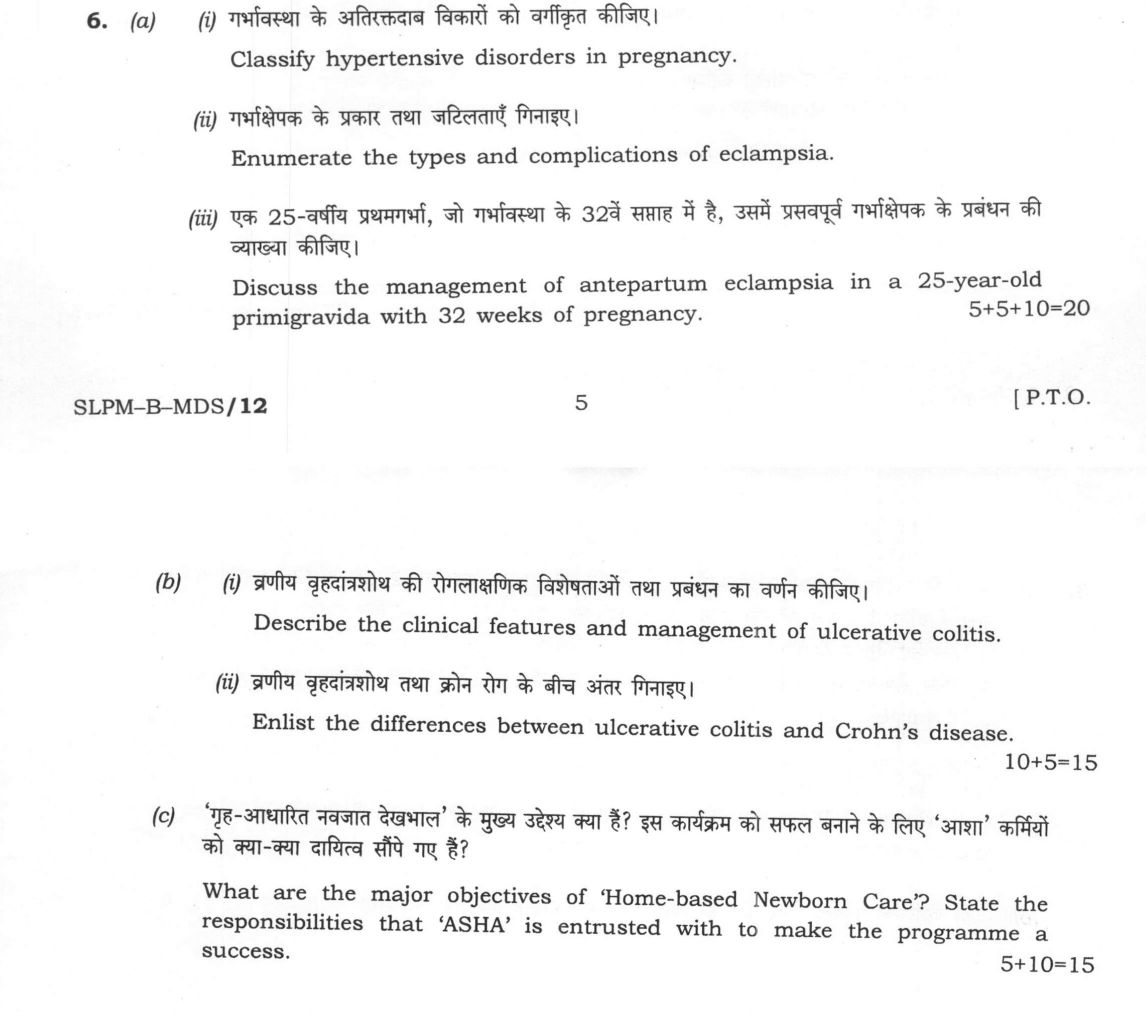
(a) (i) Classify hypertensive disorders in pregnancy. (ii) Enumerate the types and complications of eclampsia. (iii) Discuss the…
Classify hypertensive disorders in pregnancy.
Enumerate the types and complications of eclampsia.
Discuss the management of antepartum eclampsia in a 25-year-old primigravida with 32 weeks of pregnancy. 5+5+10=20
Describe the clinical features and management of ulcerative colitis.
Enlist the differences between ulcerative colitis and Crohn's disease. 10+5=15
What are the major objectives of 'Home-based Newborn Care'? State the responsibilities that 'ASHA' is entrusted with to make the programme a success. 5+10=15
हिंदी में प्रश्न पढ़ें
गर्भावस्था के अतिरक्तदाब विकारों को वर्गीकृत कीजिए।
गर्भक्षेपक के प्रकार तथा जटिलताएँ गिनाइए।
एक 25-वर्षीय प्रथमगर्भा, जो गर्भावस्था के 32वें सप्ताह में है, उसमें प्रसवपूर्व गर्भक्षेपक के प्रबंधन की व्याख्या कीजिए। 5+5+10=20
व्रणीय वृहदांत्रशोथ की रोगलाक्षणिक विशेषताओं तथा प्रबंधन का वर्णन कीजिए।
व्रणीय वृहदांत्रशोथ तथा क्रोन रोग के बीच अंतर गिनाइए। 10+5=15
'गृह-आधारित नवजात देखभाल' के मुख्य उद्देश्य क्या हैं? इस कार्यक्रम को सफल बनाने के लिए 'आशा' कर्मियों को क्या-क्या दायित्व सौंपे गए हैं? 5+10=15
Model answer
Written by UPSC Answer Check against this question's marking rubric, to the expected length. UPSC does not publish answers for Mains — this is one way to score well, not an official key.
Hypertensive disorders in pregnancy are classified per ISSHP/ACOG by timing, proteinuria and end-organ injury. Chronic hypertension is BP ≥140/90 mmHg before pregnancy or before 20 weeks, or new hypertension after 20 weeks that persists beyond 12 weeks postpartum. Gestational hypertension is new BP ≥140/90 after 20 weeks without proteinuria or other preeclampsia features, resolving by 12 weeks postpartum. Preeclampsia is new hypertension after 20 weeks with proteinuria (≥300 mg/24 h or protein/creatinine ratio ≥0.3) or end-organ dysfunction; severe features include BP ≥160/110, renal/hepatic impairment, cerebral/visual symptoms, pulmonary edema, HELLP. Eclampsia is preeclampsia with generalized tonic-clonic seizures. Superimposed preeclampsia occurs when chronic hypertension develops new proteinuria/end-organ disease after 20 weeks or sudden worsening.
Eclampsia is classified as antepartum, intrapartum and postpartum; postpartum may be immediate (within 48 h) or late. Maternal complications include cerebral haemorrhage/infarction, cerebral oedema, DIC, acute renal failure, hepatic rupture/HELLP, pulmonary oedema, ARDS and death. Fetal complications include IUGR, placental abruption, preterm birth, stillbirth and neonatal death.
In a 25-year-old primigravida with antepartum eclampsia at 32 weeks, management is in a tertiary unit using ABCDE: left lateral position, airway, oxygen, suction, seizure control. MgSO4 is first-line: Pritchard regimen 4 g IV over 15–20 min plus 10 g IM (5 g each buttock), then 5 g IM every 4 h; or Zuspan 4 g IV loading then 1–2 g/h infusion. Monitor reflexes, respiratory rate, urine output and Mg levels; toxicity suggests absent patellar reflex, RR <12, oliguria; keep calcium gluconate ready. MgSO4 is continued for at least 24 h after delivery or last seizure. Severe hypertension is treated with IV labetalol or hydralazine to prevent stroke, avoiding abrupt falls. Delivery is definitive; at 32 weeks, after stabilization, give antenatal corticosteroids if delivery can be safely delayed and there is no ongoing maternal/fetal compromise, then plan delivery by obstetric indications, vaginal if favourable, caesarean for obstetric reasons. If cervix unfavourable and mother stable, cervical ripening may be considered; fetal distress mandates emergency delivery. ICU monitoring, fetal surveillance, correction of coagulopathy and fluid restriction complete care.
Ulcerative colitis presents with bloody diarrhoea, urgency, tenesmus, abdominal pain, fever, weight loss and anaemia; extraintestinal features include uveitis, arthritis, erythema nodosum and primary sclerosing cholangitis. It involves the rectum and extends continuously proximally, is mucosal/submucosal, and shows crypt abscesses and pseudopolyps. Management is severity-based: hydration, exclude C. difficile, 5-ASA for mild-moderate disease, corticosteroids for acute flares, immunomodulators such as azathioprine and biologics for moderate-severe/refractory disease. Maintenance therapy aims to prevent relapse and preserve quality of life. Toxic megacolon or perforation requires emergency subtotal colectomy with end ileostomy; IPAA is an elective reconstructive option after recovery, not an emergency operation. Surgery is also indicated for dysplasia/cancer or medically refractory disease.
The differences from Crohn’s disease are: UC has continuous rectal involvement, mucosal inflammation, bloody diarrhoea, no granulomas, no fistulae and no rectal sparing; Crohn’s has skip lesions, transmural inflammation, non-caseating granulomas, strictures/fistulae/perianal disease, rectal sparing and small-bowel involvement.
Home-based Newborn Care aims to reduce neonatal and infant mortality, detect danger signs early, promote exclusive breastfeeding, ensure thermal care, cord care, immunization and timely referral. Under the National Health Mission, it strengthens the last-mile link between facility and family. ASHA is responsible for the seven scheduled visits—within 24 hours, and on days 3, 7, 14, 28, 42 and 90—assessing weight, temperature, feeding, cord and immunization status, tracking LBW and sick babies, counselling mothers, maintaining records, linking families with ANM and community health workers, and referring danger signs to the nearest facility. Thus, integrated maternal-neonatal care, from antenatal hypertension control to newborn home surveillance, is the way forward for reducing preventable deaths.
What "Discuss" is asking you to do
Lay the issue out from more than one side — how it arose, what is claimed for it, what is held against it, and where it now stands. UPSC attaches discuss to broad topics with several live dimensions, so coverage of the dimensions earns more than the strength of your opinion.
Structure that answers it
Set the issue up → the case as it is made → the case against → the dimension both sides leave out → where the balance now lies
Where marks are lost
Listing facts with no thread between them, or arguing one side throughout and calling it a discussion.
How this answer will be evaluated
Approach
Framework: Clinical sequence: Definition > Aetiology/Pathophysiology > Features > Investigation > Management (Immediate/Definitive/Follow-up). (a(i)) enumerate: list the items in order > one line each > no commentary | (a(ii)) enumerate: list the items in order > one line each > no commentary | (a(iii)) discuss: intro > 3-4 dimensions > example > balanced close | (b(i)) describe: define > structure or process in order > labelled diagram > significance | (b(ii)) compare: paired headings or table > key differences > significance > conclusion | (c) explain: definition/context > points in order > small example > short close Full marks: Precise clinical management with correct drug names and timing; clear distinction between UC and CD; specific ASHA visit schedule.
Key points expected
- Chronic hypertension
- Gestational hypertension
- Pre-eclampsia
- Eclampsia
- Antepartum eclampsia
- Intrapartum eclampsia
- Postpartum eclampsia
- Maternal complications (e.g., DIC, renal failure)
Evaluation rubric
Each sub-part is marked on its own, against the marks and word limit printed on the paper.
- (a(i)) Systematic classification of hypertensive disorders in pregnancy. 5 marks
enumerate— list the items in order → one line each → no commentary
Must cover
- Chronic hypertension
- Gestational hypertension
- Pre-eclampsia
- Eclampsia
Loses marks
- Mixing obstetric and medical causes
- Omitting eclampsia from the list
Earns more
- Superimposed pre-eclampsia
- HELLP syndrome
Extra mark
- Reference to ACOG or NICE guidelines
- (a(ii)) List of eclampsia types and associated complications. 5 marks
enumerate— list the items in order → one line each → no commentary
Must cover
- Antepartum eclampsia
- Intrapartum eclampsia
- Postpartum eclampsia
- Maternal complications (e.g., DIC, renal failure)
Loses marks
- Listing symptoms instead of types
- Vague complications without organ systems
Earns more
- Fetal complications (e.g., IUGR, distress)
Extra mark
- Mention of late postpartum eclampsia
- (a(iii)) Management plan for antepartum eclampsia at 32 weeks. 10 marks
discuss— intro → 3-4 dimensions → example → balanced close
Must cover
- Seizure control (MgSO4)
- BP control (Labetalol/Hydralazine)
- Timing of delivery (stabilization first)
- Corticosteroids for fetal lung maturity
Loses marks
- Immediate delivery without stabilization
- Omitting seizure prophylaxis
Earns more
- ICU monitoring
- Fluid balance management
Extra mark
- Specific MgSO4 dosing protocol
- (b(i)) Clinical features and management of ulcerative colitis. 10 marks
describe— define → structure or process in order → labelled diagram → significance
Must cover
- Bloody diarrhea
- Left-sided colitis distribution
- 5-ASA/Mesalamine therapy
- Corticosteroids for flare
Loses marks
- Confusing with Crohn's features
- Management without severity stratification
Earns more
- Extraintestinal manifestations
- Surgical management (Colectomy)
Extra mark
- Reference to ECCO guidelines
- (b(ii)) Differences between ulcerative colitis and Crohn's disease. 5 marks
compare— paired headings or table → key differences → significance → conclusion
Must cover
- Mucosal vs transmural inflammation
- Continuous vs skip lesions
- Rectal involvement (UC) vs Sparing (CD)
- Strictures/Fistulas (CD) vs Toxic megacolon (UC)
Loses marks
- Listing features without pairing
- Omitting histological differences
Earns more
- Granulomas (CD) vs Crypt abscesses (UC)
Extra mark
- Comparison table format
- (c) Objectives of Home-based Newborn Care and ASHA's role. 15 marks
explain— definition/context → points in order → small example → short close
Must cover
- Early detection of neonatal illness
- Promotion of exclusive breastfeeding
- ASHA home visits (Day 1, 3, 7, 14)
- Referral of sick newborns
Loses marks
- General newborn care without home-based focus
- Omitting ASHA's specific visit duties
Earns more
- Thermal care (Kangaroo Mother Care)
- Vitamin K administration
Extra mark
- Specific HBNCC visit schedule details
Practice this exact question
Write your answer and it is marked point by point against the model answer above — what you covered, what you missed, what you got wrong.
Evaluate my answer →More from Medical Science 2025 Paper II
- Q3 (a) (i) Elaborate the indications for initiating antiviral therapy in a patient with chro…
- Q4 (a) (i) How do you differentiate between acute lymphoblastic leukaemia (ALL) and acute my…
- Q5 (a) (i) Enumerate the advantages as well as the limitations of laparoscopic surgery. (ii)…
- Q6 (a) (i) Classify hypertensive disorders in pregnancy. (ii) Enumerate the types and compli…
- Q7 (a) (i) Describe the clinical features and diagnostic workup of a suspected case of perit…
- Q8 (a) Under the National Framework for Malaria Elimination in India, what are the targets s…