Paper II — Q2
(a) A 23-year-old woman with type I diabetes mellitus presents with nausea, vomiting and altered sensorium. On examination, she…
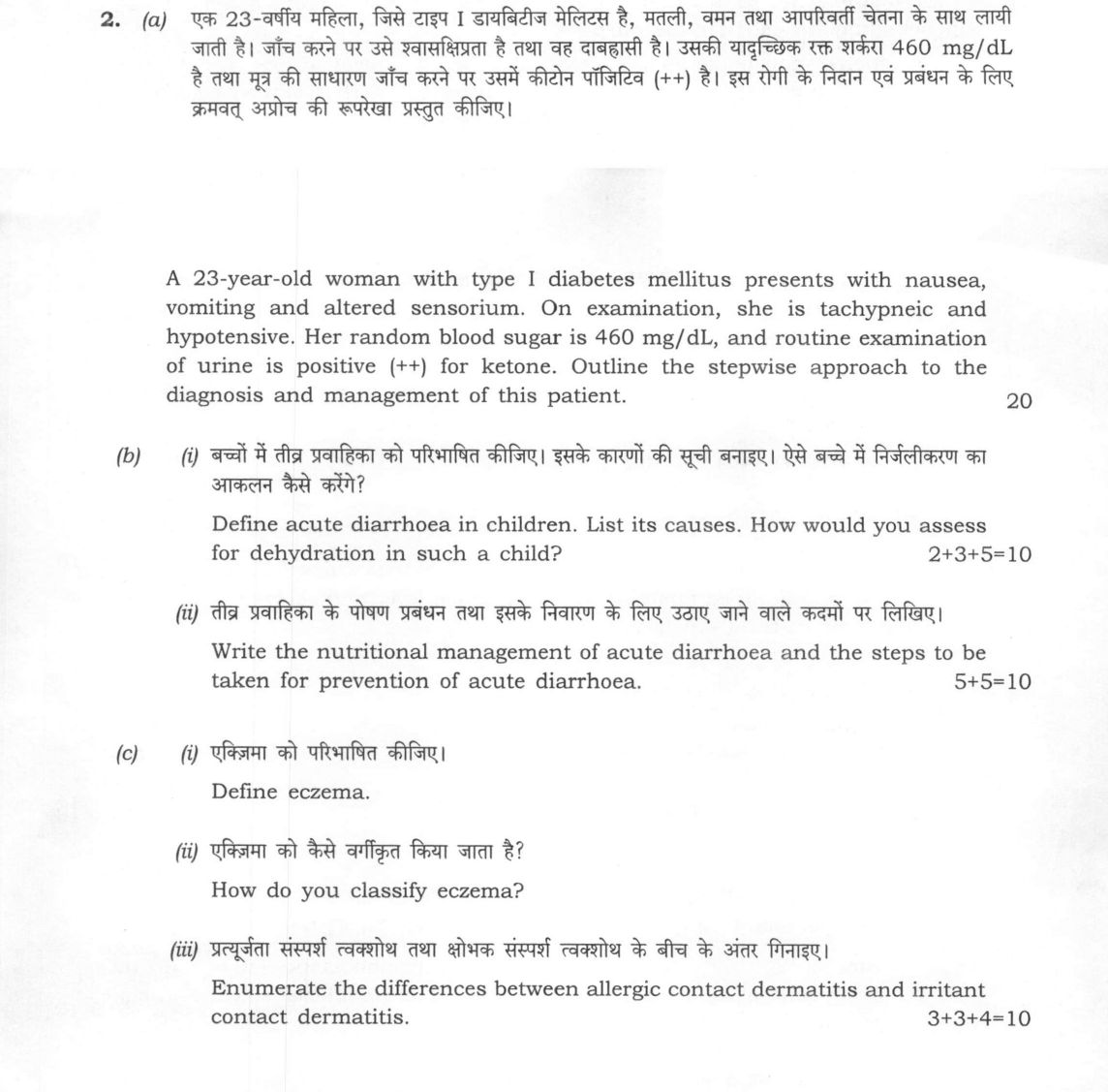
A 23-year-old woman with type I diabetes mellitus presents with nausea, vomiting and altered sensorium. On examination, she is tachypneic and hypotensive. Her random blood sugar is 460 mg/dL, and routine examination of urine is positive (++) for ketone. Outline the stepwise approach to the diagnosis and management of this patient. 20 marks
Define acute diarrhoea in children. List its causes. How would you assess for dehydration in such a child? 2+3+5=10
Write the nutritional management of acute diarrhoea and the steps to be taken for prevention of acute diarrhoea. 5+5=10
Define eczema.
How do you classify eczema?
Enumerate the differences between allergic contact dermatitis and irritant contact dermatitis. 3+3+4=10
हिंदी में प्रश्न पढ़ें
एक 23-वर्षीय महिला, जिसे टाइप I डायबिटीज मेलिटस है, मतली, वमन तथा अपरिवर्ती चेतना के साथ लायी जाती है। जाँच करने पर उसे श्वासध्वसिता है तथा वह दाबहीन है। उसकी यादृच्छिक रक्त शर्करा 460 mg/dL है तथा मूत्र की साधारण जाँच करने पर उसमें कीटोन पॉजिटिव (++) है। इस रोगी के निदान एवं प्रबंधन के लिए क्रमवत् अप्रोच की रूपरेखा प्रस्तुत कीजिए। 20
बच्चों में तीव्र प्रवाहिका को परिभाषित कीजिए। इसके कारणों की सूची बनाइए। ऐसे बच्चे में निर्जलीकरण का आकलन कैसे करेंगे? 2+3+5=10
तीव्र प्रवाहिका के पोषण प्रबंधन तथा इसके निवारण के लिए उठाए जाने वाले कदमों पर लिखिए। 5+5=10
एक्जिमा को परिभाषित कीजिए।
एक्जिमा को कैसे वर्गीकृत किया जाता है?
प्रत्यूजिता संपर्शी त्वक्शोथ तथा शोभक संपर्शी त्वक्शोथ के बीच के अंतर गिनाइए। 3+3+4=10
Model answer
Written by UPSC Answer Check against this question's marking rubric, to the expected length. UPSC does not publish answers for Mains — this is one way to score well, not an official key.
(a) The presentation is diabetic ketoacidosis (DKA): hyperglycaemia >250 mg/dL, ketonaemia/ketonuria and metabolic acidosis, usually pH <7.3. The history should elicit insulin omission, infection, myocardial infarction, pancreatitis or drugs. Examination shows tachypnoea, altered sensorium and hypotension from volume depletion due to osmotic diuresis and vomiting. Initial assessment includes temperature, heart rate, blood pressure, respiratory rate, level of consciousness and urine output. Diagnosis is confirmed by random blood sugar, urine ketones, serum ketones, venous blood gas, serum electrolytes, renal function, complete blood count, ECG, blood and urine cultures, and chest X-ray if infection is suspected. Management is stepwise. First, ABC stabilisation: airway, oxygen if hypoxic, two large-bore IV lines, cardiac monitoring, urinary catheter, and correction of hypotension with isotonic saline. Give 0.9% saline 15–20 mL/kg in the first hour; thereafter replace deficits at 250–500 mL/hr (about 4–8 mL/kg/hr in a 60–70 kg adult), switching to 0.45% saline with dextrose when glucose falls to ~250 mg/dL. Start fixed-rate IV insulin 0.1 U/kg/hr, or a weight-based protocol, after confirming potassium is not <3.3 mEq/L; if K+ is 3.3–5.2, add potassium to fluids, if <3.3 hold insulin and replace potassium, and maintain serum potassium 4–5 mEq/L. Do not give bicarbonate unless pH <6.9. Monitor glucose hourly, electrolytes, ketones, fluid balance and mental status, watching for cerebral oedema. Continue insulin until ketones clear and acidosis resolves, then transition to subcutaneous insulin with overlap. Simultaneously identify and treat precipitating factors: infection, insulin omission, myocardial infarction, pancreatitis and drugs.
(b)(i) Acute diarrhoea in children is passage of three or more loose stools in 24 hours for less than 14 days. Causes are viral (rotavirus, norovirus), bacterial (ETEC, Shigella, Salmonella, Vibrio cholerae), protozoal (Giardia, Entamoeba) and non-infectious (antibiotic-associated, lactose intolerance); in India, rotavirus is a leading cause of severe acute diarrhoea in under-fives. Dehydration is assessed using IAP/IMNCI: no dehydration, some dehydration, severe dehydration and shock. Examine mental status (alert, irritable, lethargic), tears (present or absent), skin pinch (normal, slow, very slow), thirst and radial pulse (present, weak, not palpable); two or more abnormal signs indicate some dehydration, while severe signs or shock require urgent rehydration. Weighing, if available, helps estimate deficit, but clinical assessment guides immediate action. In severe dehydration, the child may be lethargic or unresponsive, with absent tears, very slow skin pinch, inability to drink and weak or absent radial pulse.
(b)(ii) Nutritional management is continued feeding without fasting: breast milk or formula, age-appropriate energy-dense foods, small frequent meals, low-osmolarity ORS for dehydration, and zinc 10 mg/day for children under six months or 20 mg/day for older children for 10–14 days; avoid sugary drinks. ORS should be given according to age/weight, and feeding should resume as soon as the child can drink. Prevention includes exclusive breastfeeding for six months, continued breastfeeding with safe complementary feeding, safe drinking water, sanitation, handwashing, ORS corner promotion and rotavirus vaccine under India’s UIP.
(c)(i) Eczema is a non-specific term for an inflammatory dermatosis with pruritus, erythema and epidermal changes such as scaling, vesiculation, crusting or lichenification. (ii) It is classified as endogenous—atopic, seborrhoeic, nummular, dyshidrotic, lichen simplex chronicus—and exogenous—contact, photodermatitis, stasis. (iii) Allergic contact dermatitis is type IV delayed hypersensitivity, requires prior sensitisation, has no dose threshold, is well-demarcated to the contact site though it may spread, and is caused by nickel or poison ivy. Irritant contact dermatitis is direct cytotoxicity, is threshold-dependent, occurs immediately or after repeated exposure, is confined to the contact site, and is caused by detergents or acids. ACD often recurs on re-exposure and may show vesicles; ICD recurs with continued irritant and shows burning, fissures or erosion. Thus, the approach is a structured, stepwise protocol.
What "Outline" is asking you to do
Set out a whole scheme from end to end in its main steps without going into any of them. It is the directive used for protocols and frameworks — a management plan, a reaction mechanism, a statutory scheme — where the mark lies in having the full sequence with nothing missing.
Structure that answers it
What the scheme is for → step one → step two → the remaining steps through to the end point → the condition on which the sequence turns
Where marks are lost
Depth in the wrong place: elaborating the first two steps and never reaching the end of the scheme, which is where completeness is checked.
How this answer will be evaluated
Approach
Framework: Clinical Sequence: Diagnosis > Management (Immediate/Definitive/Follow-up). (a) explain: Diagnosis (Criteria + Investigations) > Management (Immediate, Definitive, Follow-up) | (b) explain: Definition and Causes > Assessment (Dehydration signs) > Nutritional Management and Prevention | (c) explain: Definition and Classification > Differentiation (Allergic vs Irritant) Full marks: Precise clinical sequence, correct prioritization, specific guidelines
Key points expected
- DKA: Fluids before Insulin
- Diarrhea: WHO Dehydration Plans
- Eczema: Type IV Hypersensitivity mechanism
Evaluation rubric
Each sub-part is marked on its own, against the marks and word limit printed on the paper.
- (a) Stepwise diagnosis of DKA and tiered management protocol 20 marks
explain— Diagnosis (Criteria + Investigations) → Management (Immediate, Definitive, Follow-up)
Must cover
- Diagnostic criteria: Hyperglycemia, Acidosis, Ketosis
- Immediate: IV fluids (Normal Saline), Potassium replacement
- Definitive: IV Insulin infusion, Monitor electrolytes
- Investigations: ABG, Electrolytes, Blood culture
Loses marks
- Starting insulin before fluid resuscitation
- Ignoring hypotension in initial assessment
Earns more
- Mention of Kussmaul breathing mechanism
- Specific fluid calculation (e.g., 15-20 ml/kg)
Extra mark
- Reference to ADA or ISDT guidelines
- (b) Definition, causes, dehydration assessment, nutrition, and prevention 10 marks
explain— Definition and Causes → Assessment (Dehydration signs) → Nutritional Management and Prevention
Must cover
- Definition: <14 days duration, watery stools
- Assessment: WHO plan (No, Some, Severe dehydration)
- Nutrition: Continue feeding, ORS, Zinc supplementation
- Prevention: ORT, Breastfeeding, Hand hygiene
Loses marks
- Withholding food during acute phase
- Vague dehydration assessment without WHO criteria
Earns more
- Specific dehydration signs (sunken eyes, skin pinch)
- Mention of rotavirus vaccine
Extra mark
- Reference to National Diarrhoeal Disease Control Programme
- (c) Definition, classification, and specific differences between contact dermatitis types 10 marks
explain— Definition and Classification → Differentiation (Allergic vs Irritant)
Must cover
- Definition: Chronic, relapsing, itchy eczematous dermatitis
- Classification: Atopic, Contact, Seborrheic, Stasis
- Allergic: Type IV hypersensitivity, delayed onset
- Irritant: Direct damage, dose-dependent, no sensitization
Loses marks
- Treating allergic CD as immediate hypersensitivity
- Vague differences without mechanism
Earns more
- Mention of patch testing for allergic CD
- Specific examples (Nickel vs Soap)
Extra mark
- Histological difference (spongiosis vs necrosis)
Practice this exact question
Write your answer and it is marked point by point against the model answer above — what you covered, what you missed, what you got wrong.
Evaluate my answer →More from Medical Science 2025 Paper II
- Q1 (a) Briefly describe the role of lifestyle interventions in prevention of coronary artery…
- Q2 (a) A 23-year-old woman with type I diabetes mellitus presents with nausea, vomiting and…
- Q3 (a) (i) Elaborate the indications for initiating antiviral therapy in a patient with chro…
- Q4 (a) (i) How do you differentiate between acute lymphoblastic leukaemia (ALL) and acute my…
- Q5 (a) (i) Enumerate the advantages as well as the limitations of laparoscopic surgery. (ii)…