Paper II — Q8
(a) Under the National Framework for Malaria Elimination in India, what are the targets set for the years 2027 and 2030…
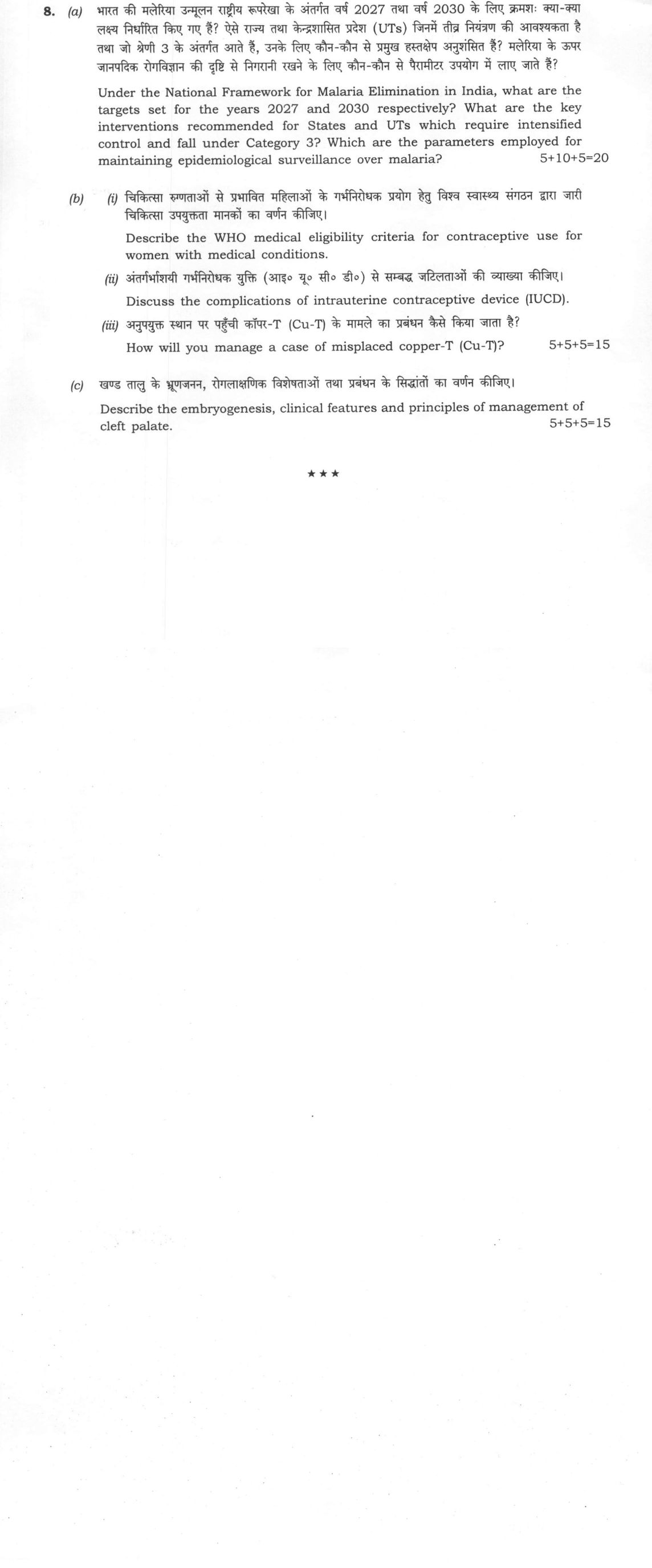
Under the National Framework for Malaria Elimination in India, what are the targets set for the years 2027 and 2030 respectively? What are the key interventions recommended for States and UTs which require intensified control and fall under Category 3? Which are the parameters employed for maintaining epidemiological surveillance over malaria? 5+10+5=20
Describe the WHO medical eligibility criteria for contraceptive use for women with medical conditions.
Discuss the complications of intrauterine contraceptive device (IUCD).
How will you manage a case of misplaced copper-T (Cu-T)? 5+5+5=15
Describe the embryogenesis, clinical features and principles of management of cleft palate. 5+5+5=15
हिंदी में प्रश्न पढ़ें
भारत की मलेरिया उन्मूलन राष्ट्रीय रूपरेखा के अंतर्गत वर्ष 2027 तथा वर्ष 2030 के लिए क्रमशः क्या-क्या लक्ष्य निर्धारित किए गए हैं? ऐसे राज्य तथा केंद्रशासित प्रदेश (UTs) जिनमें तीव्र नियंत्रण की आवश्यकता है तथा जो श्रेणी 3 के अंतर्गत आते हैं, उनके लिए कौन-कौन से प्रमुख हस्तक्षेप अनुशंसित हैं? मलेरिया के ऊपर जानपदिक रोगविज्ञान की दृष्टि से निगरानी रखने के लिए कौन-कौन से पैरामीटर उपयोग में लाए जाते हैं? 5+10+5=20
चिकित्सा रुग्णताओं से प्रभावित महिलाओं के गर्भनिरोधक प्रयोग हेतु विश्व स्वास्थ्य संगठन द्वारा जारी चिकित्सा उपयुक्तता मानकों का वर्णन कीजिए।
अंतर्गर्भाशयी गर्भनिरोधक युक्ति (आइ० यू० सी० डी०) से संबंध जटिलताओं की व्याख्या कीजिए।
अनुपयुक्त स्थान पर पहुंची कॉपर-T (Cu-T) के मामले का प्रबंधन कैसे किया जाता है? 5+5+5=15
खंड तालु के भ्रूणजनन, रोगलाक्षणिक विशेषताओं तथा प्रबंधन के सिद्धांतों का वर्णन कीजिए। 5+5+5=15
Model answer
Written by UPSC Answer Check against this question's marking rubric, to the expected length. UPSC does not publish answers for Mains — this is one way to score well, not an official key.
India’s malaria elimination strategy is staged by transmission intensity. Under the National Framework for Malaria Elimination, the 2027 target is elimination of malaria in Category 3 States and UTs, i.e. high-transmission areas with API >2 per 1,000 population at risk, after earlier targets for Category 1 and 2 (2020 and 2022). The 2030 target is malaria-free India, with national elimination and certification. For Category 3, intensified control means sustained IRS in high-risk foci, universal LLIN distribution, prompt diagnosis and ACT-AL/ACT-SP treatment, radical cure with primaquine (single dose 0.75 mg/kg for P. falciparum gametocytocidal effect where safe), and strengthened surveillance. Surveillance parameters include API, slide positivity rate, Plasmodium falciparum proportion, therapeutic efficacy studies, insecticide resistance monitoring, and case-based reporting through IHIP (Integrated Health Information Portal). API tracks incidence per 1,000 population at risk, SPR tracks positive slides per 1,000 blood examinations, and Pf proportion tracks species mix; together they enable early detection of resurgence, guide vector-control response, and support certification. Category 3 also requires active case detection, community engagement, and quality assurance of testing and treatment. IHIP provides real-time data for district-level action.
Contraceptive eligibility and IUCD care. WHO MEC classifies contraceptive methods for women with medical conditions into four categories: 1 no restriction; 2 advantages generally outweigh risks; 3 theoretical or usually serious risks, but advantages generally outweigh risks; 4 unacceptable health risk. It is a counselling tool for method selection, not a diagnosis. Category 3 requires careful counselling and follow-up. Examples include category 1 for conditions such as COPD where methods are broadly safe, category 3 for conditions needing caution such as migraine with aura where hormonal methods are restricted, and category 4 for unacceptable risks such as breast cancer with hormonal methods; for Cu-IUCD, active pelvic infection, pregnancy, or uterine perforation are category 4. IUCD complications are immediate (pain, vasovagal syncope, perforation), early (expulsion, PID, abnormal bleeding), and late (pregnancy with device, embedment, actinomycosis). Perforation may present with acute pain and absent threads, PID with fever and discharge, expulsion with visible threads, and embedment with pain or failed removal. A misplaced Cu-T is managed by first confirming location with ultrasound and, if needed, X-ray; if partially expelled or extrauterine, remove it, preferably hysteroscopically if embedded, and laparoscopically if perforated into the peritoneal cavity, with antibiotics if infection is suspected. If the device is intrauterine but malpositioned, remove and replace after excluding infection.
Cleft palate. Cleft palate results from failure of the palatal shelves to elevate, meet and fuse during the 8th–12th week of embryogenesis. The primary palate forms from medial palatine processes, while the secondary palate forms from the palatal shelves of the maxillary prominences; failure at the midline produces a cleft. The process is influenced by genetic factors such as IRF6 and MSX1 mutations, environmental factors such as maternal smoking and folate deficiency, and mechanical constraints. Clinically, cleft palate may be isolated or associated with cleft lip, and is classified by Veau according to extent: Veau I involves the soft palate, Veau II the hard and soft palate, Veau III unilateral complete cleft involving the alveolus, and Veau IV bilateral complete cleft. Features include nasal regurgitation, hypernasal speech, feeding difficulty, otitis media and hearing loss, dental malocclusion, and psychosocial effects. Management is multidisciplinary: safe feeding with appropriate bottles or nasogastric tube, speech therapy, orthodontic preparation and alveolar management, and staged surgical repair, usually palatoplasty at 9–18 months, with later velopharyngoplasty or orthognathic surgery if needed. Audiometry and nutrition support are essential. Speech therapy should begin before palatoplasty and continue after repair. Alveolar bone grafting may be needed later for dental development. The public-health implication is that malaria elimination, safe contraception and congenital anomaly care are linked through primary health care, surveillance and early intervention.
What "Describe" is asking you to do
Give a full, ordered account of the thing named — its parts, stages or mechanism — in the sequence in which it actually exists or occurs. Most describe questions come from the science optionals, where the marks sit in correct technical detail and, where the stem says so, a labelled diagram.
Structure that answers it
One-line identification of the subject → the parts or stages in their real order, each with its defining detail → labelled diagram where the subject is structural → closing line on function or significance
Where marks are lost
Loose general prose where the examiner is ticking named parts, correct terminology and their sequence; and in the General Studies papers, turning to evaluation before the description is finished.
How this answer will be evaluated
Approach
Framework: Clinical Sequence (Definition > Aetiology > Features > Management). (a) describe: Targets (2027/2030) > Category 3 Interventions > Surveillance Parameters | (b) discuss: WHO MEC Criteria > IUCD Complications > Cu-T Management | (c) describe: Embryogenesis > Clinical Features > Management Principles Full marks: Precise targets, clear Category 3 focus, stepwise management, embryological link to features.
Key points expected
- 2027: 90% PFR reduction
- 2030: Malaria elimination
- Category 3: Intensified control
- Surveillance: PFR, PCR
- WHO MEC categories
- IUCD complications
- Misplaced Cu-T management
- Cleft palate embryogenesis
- Cleft palate clinical features
- Cleft palate management principles
Evaluation rubric
Each sub-part is marked on its own, against the marks and word limit printed on the paper.
- (a) Specific NMEI targets, Category 3 strategies, and surveillance metrics. 20 marks
describe— Targets (2027/2030) → Category 3 Interventions → Surveillance Parameters
Must cover
- 2027 target: 90% reduction in PFR
- 2030 target: Malaria elimination
- Category 3: Intensified control measures
- Surveillance: PFR, PCR, entomological indices
Loses marks
- Vague targets without specific years
- Generic malaria control without Category 3 focus
Earns more
- Mention of 'Category 3' definition
- Specific surveillance tools (RDT, PCR)
Extra mark
- Reference to NMEI roadmap document
- (b) WHO MEC categories, IUCD complications, and management of misplaced Cu-T. 15 marks
discuss— WHO MEC Criteria → IUCD Complications → Cu-T Management
Must cover
- WHO MEC categories (1-4)
- IUCD complications (expulsion, perforation, PID)
- Management: Ultrasound, hysteroscopy, laparoscopy
- Immediate vs definitive management
Loses marks
- Listing symptoms without mechanism
- Management without priority
Earns more
- Specific MEC examples (e.g., IUD in PID)
- Stepwise approach to misplaced Cu-T
Extra mark
- Mention of specific WHO MEC table
- (c) Embryological origin, clinical presentation, and management principles of cleft palate. 15 marks
describe— Embryogenesis → Clinical Features → Management Principles
Must cover
- Embryogenesis: Palatal shelf fusion
- Clinical features: Feeding difficulty, speech issues
- Management: Multidisciplinary team, timing of repair
- Principles: Early feeding, speech therapy
Loses marks
- Unordered detail
- No diagram where one is implied
Earns more
- Specific weeks of embryogenesis
- Multidisciplinary team members
Extra mark
- Mention of specific repair technique (e.g., von Langenbeck)
Practice this exact question
Write your answer and it is marked point by point against the model answer above — what you covered, what you missed, what you got wrong.
Evaluate my answer →More from Medical Science 2025 Paper II
- Q5 (a) (i) Enumerate the advantages as well as the limitations of laparoscopic surgery. (ii)…
- Q6 (a) (i) Classify hypertensive disorders in pregnancy. (ii) Enumerate the types and compli…
- Q7 (a) (i) Describe the clinical features and diagnostic workup of a suspected case of perit…
- Q8 (a) Under the National Framework for Malaria Elimination in India, what are the targets s…