Paper II — Q4
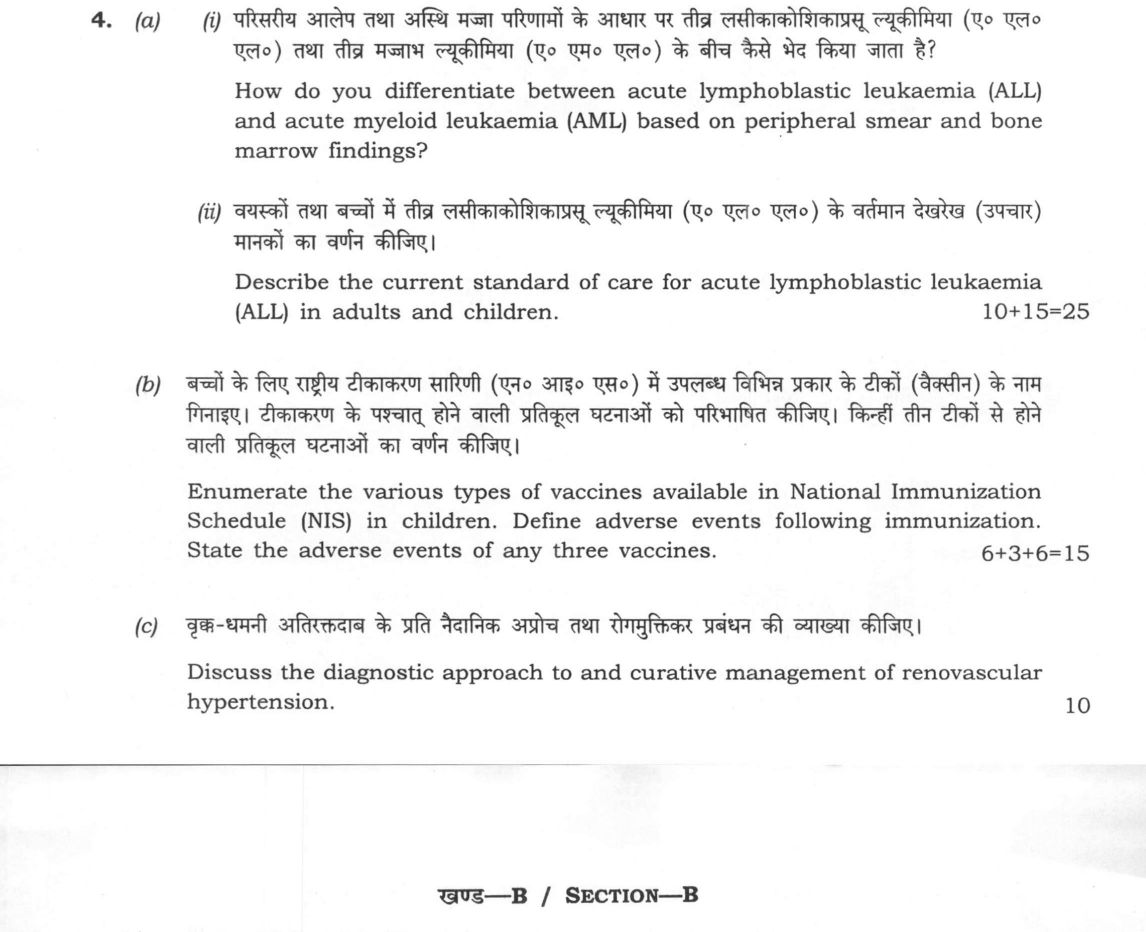
(a) (i) How do you differentiate between acute lymphoblastic leukaemia (ALL) and acute myeloid leukaemia (AML) based on…
How do you differentiate between acute lymphoblastic leukaemia (ALL) and acute myeloid leukaemia (AML) based on peripheral smear and bone marrow findings?
Describe the current standard of care for acute lymphoblastic leukaemia (ALL) in adults and children. 10+15=25
Enumerate the various types of vaccines available in National Immunization Schedule (NIS) in children. Define adverse events following immunization. State the adverse events of any three vaccines. 6+3+6=15
Discuss the diagnostic approach to and curative management of renovascular hypertension. 10 marks
हिंदी में प्रश्न पढ़ें
परिसरिय आलेख तथा अस्थि मज्जा परिणामों के आधार पर तीव्र लसीकाकोशिकाप्रसू ल्यूकीमिया (ए० एल० एल०) तथा तीव्र मज्जाभ ल्यूकीमिया (ए० एम० एल०) के बीच कैसे भेद किया जाता है?
वयस्कों तथा बच्चों में तीव्र लसीकाकोशिकाप्रसू ल्यूकीमिया (ए० एल० एल०) के वर्तमान देखभेख (उपचार) मानकों का वर्णन कीजिए। 10+15=25
बच्चों के लिए राष्ट्रीय टीकाकरण सारणी (एन० आइ० एस०) में उपलब्ध विभिन्न प्रकार के टीकों (वैक्सीन) के नाम गिनाइए। टीकाकरण के पश्चात् होने वाली प्रतिकूल घटनाओं को परिभाषित कीजिए। किन्हीं तीन टीकों से होने वाली प्रतिकूल घटनाओं का वर्णन कीजिए। 6+3+6=15
वृक्क-धमनी अतिरक्तदाब के प्रति नैदानिक अप्रोच तथा रोगमुक्तिकर प्रबंधन की व्याख्या कीजिए। 10
Model answer
Written by UPSC Answer Check against this question's marking rubric, to the expected length. UPSC does not publish answers for Mains — this is one way to score well, not an official key.
(a)(i) ALL and AML are differentiated by lineage of blasts on peripheral smear and marrow, using FAB morphology and WHO immunophenotypic and cytogenetic criteria. FAB classifies ALL as L1-L3 and AML as M0-M7, but WHO adds immunophenotype and cytogenetics. In ALL, peripheral smear shows lymphoblasts with high nuclear-to-cytoplasmic ratio, scant agranular cytoplasm, condensed chromatin and no Auer rods; immunophenotyping is TdT positive, with B-cell or T-cell markers. In AML, myeloblasts have more cytoplasm, fine chromatin, nucleoli, primary granules and Auer rods; they are myeloperoxidase and Sudan black B positive and express CD13/CD33. Peripheral smear may show circulating blasts in both, but morphology and immunophenotype identify lineage; marrow shows suppression of normal trilineage maturation. Bone marrow is hypercellular with maturation arrest in both, and marrow aspirate is required to quantify blasts. WHO generally uses a blast threshold of 20% or more for ALL and AML, except AML with defining recurrent genetic abnormalities such as t(15;17), t(8;21) or inv(16), which can be diagnosed irrespective of blast percentage. Cytogenetics further separate them: Philadelphia chromosome/BCR-ABL1 is characteristic of some ALL, while t(8;21) and inv(16) are recurrent AML abnormalities.
(a)(ii) Current ALL therapy is age- and risk-stratified. In children, protocols based on NCI/CCLG criteria use induction with vincristine, dexamethasone, L-asparaginase and doxorubicin, followed by consolidation, delayed intensification, CNS prophylaxis with intrathecal methotrexate, and prolonged maintenance with 6-mercaptopurine and methotrexate. Risk groups are defined by age, presenting white-cell count, CNS involvement and cytogenetics. Remission is assessed by marrow, and therapy is continued according to response and risk. In adults, standard regimens include hyper-CVAD or pediatric-inspired combinations; Ph+ ALL is treated with chemotherapy plus a tyrosine kinase inhibitor such as imatinib or ponatinib, and allogeneic haematopoietic stem-cell transplantation is considered in high-risk or Ph+ disease, often in first remission. For relapsed or refractory B-ALL, blinatumomab, inotuzumab ozogamicin and CAR-T cell therapy, especially tisagenlecleucel in children and young adults, are used to achieve remission before transplant where eligible.
(b) The National Immunization Schedule under the Universal Immunization Programme for children includes BCG; OPV and IPV; hepatitis B vaccine; DPT and DPT boosters; pentavalent vaccine; PCV; rotavirus vaccine; measles/MMR vaccine; JE vaccine; and OPV boosters. These include live attenuated vaccines such as BCG, OPV, MMR and JE, and inactivated, subunit or conjugate vaccines such as IPV, hepatitis B, DPT, pentavalent and PCV. An adverse event following immunization is any untoward medical occurrence after vaccination, whether or not causally related to the vaccine. AEFI reporting supports vaccine safety surveillance. Examples: DPT may cause local sterile abscess, high febrile reaction, hypotonic-hyporesponsive episode or encephalopathy; measles/MMR may cause fever, febrile seizures, rash or thrombocytopenia; OPV may cause vaccine-associated paralytic poliomyelitis.
(c) Renovascular hypertension is suspected when hypertension begins before 30 or after 55 years, is resistant, has an abdominal bruit, or presents with flash pulmonary oedema or unexplained kidney injury. Screening is usually Doppler ultrasound of renal arteries; CTA or MRA confirms stenosis, while catheter-based renal angiography remains the gold standard and allows intervention. Management depends on aetiology. In fibromuscular dysplasia, percutaneous transluminal renal angioplasty, with stenting if needed, is curative and first-line. In atherosclerotic renal artery stenosis, optimal medical therapy with antihypertensives, ACE inhibitors or ARBs with caution in bilateral stenosis, statins, antiplatelet therapy and risk-factor control is the cornerstone; revascularization is reserved for refractory hypertension, recurrent flash pulmonary oedema, acute kidney injury, or severe bilateral/solitary-kidney disease, and may be endovascular or surgical. Surgical revascularization is considered for selected atherosclerotic lesions, such as long-segment or complex stenosis, or failed endovascular therapy. Thus, curative PTRA is preferred for FMD, while atherosclerotic disease is managed medically first, with revascularization only for selected indications.
What "Differentiate" is asking you to do
Fix the criteria on which the two differ and apply each criterion to both, so the pair can no longer be mixed up. Differentiate stems usually carry a further task attached — describe the mechanism, set out the principles, discuss the applications — and that task carries its own marks.
Structure that answers it
Criterion 1 applied to both → criterion 2 → criterion 3 → summary line or table → the attached second demand answered in full
Where marks are lost
Two standalone definitions placed side by side, leaving the reader to extract the difference. The second common loss is running out of space before the attached task, which is often worth as much as the differentiation.
How this answer will be evaluated
Approach
Framework: Clinical Sequence (Definition > Aetiology > Features > Investigation > Management). (a(i)) compare: paired headings or table > key differences > significance > conclusion | (a(ii)) describe: define > structure or process in order > labelled diagram > significance | (b) enumerate: list the items in order > one line each > no commentary | (c) discuss: intro > 3-4 dimensions > example > balanced close Full marks: Precise clinical differentiation, protocol-specific management, and accurate diagnostic hierarchy.
Key points expected
- Morphology of blasts (size, N:C ratio, granules)
- Specific markers (Auer rods vs. lymphoblasts)
- Bone marrow cellularity and composition
- Immunophenotyping (CD19/CD10 vs. MPO/CD13)
- Induction therapy (multi-agent chemo)
- Consolidation and maintenance phases
- Differentiation between adult and child protocols
- Role of targeted therapy (e.g., TKIs)
Evaluation rubric
Each sub-part is marked on its own, against the marks and word limit printed on the paper.
- (a(i)) Differentiate ALL and AML using peripheral smear and bone marrow findings. 10 marks
compare— paired headings or table → key differences → significance → conclusion
Must cover
- Morphology of blasts (size, N:C ratio, granules)
- Specific markers (Auer rods vs. lymphoblasts)
- Bone marrow cellularity and composition
- Immunophenotyping (CD19/CD10 vs. MPO/CD13)
Loses marks
- Listing symptoms without morphological basis
- Confusing markers between lineages
Earns more
- Cytogenetic abnormalities (Philadelphia chromosome)
- Flow cytometry details
- Peripheral smear specific features
Extra mark
- Reference to WHO classification criteria
- (a(ii)) Outline standard of care for ALL in adults and children. 15 marks
describe— define → structure or process in order → labelled diagram → significance
Must cover
- Induction therapy (multi-agent chemo)
- Consolidation and maintenance phases
- Differentiation between adult and child protocols
- Role of targeted therapy (e.g., TKIs)
Loses marks
- Management without phase-wise priority
- Ignoring age-specific differences
Earns more
- Stem cell transplant indications
- Central nervous system prophylaxis
- Risk stratification (low/intermediate/high)
Extra mark
- Mention of specific trial protocols (e.g., COG, NCCN)
- (b) List NIS vaccines, define AEFI, and state adverse events of three vaccines. 15 marks
enumerate— list the items in order → one line each → no commentary
Must cover
- List of NIS vaccines (BCG, OPV/IPV, DPT, etc.)
- Definition of Adverse Events Following Immunization (AEFI)
- Specific adverse events for three named vaccines
- Distinction between local and systemic reactions
Loses marks
- Listing vaccines without specific adverse events
- Vague definition of AEFI
Earns more
- Schedule timing (birth, 6 weeks, etc.)
- Specific side effects (fever, swelling, seizures)
- Mention of contraindications
Extra mark
- Reference to National Immunization Schedule (NIS) guidelines
- (c) Discuss diagnostic approach and curative management of renovascular hypertension. 10 marks
discuss— intro → 3-4 dimensions → example → balanced close
Must cover
- Clinical features suggesting renovascular origin
- Diagnostic imaging (Doppler, CTA, MRA, Angiography)
- Curative management (Angioplasty/Stenting)
- Surgical revascularization options
Loses marks
- Focusing only on medical management
- Ignoring diagnostic hierarchy
Earns more
- Renin levels and lab findings
- Medical management (ACE inhibitors/ARBs)
- Indications for intervention
Extra mark
- Mention of specific surgical procedures (aortorenal bypass)
Practice this exact question
Write your answer and it is marked point by point against the model answer above — what you covered, what you missed, what you got wrong.
Evaluate my answer →More from Medical Science 2025 Paper II
- Q1 (a) Briefly describe the role of lifestyle interventions in prevention of coronary artery…
- Q2 (a) A 23-year-old woman with type I diabetes mellitus presents with nausea, vomiting and…
- Q3 (a) (i) Elaborate the indications for initiating antiviral therapy in a patient with chro…
- Q4 (a) (i) How do you differentiate between acute lymphoblastic leukaemia (ALL) and acute my…
- Q5 (a) (i) Enumerate the advantages as well as the limitations of laparoscopic surgery. (ii)…
- Q6 (a) (i) Classify hypertensive disorders in pregnancy. (ii) Enumerate the types and compli…
- Q7 (a) (i) Describe the clinical features and diagnostic workup of a suspected case of perit…