Paper II — Q5
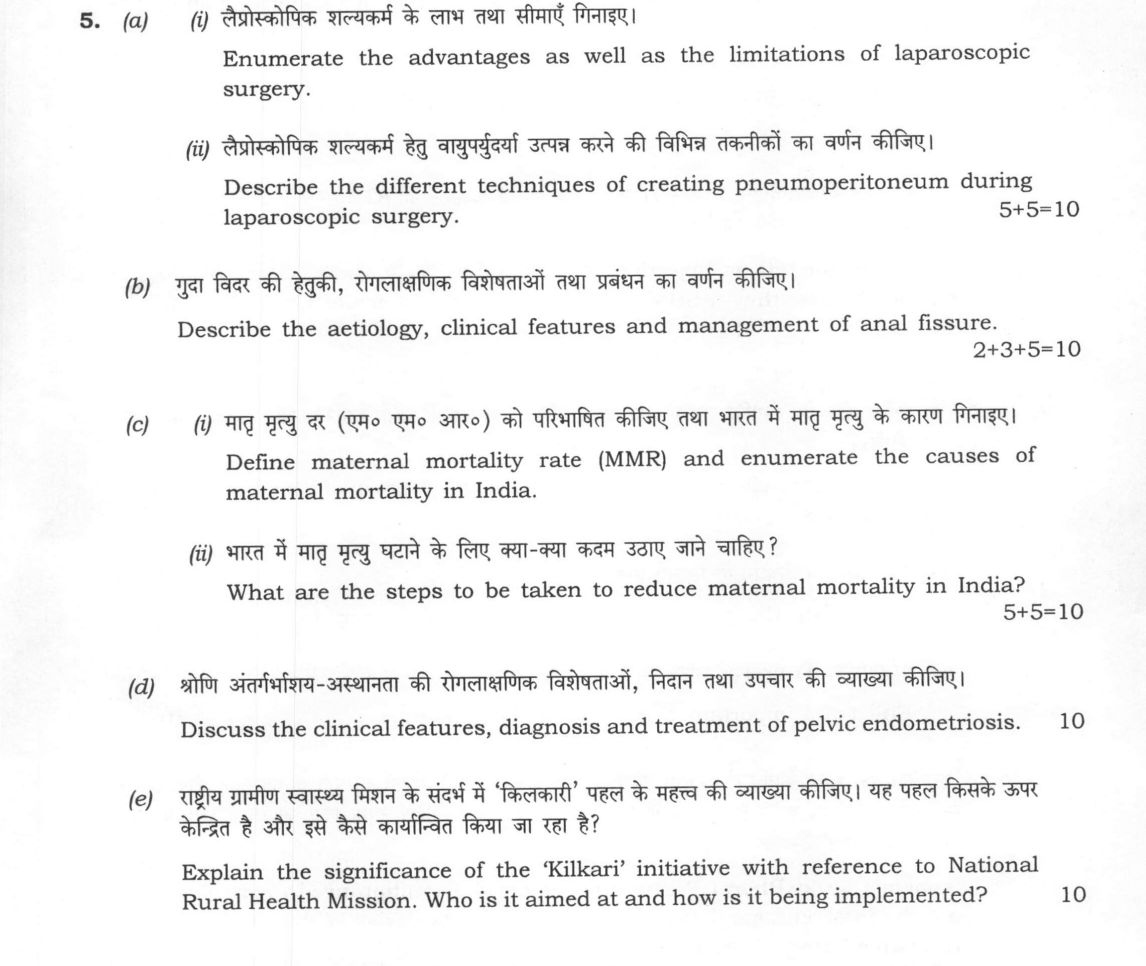
(a) (i) Enumerate the advantages as well as the limitations of laparoscopic surgery. (ii) Describe the different techniques of…
Enumerate the advantages as well as the limitations of laparoscopic surgery.
Describe the different techniques of creating pneumoperitoneum during laparoscopic surgery. 5+5=10
Describe the aetiology, clinical features and management of anal fissure. 2+3+5=10
Define maternal mortality rate (MMR) and enumerate the causes of maternal mortality in India.
What are the steps to be taken to reduce maternal mortality in India? 5+5=10
Discuss the clinical features, diagnosis and treatment of pelvic endometriosis. 10 marks
Explain the significance of the 'Kilkari' initiative with reference to National Rural Health Mission. Who is it aimed at and how is it being implemented? 10 marks
हिंदी में प्रश्न पढ़ें
लैप्रोस्कोपिक शल्यकर्म के लाभ तथा सीमाएँ गिनाइए।
लैप्रोस्कोपिक शल्यकर्म हेतु वायुपुटुर्द्या उत्पन्न करने की विभिन्न तकनीकों का वर्णन कीजिए। 5+5=10
गुदा विदर की हेतुकी, रोगलाक्षणिक विशेषताओं तथा प्रबंधन का वर्णन कीजिए। 2+3+5=10
मातृ मृत्यु दर (एम० एम० आर०) को परिभाषित कीजिए तथा भारत में मातृ मृत्यु के कारण गिनाइए।
भारत में मातृ मृत्यु घटाने के लिए क्या-क्या कदम उठाए जाने चाहिए? 5+5=10
श्रोणि अंतर्गर्भाशय-अस्थानता की रोगलाक्षणिक विशेषताओं, निदान तथा उपचार की व्याख्या कीजिए। 10
राष्ट्रीय ग्रामीण स्वास्थ्य मिशन के संदर्भ में 'किलकारी' पहल के महत्व की व्याख्या कीजिए। यह पहल किसके ऊपर केंद्रित है और इसे कैसे कार्यान्वित किया जा रहा है? 10 marks
Model answer
Written by UPSC Answer Check against this question's marking rubric, to the expected length. UPSC does not publish answers for Mains — this is one way to score well, not an official key.
Laparoscopic Surgery: Advantages, Limitations, and Techniques of Pneumoperitoneum
Laparoscopic surgery has transformed modern operative practice by minimizing surgical trauma. Its primary advantages include reduced postoperative pain, early ambulation, shorter hospital stay, superior cosmetic outcomes from minimal access incisions, reduced incidence of wound complications such as surgical site infections and incisional hernias, diminished postoperative peritoneal adhesion formation, and enhanced visualization of pelvic and abdominal anatomy due to optical magnification.
Conversely, its limitations encompass high equipment and maintenance costs, a steep learning curve for surgeons, loss of three-dimensional depth perception on standard monitors, absence of tactile and haptic feedback, potential risk of port-site metastasis in undetected malignancies, and risks of trocar-induced visceral or major retroperitoneal vascular injuries. Furthermore, carbon dioxide insufflation carries systemic risks including hypercarbia, cardiac arrhythmias, and gas embolism.
Pneumoperitoneum is the prerequisite step to create adequate working space. Carbon dioxide is the preferred insufflation gas due to its non-combustible nature, high blood solubility, and rapid pulmonary elimination. The working intra-abdominal pressure is safely maintained between 12 to 15 mmHg. The standard techniques include:
Closed Technique (Veress Needle): The Veress needle is inserted blindly through a sub-umbilical incision or at Palmer’s point (left upper quadrant) in patients with previous midline incisions. Correct intra-peritoneal placement is verified using the saline drop test, aspiration test, and low initial insufflation pressure (<10 mmHg).
Open Technique (Hasson Method): Performed under direct vision through a small infra-umbilical incision. The fascial edges and peritoneum are incised, stay sutures are placed, and a blunt-tipped Hasson cannula is secured. This method significantly reduces the risk of major vascular and bowel injury, especially in abdomen with prior surgical scars.
Direct Trocar Insertion: Entails direct insertion of the primary trocar without prior needle insufflation, requiring continuous elevation of the anterior abdominal wall.
Optical Trocar Technique: Employs a clear-tipped trocar housing a laparoscope, permitting continuous, real-time visualization of abdominal wall layers during entry.
Complications associated with pneumoperitoneum include extraperitoneal insufflation causing subcutaneous emphysema, pneumothorax, visceral perforation, vascular laceration, and acute gas embolism.
Anal Fissure: Aetiology, Clinical Features, and Management
An anal fissure is a longitudinal tear in the anoderm distal to the dentate line.
Aetiology: The primary cause is mechanical trauma secondary to the passage of hard, dry stools in patients with chronic constipation and a low-fibre diet, or frequent watery stools in chronic diarrhea. Secondary factors include trauma during vaginal childbirth, previous anal surgery, and underlying conditions such as Crohn's disease, tuberculosis, or anal malignancy. Pathophysiologically, hypertonicity of the internal anal sphincter causes ischemia of the posterior midline anoderm, impairing tissue healing.
Clinical Features: Acute fissures present with severe, sharp, tearing pain during defecation, persisting as a burning ache for hours, accompanied by bright red streaks of blood on the stool surface or toilet paper. Severe internal sphincter spasm is evident on inspection. Chronic fissures (persisting >6 weeks) demonstrate the classic anatomical triad: an external skin tag (sentinel pile) at the distal margin, an indurated ulcer with visible circular fibres of the internal anal sphincter at its base, and a hypertrophied anal papilla at the proximal apex.
Management: Conservative Therapy: First-line management for acute fissures includes a high-fibre diet, adequate fluid intake, stool softeners, and warm sitz baths to relieve spasm. Pharmacological sphincter relaxation is achieved with topical 0.2% glyceryl trinitrate (GTN) ointment or topical calcium channel blockers (2% diltiazem, nifedipine) applied twice daily for 6 to 8 weeks. Botulinum toxin injection into the internal sphincter provides temporary chemical denervation for resistant cases.
Surgical Therapy: Indicated for chronic fissures refractory to medical therapy. Lateral internal sphincterotomy (LIS), performed via open or closed techniques, remains the gold standard, dividing the lower third of the internal sphincter to reduce resting anal pressure. Fissurectomy with or without an advancement flap is indicated for atypical, fibrotic, or non-healing fissures.
Maternal Mortality Rate (MMR) and Reduction Strategies in India
Maternal Mortality Ratio (clinically referred to as MMR) is defined as the number of maternal deaths occurring during pregnancy, childbirth, or within 42 days of termination of pregnancy, irrespective of the duration and site of the pregnancy, per 100,000 live births.
Causes of Maternal Mortality in India: According to the Sample Registration System (SRS) and Health Management Information System (HMIS), direct obstetric causes contribute to over two-thirds of deaths. These include postpartum haemorrhage (PPH, the single largest cause), hypertensive disorders of pregnancy (preeclampsia and eclampsia), puerperal sepsis, obstructed and prolonged labour, and complications of unsafe abortion. Indirect causes are predominantly severe nutritional anaemia, pre-existing cardiac disease, viral hepatitis, and respiratory infections.
Steps to Reduce Maternal Mortality: Institutional Delivery Promotion: Strengthening conditional cash transfers and entitlements through the Janani Suraksha Yojana (JSY) and Janani Shishu Suraksha Karyakram (JSSK), guaranteeing zero out-of-pocket expenditure for drugs, diagnostics, transport, and diet.
Clinical Capacity Building: Comprehensive training of healthcare providers through Skilled Birth Attendant (SBA) training and Emergency Obstetric and Newborn Care (EmONC) modules.
Antenatal and Emergency Care: Assured quality antenatal check-ups under the Pradhan Mantri Surakshit Matritva Abhiyan (PMSMA) on the 9th of every month, alongside establishing functional First Referral Units (FRUs) equipped with dedicated blood storage and surgical facilities.
Preventive Public Health Measures: Intensified anaemia prophylaxis and parenteral iron therapies under Anemia Mukt Bharat, expansion of Postpartum Intrauterine Contraceptive Device (PPIUCD) services, and grassroots tracking of high-risk pregnancies by Accredited Social Health Activists (ASHAs) linked with the Reproductive and Child Health (RCH) portal.
Pelvic Endometriosis: Clinical Features, Diagnosis, and Treatment
Pelvic endometriosis is defined by the presence of functional endometrial glands and stroma outside the uterine cavity, inducing a chronic inflammatory reaction.
Clinical Features: Symptoms correlate poorly with lesion size but depend on anatomical depth. The classical presentation includes secondary dysmenorrhoea, deep dyspareunia, chronic non-menstrual pelvic pain, dyschezia, and subfertility. Physical findings reveal a fixed, retroverted uterus, tender nodules across the uterosacral ligaments and pouch of Douglas, and enlarged, fixed adnexal masses (endometriomas or "chocolate cysts").
Diagnosis: High-resolution Transvaginal Sonography (TVS) is the primary imaging modality for diagnosing endometriomas and deep infiltrating nodules. Magnetic Resonance Imaging (MRI) is utilized for complex pelvic mapping. Laparoscopy combined with histological biopsy remains the gold standard, allowing direct visualization of superficial powder-burn or flame lesions, deep nodules, and staging according to the revised American Society for Reproductive Medicine (rASRM) classification (Stages I to IV).
Treatment: Medical Management: Aimed at suppressing ovarian steroidogenesis and inducing atrophy of ectopic implants. First-line therapies include non-steroidal anti-inflammatory drugs (NSAIDs) for pain, combined oral contraceptive pills (COCs), and progestins (oral dienogest or levonorgestrel-releasing intrauterine system [LNG-IUD]). Second-line agents include Gonadotropin-Releasing Hormone (GnRH) agonists (with add-back hormonal therapy to prevent bone loss) and oral GnRH antagonists.
Surgical Management: Indicated in severe pain, endometriomas greater than 3 to 4 cm, or distorted pelvic anatomy causing infertility. Conservative laparoscopic surgery involves excision or ablation of peritoneal implants, ovarian cystectomy, and adhesiolysis to restore anatomy while preserving ovarian reserve. Assisted Reproductive Technology (ART/IVF) is indicated for associated tubal or male factor subfertility.
The 'Kilkari' Initiative under the National Health Mission
The Kilkari initiative is a centralized, mobile-based voice messaging (mHealth) service launched under the National Rural Health Mission (now National Health Mission) by the Ministry of Health and Family Welfare, Government of India, in technical partnership with BBC Media Action.
Target Group: It is directly aimed at pregnant women, new mothers, and their families, starting from the second trimester of pregnancy and continuing until the child attains one year of age.
Implementation Mechanism: Kilkari delivers 72 time-sensitive, weekly, pre-recorded outbound audio messages directly to the registered mobile numbers of beneficiaries. The calls feature an authoritative, culturally relatable persona named "Dr. Anita." Content covers critical, chronologically sequenced information regarding antenatal care visits, institutional delivery, balanced maternal nutrition, exclusive breastfeeding, routine infant immunization, and postpartum family planning. The service is integrated with the national Mother and Child Tracking System (MCTS) and RCH portal, operating free of cost to the end-user and overcoming literacy barriers through spoken-word communication.
A comprehensive approach combining surgical advancements, structured clinical guidelines for pelvic and anorectal pathology, and community-driven mHealth strategies like Kilkari is vital to improving individualized patient outcomes and accelerating progress toward Sustainable Development Goal targets for maternal and reproductive health.
What "Discuss" is asking you to do
Lay the issue out from more than one side — how it arose, what is claimed for it, what is held against it, and where it now stands. UPSC attaches discuss to broad topics with several live dimensions, so coverage of the dimensions earns more than the strength of your opinion.
Structure that answers it
Set the issue up → the case as it is made → the case against → the dimension both sides leave out → where the balance now lies
Where marks are lost
Listing facts with no thread between them, or arguing one side throughout and calling it a discussion.
How this answer will be evaluated
Approach
Framework: Clinical Sequence (Definition > Aetiology > Features > Management). (a(i)) enumerate: list the items in order > one line each > no commentary | (a(ii)) describe: define > structure or process in order > labelled diagram > significance | (b) describe: define > structure or process in order > labelled diagram > significance | (c(i)) enumerate: list the items in order > one line each > no commentary | (c(ii)) suggest: the problem in one line > implementable measures > who acts > conclusion | (d) discuss: intro > 3-4 dimensions > example > balanced close | (e) explain: definition/context > points in order > small example > short close Full marks: Precise clinical terminology, correct prioritization of management, specific Indian context for public health parts.
Key points expected
- Advantages: reduced pain, shorter hospital stay, less scarring
- Limitations: loss of tactile sensation, 2D vision, cost
- Limitations: conversion to open surgery risk, learning curve
- Veress needle technique (blind insertion)
- Open (Hasson) technique (direct visualization)
- Optical (direct) technique (trocar under vision)
- Aetiology: trauma, constipation, sphincter spasm
- Features: severe pain during defecation, bleeding, sentinel tag
Evaluation rubric
Each sub-part is marked on its own, against the marks and word limit printed on the paper.
- (a(i)) List advantages and limitations of laparoscopic surgery. 5 marks
enumerate— list the items in order → one line each → no commentary
Must cover
- Advantages: reduced pain, shorter hospital stay, less scarring
- Limitations: loss of tactile sensation, 2D vision, cost
- Limitations: conversion to open surgery risk, learning curve
Loses marks
- Listing only advantages without limitations
- Vague statements without specific surgical context
Earns more
- Mention of specific complications (e.g., port site hernia)
Extra mark
- Comparison with open surgery recovery time
- (a(ii)) Explain techniques for creating pneumoperitoneum. 5 marks
describe— define → structure or process in order → labelled diagram → significance
Must cover
- Veress needle technique (blind insertion)
- Open (Hasson) technique (direct visualization)
- Optical (direct) technique (trocar under vision)
Loses marks
- Confusing techniques or missing safety steps
- Failing to distinguish open vs closed methods
Earns more
- Mention of CO2 as insufflation gas
- Safety checks (aspiration test)
Extra mark
- Diagram of Veress needle mechanism
- (b) Aetiology, clinical features, and management of anal fissure. 10 marks
describe— define → structure or process in order → labelled diagram → significance
Must cover
- Aetiology: trauma, constipation, sphincter spasm
- Features: severe pain during defecation, bleeding, sentinel tag
- Management: conservative (fiber, sitz bath, ointments)
- Management: surgical (LIS, Botox) for chronic cases
Loses marks
- Missing the 'pain' component in clinical features
- Suggesting surgery as first-line treatment
Earns more
- Distinction between acute and chronic fissure
- Mention of 'pain-constipation-fissure' cycle
Extra mark
- Specific pharmacological agents (e.g., GTN, Diltiazem)
- (c(i)) Define MMR and list causes of maternal mortality in India. 5 marks
enumerate— list the items in order → one line each → no commentary
Must cover
- Definition: maternal deaths per 100,000 live births
- Causes: Hemorrhage (PPH), Hypertension (Eclampsia)
- Causes: Sepsis, Obstructed labor, Unsafe abortion
Loses marks
- Incorrect definition of MMR
- Listing causes without prioritizing major killers
Earns more
- Mention of 'Direct' vs 'Indirect' causes
- Reference to specific Indian data trends
Extra mark
- Specific statistic for current Indian MMR
- (c(ii)) Steps to reduce maternal mortality in India. 5 marks
suggest— the problem in one line → implementable measures → who acts → conclusion
Must cover
- Skilled birth attendance (ASHA/Anganwadi)
- Emergency obstetric care (EmOC) availability
- Family planning and spacing
- Referral systems and transport (108/102)
Loses marks
- Generic advice not applicable to Indian context
- Ignoring the role of primary health centers
Earns more
- Mention of Janani Suraksha Yojana (JSY)
- Focus on rural infrastructure
Extra mark
- Specific government scheme names (e.g., PMMVY)
- (d) Clinical features, diagnosis, and treatment of pelvic endometriosis. 10 marks
discuss— intro → 3-4 dimensions → example → balanced close
Must cover
- Features: Dysmenorrhea, dyspareunia, infertility
- Diagnosis: Laparoscopy (gold standard), Ultrasound
- Treatment: Medical (OCPs, GnRH agonists)
- Treatment: Surgical (excision/ablation)
Loses marks
- Confusing endometriosis with adenomyosis
- Omitting infertility as a key clinical feature
Earns more
- Mention of 'chocolate cysts' (endometriomas)
- Discussion of fertility preservation in treatment
Extra mark
- Mention of CA-125 as a supportive marker
- (e) Significance, target, and implementation of 'Kilkari' initiative. 10 marks
explain— definition/context → points in order → small example → short close
Must cover
- Significance: Reducing neonatal mortality
- Target: Newborns (0-28 days) and mothers
- Implementation: ASHA visits, home-based newborn care
- Implementation: Referral for danger signs
Loses marks
- Confusing Kilkari with Janani Suraksha Yojana
- Failing to mention the role of ASHA workers
Earns more
- Mention of 'Kilkari' meaning (sound of baby)
- Link to National Rural Health Mission (NRHM)
Extra mark
- Specific visit schedule (e.g., 7 visits)
Practice this exact question
Write your answer and it is marked point by point against the model answer above — what you covered, what you missed, what you got wrong.
Evaluate my answer →More from Medical Science 2025 Paper II
- Q2 (a) A 23-year-old woman with type I diabetes mellitus presents with nausea, vomiting and…
- Q3 (a) (i) Elaborate the indications for initiating antiviral therapy in a patient with chro…
- Q4 (a) (i) How do you differentiate between acute lymphoblastic leukaemia (ALL) and acute my…
- Q5 (a) (i) Enumerate the advantages as well as the limitations of laparoscopic surgery. (ii)…
- Q6 (a) (i) Classify hypertensive disorders in pregnancy. (ii) Enumerate the types and compli…
- Q7 (a) (i) Describe the clinical features and diagnostic workup of a suspected case of perit…
- Q8 (a) Under the National Framework for Malaria Elimination in India, what are the targets s…