Paper II — Q1
(a) Why does Rawls consider it necessary that the two principles of justice be applied in lexical order ? Explain. (10…
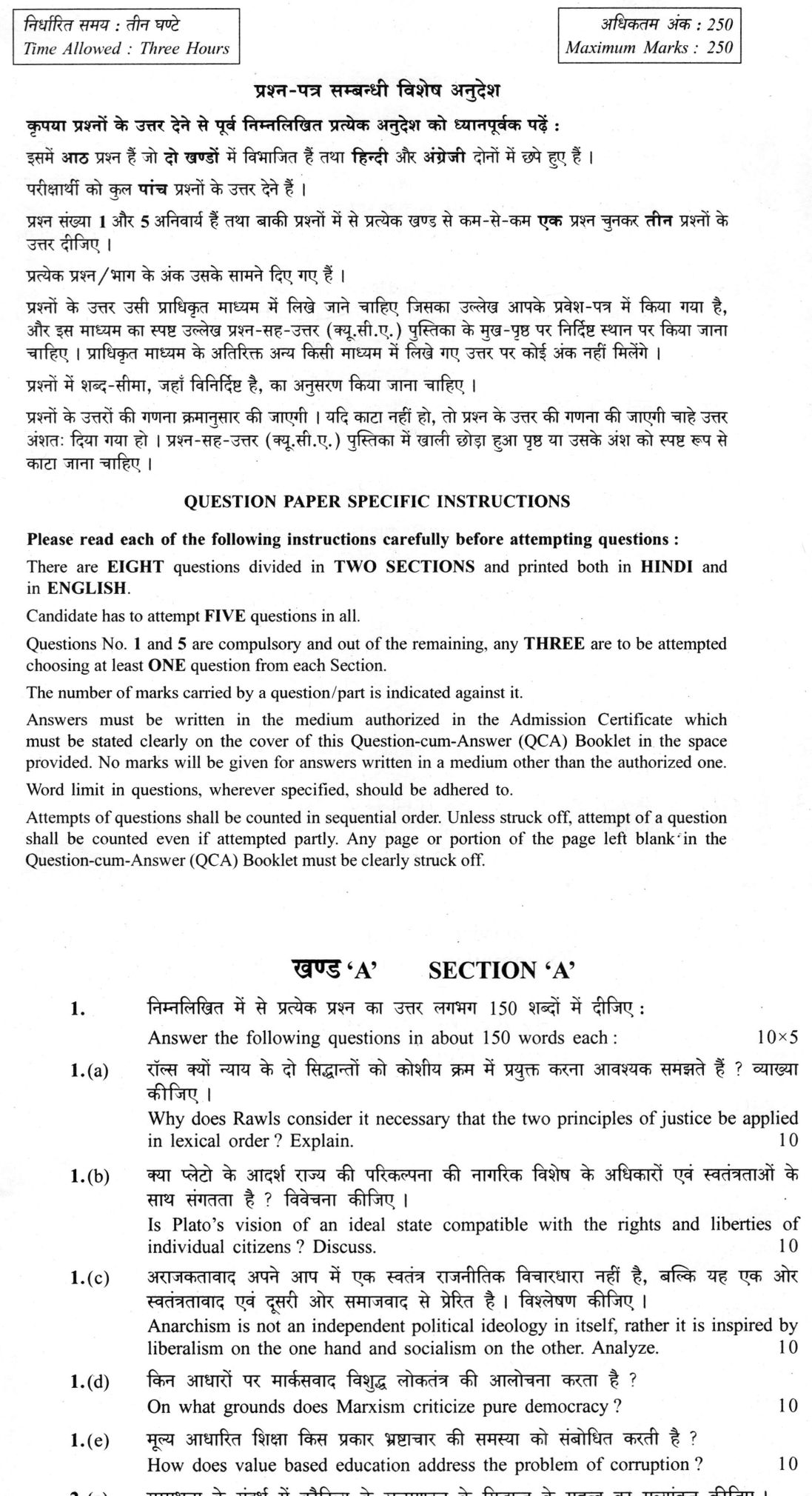
Answer the following questions in about 150 words each :
Why does Rawls consider it necessary that the two principles of justice be applied in lexical order ? Explain. 10 marks
Is Plato's vision of an ideal state compatible with the rights and liberties of individual citizens ? Discuss. 10 marks
Anarchism is not an independent political ideology in itself, rather it is inspired by liberalism on the one hand and socialism on the other. Analyze. 10 marks
On what grounds does Marxism criticize pure democracy ? 10 marks
How does value based education address the problem of corruption ? 10 marks
हिंदी में प्रश्न पढ़ें
निम्नलिखित में से प्रत्येक प्रश्न का उत्तर लगभग 150 शब्दों में दीजिए :
रॉल्स क्यों न्याय के दो सिद्धान्तों को कोशीय क्रम में प्रयुक्त करना आवश्यक समझते हैं ? व्याख्या कीजिए । (10 अंक)
क्या प्लेटो के आदर्श राज्य की परिकल्पना की नागरिक विशेष के अधिकारों एवं स्वतंत्रताओं के साथ संगतता है ? विवेचना कीजिए । (10 अंक)
अराजकतावाद अपने आप में एक स्वतंत्र राजनीतिक विचारधारा नहीं है, बल्कि यह एक ओर उदारवाद एवं दूसरी ओर समाजवाद से प्रेरित है । विश्लेषण कीजिए । (10 अंक)
किन आधारों पर मार्क्सवाद विशुद्ध लोकतंत्र की आलोचना करता है ? (10 अंक)
मूल्य आधारित शिक्षा किस प्रकार भ्रष्टाचार की समस्या को संबोधित करती है ? (10 अंक)
Model answer
Drafted with AI by UPSC Answer Check against this question's marking rubric, to the 150-word length. UPSC does not publish answers for Mains — this is one way to score well, not an official key. How we build rubrics and answers.
(a) Rawls: why the two principles are lexically ordered
In A Theory of Justice (1971) Rawls's first principle gives each person an equal right to the most extensive scheme of basic liberties compatible with a like scheme for all. The second requires that social and economic inequalities be attached to offices open to all under fair equality of opportunity and be to the greatest benefit of the least advantaged (the difference principle). The order is lexical: the first principle must be satisfied before the second, and fair equality of opportunity before the difference principle, so no gain in wealth can compensate for a loss of basic liberty.
The reasons come from the original position. Behind the veil of ignorance the parties do not know their conception of the good, so they cannot risk the liberties needed to pursue and revise whatever it turns out to be; reasoning by maximin, they will not trade them for economic advantage. Hence "liberty can be restricted only for the sake of liberty", and the right has priority over the good, rather than being balanced intuitively against welfare. Rawls confines the priority to reasonably favourable conditions; Hart argued that it was inadequately defended.
(b) Plato's ideal state and individual rights
The Kallipolis of the Republic is ruled by philosopher-kings, defended by auxiliaries and supported by producers, mirroring the three parts of the soul; justice is each class "doing its own work". Several institutions sit badly with individual rights and liberties: guardians have no private property or family, and mating is regulated; the "noble lie" of the metals fixes each person's station; poetry and music are censored (Books II–III, X). Popper (The Open Society and Its Enemies, 1945) reads this as totalitarian: the individual exists for the state. Aristotle (Politics II) had already objected that such excessive unity destroys the city.
In defence, "rights against the state" is an anachronistic standard; Plato aims at the happiness of the whole city, not of one class (Book IV); communism applies only to guardians and auxiliaries, not producers; and women may be guardians (Book V). Still, freedom of expression, choice of occupation and private life are subordinated to functional harmony. Plato's vision is therefore largely incompatible with modern individual rights, though not with the ideal of a common good.
(c) Anarchism: derivative or independent?
The statement has force. Individualist anarchism radicalises liberal premises of autonomy, contract and property: Josiah Warren and Benjamin Tucker, Max Stirner's egoism, and Murray Rothbard's anarcho-capitalism. Social anarchism draws on socialist ideals of equality and common ownership: Proudhon's mutualism ("property is theft"), Bakunin's collectivism and Kropotkin's communist anarchism grounded in Mutual Aid (1902).
But anarchism is not merely a hybrid. Its defining core, rejection of the state as such and of coercive authority, is shared by neither parent. Liberalism keeps at least a minimal, night-watchman state; Marxism keeps a transitional proletarian state that is later to wither away. The Bakunin–Marx split in the First International (1872) turned precisely on this. R. P. Wolff's In Defense of Anarchism (1970) gives the core its own philosophical basis: moral autonomy conflicts with any claim of legitimate authority. The two strands also disagree sharply about property, which shows that what unites them is anti-statism, not liberalism or socialism. Anarchism borrows its economics, but its political principle is its own.
(d) The Marxist critique of 'pure democracy'
"Pure democracy", in Lenin's polemic The Proletarian Revolution and the Renegade Kautsky (1918), means a supposedly class-neutral democracy standing above classes. Marxism rejects it on several grounds. First, the state is an instrument of class rule: "the executive of the modern state is but a committee for managing the common affairs of the whole bourgeoisie" (Communist Manifesto, 1848). Second, political emancipation is not human emancipation (On the Jewish Question, 1843): equal citizenship leaves the inequality of civil society untouched, so equality remains formal, not real. Third, economic power controls the press, parties and elections, so bourgeois democracy is "democracy for the rich" (Lenin, The State and Revolution, 1917).
The alternative is not the abolition of democracy but proletarian democracy: the Paris Commune, "the political form at last discovered" (The Civil War in France, 1871), the dictatorship of the proletariat as a transition (Critique of the Gotha Programme, 1875), and the eventual withering away of the state (Engels). Critics point to the record of one-party states, and Kautsky and Bernstein argued that parliamentary democracy could itself transform capitalism.
(e) Value-based education and corruption
In Klitgaard's formula corruption equals monopoly plus discretion minus accountability (C = M + D − A). Institutional reform acts on opportunity; value-based education acts on motivation, the disposition to use discretion honestly. It works through several mechanisms. It helps individuals internalise norms, so that honesty does not depend on fear of detection; Kohlberg's stages describe the move from punishment-avoidance to principled conscience. It forms character by habituation (Aristotle, Nicomachean Ethics II). It links the self to public duty: Gandhi's Nai Talim (Wardha, 1937) joined craft and character, and his "Seven Social Sins" include "commerce without morality" and "politics without principle"; Vivekananda called for "man-making" education. Policy echoes this in the Kothari Commission (1964–66), NEP 2020's stress on ethical and constitutional values, and the fundamental duties of Article 51A.
Its limits are real. A "hidden curriculum" of copying and favouritism can defeat classroom lessons, and values cannot substitute for reducing monopoly and discretion and raising accountability. Value education is thus necessary but not sufficient.
How this answer will be evaluated
Evaluation rubric
Each sub-part is marked on its own, against the marks and word limit printed on the paper.
- (a) 'Explain' the reasons (not merely state the principles): the candidate must first set out Rawls's two principles of justice from A Theory of Justice (1971) and then give the grounds why Rawls insists they be satisfied in lexical (serial) order rather than balanced against one another. 10 marks · 150 words
Must cover
- John Rawls, A Theory of Justice (1971)
- lexical / serial order
- principle of equal basic liberties
- fair equality of opportunity
- difference principle
- original position and veil of ignorance
- maximin
- priority of the right over the good
- 'liberty can be restricted only for the sake of liberty'
Loses marks
- Merely listing the two principles and never explaining WHY the order must be lexical — the question asks for the reason.
- Getting the internal order wrong: placing the difference principle before fair equality of opportunity.
- Confusing lexical priority with 'weighing' or 'balancing' the principles, which is precisely what Rawls rejects (intuitionism).
- Attributing a utilitarian reading to Rawls, or claiming the difference principle permits curtailing basic liberties for the poor.
- Ignoring Rawls's own caveat that the priority of liberty presupposes reasonably favourable economic conditions.
Earns more
- Original position ground: parties behind the veil of ignorance, reasoning under maximin and ignorant of their conception of the good, would secure basic liberty first
- Rawls's qualifications and a critical note: liberty restricted only for the sake of liberty; lexical priority presupposes favourable conditions (otherwise the general conception of justice); Hart's criticism that the priority of liberty is inadequately defended
- (b) 'Discuss' whether Plato's ideal state in the Republic can accommodate individual rights and liberties: the candidate must set out the relevant features of the Kallipolis, argue the case for incompatibility and the case for defence, and reach a reasoned verdict. 10 marks · 150 words
Must cover
- Plato, Republic
- Kallipolis / ideal state
- philosopher-king
- tripartite soul and tripartite state
- justice as doing one's own work
- communism of property and family for guardians
- noble lie / myth of the metals
- censorship of poetry (Books II-III, Book X)
- Karl Popper, The Open Society and Its Enemies (1945)
- Aristotle, Politics Book II
Loses marks
- Narrating the whole Republic (theory of Forms, allegory of the cave, divided line) instead of addressing rights and liberties.
- Asserting that Plato 'denied rights' without naming the specific institutions — censorship, noble lie, regulated procreation, abolition of guardian property — that show it.
- Attributing Popper's critique vaguely to 'critics' or misattributing it to Aristotle or to Russell.
- Presenting only the prosecution case; 'Discuss' requires the defence (anachronism of 'rights', Plato's aim of the good of the whole, equality of women guardians) as well.
- Wrongly saying the communism of property applies to the whole city — it applies only to the guardian and auxiliary classes, not the producers.
Earns more
- The defence: the Greeks had no concept of individual rights against the polis; Plato's declared aim is the happiness of the city as a whole rather than of any one class; Book V's admission of women to the guardian class; rule by knowledge rather than arbitrary will
- A clear, argued verdict rather than a listing — e.g. that Plato's state subordinates the individual to functional harmony and is therefore incompatible with liberal rights, while the anachronism charge is acknowledged
- (c) 'Analyze' a contested claim: the candidate must show how individualist anarchism draws on liberal premises and social/collectivist anarchism on socialist premises, and then judge whether anarchism nevertheless possesses an independent core of its own. 10 marks · 150 words
Must cover
- anti-statism as the core of anarchism
- individualist anarchism
- Max Stirner
- Benjamin Tucker / Josiah Warren
- anarcho-capitalism (Murray Rothbard)
- Pierre-Joseph Proudhon, 'property is theft'
- Mikhail Bakunin
- Peter Kropotkin, Mutual Aid
- the Bakunin–Marx split in the First International
- R. P. Wolff, In Defense of Anarchism (1970)
Loses marks
- Treating anarchism as a single doctrine and so being unable to show the two strands the question presupposes.
- Naming no anarchist thinker, or attributing 'property is theft' to Marx or Bakunin instead of Proudhon.
- Confusing anarchism with nihilism, terrorism or mere disorder, when the anarchist claim is that order is possible without the state.
- Simply agreeing with the statement; 'Analyze' requires testing it, including the reply that anarchism's rejection of the state as such is unique to it.
- Omitting anarcho-capitalism, which is the clearest evidence of the liberal inspiration the question alleges.
Earns more
- The counter-argument that anarchism is independent: liberalism keeps the minimal or night-watchman state and Marxism keeps a transitional proletarian state, whereas anarchism rejects the state as such — shown by the Bakunin–Marx conflict in the First International; R. P. Wolff's In Defense of Anarchism grounds it philosophically in the conflict between autonomy and authority
- A reasoned verdict that weighs both sides instead of merely agreeing with the statement
- (d) 'On what grounds' asks for the specific Marxist arguments against 'pure democracy' — the notion of a class-neutral, purely political democracy — and expects them to be attributed to Marx, Engels and Lenin rather than stated as generic criticism. 10 marks · 150 words
Must cover
- Lenin, The Proletarian Revolution and the Renegade Kautsky (1918)
- Lenin, The State and Revolution (1917)
- Marx, On the Jewish Question (1843) — political vs human emancipation
- Marx, The Civil War in France (1871) and the Paris Commune
- Communist Manifesto (1848)
- Critique of the Gotha Programme (1875) — dictatorship of the proletariat
- class character of the state
- formal vs substantive/real equality
- withering away of the state
Loses marks
- Giving a general leftist critique of democracy without attributing any ground to a named Marx, Engels or Lenin text.
- Claiming Marxism rejects democracy as such; it rejects bourgeois parliamentary democracy and proposes proletarian democracy in its place.
- Misdefining 'pure democracy' as direct democracy or as Athenian democracy — in Lenin's usage it is the alleged class-neutral democracy above classes.
- Confusing the dictatorship of the proletariat with personal dictatorship, or with the classless communist end-state.
- Omitting the formal/real equality distinction, which is the philosophical heart of the critique.
Earns more
- The positive alternative: the Paris Commune as the political form at last discovered, proletarian democracy and the dictatorship of the proletariat as a transitional stage (Critique of the Gotha Programme, 1875), the state withering away (Engels, Anti-Dühring; Lenin, The State and Revolution, 1917)
- Critical note: the historical record of one-party socialist states, and the reformist reply of Kautsky and Bernstein that parliamentary democracy can be used to transform capitalism
- (e) 'How does' requires a causal/mechanistic account: the candidate must show by what specific means value-based education acts on corruption (internalisation of norms, moral development, character formation), illustrate it from Indian educational thought and policy, and note its limits. 10 marks · 150 words
Must cover
- value-based education as internalisation of values
- Lawrence Kohlberg's stages of moral development
- Aristotle, Nicomachean Ethics — virtue by habituation
- Gandhi's Nai Talim / Basic Education (Wardha, 1937)
- Gandhi's 'Seven Social Sins'
- Swami Vivekananda's man-making education
- NEP 2020 / Kothari Commission on value education
- Article 51A fundamental duties
- Klitgaard's C = M + D − A
Loses marks
- Writing a general essay on the evils of corruption instead of showing the mechanism by which education acts on it.
- Giving pious generalities ('values should be taught') with no named theory, thinker, scheme or policy.
- Claiming value education alone can eliminate corruption, ignoring incentive structures, discretion and weak accountability.
- Confusing value education with religious or moral indoctrination — the Indian constitutional frame requires secular, reason-based value education (as the Sri Prakasa Committee debate showed).
- Ignoring the 'hidden curriculum': explicit moral instruction is undercut if the school or examination system is itself corrupt.
Earns more
- Indian sources named: Gandhi's Nai Talim / Basic Education scheme (Wardha, 1937) integrating craft, character and learning, and his 'Seven Social Sins' including commerce without morality and politics without principle; Vivekananda's 'man-making' education; Kothari Commission (1964-66) and the National Education Policy 2020 on ethical and constitutional values; Article 51A fundamental duties
- Honest statement of limits: value education is necessary but not sufficient — Robert Klitgaard's formula, corruption = monopoly + discretion − accountability, shows that opportunity structures must also change; the hidden curriculum of a corrupt institution can defeat explicit moral instruction
What "Explain" is asking you to do
Make the working of something clear — what sets it off, what follows from what, and what it produces. Explain is the Commission's mechanism word: it dominates the technical papers and the “explain why” stems, where the marks sit in the causal chain and not in the label.
Structure that answers it
State what it is → the initiating condition → the chain of cause, step by step → an instance where it plays out → what the chain produces
Where marks are lost
Describing what something looks like instead of why it works that way. Naming the stages without linking them reads as description too.
Practice this exact question
Write your answer and it is marked point by point against the model answer above — what you covered, what you missed, what you got wrong.
Evaluate my answer →More from Philosophy 2026 Paper II
- Q1 Answer the following questions in about 150 words each : (a) Why does Rawls consider it n…
- Q2 (a) Evaluate the importance of Kautilya's theory of Rajamandala in the context of soverei…
- Q3 (a) Retributivism presents a deontological justification for capital punishment, whereas…
- Q4 (a) How has Ambedkar applied the concept of ‘Social Endosmosis’ for annihilation of caste…