Paper II — Q4
(a) How has Ambedkar applied the concept of ‘Social Endosmosis’ for annihilation of castes. Evaluate its relevance for…
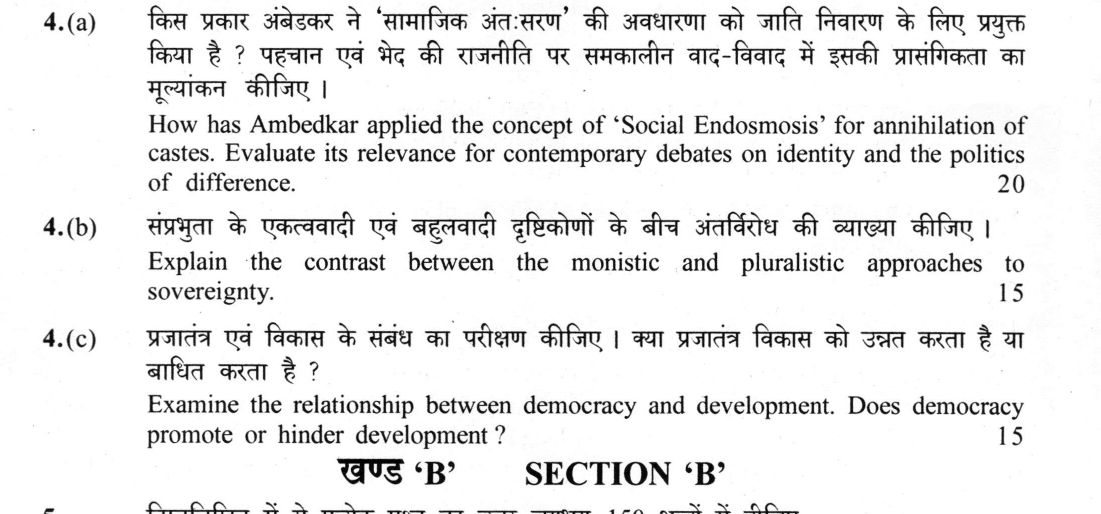
How has Ambedkar applied the concept of ‘Social Endosmosis’ for annihilation of castes. Evaluate its relevance for contemporary debates on identity and the politics of difference. 20 marks
Explain the contrast between the monistic and pluralistic approaches to sovereignty. 15 marks
Examine the relationship between democracy and development. Does democracy promote or hinder development ? 15 marks
हिंदी में प्रश्न पढ़ें
किस प्रकार अंबेडकर ने ‘सामाजिक अंत:सरण’ की अवधारणा को जाति निवारण के लिए प्रयुक्त किया है ? पहचान एवं भेद की राजनीति पर समकालीन वाद-विवाद में इसकी प्रासंगिकता का मूल्यांकन कीजिए । (20 अंक)
संप्रभुता के एकत्ववादी एवं बहुलवादी दृष्टिकोणों के बीच अंतर्विरोध की व्याख्या कीजिए । (15 अंक)
प्रजातंत्र एवं विकास के संबंध का परीक्षण कीजिए । क्या प्रजातंत्र विकास को उन्नत करता है या बाधित करता है ? (15 अंक)
Model answer
Drafted with AI by UPSC Answer Check against this question's marking rubric, to the expected length. UPSC does not publish answers for Mains — this is one way to score well, not an official key. How we build rubrics and answers.
(a) Ambedkar's social endosmosis and the annihilation of caste (20 marks)
Ambedkar's diagnosis, in Castes in India (1916), is that caste is an "enclosed class", sustained by endogamy imposed upon exogamous groups: since every group forbids marriage outside itself, the boundaries are rigid, and the resulting "surplus" of women or men is controlled through practices such as enforced widowhood and child marriage. In Annihilation of Caste (1936) he adds that the real barrier is religious sanction: the Shastras give caste a sacred authority, so it cannot be dislodged only by reform of custom.
"Social endosmosis" is the term, drawn from John Dewey's idea of democracy as "associated living", that he uses for an ideal society: one with many interests consciously communicated and shared, and with varied and free points of contact with other groups, so that a change in one part is conveyed to all. Endosmosis, like the diffusion of fluids through a membrane, means the free flow of persons, ideas and interests across group boundaries. Caste blocks this by closing off dining, marriage and occupation. Hence his remedies: inter-dining and, above all, intermarriage, which fuses blood and creates kinship feeling; the destruction of the religious authority of the Shastras; and a society built on liberty, equality and fraternity, where fraternity means "a mode of associated living". For him democracy is not merely government but an attitude of respect towards fellow-beings.
Contemporary relevance. First, it offers a test of real social integration: identity politics emphasises recognition, yet endosmosis reminds that recognition must be joined with a shared civic life, and that enclosed identities can turn into hierarchies. Second, it sharpens the debate on the politics of difference (Young, Taylor, Fraser): difference cannot be celebrated when it comes with graded inequality and exclusion; so Ambedkar rejects the "harmony" or pride in caste roles defended by others, including Gandhi's early defence of varna. Third, evidence supports his diagnosis: endogamy remains strong, with inter-caste marriage only in the low single-digit percentages in national surveys, and honour violence targets those who cross lines.
Evaluation. Strengths: it locates caste in social relations rather than only in economics, and it joins liberal ideals with a practical programme. Limits: intermarriage is slow and cannot be legislated, so critics say it underrates structural, economic and political levers such as reservation and land; and asserting Dalit identity (as Ambedkar himself did in demanding separate electorates and in the Poona Pact of 1932) may appear to conflict with annihilating caste. The reconciliation is that group assertion is a means to equality, while endosmosis is the end: a mobile, communicative society in which difference no longer means hierarchy.
(b) Monistic and pluralistic approaches to sovereignty (15 marks)
The monistic theory of sovereignty, of Bodin, Hobbes and Austin, holds that in every state there is one supreme, legally unlimited power, indivisible, inalienable and located in the state; law is its command, and all other associations, such as the church, the family and trade bodies, exist by its permission. Its merits are clarity of authority, law and order, and unity in decisions.
Pluralism, of Maitland, Figgis, Duguit, G. D. H. Cole, Barker and the early Laski, denies this. Society consists of many associations, each with its own purpose, rights and loyalties, that are not created by the state; the state is one association among them, distinguished by its territorial and coordinating role, not by unlimited power. Sovereignty should therefore be divided and shared, functionally, among the state, churches, unions and professional bodies; the state is to be judged as a public service, in Duguit's view, by its performance, and Laski insisted that people's loyalty is conditional on the state's serving the common good.
The contrast lies in: the nature of the power (unitary and absolute against divided and limited); the state's relation to associations (superior and source of rights against equal partner); the basis of obedience (command against consent and service); and the view of law (state command against social fact). Criticism of pluralism: someone must finally settle disputes among associations, so a supreme coordinating authority is inevitable, and Laski himself later moved away. Criticism of monism: it ignores social reality and permits absolutism. The two meet in modern constitutional systems: in India, sovereignty rests with the people and the Constitution is supreme, and the Basic Structure doctrine (Kesavananda Bharati, 1973) limits even Parliament, while federalism and international commitments divide sovereign power.
(c) Democracy and development (15 marks)
Development should be understood broadly. For Amartya Sen it is the expansion of substantive freedoms and capabilities, not only growth of income, and so it includes political freedom as both an end and a means. On that view democracy and development are constitutively linked.
The case that democracy promotes development: Sen shows that no substantial famine has occurred in a functioning democracy with a free press, because governments face electoral pressure and public criticism; democracies protect rights and property, provide accountability that checks corruption, generate information and allow peaceful correction of errors, and tend to invest more in health and education, giving steadier growth with less variance. Acemoglu and Robinson link prosperity to inclusive political institutions.
The case that it hinders: Lee Kuan Yew and the East Asian "developmental state" experience (South Korea, Taiwan, Singapore and, later, China) suggested that firm, authoritarian direction can achieve rapid growth by suppressing consumption, protecting investment and overriding interest groups; democracies may suffer short-termism, populism, coalition bargaining and delayed decisions. India's democracy long had slow growth, a "Hindu rate" of about 3.5% until the 1980s, though it then accelerated without abandoning democracy.
Evidence is mixed. Przeworski and Limongi found that democracy does not systematically raise or lower growth, although democracies in wealthy countries almost never collapse; Lipset's modernisation thesis argues that wealth favours democracy, so causation may run the other way; and authoritarian regimes vary from very successful to disastrous, since dictators are less checked. Hence the relation is conditional on institutions, state capacity and inequality; and democracy is valued not only as an instrument, because development that lacks freedom and participation is incomplete.
How this answer will be evaluated
Evaluation rubric
Each sub-part is marked on its own, against the marks and word limit printed on the paper.
- (a) How Ambedkar applied 'social endosmosis' for annihilation of caste; evaluate its relevance to contemporary debates on identity and the politics of difference (20). 20 marks
Must cover
- Caste as enclosed class sustained by endogamy (Castes in India, 1916) and the religious sanction of the Shastras
- Social endosmosis defined (Dewey-derived): free flow and communication across group boundaries; caste blocks it
- Application: inter-dining and intermarriage, destruction of Shastric authority, liberty-equality-fraternity
- Evaluation for identity and difference politics: recognition versus annihilation, graded inequality, strengths and limits
Loses marks
- Describing caste generally without endosmosis.
- Treating endosmosis as assimilation into the upper castes.
- One-sided praise or dismissal without evaluation.
Earns more
- Use of Annihilation of Caste (1936) and the phrase 'associated living'.
- Contemporary evidence (persistence of endogamy, honour violence) and theorists (Young, Taylor, Fraser).
Extra mark
- Reconciling Dalit assertion (Poona Pact) with annihilation as means and end
- (b) Explain the contrast between the monistic and pluralistic approaches to sovereignty (15). 15 marks
Must cover
- Monism: supreme, unlimited, indivisible power in the state (Bodin, Hobbes, Austin); law as command
- Pluralism: many associations, sovereignty divided and shared (Maitland, Figgis, Duguit, Cole, Laski)
- Points of contrast: nature of power, state and associations, basis of obedience, view of law
- Critique of each side and a modern link (Indian constitutional sovereignty, Basic Structure, federalism)
Loses marks
- Confusing legal with political sovereignty and ignoring the contrast.
- Attributing pluralism to Austin or monism to Cole.
- A list of thinkers with no contrast.
Earns more
- Named thinkers matched with the right position.
- Laski's later shift and Duguit's public service.
Extra mark
- Global and EU shared sovereignty
- (c) Examine the relationship between democracy and development; does democracy promote or hinder development (15). 15 marks
Must cover
- Broad concept of development (Sen's freedoms and capabilities) and conceptual link with democracy
- Case for democracy promoting development (famine, accountability, human development, stability)
- Case for hindering: developmental state, East Asia, short-termism, populism
- Mixed evidence and conditional conclusion (Przeworski-Limongi, Lipset, institutions and capacity)
Loses marks
- Equating development with GDP only.
- One-sided answer.
- Asserting that authoritarian growth is always better or always worse.
Earns more
- Indian experience (Hindu rate, later growth) used as evidence.
- Direction of causation discussed.
Extra mark
- Acemoglu-Robinson inclusive institutions
What "Evaluate" is asking you to do
Judge how well something has performed against the standard it set for itself — its stated aim, mandate or promise — and commit to a verdict. Name the yardstick before you judge; an unanchored judgement reads as opinion.
Structure that answers it
Name the yardstick — stated aim, mandate or benchmark → performance against it → shortfall against it → why the gap exists → verdict
Where marks are lost
Presenting both sides and then declining to decide, or delivering a verdict against a standard you never stated, which makes it look arbitrary.
Practice this exact question
Write your answer and it is marked point by point against the model answer above — what you covered, what you missed, what you got wrong.
Evaluate my answer →More from Philosophy 2026 Paper II
- Q1 Answer the following questions in about 150 words each : (a) Why does Rawls consider it n…
- Q2 (a) Evaluate the importance of Kautilya's theory of Rajamandala in the context of soverei…
- Q3 (a) Retributivism presents a deontological justification for capital punishment, whereas…
- Q4 (a) How has Ambedkar applied the concept of ‘Social Endosmosis’ for annihilation of caste…
- Q5 Answer the following questions in about 150 words each : (a) On what grounds does William…
- Q6 (a) In what sense does St. Augustine's identification of all evil as either sin or as the…
- Q7 (a) Analyse R. M. Hare's concept of ‘blik’ and assess whether it successfully defends the…