Paper II — Q5
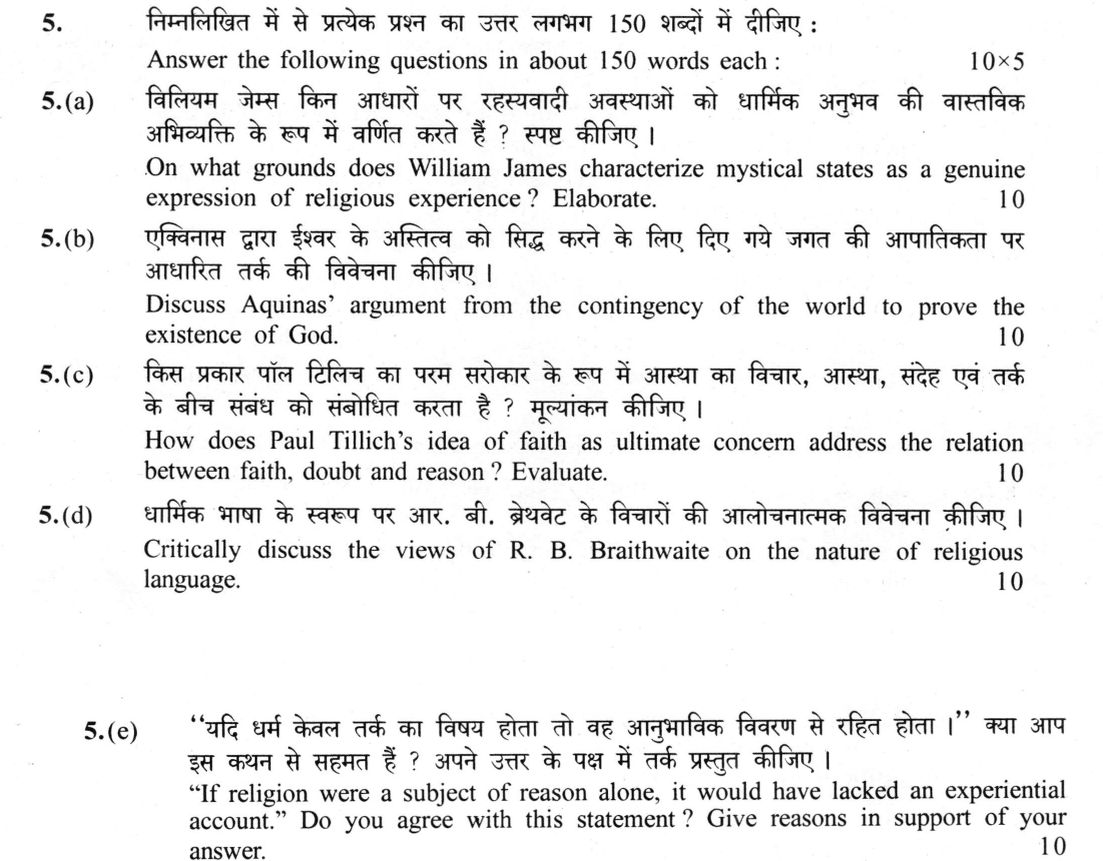
(a) On what grounds does William James characterize mystical states as a genuine expression of religious experience ? Elaborate…
Answer the following questions in about 150 words each :
On what grounds does William James characterize mystical states as a genuine expression of religious experience ? Elaborate. 10 marks
Discuss Aquinas’ argument from the contingency of the world to prove the existence of God. 10 marks
How does Paul Tillich’s idea of faith as ultimate concern address the relation between faith, doubt and reason ? Evaluate. 10 marks
Critically discuss the views of R. B. Braithwaite on the nature of religious language. 10 marks
“If religion were a subject of reason alone, it would have lacked an experiential account.” Do you agree with this statement ? Give reasons in support of your answer. 10 marks
हिंदी में प्रश्न पढ़ें
निम्नलिखित में से प्रत्येक प्रश्न का उत्तर लगभग 150 शब्दों में दीजिए :
विलियम जेम्स किन आधारों पर रहस्यवादी अवस्थाओं को धार्मिक अनुभव की वास्तविक अभिव्यक्ति के रूप में वर्णित करते हैं ? स्पष्ट कीजिए । (10 अंक)
एक्विनास द्वारा ईश्वर के अस्तित्व को सिद्ध करने के लिए दिए गए जगत की आपातिकता पर आधारित तर्क की विवेचना कीजिए । (10 अंक)
किस प्रकार पॉल टिलिच का परम सरोकार के रूप में आस्था का विचार, आस्था, संदेह एवं तर्क के बीच संबंध को संबोधित करता है ? मूल्यांकन कीजिए । (10 अंक)
धार्मिक भाषा के स्वरूप पर आर. बी. ब्रेथवेट के विचारों की आलोचनात्मक विवेचना कीजिए । (10 अंक)
“यदि धर्म केवल तर्क का विषय होता तो वह आनुभाविक विवरण से रहित होता है।” क्या आप इस कथन से सहमत हैं ? अपने उत्तर के पक्ष में तर्क प्रस्तुत कीजिए । (10 अंक)
Model answer
Drafted with AI by UPSC Answer Check against this question's marking rubric, to the 150-word length. UPSC does not publish answers for Mains — this is one way to score well, not an official key. How we build rubrics and answers.
(a) James on mystical states as genuine religious experience (10 marks)
In The Varieties of Religious Experience (1902) James identifies four marks of mystical states: ineffability (they defy expression), a noetic quality (they seem to disclose truth unavailable to the intellect), transiency, and passivity (the subject feels held by a higher power). His grounds for regarding them as genuine expressions of religious experience are these. First, they are, and have every right to be, absolutely authoritative for the person who has them, being immediate and not dependent on inference. Second, they are not authoritative for others, who may weigh them critically. Third, they break the monopoly of rationalistic, non-mystical consciousness, showing it is only one type of consciousness among others, so they must be taken into account. Further, James judges religion pragmatically "by its fruits": mystical states yield saintliness, charity, and moral strength. Their convergence across traditions supports a shared core, though James concedes they establish no proof for outsiders.
(b) Aquinas's argument from contingency (10 marks)
The Third Way (Summa Theologiae I, q.2, a.3) argues from possibility and necessity. We observe things that are contingent, that come into being and pass away, so that they can exist or not exist. If everything were contingent, then at some time nothing would have existed; but then nothing could begin to exist, and nothing would exist now, which is false. So something must exist necessarily. A necessary being either has its necessity from another or from itself; an infinite regress of necessary beings dependent on others is impossible, so there must be a being necessary in itself, which is the source of the necessity of others, and this is God.
Criticisms: Hume, Kant and Russell held that the move from "each thing has a time when it does not exist" to "there was a time when nothing existed" is a quantifier-shift fallacy; the world might be eternal or a brute fact (Russell, in his debate with Copleston); the notion of necessary existence is questioned; and modern cosmology changes the premises. Defenders (Leibniz, Copleston) recast it through the principle of sufficient reason.
(c) Tillich: faith as ultimate concern, doubt and reason (10 marks)
In Dynamics of Faith (1957) Tillich defines faith as the state of being ultimately concerned: a total, centred act of the whole person directed to what is of unconditional significance, which he calls God, or the "ground of being". Faith is therefore not belief on inadequate evidence, and not opposed to reason, which is the structure of the mind and works within faith. Doubt is not the opposite of faith but an element within it: the risk of commitment includes doubt, and real faith involves the courage to accept doubt and insecurity, as in the "courage to be". Sceptical or methodological doubt is compatible with faith, whereas the doubt of indifference is not. Evaluation: he reconciles faith with reason and honest doubt, and locates faith in existential seriousness. Critics say "ultimate concern" is vague and too wide, since it could include nationalism or success (which he calls idolatry), and it makes faith impersonal and thin in doctrinal content.
(d) Braithwaite on the nature of religious language (10 marks)
R. B. Braithwaite, in An Empiricist's View of the Nature of Religious Belief (1955), accepts the verification principle: religious statements are not empirically verifiable as factual claims about a supernatural being, so they are not cognitive assertions. Instead they are like moral statements, declarations of adherence to a policy of action, a way of life such as the agapeistic (loving) one; to assert "God is love" is to commit oneself to live lovingly. Religious stories (parables, the Christian narrative) need not be believed as true; they are entertained as stories that psychologically support and intensify that commitment.
Criticism: this reduces religion to ethics plus stories, and makes it fail to be what believers mean, since they assert the truth of, say, the Resurrection; it separates the moral policy from the story, leaving the story with no distinct role; and later thinkers (Ramsey, Wittgenstein's followers) offer alternative accounts of meaning through language-games and models. Still, it takes religious use seriously and shows that non-cognitive accounts avoid the falsification problem.
(e) Reason and the experiential account of religion (10 marks)
I agree, with qualification. If religion were a subject for reason alone, it would consist of arguments about God's existence and morality, an abstract natural theology or deism, and there would be no place for accounts of encounter, worship, awe and communion. Yet such accounts pervade religion: Schleiermacher's feeling of absolute dependence, Otto's numinous, James's mystical states, and the testimony of saints in every tradition. Kierkegaard argues that faith involves passion and a leap that reason cannot supply, and Swinburne's principle of credulity treats experience as prima facie evidence. Therefore the fact that religion has an experiential dimension shows that it exceeds reason.
The qualification is that experience does not replace reason. Experiences are not self-authenticating, differ across traditions and can be explained neurologically, so reason must scrutinise, interpret and compare them. Religion is best seen as a domain in which reason and experience work together, with neither sufficient alone.
How this answer will be evaluated
Evaluation rubric
Each sub-part is marked on its own, against the marks and word limit printed on the paper.
- (a) On what grounds does William James characterise mystical states as a genuine expression of religious experience (10, about 150 words). 10 marks · 150 words
Must cover
- Four marks: ineffability, noetic quality, transiency, passivity
- Authoritative for the subject but not for others
- Breaks the monopoly of rationalistic consciousness
- Pragmatic test: fruits in saintliness and moral life (Varieties, 1902)
Loses marks
- Only listing four marks with no grounds for genuineness.
- Attributing four marks to another author.
- Claiming James proves the existence of God.
Earns more
- Cross-traditional convergence.
- Limits acknowledged by James.
Extra mark
- Comparison with the immediacy, luminousness, helpfulness criteria
- (b) Discuss Aquinas's argument from the contingency of the world (10, about 150 words). 10 marks · 150 words
Must cover
- Third Way from possibility and necessity (Summa I, q.2, a.3)
- Contingent beings; if all contingent, at some time nothing; so something necessary
- No infinite regress of dependently necessary beings; a being necessary in itself, God
- At least one criticism (quantifier-shift, eternal world, necessary existence) or reply
Loses marks
- Confusing with the First or Fifth Way.
- Presenting the argument without a criticism.
- Misstating that the world had a beginning in time as a premise.
Earns more
- Contrast of the reasoning with the cosmological argument of Leibniz (PSR).
- Russell-Copleston debate.
Extra mark
- Modern cosmology bearing on the premises
- (c) How does Tillich's idea of faith as ultimate concern address the relation between faith, doubt and reason; evaluate (10, about 150 words). 10 marks · 150 words
Must cover
- Faith as ultimate concern, the whole person, unconditional
- Doubt as an element within faith; courage
- Reason not opposed to faith; faith is not belief on weak evidence
- Evaluation: strengths and criticisms (vagueness, breadth, idolatry, impersonal God)
Loses marks
- Treating doubt as the opposite of faith.
- No evaluation.
- Confusing Tillich with Kierkegaard or Barth.
Earns more
- Distinction between existential and methodological doubt.
- Dynamics of Faith (1957) and The Courage to Be.
Extra mark
- God as 'ground of being' and symbolic language
- (d) Critically discuss Braithwaite's views on the nature of religious language (10, about 150 words). 10 marks · 150 words
Must cover
- Empiricist acceptance of verification; religious statements non-cognitive
- Religious assertion as declaration of adherence to a policy of action (agapeistic way of life)
- Role of stories: entertained, not asserted as true, to support commitment
- Criticism: reductionism, believers assert truth, the story's redundant role
Loses marks
- Attributing to Braithwaite the claim that religious statements are meaningless.
- Uncritical exposition.
- Confusing with Ayer or Flew.
Earns more
- Compare with the moral-language analogy.
- Alternatives such as Ramsey or language-games.
Extra mark
- Falsification challenge avoided by non-cognitivism
- (e) 'If religion were a subject of reason alone, it would have lacked an experiential account.' Agree or not, with reasons (10, about 150 words). 10 marks · 150 words
Must cover
- Clear position stated
- Reasons that religion goes beyond reason: experience, worship, mystical states (Schleiermacher, Otto, James)
- Role of reason in scrutinising experience; limits of self-authenticating experience
- Balanced conclusion (reason and experience jointly)
Loses marks
- No position taken.
- Only listing thinkers.
- Dismissing experience or reason entirely.
Earns more
- Use of Kierkegaard or Swinburne's credulity principle.
- Alternative explanation (neurological) of experience.
Extra mark
- Distinction between natural theology and revealed religion
What "Elaborate" is asking you to do
Give the full detailed account the question has compressed into a line — every dimension of it, with specifics. Elaborate rewards completeness and detail rather than clarification or argument: the examiner is checking whether you can fill out a topic without being told what its parts are.
Structure that answers it
State the proposition → first dimension in detail → second dimension in detail → the part the statement leaves implicit → the consolidated picture
Where marks are lost
Repeating the statement at greater length instead of adding substance. Elaborate also punishes narrowness: omitting a whole dimension costs more here than anywhere else in this family.
Practice this exact question
Write your answer and it is marked point by point against the model answer above — what you covered, what you missed, what you got wrong.
Evaluate my answer →More from Philosophy 2026 Paper II
- Q2 (a) Evaluate the importance of Kautilya's theory of Rajamandala in the context of soverei…
- Q3 (a) Retributivism presents a deontological justification for capital punishment, whereas…
- Q4 (a) How has Ambedkar applied the concept of ‘Social Endosmosis’ for annihilation of caste…
- Q5 Answer the following questions in about 150 words each : (a) On what grounds does William…
- Q6 (a) In what sense does St. Augustine's identification of all evil as either sin or as the…
- Q7 (a) Analyse R. M. Hare's concept of ‘blik’ and assess whether it successfully defends the…
- Q8 (a) Critically evaluate the shift in Gandhi's view from ‘God is Truth’ to ‘Truth is God’,…