Paper II — Q6
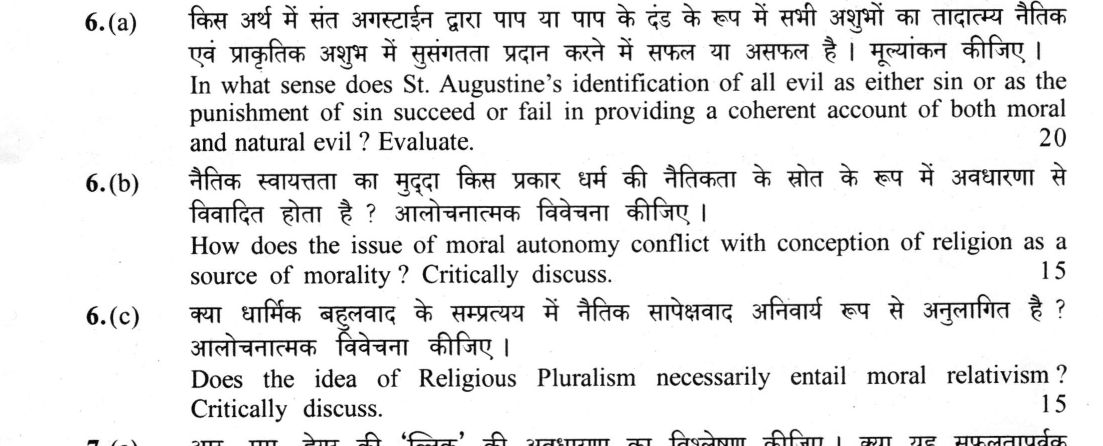
(a) In what sense does St. Augustine's identification of all evil as either sin or as the punishment of sin succeed or fail in…
In what sense does St. Augustine's identification of all evil as either sin or as the punishment of sin succeed or fail in providing a coherent account of both moral and natural evil ? Evaluate. 20 marks
How does the issue of moral autonomy conflict with conception of religion as a source of morality ? Critically discuss. 15 marks
Does the idea of Religious Pluralism necessarily entail moral relativism ? Critically discuss. 15 marks
हिंदी में प्रश्न पढ़ें
किस अर्थ में संत अगस्टाईन द्वारा पाप या पाप के दंड के रूप में सभी अशुभों का तादात्म्य नैतिक एवं प्राकृतिक अशुभ में सुसंगता प्रदान करने में सफल या असफल है । मूल्यांकन कीजिए । (20 अंक)
नैतिक स्वायत्तता का मुद्दा किस प्रकार धर्म की नैतिकता के स्रोत के रूप में अवधारणा से विवादित होता है ? आलोचनात्मक विवेचना कीजिए । (15 अंक)
क्या धार्मिक बहुलवाद के सम्प्रत्यय में नैतिक सापेक्षवाद अनिवार्य रूप से अनुलगित है ? आलोचनात्मक विवेचना कीजिए । (15 अंक)
Model answer
Drafted with AI by UPSC Answer Check against this question's marking rubric, to the expected length. UPSC does not publish answers for Mains — this is one way to score well, not an official key. How we build rubrics and answers.
(a) Augustine on evil: sin and punishment for sin (20 marks)
Augustine's account, developed against the Manichaeans in the Confessions, On Free Choice of the Will, the Enchiridion and The City of God, holds that God is wholly good and made everything good; evil therefore is not a substance but a privation of good (privatio boni), a corruption or deficiency in something good, as blindness is the absence of sight. Evil is of two kinds, both traced back to the will. Moral evil is sin: rational creatures, angels and humans, freely turn from the higher good (God) to lower goods, and the cause is a defective will, not any created nature. Natural evil (pain, disease, death, disorder in nature) is the punishment of sin: through Adam's Fall, human nature and the created order were corrupted, and suffering is a just penalty, and also serves as discipline. Additionally, the beauty of the whole, in which evil is like shadow that sets off light, is a justification, and God can bring good out of evil.
Success. The theory is coherent: it removes any charge that God is the author of evil; it avoids Manichaean dualism; it unifies moral and natural evil under one explanation, the misuse of freedom; and it preserves divine justice, which punishes only what is deserved. It reasons that a world with free creatures is better than one without, so the possibility of sin is a good.
Failure. First, natural evils, earthquakes, predation, and disease, existed long before humans, as science shows, so they cannot be punishment for the Fall, and evolution presupposes death and suffering; Augustine's view of a historical Adam and a cosmic fall is untenable. Second, the suffering of infants, animals and the innocent is disproportionate and unjust as a penalty; and a doctrine of inherited guilt is morally questionable, as is everlasting hell. Third, privation minimises what is felt as positive, since pain is not merely absence. Fourth, as Schleiermacher and Hick observe, if Adam was created perfect and free from evil, why did he sin? Either the flaw lay in his creation or sin was uncaused, which is incoherent. Hick therefore prefers the Irenaean approach, in which suffering serves soul-making.
Evaluation: Augustine gives a logically coherent framework, strong against the problem of moral evil and the ontological status of evil, but it strains against the facts of natural evil and the demand for proportionate justice; hence, it succeeds chiefly as a defence of God's goodness and fails as a full explanation.
(b) Moral autonomy and religion as the source of morality (15 marks)
Moral autonomy, in Kant, means that a rational agent gives the moral law to himself; the will is autonomous when it acts from duty out of respect for law that reason legislates, and heteronomous when it is determined by anything external, such as desire, social pressure or an authority's command. The conception of religion as the source of morality, as in divine command theory, holds that right and wrong are constituted by God's will and are known through revelation, and that obedience is the ground of moral duty.
The conflict arises here. If actions are right only because God commands them, moral agents obey an external will, which is heteronomy, and moral worth seems to rest on fear of punishment or hope of reward. It also raises the Euthyphro dilemma: is an act good because God commands it, so that morality is arbitrary and God could command cruelty; or does God command it because it is good, so that morality is independent of God? Further, moral knowledge and motivation appear available to non-believers, and religious moral claims that contradict conscience (Abraham's binding of Isaac, Kierkegaard's "teleological suspension of the ethical") show the tension.
Critical discussion. Kant himself did not see religion as the source but held that morality leads to religion: we recognise our duties as divine commands, and God is a postulate of practical reason (Religion within the Boundaries of Mere Reason). Aquinas's natural law treats moral law as reason's participation in God's eternal law, so following reason is following God; Tillich's theonomy sees autonomy and divine ground as united; and Adams's modified divine command theory locates the good in God's loving nature, avoiding arbitrariness. The conflict is thus sharp only for the strong voluntarist version; a rational theistic ethics can honour autonomy. Yet the dilemma about authority remains for revelation-based systems.
(c) Religious pluralism and moral relativism (15 marks)
Religious pluralism, as in Hick, holds that the major traditions are different, culturally conditioned responses to one ultimate Reality and that all are equally valid paths to salvation or liberation; it is echoed in Indian thought (Ramakrishna's "as many paths as faiths", Gandhi's sarva dharma sama bhava). Moral relativism holds that moral judgments are true or right only relative to a culture, group or individual, and that there is no universal standard.
The idea does not necessarily entail relativism. First, the two are different questions: pluralism concerns the truth and soteriological validity of religions, while relativism concerns the status of moral judgments; a pluralist can hold universal moral principles. Second, Hick argues that the traditions are validated by a common moral criterion, the transformation of human existence from self-centredness to Reality-centredness, seen in shared moral ideals such as the golden rule and compassion; Küng's Global Ethic makes a similar claim. Third, pluralism itself rests on universal values, tolerance and respect for persons, which are not relative.
However, a risk remains. If every tradition is equally valid, yet they conflict on moral practices such as caste hierarchy, treatment of women or sacrifice, the pluralist seems unable to criticise any of them unless there is a criterion independent of the traditions; if none exists, relativism follows, and if one exists, then it, not the religion, becomes the final standard. Critics (exclusivists like Plantinga, and Hick's critics such as D'Costa) also say pluralism ignores real contradictions. In India, the Constitution deals with this by combining equal respect for all religions with fundamental rights that limit religious practice.
No necessary entailment, but pluralism must supply a shared moral criterion, or slide into relativism.
How this answer will be evaluated
Evaluation rubric
Each sub-part is marked on its own, against the marks and word limit printed on the paper.
- (a) In what sense does Augustine's identification of all evil as sin or punishment for sin succeed or fail in giving a coherent account of moral and natural evil (20). 20 marks
Must cover
- Evil as privation (privatio boni), against Manichaeism
- Moral evil as sin from misused free will; natural evil as punishment for sin (the Fall)
- Success: coherence, God not author of evil, unity of the account, justice
- Failure: pre-human natural evil and evolution, disproportionate suffering of innocents, positive reality of pain, origin of the first sin
Loses marks
- Merely describing Augustine without evaluating.
- Confusing privation with denying the reality of suffering.
- Ignoring natural evil.
Earns more
- Named texts (Confessions, City of God, On Free Choice).
- Hick's contrast of Augustinian and Irenaean theodicies.
Extra mark
- Aesthetic argument and Schleiermacher's objection
- (b) How does moral autonomy conflict with religion as a source of morality; critically discuss (15). 15 marks
Must cover
- Autonomy (Kant) versus heteronomy; divine command theory
- The conflict: obedience to external will, Euthyphro dilemma, motivation by reward and punishment
- Reconciliations: Kant's postulate, Aquinas's natural law, Tillich's theonomy, modified divine command
- Critical conclusion: sharp only for strong voluntarism; residual tension with revelation
Loses marks
- Treating religion as necessarily opposed to morality.
- Stating the Euthyphro dilemma incorrectly.
- No critical evaluation.
Earns more
- Abraham and Kierkegaard's suspension of the ethical.
- Non-believers' moral knowledge.
Extra mark
- Adams's modified divine command theory
- (c) Does religious pluralism necessarily entail moral relativism; critically discuss (15). 15 marks
Must cover
- Definitions of pluralism (Hick) and moral relativism
- Argument that they are different questions and entailment does not follow
- Common moral criterion (Hick's Reality-centredness, golden rule, Global Ethic); pluralism rests on universal values
- The risk when traditions conflict morally, and the need for an independent criterion; conclusion
Loses marks
- Equating pluralism with relativism without argument.
- Only describing religions.
- No judgement on the word 'necessarily'.
Earns more
- Indian anchors (Ramakrishna, Gandhi, Constitution).
- Criticism from exclusivists.
Extra mark
- Distinction of ethical and religious pluralism
What "Evaluate" is asking you to do
Judge how well something has performed against the standard it set for itself — its stated aim, mandate or promise — and commit to a verdict. Name the yardstick before you judge; an unanchored judgement reads as opinion.
Structure that answers it
Name the yardstick — stated aim, mandate or benchmark → performance against it → shortfall against it → why the gap exists → verdict
Where marks are lost
Presenting both sides and then declining to decide, or delivering a verdict against a standard you never stated, which makes it look arbitrary.
Practice this exact question
Write your answer and it is marked point by point against the model answer above — what you covered, what you missed, what you got wrong.
Evaluate my answer →More from Philosophy 2026 Paper II
- Q3 (a) Retributivism presents a deontological justification for capital punishment, whereas…
- Q4 (a) How has Ambedkar applied the concept of ‘Social Endosmosis’ for annihilation of caste…
- Q5 Answer the following questions in about 150 words each : (a) On what grounds does William…
- Q6 (a) In what sense does St. Augustine's identification of all evil as either sin or as the…
- Q7 (a) Analyse R. M. Hare's concept of ‘blik’ and assess whether it successfully defends the…
- Q8 (a) Critically evaluate the shift in Gandhi's view from ‘God is Truth’ to ‘Truth is God’,…