Paper II — Q7
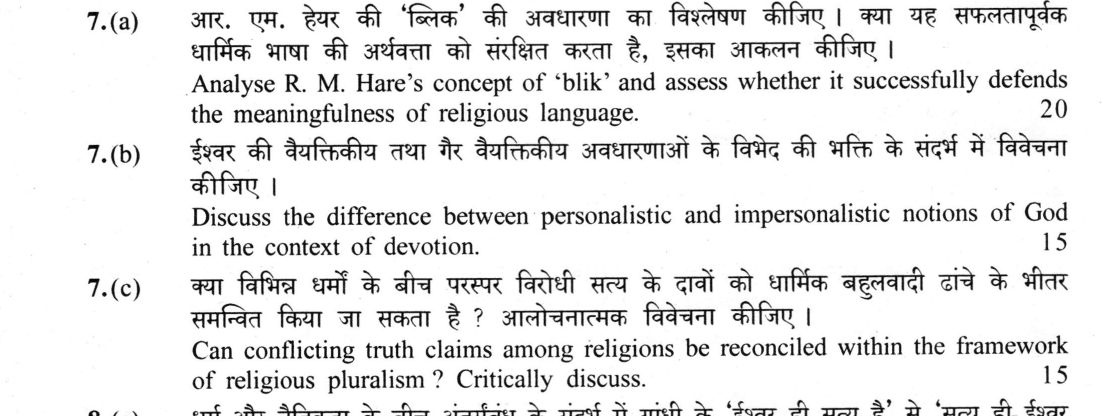
(a) Analyse R. M. Hare's concept of ‘blik’ and assess whether it successfully defends the meaningfulness of religious language…
Analyse R. M. Hare's concept of ‘blik’ and assess whether it successfully defends the meaningfulness of religious language. 20 marks
Discuss the difference between personalistic and impersonalistic notions of God in the context of devotion. 15 marks
Can conflicting truth claims among religions be reconciled within the framework of religious pluralism ? Critically discuss. 15 marks
हिंदी में प्रश्न पढ़ें
आर. एम. हेयर की ‘ब्लिक’ की अवधारणा का विश्लेषण कीजिए । क्या यह सफलतापूर्वक धार्मिक भाषा की अर्थवत्ता को संरक्षित करता है, इसका आकलन कीजिए । (20 अंक)
ईश्वर की वैयक्तिकीय तथा गैर वैयक्तिकीय अवधारणाओं के विभेद की भक्ति के संदर्भ में विवेचना कीजिए । (15 अंक)
क्या विभिन्न धर्मों के बीच परस्पर विरोधी सत्य के दावों को धार्मिक बहुलवादी ढांचे के भीतर समन्वित किया जा सकता है ? आलोचनात्मक विवेचना कीजिए । (15 अंक)
Model answer
Drafted with AI by UPSC Answer Check against this question's marking rubric, to the expected length. UPSC does not publish answers for Mains — this is one way to score well, not an official key. How we build rubrics and answers.
(a) Hare's concept of a blik and the meaningfulness of religious language (20 marks)
The context is Antony Flew's challenge in "Theology and Falsification" (1955): a religious assertion, like that of the invisible, undetectable gardener in Wisdom's parable, is emptied of meaning if nothing could count against it, because it "dies the death of a thousand qualifications". Believers, in his view, make claims about God's love that they protect from any evidence of suffering, and so say nothing.
R. M. Hare, replying in the same volume, accepts that religious claims are not falsifiable assertions but denies that they are meaningless. He introduces the blik: a fundamental, unfalsifiable way of seeing the world, an attitude or framework of interpretation, that determines how one takes all experience but is not itself an explanation. His parable: a lunatic is convinced that the university dons want to murder him; each kind, harmless don he meets is taken as proof of their cunning, and no evidence can dislodge his blik. A sane person has a different blik, that dons are friendly, which is likewise not an assertion open to refutation. Yet the difference matters: it is important which blik one has, since bliks shape action and one's response to the world; the lunatic's blik is wrong, and the sane one right, though neither is verified. Our belief in the uniformity of nature and in the regularity of the world is such a blik. So religious language expresses a blik, a way of living and seeing, and is meaningful in that role.
Assessment. Success: Hare shows that unfalsifiable statements can be meaningful and important, since they underlie all empirical inquiry and shape conduct; he identifies the regulative and attitudinal function of religious talk, and he changes the debate from evidence to commitment.
Failure. First, Flew replies that if religious belief is only a blik, it says nothing about how the world is, so the religious person cannot claim that God exists or loves; the believer's claim is factual and the blik makes it non-cognitive, which believers reject. Second, Basil Mitchell (the parable of the Partisan and the Stranger) argues that religious belief is not immune to evidence: the believer takes suffering as a real strain, holds his faith by trust, and so his claims are cognitive though not conclusively falsifiable. Third, Hare gives no criterion for sane against insane bliks, so the view risks relativism or irrationality; and if religious bliks are just attitudes, no rational choice between them is possible. Fourth, it leaves out the difference between being a Christian and a naturalist who holds the same practical attitudes.
Conclusion: the blik defends religious language against the charge of meaninglessness only by relocating it to non-cognitive ground, a costly defence which preserves significance but not the truth-claim that believers make.
(b) Personal and impersonal notions of God and devotion (15 marks)
A personal God is a being with will, knowledge, love and responsiveness, one to whom the believer stands as an "I" to a "Thou" (Buber): the Christian, Islamic and Vaishnava God. An impersonal God is an ultimate reality without personality or attributes: Shankara's nirguna Brahman, Spinoza's God-or-Nature, Tillich's ground of being, the Tao.
In devotion (bhakti) the two differ. With a personal God, devotion is a loving relationship: prayer, surrender, worship, gratitude and trust in grace; there is a distinction between devotee and deity, which Ramanuja treats as real, since love needs an object who can respond. The experience is emotional, intimate and moral, and the problems are anthropomorphism, the problem of evil and divine partiality. With an impersonal God, there is nothing to love or address; the path is contemplation and knowledge (jnana), aiming at realisation or identification, and devotion is a reverence for a truth or a meditation, not a dialogue; the risk is that it lacks warmth and comfort and cannot answer prayer. Shankara himself allows worship of saguna Ishvara at the practical level as a preparation for knowledge. The Bhagavad Gita (12.5) acknowledges that devotion to the unmanifest is possible but harder for embodied beings. Kabir and Nanak show a synthesis: nirguna bhakti, love for a formless God. Thus personal notions support the bhakti of relation, impersonal notions support the path of knowledge or meditation, and many traditions use both.
(c) Conflicting truth claims and religious pluralism (15 marks)
Religions make claims that seem to conflict: on God's nature (Trinity against strict monotheism, theism against non-theism), on Jesus (divine, prophet, or neither), on the afterlife (resurrection, rebirth), and on salvation. Pluralism must reconcile them if all are equally valid.
Attempts at reconciliation. Hick draws on Kant: the Real an sich is beyond human concepts, and different traditions experience it through different cultural lenses, the personae and impersonae of the Real; so the doctrines are different phenomenal descriptions and are not literally competing. He reads doctrines like the Incarnation as myth or metaphor, and holds that they are judged by their soteriological fruits, the transformation from self-centredness. Jain anekantavada, the doctrine of many-sidedness, and syadvada hold that any claim is partly true from a standpoint (the blind men and the elephant); Vivekananda and Ramakrishna offer a Vedantic version of unity beneath diversity.
Criticism. First, some claims are historical or factual and contradictory: Christians say Jesus died on the cross and rose, while the Quran (4:157) denies it; both cannot be literally true. Reconciliation by treating them as myth denies the traditions' own self-understanding, so pluralism is a revisionary claim. Second, Plantinga argues that pluralism is itself a competing truth claim, since it excludes exclusivism, and that it cannot be known if the Real is beyond concepts. Third, the notion of the Real is not neutral: the non-theistic traditions and the theistic ones do not all agree that there is a transcendent Real. Fourth, alternative responses are exclusivism and inclusivism (Rahner's "anonymous Christians").
Pluralism can reconcile conflicts on the level of function, salvation and practice, and on symbolic or non-literal readings, but not fully on the literal, factual claims; a modest pluralism, treating traditions as partial and revisable, is better placed than a strong one.
How this answer will be evaluated
Evaluation rubric
Each sub-part is marked on its own, against the marks and word limit printed on the paper.
- (a) Analyse Hare's concept of a blik and assess whether it successfully defends the meaningfulness of religious language (20). 20 marks
Must cover
- Context: Flew's falsification challenge (Gardener parable)
- Blik defined with the lunatic-student parable; unfalsifiable but consequential; sane versus insane bliks
- Religious language as expressing a blik; regulative, attitudinal meaning
- Assessment: success (meaningful, underlies empirical inquiry) and failure (non-cognitive, Mitchell's reply, no criterion, believers' factual claims)
Loses marks
- Confusing blik with a falsifiable hypothesis.
- No assessment.
- Attributing the Gardener parable to Hare.
Earns more
- Uniformity of nature as an example of a blik.
- Flew's and Mitchell's specific replies.
Extra mark
- Comparison with Braithwaite
- (b) Discuss the difference between personalistic and impersonalistic notions of God in the context of devotion (15). 15 marks
Must cover
- Definitions: personal God (will, love, response; I-Thou) and impersonal (nirguna Brahman, Tillich, Spinoza)
- Personal: devotion as loving relation, prayer, grace (Ramanuja); problems
- Impersonal: contemplation and knowledge (Shankara); lack of relational warmth
- Indian anchors (Gita 12.5, saguna and nirguna, Kabir and Nanak) and a balanced conclusion
Loses marks
- Confusing impersonal with atheistic.
- No link to devotion.
- Ignoring the Indian synthesis.
Earns more
- Distinction of devotee and deity.
- Anthropomorphism and problem of evil as challenges.
Extra mark
- Buber's I-Thou
- (c) Can conflicting truth claims of religions be reconciled within the framework of religious pluralism; critically discuss (15). 15 marks
Must cover
- Examples of conflicting claims (nature of God, Jesus, afterlife, salvation)
- Reconciliation attempts: Hick's Kantian Real and personae, myth and metaphor, soteriological criterion; Jain anekantavada or Vedanta
- Criticism: literal contradictions, pluralism as its own truth claim (Plantinga), revisionism, non-theistic traditions
- Judgement: partial reconciliation on function, not on literal claims; inclusivism and exclusivism as alternatives
Loses marks
- Asserting all religions are the same.
- Ignoring the contradictions.
- No critical judgement.
Earns more
- Named example of a strict factual contradiction.
- Rahner's inclusivism.
Extra mark
- Modest versus strong pluralism
What "Analyse" is asking you to do
Break the subject into its working parts and show how they act on each other. The marks are in the interconnections — which factor drives which, and what the resulting structure explains — not in the inventory of factors.
Structure that answers it
Define the whole → separate it into its parts → show which part drives which → what that interaction produces → what the structure implies
Where marks are lost
A flat list of causes with no account of which drives which. An answer of neatly separated headings, each self-contained, scores as description.
Practice this exact question
Write your answer and it is marked point by point against the model answer above — what you covered, what you missed, what you got wrong.
Evaluate my answer →More from Philosophy 2026 Paper II
- Q4 (a) How has Ambedkar applied the concept of ‘Social Endosmosis’ for annihilation of caste…
- Q5 Answer the following questions in about 150 words each : (a) On what grounds does William…
- Q6 (a) In what sense does St. Augustine's identification of all evil as either sin or as the…
- Q7 (a) Analyse R. M. Hare's concept of ‘blik’ and assess whether it successfully defends the…
- Q8 (a) Critically evaluate the shift in Gandhi's view from ‘God is Truth’ to ‘Truth is God’,…