Paper II — Q8
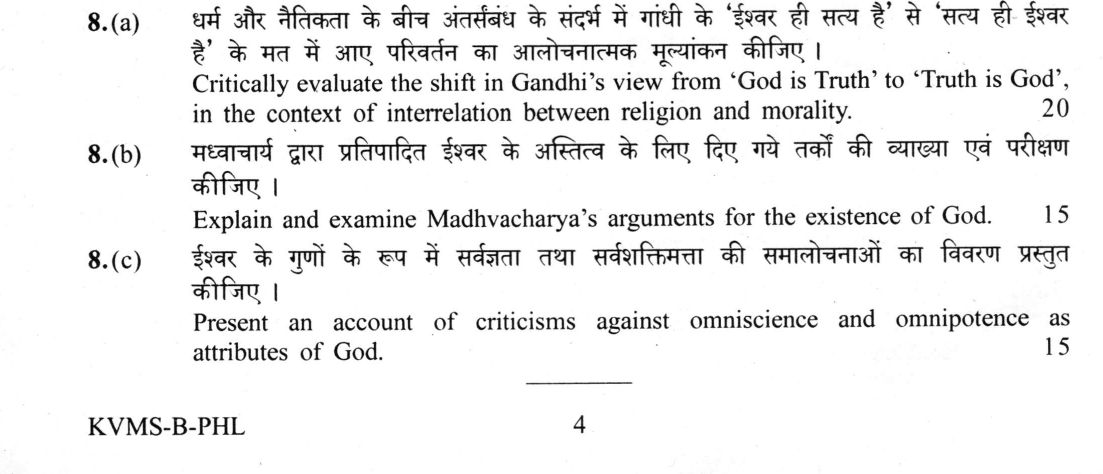
(a) Critically evaluate the shift in Gandhi's view from ‘God is Truth’ to ‘Truth is God’, in the context of interrelation between…
Critically evaluate the shift in Gandhi's view from ‘God is Truth’ to ‘Truth is God’, in the context of interrelation between religion and morality. 20 marks
Explain and examine Madhvacharya's arguments for the existence of God. 15 marks
Present an account of criticisms against omniscience and omnipotence as attributes of God. 15 marks
हिंदी में प्रश्न पढ़ें
धर्म और नैतिकता के बीच अंतर्संबंध के संदर्भ में गांधी के ‘ईश्वर ही सत्य है’ से ‘सत्य ही ईश्वर है’ के मत में आए परिवर्तन का आलोचनात्मक मूल्यांकन कीजिए । (20 अंक)
मध्वाचार्य द्वारा प्रतिपादित ईश्वर के अस्तित्व के लिए दिए गए तर्कों की व्याख्या एवं परीक्षण कीजिए । (15 अंक)
ईश्वर के गुणों के रूप में सर्वज्ञता तथा सर्वशक्तिमत्ता की समालोचनाओं का विवरण प्रस्तुत कीजिए । (15 अंक)
Model answer
Drafted with AI by UPSC Answer Check against this question's marking rubric, to the expected length. UPSC does not publish answers for Mains — this is one way to score well, not an official key. How we build rubrics and answers.
(a) Gandhi's shift from 'God is Truth' to 'Truth is God' (20 marks)
For much of his life Gandhi said "God is Truth", most famously in the Autobiography (My Experiments with Truth): God, a being already given by religion, is identified with Truth, satya, from sat, being. Around 1931, in Young India, he announced a change: "Truth is God". The two statements differ in logical order. In the first, God is the subject, and Truth a predicate that describes him; in the second, Truth is the subject, the ultimate reality, and "God" is one name for it.
Reasons for the shift. First, the atheist denies God, but hardly anyone denies Truth; so the second formulation can hold everyone, believers, agnostics and atheists, in one search. Second, "God" has generated sectarian conflict, disputes over names, forms and revelations, while Truth is not owned by any religion. Third, Truth is verifiable in experience: it can be tested in living, by ahimsa (non-violence) as the means, so that religion becomes an experiment (satyagraha, the "experiments with truth") and not a dogma. Fourth, it puts the ethical first, since the Truth one seeks is a moral reality, not an external being.
Religion and morality. For Gandhi they are inseparable: religion divorced from morality is no religion; morality is the essence of religion, and the practice of truthfulness and non-violence is worship. The shift strengthens this link, since the moral law is now the very nature of ultimate reality, so that God is not a lawgiver whose commands could be arbitrary. The inner voice, the conscience, is the means of knowing it, and truth in speech, thought and action is the daily discipline; political and social action (untouchability, communal harmony) becomes a religious duty.
Critical evaluation. Strengths: it is inclusive and supports interreligious dialogue; it gives a moral criterion for judging religious practice (untouchability cannot be true religion); it makes religion self-critical and experimental; and it draws on the Upanishadic and Advaitic idea of sat. Weaknesses: the content of "Truth" is contested, and Gandhi's reliance on the inner voice is subjective, since different people's convictions conflict, and it supplies no public test beyond non-violence; his theistic critics say it reduces a personal God, object of prayer and devotion, to an abstract principle, though Gandhi himself continued to pray and used Rama's name, and so the shift may be one of emphasis rather than of doctrine; and atheists may hold that Truth need not be called God at all. Overall, the shift is a philosophically fruitful re-ordering, making ethics and enquiry, not creed, the test of religion, though it leaves the epistemology of conscience open.
(b) Madhva's arguments for the existence of God (15 marks)
Madhva (Dvaita Vedanta) holds that God, Vishnu, the independent (svatantra) Supreme Being, is known primarily through scripture, the Vedas, which are authorless, but he also supports it with inference, since reason confirms what scripture says.
Explanation of the arguments. (1) The cosmological or causal argument: the world is an effect, made of parts, non-eternal and insentient; every effect has a cause, and an unconscious world cannot produce itself or order itself, so there must be an intelligent maker, as a pot needs a potter. (2) The teleological argument: the world's order and adaptation to purposes, which matter cannot supply, show a guiding intelligence. (3) The dependence argument, characteristic of Dvaita: the world and souls are dependent (paratantra), and dependence presupposes an independent being on which they rest. (4) The moral (karmic) argument: souls experience unequal joy and suffering according to their deeds, but karma itself is insentient, so a sentient dispenser of fruits, who knows all deeds, is needed. (5) Scripture: the Vedas declare Vishnu as supreme, and their authority (apaurusheyatva) is independent.
Examination. Merits: the arguments are cumulative and combine reason with revelation, and they protect the reality of the world and difference against Advaita. Weaknesses: the causal argument shows at most that some maker exists, not that it is one, omniscient, omnipotent and identical with Vishnu; Buddhists, Mimamsakas and Jains reject the assumption that every composite implies a creator (a fallacy of universal concomitance, as in the case of mountains), and the analogy of a potter is contested; the karma argument gives the deity a role that Mimamsa denies (karma yields fruit itself); scripture as the final proof is circular for non-believers and Madhva's reading of texts is contested by Advaita; and the identification with Vishnu depends on scripture, not on reason. Hence the arguments are better as supports of faith than as independent proofs.
(c) Criticisms of omniscience and omnipotence as attributes of God (15 marks)
Omnipotence. (1) The paradox of the stone: can God create a stone too heavy for him to lift? Either answer denies some power. Aquinas and most theists reply that omnipotence means the power to do whatever is logically possible, so contradictions such as square circles are not things, but Descartes held God can do even logical impossibilities. (2) Conflict with other attributes: God cannot sin or do evil, so moral perfection limits power, and cannot change the past or make a being both free and determined. (3) The problem of evil: if God is all-powerful and all-good, suffering should not exist; the free-will defence responds but limits power. (4) Geach's suggestion that "almighty" means having power over all things is more defensible than "able to do anything".
Omniscience. (1) Foreknowledge and free will: if God knows now what I shall do tomorrow, my act seems necessary, so freedom is lost; responses include Boethius and Aquinas (God's timeless knowledge), Molinism (middle knowledge) and open theism, which limits foreknowledge. (2) Indexical and experiential knowledge: Prior and Kretzmann argue that a timeless God cannot know "what time it is now", and that God cannot know what it is to be afraid or sinful, since these need finite experience. (3) Conflict with omnipotence and immutability: if God knows he will act in a certain way, he cannot do otherwise, and if he knows the changing world, he changes. (4) Omniscience of an infinite number of truths and paradoxes of self-reference.
Indian criticisms add that Buddhists and Jains deny a creator or omniscient God on the ground that an unchanging being cannot act; Mimamsa and Carvaka reject the proofs. Thus classical attributes need refinement or restriction to remain coherent.
How this answer will be evaluated
Evaluation rubric
Each sub-part is marked on its own, against the marks and word limit printed on the paper.
- (a) Critically evaluate the shift in Gandhi's view from 'God is Truth' to 'Truth is God', in the context of the interrelation between religion and morality (20). 20 marks
Must cover
- Both formulations stated and the logical difference (subject and predicate); shift around 1931
- Reasons: atheists accept Truth, avoids sectarian conflict, verifiable in experience, satya from sat
- Religion and morality inseparable; truth and non-violence as worship; inner voice; political action as duty
- Critical assessment: strengths (inclusive, ethical criterion) and weaknesses (subjectivity of inner voice, content of truth, loss of personal God, or shift of emphasis only)
Loses marks
- Treating the two formulations as identical.
- Describing Gandhi's politics without the philosophical shift.
- Uncritical praise.
Earns more
- Textual anchors (Autobiography, Young India).
- Reference to Upanishadic sat or Advaita.
Extra mark
- Practice of daily prayer alongside the shift
- (b) Explain and examine Madhvacharya's arguments for the existence of God (15). 15 marks
Must cover
- Dvaita context: God as Vishnu, independent (svatantra); scripture primary, inference supportive
- At least three arguments (causal, teleological, dependence, karmic or moral, scriptural)
- Examination: strengths (cumulative, protects reality and difference)
- Weaknesses: causal argument does not identify one omniscient God, Buddhist and Mimamsa objections, scriptural circularity, Advaita's reading
Loses marks
- Presenting Western ontological and cosmological arguments in Madhva's name.
- Only exposition, no examination.
- Confusing Dvaita with Advaita.
Earns more
- Pot-and-potter analogy and universal concomitance objection.
- Relation to Nyaya (Udayana) arguments.
Extra mark
- Contrast with Ramanuja or Shankara
- (c) Present an account of criticisms against omniscience and omnipotence as attributes of God (15). 15 marks
Must cover
- Omnipotence: paradox of the stone and the logical-possibility reply
- Omnipotence: conflict with moral perfection, immutability, problem of evil
- Omniscience: foreknowledge versus free will and named responses (Boethius, Aquinas, Molina, open theism)
- Omniscience: indexical or experiential knowledge, conflict with immutability; Indian objections (Buddhist, Jain, Mimamsa)
Loses marks
- Only listing attributes without criticisms.
- Confusing omniscience with omnipresence.
- No response or evaluation.
Earns more
- Descartes' view of logical impossibilities.
- Geach on almightiness.
Extra mark
- Kretzmann or Prior on temporal knowledge
What "Critically evaluate" is asking you to do
Judge how well something has performed against the standard it set for itself — its stated aim, mandate or promise — and commit to a verdict. Name the yardstick before you judge; an unanchored judgement reads as opinion. “Critically” is not a section added at the end: name the yardstick you are judging by — the evidence, the stated objective, a constitutional principle, a rival explanation — and let a verdict close each part of the body. Where the question quotes a claim, that verdict must land on the claim itself, accepted, qualified or rejected, and not on the theme in general.
Structure that answers it
Name the yardstick — stated aim, mandate or benchmark → performance against it → shortfall against it → why the gap exists → verdict
Where marks are lost
Merits in one paragraph, demerits in the next, and a conclusion calling for a balanced and holistic approach. That is a survey with the judgement left out and it holds the answer in the middle band. The opposite error is reading “critically” as permission to attack — and with the odd pairings, critically describe or critically explain, the exposition still carries most of the marks, the judgement being a layer on it rather than a substitute for it.
Practice this exact question
Write your answer and it is marked point by point against the model answer above — what you covered, what you missed, what you got wrong.
Evaluate my answer →More from Philosophy 2026 Paper II
- Q5 Answer the following questions in about 150 words each : (a) On what grounds does William…
- Q6 (a) In what sense does St. Augustine's identification of all evil as either sin or as the…
- Q7 (a) Analyse R. M. Hare's concept of ‘blik’ and assess whether it successfully defends the…
- Q8 (a) Critically evaluate the shift in Gandhi's view from ‘God is Truth’ to ‘Truth is God’,…