Paper II — Q3
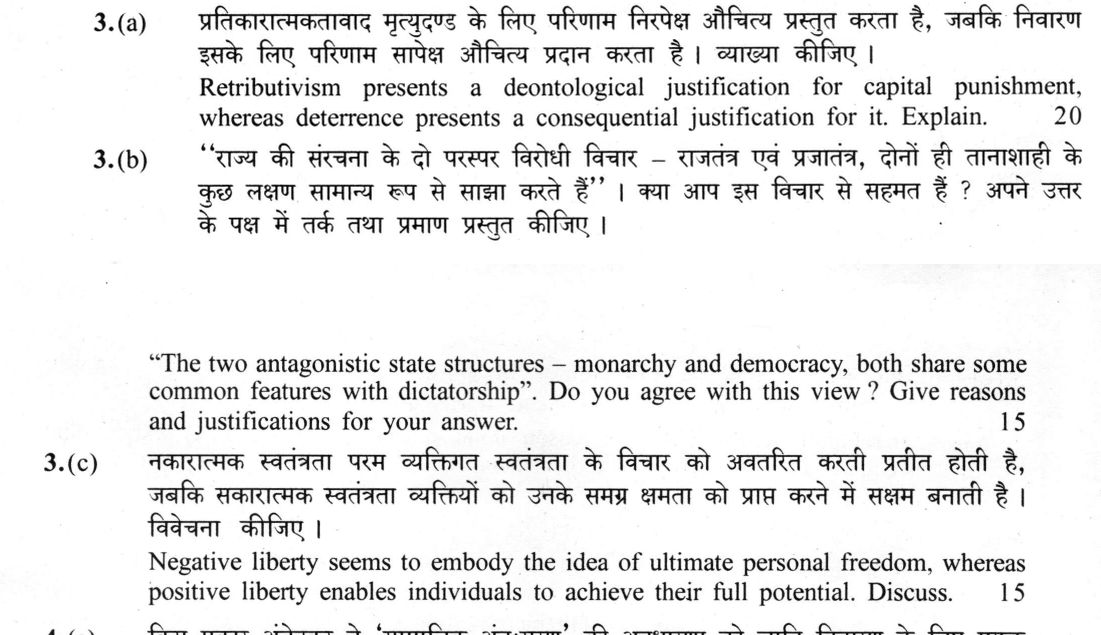
(a) Retributivism presents a deontological justification for capital punishment, whereas deterrence presents a consequential…
Retributivism presents a deontological justification for capital punishment, whereas deterrence presents a consequential justification for it. Explain. 20 marks
“The two antagonistic state structures – monarchy and democracy, both share some common features with dictatorship”. Do you agree with this view ? Give reasons and justifications for your answer. 15 marks
Negative liberty seems to embody the idea of ultimate personal freedom, whereas positive liberty enables individuals to achieve their full potential. Discuss. 15 marks
हिंदी में प्रश्न पढ़ें
प्रतिकारात्मकतावाद मृत्युदण्ड के लिए परिणाम निरपेक्ष औचित्य प्रस्तुत करता है, जबकि निवारण इसके लिए परिणाम सापेक्ष औचित्य प्रदान करता है । व्याख्या कीजिए । (20 अंक)
“राज्य की संरचना के दो परस्पर विरोधी विचार – राजतंत्र एवं प्रजातंत्र, दोनों ही तानाशाही के कुछ लक्षण सामान्य रूप से साझा करते हैं” । क्या आप इस विचार से सहमत हैं ? अपने उत्तर के पक्ष में तर्क तथा प्रमाण प्रस्तुत कीजिए । (15 अंक)
नकारात्मक स्वतंत्रता परम व्यक्तिगत स्वतंत्रता के विचार को अवतरित करती प्रतीत होती है, जबकि सकारात्मक स्वतंत्रता व्यक्तियों को उनकी समग्र क्षमता को प्राप्त करने में सक्षम बनाती है । विवेचना कीजिए । (15 अंक)
Model answer
Drafted with AI by UPSC Answer Check against this question's marking rubric, to the expected length. UPSC does not publish answers for Mains — this is one way to score well, not an official key. How we build rubrics and answers.
(a) Retribution and deterrence as justifications of capital punishment
Retributivism is deontological because it justifies punishment by what the offender has done, not by what punishment will achieve. It is backward-looking and desert-based. Kant (The Metaphysics of Morals) holds that punishment must be inflicted "only because he has committed a crime", never merely as a means; by the principle of equality (ius talionis) the murderer must die. Even an island society about to disband must first execute the last murderer, so that blood-guilt does not cling to the people. Hegel (Philosophy of Right) treats punishment as the annulment of the crime and as the criminal's own right, honouring him as rational. Retributivism thus forbids punishing the innocent in principle.
Deterrence is consequentialist because it looks forward to the good punishment produces. For Bentham "all punishment is mischief", justified only if it prevents a greater mischief; execution is warranted only if its general deterrence (warning others) and incapacitation outweigh its harm. Beccaria (On Crimes and Punishments, 1764) used the same logic against the death penalty: certainty deters more than severity.
Each faces characteristic objections. Retribution is charged with being legalised revenge; deterrence could license punishing an innocent scapegoat (McCloskey) and rests on contested evidence of marginal deterrence. Hart's distinction between the general justifying aim of punishment and the principles of its distribution offers a mixed view. India's "rarest of rare" doctrine (Bachan Singh v. State of Punjab, 1980) and the Law Commission's 262nd Report (2015), which found no greater deterrent effect than life imprisonment and recommended abolition except for terrorism-related offences, reflect this tension.
(b) Monarchy, democracy and dictatorship
I agree in part. Dictatorship is defined not by the number of rulers but by power that is unlimited and unaccountable. By that mark, both monarchy and democracy can share its features, but only in their unconstitutional forms.
Absolute monarchy does so plainly. Bodin's indivisible, perpetual sovereignty, Filmer's divine right of kings and Hobbes's Leviathan, whose sovereign cannot be lawfully resisted, all place the ruler above accountability, as a dictator stands. Constitutional monarchy, where the monarch "reigns but does not rule", does not.
Democracy can do so too. Plato (Republic VIII) argued that excessive liberty breeds the tyrant who poses as the people's champion; Aristotle (Politics IV) described extreme democracy in which decrees override law; Tocqueville and Mill (On Liberty) warned of the tyranny of the majority; Talmon (The Origins of Totalitarian Democracy, 1952) traced "totalitarian democracy" to Rousseau's general will and "forcing men to be free". Lord Hailsham's phrase "elective dictatorship" and the abuse of emergency powers show that elected executives can concentrate power.
The disanalogies are decisive. Liberal democracy has periodic elections, a legal opposition, judicial review, a free press and entrenched rights, so power is revocable and rests on consent; a dictatorship tolerates none of these. The shared feature is therefore unchecked power, not the form of rule, and constitutionalism removes it from both.
(c) Negative and positive liberty
Isaiah Berlin's "Two Concepts of Liberty" (1958) separates two questions. Negative liberty answers "what is the area within which I am left free from interference by others?"; it belongs to Hobbes, Locke, Bentham, Constant and Mill's harm principle. Positive liberty answers "who or what is the source of control?", self-mastery or self-government; it runs through Rousseau, Kant, Hegel and T. H. Green.
The statement is partly right. Negative liberty secures a protected private sphere, the condition of personal choice. But as Charles Taylor argues ("What's Wrong with Negative Liberty?"), it is an opportunity concept that ignores internal obstacles such as fear or false consciousness, and non-interference is hollow without the means to act. Positive liberty, as Green held, enables people to realise their capacities. Yet Berlin warned that it divides the self into a "higher" rational self and a "lower" empirical one; others may then claim to know my true self and coerce me in its name, as in Rousseau's "forced to be free".
MacCallum argues that there is one triadic concept, freedom of an agent from some constraint to do something, filled in differently. Sen's capability approach and Pettit's and Skinner's republican liberty as non-domination offer alternatives. The two are complementary: non-interference without capacity is empty, and "self-realisation" imposed by others is not freedom.
How this answer will be evaluated
Evaluation rubric
Each sub-part is marked on its own, against the marks and word limit printed on the paper.
- (a) 'Explain' a two-part claim: the candidate must show precisely why retributivism is a deontological (backward-looking, desert-based, consequence-independent) justification of capital punishment, and why deterrence is a consequentialist (forward-looking, utility-based) one, bringing out the contrasting logic, the named proponents, and the characteristic objections to each. 20 marks
Must cover
- retributivism as deontological / desert-based / backward-looking
- Immanuel Kant, The Metaphysics of Morals; ius talionis; the island/dissolving-society argument
- G. W. F. Hegel, Philosophy of Right — punishment as annulment of crime; the criminal's right to be punished
- deterrence as consequentialist / utilitarian / forward-looking
- Jeremy Bentham — punishment as an evil justified only by greater good prevented
- Cesare Beccaria, On Crimes and Punishments (1764) — certainty over severity; opposition to capital punishment
- specific and general deterrence
- the scapegoating/punishing-the-innocent objection to deterrence
- H. L. A. Hart, Punishment and Responsibility
- Bachan Singh v. State of Punjab (1980) — 'rarest of rare'
- Law Commission of India, 262nd Report (2015)
Loses marks
- Giving a general debate on whether the death penalty should be abolished instead of explaining the two justificatory logics the question names.
- Explaining what each theory says but never saying WHY one is deontological and the other consequentialist — which is the whole demand.
- Misattributing: assigning lex talionis to Bentham, or claiming Beccaria supported capital punishment when he argued against it.
- Confusing retribution with revenge, or with deterrence-by-example, and so losing the distinction the question rests on.
- Asserting as established fact that the death penalty does or does not deter; the empirical literature is contested and should be described as inconclusive.
- Omitting reformative/restorative theory entirely where a sentence of contrast would strengthen the evaluation — though it is not itself asked for.
Earns more
- Correctly identifies WHY this is deontological: the justification is independent of consequences, rests on the intrinsic wrongness of the act and the offender's desert, respects the offender as a rational end, and rules out punishing the innocent in principle
- Objections to both, stated distinctly: against retributivism — legalised revenge, incoherence of talion for most crimes, irreversibility and wrongful conviction; against deterrence — the empirical evidence on the marginal deterrent effect of the death penalty is widely regarded as inconclusive, and in principle the theory licenses scapegoating the innocent and disproportionate severity (the standard objection pressed by H. J. McCloskey and others)
- A mixed or Indian frame: H. L. A. Hart's distinction in Punishment and Responsibility between the general justifying aim of punishment and the principles of its distribution; India's 'rarest of rare' doctrine from Bachan Singh v. State of Punjab (1980) and the Law Commission of India's 262nd Report (2015) recommending abolition except for terrorism-related offences and waging war
- (b) The candidate must take a position on whether monarchy and democracy, though opposed, share features with dictatorship, and support it with reasons and justifications — defining all three forms, identifying the shared features in each case, and marking the crucial disanalogies. 15 marks
Must cover
- dictatorship defined by unaccountable, unlimited power
- absolute vs constitutional monarchy
- Jean Bodin's indivisible sovereignty; Filmer's divine right; Hobbes's Leviathan
- tyranny of the majority — Tocqueville and J. S. Mill, On Liberty
- Plato, Republic Book VIII — democracy degenerating into tyranny
- Aristotle, Politics — extreme democracy where decrees replace law
- elective dictatorship / emergency powers
- J. L. Talmon, The Origins of Totalitarian Democracy (1952)
- Rousseau's general will and 'forcing men to be free'
- rule of law, judicial review, periodic elections and a free press as the disanalogy
Loses marks
- Defining dictatorship simply as 'rule by one person', which makes the comparison with democracy impossible and misses the point about unaccountability.
- Treating all monarchy as absolute and ignoring constitutional monarchy, where the monarch reigns but does not rule.
- Agreeing or disagreeing flatly without the reasons and justifications the question explicitly demands.
- Naming no thinker; Plato, Tocqueville, Mill and Talmon are the expected anchors for the majority-tyranny argument.
- Drifting into contemporary partisan political commentary instead of philosophical analysis of the forms of government.
Earns more
- The crucial disanalogies stated, so the answer is not one-sided: constitutional monarchy is titular and bound by the rule of law; liberal democracy has periodic elections, a legal opposition, judicial review, a free press and entrenched fundamental rights, none of which a dictatorship tolerates; legitimacy in a democracy rests on consent and is revocable
- A clear, justified verdict — typically partial agreement: the shared feature is unchecked power, which absolute monarchy and unrestrained majoritarianism both exhibit, while constitutionalism in either form removes it; J. L. Talmon's The Origins of Totalitarian Democracy (1952), and the critique of Rousseau's general will and 'forcing men to be free', may anchor the strongest version of the claim
- (c) 'Discuss' a statement that summarises Berlin's two concepts of liberty: the candidate must expound negative and positive liberty accurately, name their traditions, examine the claim that the first is ultimate personal freedom while the second enables self-realisation, and engage the standard criticisms of the dichotomy. 15 marks
Must cover
- Isaiah Berlin, 'Two Concepts of Liberty' (1958), in Four Essays on Liberty (1969)
- negative liberty as absence of interference; 'over what area am I master?'
- positive liberty as self-mastery; 'who is master?'
- Hobbes, Locke, Bentham, Constant, J. S. Mill's harm principle
- Rousseau, Kant, Hegel, T. H. Green, Bosanquet
- Rousseau's 'forced to be free'
- Gerald MacCallum's triadic conception of freedom
- Charles Taylor, 'What's Wrong with Negative Liberty?' — opportunity vs exercise concept
- Amartya Sen's capability approach
- Philip Pettit / Quentin Skinner — liberty as non-domination
Loses marks
- Equating negative liberty with 'bad' and positive liberty with 'good', or vice versa, instead of stating the two questions each answers.
- Failing to attribute the distinction to Berlin, or misdating it to a book by Mill.
- Omitting Berlin's specific warning about the divided self, which is the philosophical core of his argument rather than a general dislike of the state.
- Reciting the textbook contrast with no critical engagement, when 'Discuss' invites MacCallum's or Taylor's challenge to the dichotomy itself.
- Confusing positive liberty with positive rights or with welfare provision alone; the concept is about self-mastery, of which enabling conditions are only one aspect.
Earns more
- Critical engagement with the dichotomy: Gerald MacCallum's triadic formula — freedom is always of an agent x from a constraint y to do z, so there is one concept with different fillings, not two; Charles Taylor's 'What's Wrong with Negative Liberty?' distinguishing an opportunity concept from an exercise concept and defending internal obstacles (fear, false consciousness) as genuine unfreedom
- Extension and verdict: Amartya Sen's capability approach recasts effective freedom as what a person can actually do and be, and Philip Pettit's and Quentin Skinner's republican concept of liberty as non-domination offers a third alternative to Berlin's pair; the statement is accepted with the qualification that the two are complementary — formal non-interference without capacity is hollow, and self-realisation enforced by others is not freedom
What "Explain" is asking you to do
Make the working of something clear — what sets it off, what follows from what, and what it produces. Explain is the Commission's mechanism word: it dominates the technical papers and the “explain why” stems, where the marks sit in the causal chain and not in the label.
Structure that answers it
State what it is → the initiating condition → the chain of cause, step by step → an instance where it plays out → what the chain produces
Where marks are lost
Describing what something looks like instead of why it works that way. Naming the stages without linking them reads as description too.
Practice this exact question
Write your answer and it is marked point by point against the model answer above — what you covered, what you missed, what you got wrong.
Evaluate my answer →More from Philosophy 2026 Paper II
- Q1 Answer the following questions in about 150 words each : (a) Why does Rawls consider it n…
- Q2 (a) Evaluate the importance of Kautilya's theory of Rajamandala in the context of soverei…
- Q3 (a) Retributivism presents a deontological justification for capital punishment, whereas…
- Q4 (a) How has Ambedkar applied the concept of ‘Social Endosmosis’ for annihilation of caste…
- Q5 Answer the following questions in about 150 words each : (a) On what grounds does William…
- Q6 (a) In what sense does St. Augustine's identification of all evil as either sin or as the…