Paper II — Q2
(a) Evaluate the importance of Kautilya's theory of Rajamandala in the context of sovereignty. (20 marks) (b) Does providing…
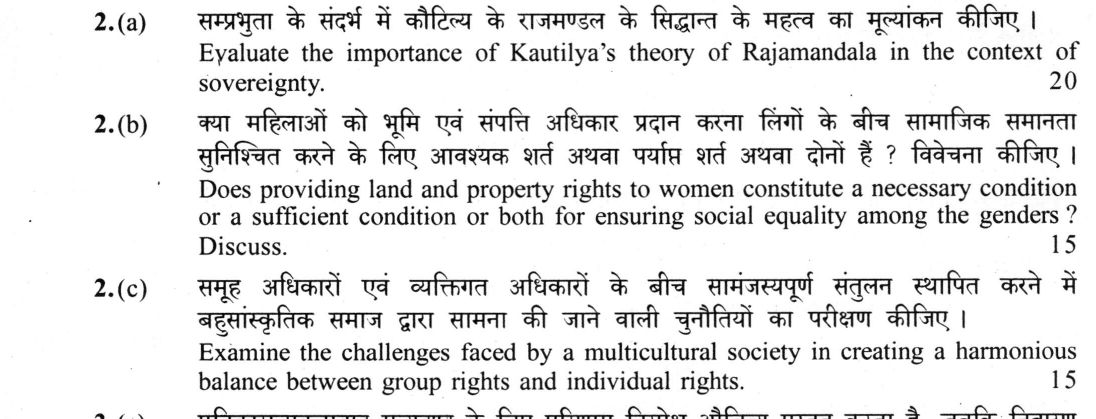
Evaluate the importance of Kautilya's theory of Rajamandala in the context of sovereignty. 20 marks
Does providing land and property rights to women constitute a necessary condition or a sufficient condition or both for ensuring social equality among the genders ? Discuss. 15 marks
Examine the challenges faced by a multicultural society in creating a harmonious balance between group rights and individual rights. 15 marks
हिंदी में प्रश्न पढ़ें
सम्प्रभुता के संदर्भ में कौटिल्य के राजमण्डल के सिद्धान्त के महत्व का मूल्यांकन कीजिए । (20 अंक)
क्या महिलाओं को भूमि एवं संपत्ति अधिकार प्रदान करना लिंगों के बीच सामाजिक समानता सुनिश्चित करने के लिए आवश्यक शर्त अथवा पर्याप्त शर्त अथवा दोनों हैं ? विवेचना कीजिए । (15 अंक)
समूह अधिकारों एवं व्यक्तिगत अधिकारों के बीच सामंजस्यपूर्ण संतुलन स्थापित करने में बहुसांस्कृतिक समाज द्वारा सामना की जाने वाली चुनौतियों का परीक्षण कीजिए । (15 अंक)
Model answer
Drafted with AI by UPSC Answer Check against this question's marking rubric, to the expected length. UPSC does not publish answers for Mains — this is one way to score well, not an official key. How we build rubrics and answers.
(a) Kautilya's Rajamandala and sovereignty
In the Arthashastra Kautilya's rajamandala (circle of kings) places the would-be conqueror (vijigishu) at the centre. A rule of alternation governs it: the immediate neighbour is the natural enemy (ari), the neighbour's neighbour the natural ally (mitra), and so on outward; behind lie the rear enemy (parshnigraha) and rear ally (akranda); beyond stand the middle king (madhyama), able to help or check both sides, and the neutral (udasina). Together these form the twelve-king circle (dvadasha-rajya-mandala).
The mandala is the external face of the saptanga state: swami (king), amatya (ministers), janapada (territory and people), durga (fort), kosha (treasury), danda (army) and mitra (ally). Relations within it are managed by the six measures (shadgunya): sandhi (peace), vigraha (hostility), asana (staying quiet), yana (marching), samshraya (seeking shelter) and dvaidhibhava (peace with one, war with another), and by the four upayas: sama, dana, bheda, danda. A king's standing depends on three powers (shakti): counsel (mantra), might of treasury and army (prabhava) and energy (utsaha).
Importance: sovereignty appears as relative, relational and graded by power, an early realist balance-of-power theory in which external sovereignty must be continually secured. Internally it is limited by dharma and the duty of welfare (yogakshema): "in the happiness of his subjects lies the king's happiness" (1.19). Limits: sovereignty is personal to the king, neither the impersonal legal sovereignty of Bodin, Hobbes or Austin nor popular sovereignty; the concentric geography does not fit non-contiguous or maritime powers; and secret warfare (kutayuddha) sits uneasily with dharmic restraint.
(b) Women's land and property rights: necessary, sufficient or both?
A condition is necessary if equality cannot occur without it, and sufficient if its presence guarantees equality. Land and property rights are best seen as necessary but not sufficient.
They are necessary because property shapes bargaining power within the household. In Sen's model of "cooperative conflicts" the party with the better fall-back position gains more; Bina Agarwal's A Field of One's Own (1994) shows that independent land rights improve women's fall-back position, their security in widowhood or separation, and their voice in household and village. Without them, economic dependence reproduces subordinate status. India's Hindu Succession (Amendment) Act, 2005, confirmed in Vineeta Sharma v. Rakesh Sharma (2020), made daughters coparceners by birth.
They are not sufficient. Title differs from control: many women hold land they cannot manage, sell or mortgage. Social pressure and adaptive preferences lead daughters to relinquish shares to brothers, and dowry is treated as a pre-mortem inheritance. Many tribal women remain outside statutory inheritance under customary law. As Sen's and Nussbaum's capability approach stresses, resources must be converted into capabilities through education, paid work, political voice, enforcement and changed norms. Property rights are thus a necessary foundation, not the whole of gender equality.
(c) Group rights and individual rights in a multicultural society
The first challenge is structural. Will Kymlicka (Multicultural Citizenship, 1995) distinguishes external protections, which shield a minority from the majority and are compatible with liberalism, from internal restrictions, which limit members' liberty. Recognition meant as protection can slide into restriction.
Second, "minorities within minorities". Susan Moller Okin ("Is Multiculturalism Bad for Women?", 1999) argued that group accommodation often protects patriarchal norms; Ayelet Shachar called this the paradox of multicultural vulnerability. The Shah Bano judgment (1985) and the Muslim Women (Protection of Rights on Divorce) Act, 1986 showed the conflict; the Sabarimala case (2018) set denominational autonomy against women's right of worship and was referred to a larger bench in 2019.
Third, equal citizenship: differentiated rights strain equality before law. In India, Articles 25–30 protect religious freedom and minority institutions, while Article 44 directs the state towards a uniform civil code, a continuing debate. Brian Barry (Culture and Equality, 2001) argues that uniform rules already suffice.
Fourth, essentialism: treating groups as homogeneous silences dissenting members.
A balance is sought through Bhikhu Parekh's intercultural dialogue, testing practices against a society's operative public values (Rethinking Multiculturalism, 2000); Charles Taylor's politics of recognition joined to equal dignity; and a real right of exit, so that group membership does not become a prison.
How this answer will be evaluated
Evaluation rubric
Each sub-part is marked on its own, against the marks and word limit printed on the paper.
- (a) 'Evaluate the importance' requires more than exposition: the candidate must expound Kautilya's Rajamandala (circle of states) from the Arthashastra, relate it to the Saptanga conception of the state and the Shadgunya policy, and then assess what it contributes to — and where it falls short of — a theory of sovereignty, internal and external. 20 marks
Must cover
- Kautilya (Chanakya/Vishnugupta), Arthashastra
- Rajamandala / dvadasha-rajya-mandala (twelve-king circle)
- vijigishu
- ari, mitra, madhyama, udasina
- parshnigraha (rear enemy) and akranda (rear ally)
- Saptanga — swami, amatya, janapada, durga, kosha, danda/bala, mitra
- shadgunya — sandhi, vigraha, asana, yana, samshraya, dvaidhibhava
- four upayas — sama, dana, bheda, danda
- three shaktis — mantra, prabhava, utsaha
- yogakshema; 'in the happiness of his subjects lies the king's happiness' (1.19)
- contrast with Bodin/Hobbes/Austin's monistic legal sovereignty
Loses marks
- Describing the Mandala vaguely as 'circle of friends and enemies' without naming vijigishu, ari, mitra, madhyama and udasina.
- Confusing the Saptanga (internal elements of the state) with the Mandala (external circle of states), or omitting one of the seven limbs.
- Listing shadgunya wrongly — e.g. glossing asana as 'alliance' rather than sitting quiet/neutrality, or dvaidhibhava as 'duplicity' rather than the double policy of peace with one king and war with another.
- Pure exposition with no evaluation, when the directive verb is 'Evaluate' and the frame is explicitly sovereignty.
- Reading modern legal or popular sovereignty into Kautilya, or asserting that his king is an absolute Austinian sovereign despite the dharmic and saptanga constraints.
- Asserting a precise date for the Arthashastra as settled fact; its dating (roughly 4th century BCE to 2nd century CE) is disputed among scholars.
Earns more
- Evaluation in favour: sovereignty emerges as relative, relational and power-based (graded by the three shaktis — mantra-shakti of counsel, prabhava/prabhu-shakti of treasury and army, utsaha-shakti of energy), an early realist balance-of-power doctrine; the king's authority is limited by dharma and by yogakshema — 'in the happiness of his subjects lies the king's happiness' (Arthashastra 1.19)
- Evaluation against, with comparison: no conception of an impersonal legal sovereign or of popular sovereignty as in Bodin, Hobbes and Austin; sovereignty is personal to the king; the concentric-circle geography is schematic and does not fit non-contiguous, maritime or multipolar power; the amoral devices of kutayuddha and espionage sit uneasily with the dharmic restraint
- (b) The question is a precise conceptual one: the candidate must use the logic of necessary and sufficient conditions, argue whether women's land and property rights are necessary for gender-based social equality, whether they are sufficient, and 'discuss' towards a defended verdict — the expected line being necessary but not sufficient. 15 marks
Must cover
- necessary condition vs sufficient condition
- Bina Agarwal, A Field of One's Own: Gender and Land Rights in South Asia (1994)
- Amartya Sen, 'Gender and Cooperative Conflicts' — fall-back/breakdown position
- capability approach (Sen, Nussbaum)
- adaptive preferences
- Hindu Succession (Amendment) Act, 2005
- Vineeta Sharma v. Rakesh Sharma (2020)
- ownership vs effective control of land
- relinquishment of shares by daughters; dowry as pre-mortem inheritance
Loses marks
- Ignoring the conceptual structure of the question and writing a descriptive essay on women's property rights in India.
- Answering 'both' without showing what would make the condition sufficient — the strong claim requires evidence that title alone ends gender inequality, which is not available.
- Confusing legal ownership with effective control, and so overstating the effect of the 2005 amendment.
- Naming no thinker or statute; at this level Agarwal and the Hindu Succession (Amendment) Act 2005 are the expected anchors.
- Treating 'women' as homogeneous and ignoring differences of caste, tribe, religion and personal law — notably the exclusion of many tribal women from statutory inheritance.
Earns more
- Legal and institutional specifics named: the Hindu Succession (Amendment) Act 2005 making daughters coparceners by birth, confirmed in Vineeta Sharma v. Rakesh Sharma (2020); the continuing exclusion of many tribal women under customary/tenancy law; unequal shares under some personal laws — showing that even reformed law has not produced equality
- Explicit verdict — necessary but not sufficient — with the further conditions named (education, paid employment, political participation, enforcement machinery, change in norms), and ideally framed through Sen's and Nussbaum's capability approach: resources must be converted into capabilities
- (c) 'Examine the challenges' — the candidate must not merely describe multiculturalism but identify the specific structural tensions that arise when a multicultural polity tries to recognise group rights while guaranteeing individual rights, illustrate them from named theorists and cases, and indicate how the balance may be struck. 15 marks
Must cover
- Will Kymlicka, Multicultural Citizenship (1995)
- external protections vs internal restrictions
- Susan Moller Okin, 'Is Multiculturalism Bad for Women?' (1999)
- minorities within minorities / Ayelet Shachar's paradox of multicultural vulnerability
- right of exit
- Bhikhu Parekh, Rethinking Multiculturalism (2000)
- Charles Taylor, 'The Politics of Recognition' (1994)
- Brian Barry, Culture and Equality (2001)
- Shah Bano (1985) and the Muslim Women (Protection of Rights on Divorce) Act 1986
- Articles 25-30 and Article 44 of the Indian Constitution
Loses marks
- Describing multiculturalism and India's diversity in general terms without isolating any specific group-rights/individual-rights conflict.
- Naming no theorist; at this level Kymlicka and Okin are the expected anchors of the two sides.
- Treating cultural groups as homogeneous, which is precisely the essentialism the question's 'challenges' point to.
- Assuming group rights are always illiberal — Kymlicka's whole point is that external protections can be liberal while internal restrictions are not.
- Asserting contested constitutional or judicial positions as settled: the Sabarimala review has been referred to a larger bench, and the uniform civil code is a live policy dispute; say so rather than declaring an outcome.
Earns more
- The equal-citizenship challenge, illustrated from India: differentiated rights strain equality before law and uniform citizenship — the Shah Bano judgment (1985) and the Muslim Women (Protection of Rights on Divorce) Act 1986; Articles 25-30 on religious freedom and minority educational institutions against Article 44's directive on a uniform civil code; the Sabarimala case (Indian Young Lawyers Association v. State of Kerala, 2018) pitting denominational autonomy against women's individual right of worship
- Routes to a balance, with attribution: Bhikhu Parekh's Rethinking Multiculturalism (2000) — intercultural dialogue tested against society's operative public values; Charles Taylor's 'The Politics of Recognition' (1994) on equal dignity versus the politics of difference; Brian Barry's Culture and Equality (2001) as the egalitarian-liberal objection that uniform rules already suffice
What "Evaluate" is asking you to do
Judge how well something has performed against the standard it set for itself — its stated aim, mandate or promise — and commit to a verdict. Name the yardstick before you judge; an unanchored judgement reads as opinion.
Structure that answers it
Name the yardstick — stated aim, mandate or benchmark → performance against it → shortfall against it → why the gap exists → verdict
Where marks are lost
Presenting both sides and then declining to decide, or delivering a verdict against a standard you never stated, which makes it look arbitrary.
Practice this exact question
Write your answer and it is marked point by point against the model answer above — what you covered, what you missed, what you got wrong.
Evaluate my answer →More from Philosophy 2026 Paper II
- Q1 Answer the following questions in about 150 words each : (a) Why does Rawls consider it n…
- Q2 (a) Evaluate the importance of Kautilya's theory of Rajamandala in the context of soverei…
- Q3 (a) Retributivism presents a deontological justification for capital punishment, whereas…
- Q4 (a) How has Ambedkar applied the concept of ‘Social Endosmosis’ for annihilation of caste…
- Q5 Answer the following questions in about 150 words each : (a) On what grounds does William…